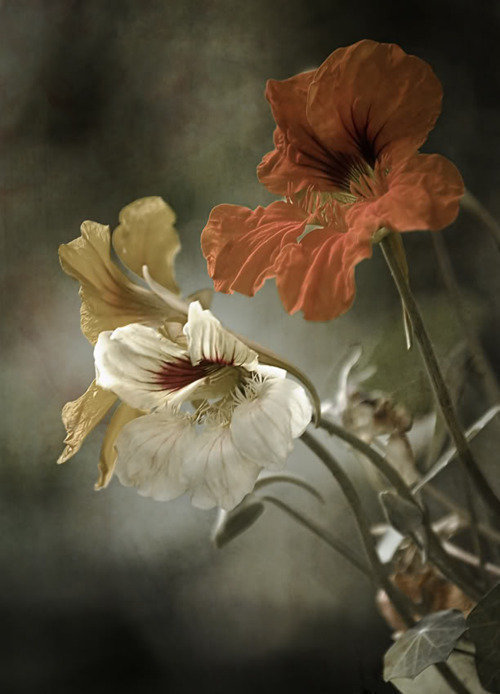
"I am not one who was born in the custody of wisdom. I am one who is fond of olden times and intense in quest of the sacred knowing of the ancients." Gustave Courbet

24 December 2017

Whirling.

The Mevleviye is an ascetic Sufi order founded in 1273 in Konya, from where it gradually spread throughout the Ottoman Empire. Today, the Mevleviye can be found in many Turkish communities throughout the world, but the most active and famous centres of the orders activity are in Konya and Istanbul.

The Mevleviye are renowned for their whirling dances. Following a recommended fast of several hours, the whirlers begin to rotate on their left feet in short twists, using the right foot to drive their bodies around the left foot. The body of the whirler is meant to be supple, with eyes open but unfocused so that images become blurred and flowing. At their dancing ceremonies, or Sema, a particular musical repertoire called ay›n is played. Based on four sections of both vocal and instrumental compositions, it is performed by at least one singer, a flute-player, called neyzen, a kettledrummer and a cymbal player. Dancers used to receive 1,001 days of reclusive training within the mevlevi-houses (mevlevihane), where they learned about ethics, codes of behaviour and beliefs by practising prayer, religious music, poetry and dance. After this training, they remained members of the order but returned to their work and families.


Thank You, Jessica.

Festival.

The BBC's 1954 broadcast of The Festival of Lessons and Carols from Kings College, Cambridge, England ...

Lighting.


A candle loses nothing by lighting another candle.

Erin Majors

Thank you, and Merry Christmas, Execupundit.

Delights.


The Bodleian Libraries' Advent Calendar is "a box of delights" ... HERE

Maturity.


When we look back at the ways our ancestors lived, there’s no getting around it: we are tribal primates. We are exquisitely designed and adapted by evolution for life in small societies with intense, animistic religion and violent intergroup conflict over territory. We love tribal living so much that we invented sports, fraternities, street gangs, fan clubs, and tattoos. Tribalism is in our hearts and minds. We’ll never stamp it out entirely, but we can minimize its effects because we are a behaviorally flexible species. We can live in many different ways, from egalitarian hunter-gatherer groups of 50 individuals to feudal hierarchies binding together millions. And in the last two centuries, a lot of us have lived in large, multi-ethnic secular liberal democracies. So clearly that is possible. But how much margin of error do we have in such societies?

Here is the fine-tuned liberal democracy hypothesis: as tribal primates, human beings are unsuited for life in large, diverse secular democracies, unless you get certain settings finely adjusted to make possible the development of stable political life. This seems to be what the Founding Fathers believed. Jefferson, Madison, and the rest of those eighteenth-century deists clearly did think that designing a constitution was like designing a giant clock, a clock that might run forever if they chose the right springs and gears.

Thankfully, our Founders were good psychologists. They knew that we are not angels; they knew that we are tribal creatures. As Madison wrote in Federalist 10: “the latent causes of faction are thus sown in the nature of man.” Our Founders were also good historians; they were well aware of Plato’s belief that democracy is the second worst form of government because it inevitably decays into tyranny. Madison wrote in Federalist 10 about pure or direct democracies, which he said are quickly consumed by the passions of the majority: “such democracies have ever been spectacles of turbulence and contention . . . and have in general been as short in their lives as they have been violent in their deaths.”

So what did the Founders do? They built in safeguards against runaway factionalism, such as the division of powers among the three branches, and an elaborate series of checks and balances. But they also knew that they had to train future generations of clock mechanics. They were creating a new kind of republic, which would demand far more maturity from its citizens than was needed in nations ruled by a king or other Leviathan.

Celebrate.


People often ask me about the difficulties of writing about war. They want to know if it’s hard to remain upbeat after seeing so many terrible things.

Truthfully, the answer is yes, sometimes it’s tough. It’s hard to care about the normal, trivial problems of life after witnessing how much people suffer in war.

Sometimes, when the holidays roll around, and the wars go on and on, I wonder what’s worth celebrating.

But I also remember something else I’ve learned over the years from my wartime experiences. War brings out the most beautiful parts of humanity, too. In war, you see instances of total selflessness, of men and women willing to sacrifice everything for invisible ideas like freedom and justice, or to protect their families and their comrades. Sometimes, to protect people they’ve never even met.

Perhaps, in the end, war is as perennial as any holiday and always will be.

But so too are other things, like hope, love, and the unending willingness of good people to stand up against evil.

This Christmas, like any other, that’s something to celebrate.

Story.

Wyeth, Gray Barn, n/d


I do an awful lot of thinking and dreaming about things in the past and the future - the timelessness of the rocks and the hills - all the people who have existed there. I prefer winter and fall, when you feel the bone structure of the landscape - the loneliness of it, the dead feeling of winter. Something waits beneath it, the whole story doesn't show.

Andrew Wyeth

Excellent.

An excellent book ...

Beauty.


At any time between 1750 and 1930 if you asked educated people to describe the aim of poetry, art, or music, they would have replied “beauty.”

And if you had asked for the point of that you would have learned that beauty is a value, as important as truth and goodness. Then in the 20th century beauty stopped being important. Art increasingly aimed to disturb and to break moral taboos. It was not beauty but originality however achieved and at whatever moral cost that won the prizes. Not only has art made a cult of ugliness. Architecture too has become soul-less and sterile. And it is not just our physical surroundings that have become ugly. Our language, our music and our manners are increasingly raucous, self-centered and offensive as though beauty and good taste have no real place in our lives. One word is written large on all these ugly things and that word is “Me.” My profits, my desires, my pleasures. And art has nothing to say in response to this except “Yeah, go for it!”

I think we are losing beauty and there is a danger that with it we will lose the meaning of life. Beauty has been central to our civilization for over 2000 years. From its beginnings in ancient Greece philosophy has reflected on the place of beauty in art, poetry, music, architecture and everyday life. Philosophers have argued that through the pursuit of beauty we shape the world as a home. We also come to understand our own nature as spiritual beings. But our world has turned its back on beauty and because of that we find ourselves surrounded by ugliness and alienation.

Beauty matters; it is not just a subjective thing, but a universal need of human beings. If we ignore this need we find ourselves in a spiritual desert. There is a  path out of that desert. It is a path that leads to home.

Roger Scruton, from Why Beauty Matters

Catalog.


You see, then, how in a variety of ways the fact that every man may set an example generates this other fact, that every man may be partaker of the sins of other men. We allow no man to shelter himself under the plea of insignificance. We deny that a man can be insignificant; he was formed in the image of his God, he is destined to be immortal. We deny yet more strongly a Christian to be insignificant; he is "a city set upon a hill;" penury cannot make him insignificant, lowliness of station cannot make him insignificant; he is a new creature, and as a new creature must attract attention and become a centre of influence. There is not one of you whose actions do not operate on the actions of others—operate, we mean, in the way of example. He would be insignificant who could only destroy his own soul; but you are all, alas! of importance enough to help also to destroy the souls of others; and hence forwards we would have you remember, that whensoever you act you act for a multitude; eyes are upon you, many or few, according to the position that you occupy ; some are either watching to take pattern, or waiting for your halting. Be vicious, and viciousness may go down as an heirloom in half a hundred families; be inconsistent, and enmity to the gospel may be propagated over a parish ; give occasions of offence, and many may fall; those who are entering in the narrow way may be discouraged, and those who have already entered may be made to stumble. Ye live not for yourselves; ye cannot live for yourselves ; a thousand fibres connect you with your fellow-men, and along those fibres, as along sympathetic threads, run your actions as causes, and return to you as effects. Ye sin not for yourselves; ye cannot sin for yourselves; ye are members of a body, and as no member can suffer alone, neither can any be injurious alone. Oh! fearful but unquestioned power which every one of us possesses—the power through the influence of example of multiplying ourselves, so that we may sin in places where we have never been, and in times when we shall not be alive. Example is like the press; a thing done is the thought printed; it may be repeated, if it cannot be recalled; it has gone forth, with a self-propagating power, and may run to the ends of the earth, and descend from generation to generation. So then, my brethren, appear we must at the tribunal of God; judged we must be by things done in the body; but when our personal actions have all been examined and weighed in themselves, alas! alas! there may remain a catalogue which thought itself can hardly measure; and these may be made up of infractions—infractions through example, for example may be justly said to bid God speed to evil doers—infractions to the prohibition contained in the words—"He that biddeth him God speed is partaker of his evil deeds."

Reverend Henry Melvill

23 December 2017

Sphering.


The WASSAIL BOWL

Next I'll cause my hopeful lad,
If a wild apple can be had,
To crown the hearth;
Lar thus conspiring with our mirth;
Then to infuse
Our browner ale into the cruse;
Which, sweetly spiced, we'll first carouse
Unto the Genius of the house.

Then the next health to friends of mine.
Loving the brave Burgundian wine,
High sons of pith,
Whose fortunes I have frolick'd with;
Such as could well
Bear up the magic bough and spell;
And dancing 'bout the mystic Thyrse,
Give up the just applause to verse;

To those, and then again to thee,
We'll drink, my Wickes, until we be
Plump as the cherry,
Though not so fresh, yet full as merry
As the cricket,
The untamed heifer, or the pricket,
Until our tongues shall tell our ears,
We're younger by a score of years.

Thus, till we see the fire less shine
From th' embers than the kitling's eyne,
We'll still sit up,
Sphering about the wassail cup,
To all those times
Which gave me honour for my rhymes;
The coal once spent, we'll then to bed,
Far more than night bewearied.

Robert Herrick

Britten, A Ceremony of Carols

Performed by The Boys of Christ Church Cathedral Choir, Oxford, director musical Francis Grier ...

Delighted.

Kosárek, Prague Winter Night, 1857


When biting Boreas, fell and doure,
Sharp shivers thro' the leafless bow'r;
When Phoebus gies a short-liv'd glow'r,
        Far south the lift,
Dim-dark'ning thro' the flaky show'r,
        Or whirling drift:


Ae night the storm the steeples rocked,
Poor Labour sweet in sleep was locked,
While burns, wi' snawy wreeths upchoked,
        Wild-eddying swirl,
Or thro' the mining outlet bocked,
        Down headlong hurl.


List'ning, the doors an' winnocks rattle,
I thought me on the ourie cattle,
Or silly sheep, wha bide this brattle
        O' winter war,
And thro' the drift, deep-lairing, sprattle,
        Beneath a scar.


Ilk happing bird, wee, helpless thing!
That, in the merry months o' spring,
Delighted me to hear thee sing,
        What comes o' thee?
Whare wilt thou cow'r thy chittering wing
        An' close thy e'e?


Ev'n you on murd'ring errands toil'd,
Lone from your savage homes exil'd,
The blood-stain'd roost, and sheep-cote spoil'd
        My heart forgets,
While pityless the tempest wild
Sore on you beats.

Robert Burns

Liberty.


Ah, liberty! how like thou art
To this large bottle lying here,
Which yesterday from foreign mart,
Came filled with potent English beer!
A touch of steel — a hand — a gush —
A pop that sounded far and near —
A wild emotion — liquid rush —
And I had drunk that English beer!
And what remains? — An empty shell!
A lifeless form both sad and queer,
A temple where no god doth dwell —
The simple memory of beer.

William Aytoun

Bad Co., "Deal with the Preacher"

Time.


... and sandwich time.

Exclaimed.


Clement C. Moore published "A Visit from St. Nicholas" on this day in 1823.

A VISIT from ST. NICHOLAS


'Twas the night before Christmas, when all through the house
Not a creature was stirring, not even a mouse;
The stockings were hung by the chimney with care,
In hopes that St. Nicholas soon would be there;
The children were nestled all snug in their beds;
While visions of sugar-plums danced in their heads;
And mamma in her 'kerchief, and I in my cap,
Had just settled our brains for a long winter's nap,
When out on the lawn there arose such a clatter,
I sprang from my bed to see what was the matter.
Away to the window I flew like a flash,
Tore open the shutters and threw up the sash.
The moon on the breast of the new-fallen snow,
Gave a lustre of midday to objects below,
When what to my wondering eyes did appear,
But a miniature sleigh and eight tiny rein-deer,
With a little old driver so lively and quick,
I knew in a moment he must be St. Nick.
More rapid than eagles his coursers they came,
And he whistled, and shouted, and called them by name:
"Now, Dasher! now, Dancer! now Prancer and Vixen!
On, Comet! on, Cupid! on, Donner and Blitzen!
To the top of the porch! to the top of the wall!
Now dash away! dash away! dash away all!"
As leaves that before the wild hurricane fly,
When they meet with an obstacle, mount to the sky;
So up to the housetop the coursers they flew
With the sleigh full of toys, and St. Nicholas too—
And then, in a twinkling, I heard on the roof
The prancing and pawing of each little hoof.
As I drew in my head, and was turning around,
Down the chimney St. Nicholas came with a bound.
He was dressed all in fur, from his head to his foot,
And his clothes were all tarnished with ashes and soot;
A bundle of toys he had flung on his back,
And he looked like a pedler just opening his pack.
His eyes—how they twinkled! his dimples, how merry!
His cheeks were like roses, his nose like a cherry!
His droll little mouth was drawn up like a bow,
And the beard on his chin was as white as the snow;
The stump of a pipe he held tight in his teeth,
And the smoke, it encircled his head like a wreath;
He had a broad face and a little round belly
That shook when he laughed, like a bowl full of jelly.
He was chubby and plump, a right jolly old elf,
And I laughed when I saw him, in spite of myself;
A wink of his eye and a twist of his head
Soon gave me to know I had nothing to dread;
He spoke not a word, but went straight to his work,
And filled all the stockings; then turned with a jerk,
And laying his finger aside of his nose,
And giving a nod, up the chimney he rose;
He sprang to his sleigh, to his team gave a whistle,
And away they all flew like the down of a thistle.
But I heard him exclaim, ere he drove out of sight—


“Happy Christmas to all, and to all a good night!”

Clement C. Moore

From 1946 ...

Ship.

Peace.


Peace on Earth.

Daquin, Noël, Grand Jeu et Duo No. 10

Olivier Latry performs ...

22 December 2017

Hearty.


One of the least pleasing effects of modern refinement is the havoc it has made among the hearty old holiday customs. It has completely taken off the sharp touchings and spirited reliefs of these embellishments of life, and has worn down society into a more smooth and polished, but certainly a less characteristic surface. Many of the games and ceremonials of Christmas have entirely disappeared, and like the sherris sack of old Falstaff, are become matters of speculation and dispute among commentators. They flourished in times full of spirit and lustihood, when men enjoyed life roughly, but heartily and vigorously; times wild and picturesque, which have furnished poetry with its richest materials, and the drama with its most attractive variety of characters and manners. The world has become more worldly. There is more of dissipation, and less of enjoyment. Pleasure has expanded into a broader, but a shallower stream, and has forsaken many of those deep and quiet channels where it flowed sweetly through the calm bosom of domestic life. Society has acquired a more enlightened and elegant tone; but it has lost many of its strong local peculiarities, its homebred feelings, its honest fireside delights. The traditionary customs of golden-hearted antiquity, its feudal hospitalities, and lordly wassailings, have passed away with the baronial castles and stately manor-houses in which they were celebrated. They comported with the shadowy hall, the great oaken gallery, and the tapestried parlour, but are unfitted to the light showy saloons and gay drawing-rooms of the modern villa.

Washington Irving. from Old Christmas

Keep.

... I prefer to keep things as they are.

Inspired.


The man who arrives at the doors of artistic creation with none of the madness of the Muses would be convinced that technical ability alone was enough to make an artist. What that man creates by means of reason will pale before the art of inspired beings.

Plato

D-wight Lightnin', "Silver Bells"

HAPPY FRIDAY and MERRY CHRISTMAS!

Seeking.


We wanderers, ever seeking the lonelier way, begin no day where we have ended another day; and no sunrise finds us where sunset left us.

Kahlil Gibran

Dick Enberg, R.I.P.


Dick Enberg has passed.

Happy birthday, Puccini.


Giacomo Puccini was born on this day in 1858.

La Bohème ...

Imagine.

Tolkien, Letter from Father Christmas, 1925