"I am not one who was born in the custody of wisdom. I am one who is fond of olden times and intense in quest of the sacred knowing of the ancients." Gustave Courbet
Showing posts with label Betjeman. Show all posts

17 January 2024

Before.


Childhood is measured out by sounds and smells and sights, before the dark hour of reason grows.

John Betjeman

03 December 2023

Lives.


CHRISTMAS

The bells of waiting Advent ring,
The Tortoise stove is lit again
And lamp-oil light across the night
Has caught the streaks of winter rain
In many a stained-glass window sheen
From Crimson Lake to Hookers Green.

The holly in the windy hedge
And round the Manor House the yew
Will soon be stripped to deck the ledge,
The altar, font and arch and pew,
So that the villagers can say
'The church looks nice' on Christmas Day.

Provincial Public Houses blaze,
Corporation tramcars clang,
On lighted tenements I gaze,
Where paper decorations hang,
And bunting in the red Town Hall
Says 'Merry Christmas to you all'.

And London shops on Christmas Eve
Are strung with silver bells and flowers
As hurrying clerks the City leave
To pigeon-haunted classic towers,
And marbled clouds go scudding by
The many-steepled London sky.

And girls in slacks remember Dad,
And oafish louts remember Mum,
And sleepless children's hearts are glad.
And Christmas-morning bells say "Come!"
Even to shining ones who dwell
Safe in the Dorchester Hotel.

And is it true,
This most tremendous tale of all,
Seen in a stained-glass window's hue,
A Baby in an ox's stall?
The Maker of the stars and sea
Become a Child on earth for me?

And is it true? For if it is,
No loving fingers tying strings
Around those tissued fripperies,
The sweet and silly Christmas things,
Bath salts and inexpensive scent
And hideous tie so kindly meant,

No love that in a family dwells,
No caroling in frosty air,
Nor all the steeple-shaking bells
Can with this single Truth compare -
That God was man in Palestine
And lives today in Bread and Wine.

John Betjeman

29 January 2023

Where's.

Sargent, Cottage at Fairford, Gloucestershire, 1892


The VILLAGE INN

"The village inn, the dear old inn,
So ancient, clean and free from sin,
True centre of our rural life
Where Hodge sits down beside his wife
And talks of Marx and nuclear fission
With all a rustic's intuition.
Ah, more than church or school or hall,
The village inn's the heart of all."
So spake the brewer's P. R. O.,
A man who really ought to know,
For he is paid for saying so.
And then he kindly gave to me
A lovely coloured booklet free.
'Twas full of prose that sang the praise
Of coaching inns in Georgian days,
Showing how public-houses are
More modern than the motor-car,
More English than the weald or wold
And almost equally as old,
And run for love and not for gold
Until I felt a filthy swine
For loathing beer and liking wine,
And rotten to the very core
For thinking village inns a bore,
And village bores more sure to roam
To village inns than stay at home.
And then I thought I must be wrong,

So up I rose and went along
To that old village alehouse where
In neon lights is written "Bear".

Ah, where's the inn that once I knew
With brick and chalky wall
Up which the knobbly pear-tree grew
For fear the place would fall?

Oh, that old pot-house isn't there,
It wasn't worth our while;
You'll find we have rebuilt "Bear"
In Early Georgian style.

But winter jasmine used to cling
With golden stars a-shine
Where rain and wind would wash and swing
The crudely painted sign.

And where's the roof of golden thatch?
The chimney-stack of stone?
The crown-glass panes that used to match
Each sunset with their own?

Oh now the walls are red and smart,
The roof has emerald tiles.
The neon sign's a work of art
And visible for miles.

The bar inside was papered green,
The settles grained like oak,
The only light was paraffin,
The woodfire used to smoke.

And photographs from far and wide
Were hung around the room
The hunt, the church, the football side,
And Kitchener of Khartoum.

Our air-conditioned bars are lined
With washable material,
The stools are steel, the taste refined,
Hygienic and ethereal.

Hurrah, hurrah, for hearts of oak!
Away with inhibitions!
For here's a place to sit and soak
In sanit'ry conditions.

John Betjeman

Churches.


It was through looking at churches that I came to believe in the reason churches were built.

John Betjeman

A Passion For Churches ...
It's always worth a try to get the key, however remote the church.  In fact, the remoter, the better.

Blessйd.


TREBETHERICK 
  
We used to picnic where the thrift
Grew deep and tufted to the edge;
We saw the yellow foam flakes drift
In trembling sponges on the ledge
Below us, till the wind would lift
Them up the cliff and o’er the hedge.
Sand in the sandwiches, wasps in the tea,
Sun on our bathing dresses heavy with the wet,
Squelch of the bladder-wrack waiting for the sea,
Fleas around the tamarisk, an early cigarette.

From where the coastguard houses stood
One used to see below the hill,
The lichened branches of a wood
In summer silver cool and still;
And there the Shade of Evil could
Stretch out at us from Shilla Mill.
Thick with sloe and blackberry, uneven in the light,
Lonely round the hedge, the heavy meadow was remote,
The oldest part of Cornwall was the wood as black as night,
And the pheasant and the rabbit lay torn open at the throat.

But when a storm was at its height,
And feathery slate was black in rain,
And tamarisks were hung with light
And golden sand was brown again,
Spring tide and blizzard would unite
And sea come flooding up the lane.
Waves full of treasure then were roaring up the beach,
Ropes round our mackintoshes, waders warm and dry,
We waited for the wreckage to come swirling into reach,
Ralph, Vasey, Alistair, Biddy, John and I.

Then roller into roller curled
And thundered down the rocky bay,
And we were in a water world
Of rain and blizzard, sea and spray,
And one against the other hurled
We struggled round to Greenaway.
Blessйd be St Enodoc, blessйd be the wave,
Blessйd be the springy turf, we pray, pray to thee,
Ask for our children all happy days you gave
To Ralph, Vasey, Alistair, Biddy, John and me.

Sir John Betjeman
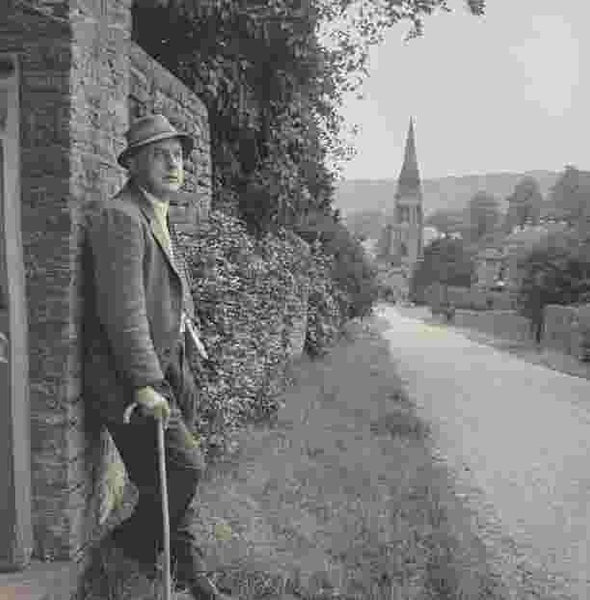
20 January 2023

Yet.

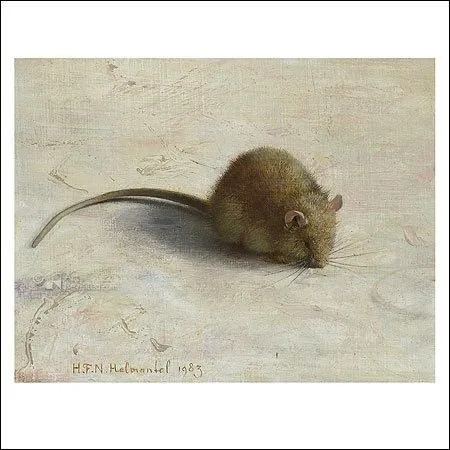
Helmantel, Muisje, 1883


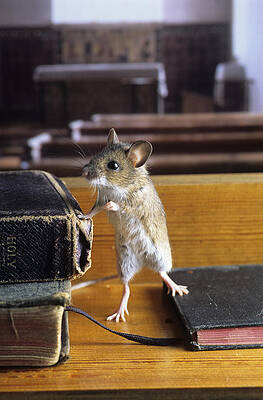
DIARY of a CHURCH MOUSE

Here among long-discarded cassocks,
Damp stools, and half-split open hassocks,
Here where the vicar never looks
I nibble through old service books.
Lean and alone I spend my days
Behind this Church of England baize.
I share my dark forgotten room
With two oil-lamps and half a broom.
The cleaner never bothers me,
So here I eat my frugal tea.
My bread is sawdust mixed with straw;
My jam is polish for the floor.
Christmas and Easter may be feasts
For congregations and for priests,
And so may Whitsun. All the same,
They do not fill my meagre frame.
For me the only feast at all
Is Autumn's Harvest Festival,
When I can satisfy my want
With ears of corn around the font.
I climb the eagle's brazen head
To burrow through a loaf of bread.
I scramble up the pulpit stair
And gnaw the marrows hanging there.
It is enjoyable to taste
These items ere they go to waste,
But how annoying when one finds
That other mice with pagan minds
Come into church my food to share
Who have no proper business there.
Two field mice who have no desire
To be baptized, invade the choir.
A large and most unfriendly rat
Comes in to see what we are at.
He says he thinks there is no God
And yet he comes ... it's rather odd.
This year he stole a sheaf of wheat
(It screened our special preacher's seat),
And prosperous mice from fields away
Come in to hear our organ play,
And under cover of its notes
Ate through the altar's sheaf of oats.
A Low Church mouse, who thinks that I
Am too papistical, and High,
Yet somehow doesn't think it wrong
To munch through Harvest Evensong,
While I, who starve the whole year through,
Must share my food with rodents who
Except at this time of the year
Not once inside the church appear.
Within the human world I know
Such goings-on could not be so,
For human beings only do
What their religion tells them to.
They read the Bible every day
And always, night and morning, pray,
And just like me, the good church mouse,
Worship each week in God's own house,
But all the same it's strange to me
How very full the church can be
With people I don't see at all
Except at Harvest Festival.

John Betjeman

26 June 2022

Soul.


INEXPENSIVE PROGRESS

Encase your legs in nylons,
Bestride your hills with pylons
O age without a soul;
Away with gentle willows
And all the elmy billows
That through your valleys roll.

Let's say goodbye to hedges
And roads with grassy edges
And winding country lanes;
Let all things travel faster
Where motor car is master
Till only Speed remains.

Destroy the ancient inn-signs
But strew the roads with tin signs
'Keep Left,' 'M4,' 'Keep Out!'
Command, instruction, warning,
Repetitive adorning
The rockeried roundabout;

For every raw obscenity
Must have its small 'amenity,'
Its patch of shaven green,
And hoardings look a wonder
In banks of floribunda
With floodlights in between.

Leave no old village standing
Which could provide a landing
For aeroplanes to roar,
But spare such cheap defacements
As huts with shattered casements
Unlived-in since the war.

Let no provincial High Street
Which might be your or my street
Look as it used to do,
But let the chain stores place here
Their miles of black glass facia
And traffic thunder through.

And if there is some scenery,
Some unpretentious greenery,
Surviving anywhere,
It does not need protecting
For soon we'll be erecting
A Power Station there.

When all our roads are lighted
By concrete monsters sited
Like gallows overhead,
Bathed in the yellow vomit
Each monster belches from it,
We'll know that we are dead.

John Betjemin

22 September 2021

Long-discarded.


DIARY of a CHURCH MOUSE


Here among long-discarded cassocks,
Damp stools, and half-split open hassocks,
Here where the vicar never looks
I nibble through old service books.
Lean and alone I spend my days
Behind this Church of England baize.
I share my dark forgotten room
With two oil-lamps and half a broom.
The cleaner never bothers me,
So here I eat my frugal tea.
My bread is sawdust mixed with straw;
My jam is polish for the floor.
Christmas and Easter may be feasts
For congregations and for priests,
And so may Whitsun. All the same,
They do not fill my meagre frame.
For me the only feast at all
Is Autumn's Harvest Festival,
When I can satisfy my want
With ears of corn around the font.
I climb the eagle's brazen head
To burrow through a loaf of bread.
I scramble up the pulpit stair
And gnaw the marrows hanging there.
It is enjoyable to taste
These items ere they go to waste,
But how annoying when one finds
That other mice with pagan minds
Come into church my food to share
Who have no proper business there.
Two field mice who have no desire
To be baptized, invade the choir.
A large and most unfriendly rat
Comes in to see what we are at.
He says he thinks there is no God
And yet he comes… it's rather odd.
This year he stole a sheaf of wheat
(It screened our special preacher's seat),
And prosperous mice from fields away
Come in to hear our organ play,
And under cover of its notes
Ate through the altar's sheaf of oats.
A Low Church mouse, who thinks that I
Am too papistical, and High,
Yet somehow doesn't think it wrong
To munch through Harvest Evensong,
While I, who starve the whole year through,
Must share my food with rodents who
Except at this time of the year
Not once inside the church appear.
Within the human world I know
Such goings-on could not be so,
For human beings only do
What their religion tells them to.
They read the Bible every day
And always, night and morning, pray,
And just like me, the good church mouse,
Worship each week in God's own house,
But all the same it's strange to me
How very full the church can be
With people I don't see at all
Except at Harvest Festival.

Sir John Betjeman

24 December 2020

Truth.


I have now to speak personally because I can think of no other way of saying why Christmas means much more to me than my birthday. The greatest reason of all will take some putting across – even to anyone who has listened so far. It is this.

I cannot believe that I am surrounded by a purposeless accident. On a clear night, I look up at the stars and, remembering amateur astronomy, know that the Milky Way is the rest of this universe and that the light from some of the stars has taken years to reach this planet. When I consider that the light from the sun ninety million miles away takes eight-and-a-half minutes to get here, the consequent immensity of this universe seems intolerable. And then I am told that some little clusters seen beyond the edge of the Milky Way on certain nights are other whole universes in outer space. It is too much, though believable.  And then on any day about now I can turn over a piece of decaying wood in our garden and see myriapods, insects and bugs startled out of sluggish winter torpor by my action. Each is perfectly formed and adapted to its life. From the immensity of the stars to the perfection of an insect – I cannot believe that I am surrounded by a purposeless accident.

But can I believe this most fantastic story of all: that the Maker of the stars and of the centipedes became a baby in Bethlehem not so long ago. No time ago at all when you reckon the age of the earth. Well, it’s asking a lot. If I weren’t such a highbrow it would be easier. No man of intelligence can believe such a thing. A child of Jewish parents the Creator of the universe? Absurd.  But if it is not true, why was I born? And if it is true, nothing else is of so much importance. No date in time is so important as Christmas Day, the birthday of God made man. And carol singers and Salvation Army bands and Christmas cards (yes, even Christmas cards from ardent unbelievers, who always seem to observe Christmas) and cathedrals and saints and church bells and hospitals and almshouses and towers and steeples and the silence and present-giving of Christmas Day all bear witness to its truth.

Beyond my reason, beyond my emotions, beyond my intellect I know that this peculiar story is true. Architecture brings it home to me, I suppose because architecture is, with poetry, my chief interest.

Last week I was in the most beautiful building in Britain – King’s College Chapel, Cambridge. You know it. It is a forest glade of old coloured glass and between the great windows columns of shafted stone shoot up and up to fountain out into a shower of exquisite, elaborate fan vaulting. It is the swansong of Perpendicular architecture, so immense, so vast, so superbly proportioned, so mysterious that no one can enter it without gasping. All the schoolchildren of Cambridge had filed into a carol service and there they were in the candlelight of the dark oak stalls. We stood waiting for the choir to come in and as we stood there the first verse of the opening carol was sung beyond us, behind the screen, away in the mighty splendour of the nave. A treble solo fluted up to the distant vaulting “Once in Royal David’s City”.  It was clear, pure, distinct.  And as I heard it I knew once more – knew despite myself – that this story was the Truth.  And knowing it I knew that, because of the birth of Christ, the world could not touch me and that between me and the time I smashed Mrs Wallis’ Christmas present hung the figure of God become man, crucified in the great east window.

John Betjeman, from his December 25, 1947 BBC Home Service talk, "Christmas Nostalgia"

08 December 2020

Lives.


CHRISTMAS

The bells of waiting Advent ring,
The Tortoise stove is lit again
And lamp-oil light across the night
Has caught the streaks of winter rain
In many a stained-glass window sheen
From Crimson Lake to Hookers Green.

The holly in the windy hedge
And round the Manor House the yew
Will soon be stripped to deck the ledge,
The altar, font and arch and pew,
So that the villagers can say
'The church looks nice' on Christmas Day.

Provincial Public Houses blaze,
Corporation tramcars clang,
On lighted tenements I gaze,
Where paper decorations hang,
And bunting in the red Town Hall
Says 'Merry Christmas to you all'.

And London shops on Christmas Eve
Are strung with silver bells and flowers
As hurrying clerks the City leave
To pigeon-haunted classic towers,
And marbled clouds go scudding by
The many-steepled London sky.

And girls in slacks remember Dad,
And oafish louts remember Mum,
And sleepless children's hearts are glad.
And Christmas-morning bells say "Come!"
Even to shining ones who dwell
Safe in the Dorchester Hotel.

And is it true,
This most tremendous tale of all,
Seen in a stained-glass window's hue,
A Baby in an ox's stall ?
The Maker of the stars and sea
Become a Child on earth for me ?

And is it true ? For if it is,
No loving fingers tying strings
Around those tissued fripperies,
The sweet and silly Christmas things,
Bath salts and inexpensive scent
And hideous tie so kindly meant,

No love that in a family dwells,
No carolling in frosty air,
Nor all the steeple-shaking bells
Can with this single Truth compare -
That God was man in Palestine
And lives today in Bread and Wine.

John Betjeman

06 May 2020

Excellent.

An excellent book ...


I shan't tell you where all the lovely places are, I want them to myself.  But I'll tell you where to look.

John Betjeman

16 April 2020

Imponderable.


One cannot assess in terms of cash or exports and imports an imponderable thing like the turn of a lane or an inn or a church tower or a familiar skyline.

Sir John Betjeman

Thanks to The Man in the Green Shirt.

13 April 2020

Interest.


I ought to warn you that my verse is of no interest to people who can think.

Sir John Betjeman

Summoned by Bells ...


A Passion for Churches ...


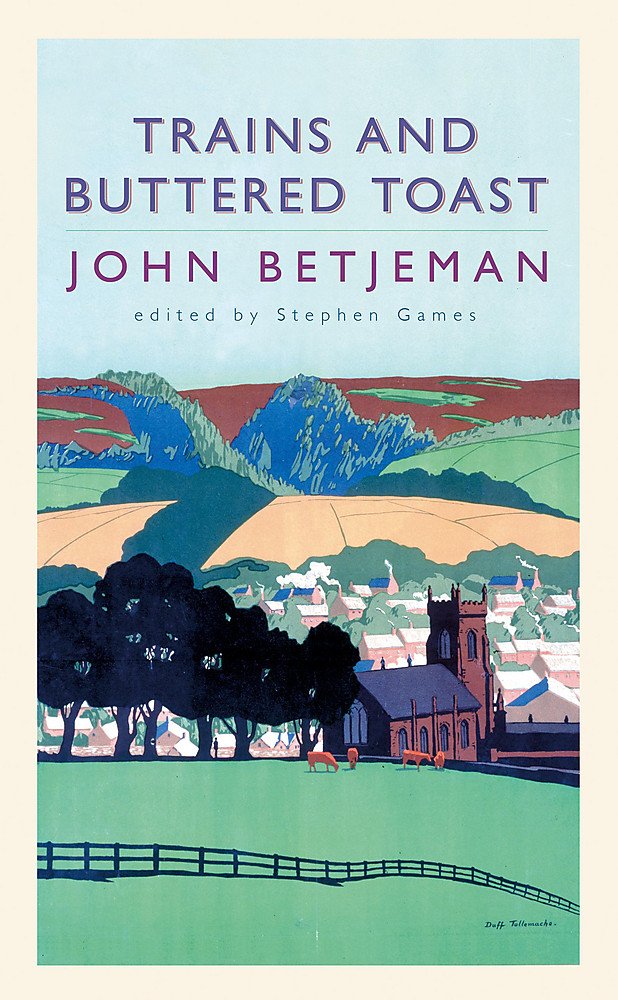
Let's Imagine: A Branch Line Railway ...


Britain's Cathedrals and Their Music ...

Progress.


INEXPENSIVE PROGRESS

Encase your legs in nylons,
Bestride your hills with pylons
O age without a soul;
Away with gentle willows
And all the elmy billows
That through your valleys roll.

Let's say goodbye to hedges
And roads with grassy edges
And winding country lanes;
Let all things travel faster
Where motor car is master
Till only Speed remains.

Destroy the ancient inn-signs
But strew the roads with tin signs
"Keep Left," "M4," "Keep Out!"
Command, instruction, warning,
Repetitive adorning
The rockeried roundabout;

For every raw obscenity
Must have its small "amenity,"
Its patch of shaven green,
And hoardings look a wonder
In banks of floribunda
With floodlights in between.

Leave no old village standing
Which could provide a landing
For aeroplanes to roar,
But spare such cheap defacements
As huts with shattered casements
Unlived-in since the war.

Let no provincial High Street
Which might be your or my street
Look as it used to do,
But let the chain stores place here
Their miles of black glass facia
And traffic thunder through.

And if there is some scenery,
Some unpretentious greenery,
Surviving anywhere,
It does not need protecting
For soon we'll be erecting
A Power Station there.

When all our roads are lighted
By concrete monsters sited
Like gallows overhead,
Bathed in the yellow vomit
Each monster belches from it,
We'll know that we are dead.

Sir John Betjeman

10 November 2019

Oil.


Too many people in the modern world view poetry as a luxury, not a necessity like petrol. But to me it's the oil of life.

Sir John Betjeman

Peace.


NORFOLK

How did the Devil come? When first attack?
These Norfolk lanes recall lost innocence,
The years fall off and find me walking back
Dragging a stick along the wooden fence
Down this same path, where, forty years ago,
My father strolled behind me, calm and slow.

I used to fill my hands with sorrel seeds
And shower him with them from the tops of stiles,
I used to butt my head into his tweeds
To make him hurry down those languorous miles
Of ash and alder-shaded lanes, till here
Our moorings and the masthead would appear.

There after supper lit by lantern light
Warm in the cabin I could lie secure
And hear against the polished sides at night
The lap lap lapping of the weedy Bure,
A whispering and watery Norfolk sound
Telling of all the moonlit reeds around.

How did the Devil come? When first attack?
The church is just the same, though now I know
Fowler of Louth restored it. Time, bring back
The rapturous ignorance of long ago,
The peace, before the dreadful daylight starts,
Of unkept promises and broken hearts.

Sir John Betjeman

19 September 2019

Before.


Childhood is measured out by sounds and smells and sights, before the dark hour of reason grows.

John Betjeman