"I am not one who was born in the custody of wisdom. I am one who is fond of olden times and intense in quest of the sacred knowing of the ancients." Gustave Courbet
Showing posts with label Rackham. Show all posts

17 June 2026

Soothing.

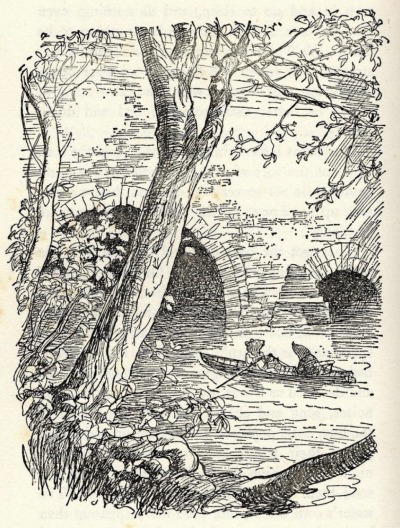
Rackham, The River, 1940


Absorbed in the new life he was entering upon, intoxicated with the sparkle, the ripple, the scents and the sounds and the sunlight, he trailed a paw in the water and dreamed long waking dreams. The Water Rat, like the good little fellow he was, sculled steadily on and forbore to disturb him.

"I like your clothes awfully, old chap," he remarked after some half an hour or so had passed. "I'm going to get a black velvet smoking-suit myself some day, as soon as I can afford it."

"I beg your pardon," said the Mole, pulling himself together with an effort. "You must think me very rude; but all this is so new to me. So—this—is—a—River!"

"The River," corrected the Rat.

"And you really live by the river? What a jolly life!"

"By it and with it and on it and in it," said the Rat. "It's brother and sister to me, and aunts, and company, and food and drink, and (naturally) washing. It's my world, and I don't want any other. What it hasn't got is not worth having, and what it doesn't know is not worth knowing. Lord! the times we've had together! Whether in winter or summer, spring or autumn, it's always got its fun and its excitements. When the floods are on in February, and my cellars and basement are brimming with drink that's no good to me, and the brown water runs by my best bedroom window; or again when it all drops away and shows patches of mud that smells like plum-cake, and the rushes and weed clog the channels, and I can potter about dry shod over most of the bed of it and find fresh food to eat, and things careless people have dropped out of boats!"

"But isn't it a bit dull at times?" the Mole ventured to ask. "Just you and the river, and no one else to pass a word with?"

"No one else to—well, I mustn't be hard on you," said the Rat with forbearance. "You're new to it, and of course you don't know. The bank is so crowded nowadays that many people are moving away altogether. O no, it isn't what it used to be, at all. Otters, king-fishers, dabchicks, moorhens, all of them about all day long and always wanting you to do something—as if a fellow had no business of his own to attend to!"

"What lies over there?" asked the Mole, waving a paw towards a background of woodland that darkly framed the water-meadows on one side of the river.

"That? O, that's just the Wild Wood," said the Rat shortly. "We don't go there very much, we river-bankers."

"Aren't they—aren't they very nice people in there?" said the Mole a trifle nervously.

"W-e-ll," replied the Rat, "let me see. The squirrels are all right. And the rabbits—some of 'em, but rabbits are a mixed lot. And then there's Badger, of course. He lives right in the heart of it; wouldn't live anywhere else, either, if you paid him to do it. Dear old Badger! Nobody interferes with him. They'd better not," he added significantly.

"Why, who should interfere with him?" asked the Mole.

"Well, of course—there—are others," explained the Rat in a hesitating sort of way. "Weasels—and stoats—and foxes—and so on. They're all right in a way—I'm very good friends with them—pass the time of day when we meet, and all that—but they break out sometimes, there's no denying it, and then—well, you can't really trust them, and that's the fact."

The Mole knew well that it is quite against animal-etiquette to dwell on possible trouble ahead, or even to allude to it; so he dropped the subject.

"And beyond the Wild Wood again?" he asked; "where it's all blue and dim, and one sees what may be hills or perhaps they mayn't, and something like the smoke of towns, or is it only cloud-drift?"

"Beyond the Wild Wood comes the Wide World," said the Rat. "And that's something that doesn't matter, either to you or me. I've never been there, and I'm never going, nor you either, if you've got any sense at all. Don't ever refer to it again, please. Now then! Here's our backwater at last, where we're going to lunch."

Leaving the main stream, they now passed into what seemed at first sight like a little landlocked lake. Green turf sloped down to either edge, brown snaky tree-roots gleamed below the surface of the quiet water, while ahead of them the silvery shoulder and foamy tumble of a weir, arm-in-arm with a restless dripping mill-wheel, that held up in its turn a grey-gabled mill-house, filled the air with a soothing murmur of sound, dull and smothery, yet with little clear voices speaking up cheerfully out of it at intervals. It was so very beautiful that the Mole could only hold up both fore-paws and gasp: "O my! O my! O my!"

Kenneth Grahame, from The Wind in the Willows

27 September 2025

Hallooing.

Rackham, Rip Van Winkle, 1904


In a long ramble of the kind on a fine autumnal day, Rip had unconsciously scrambled to one of the highest parts of the Kaatskill Mountains. He was after his favourite sport of squirrel shooting, and the still solitudes had echoed and re-echoed with the reports of his gun. Panting and fatigued, he threw himself, late in the afternoon, on a green knoll, covered with mountain herbage, that crowned the brow of a precipice. From an opening between the trees he could overlook all the lower country for many a mile of rich woodland. He saw at a distance the lordly Hudson, far, far below him, moving on its silent but majestic course, with the reflection of a purple cloud, or the sail of a lagging bark, here and there sleeping on its glassy bosom, and at last losing itself in the blue highlands.

On the other side he looked down into a deep mountain glen, wild, lonely, and shagged, the bottom filled with fragments from the impending cliffs, and scarcely lighted by the reflected rays of the setting sun. For some time Rip lay musing on this scene; evening was gradually advancing; the mountains began to throw their long blue shadows over the valleys; he saw that it would be dark long before he could reach the village, and he heaved a heavy sigh when he thought of encountering the terrors of Dame Van Winkle.

As he was about to descend, he heard a voice from a distance, hallooing: “Rip Van Winkle! Rip Van Winkle!” He looked round, but could see nothing but a crow winging its solitary flight across the mountain. He thought his fancy must have deceived him, and turned again to descend, when he heard the same cry ring through the still evening air: “Rip Van Winkle! Rip Van Winkle!” At the same time Wolf bristled up his back, and giving a low growl, skulked to his master’s side, looking fearfully down into the glen. Rip now felt a vague apprehension stealing over him; he looked anxiously in the same direction, and perceived a strange figure slowly toiling up the rocks, and bending under the weight of something he carried on his back. He was surprised to see any human being in this lonely and unfrequented place; but supposing it to be some one of the neighbourhood in need of his assistance, he hastened down to yield it.

Washington Irving, from "Rip Van Winkle," found in the pages of Geoffrey Crayon's Sketchbook

It's sandwich time.

06 June 2022

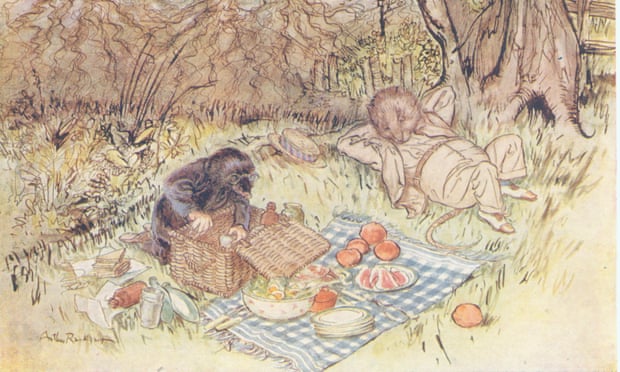
coldtonguecoldhamcoldbeefpickledgherkinssaladfrenchrollscresssandwichespottedme atgingerbeerlemonadesodawater.

Rackham, Ratty's Riverside Picnic, 1940


It all seemed too good to be true. Hither and thither through the meadows he rambled busily, along the hedgerows, across the copses, finding everywhere birds building, flowers budding, leaves thrusting—everything happy, and progressive, and occupied. And instead of having an uneasy conscience pricking him and whispering “whitewash!” he somehow could only feel how jolly it was to be the only idle dog among all these busy citizens. After all, the best part of a holiday is perhaps not so much to be resting yourself, as to see all the other fellows busy working.

He thought his happiness was complete when, as he meandered aimlessly along, suddenly he stood by the edge of a full-fed river. Never in his life had he seen a river before—this sleek, sinuous, full-bodied animal, chasing and chuckling, gripping things with a gurgle and leaving them with a laugh, to fling itself on fresh playmates that shook themselves free, and were caught and held again. All was a-shake and a-shiver—glints and gleams and sparkles, rustle and swirl, chatter and bubble. The Mole was bewitched, entranced, fascinated. By the side of the river he trotted as one trots, when very small, by the side of a man who holds one spell-bound by exciting stories; and when tired at last, he sat on the bank, while the river still chattered on to him, a babbling procession of the best stories in the world, sent from the heart of the earth to be told at last to the insatiable sea.

As he sat on the grass and looked across the river, a dark hole in the bank opposite, just above the water’s edge, caught his eye, and dreamily he fell to considering what a nice snug dwelling-place it would make for an animal with few wants and fond of a bijou riverside residence, above flood level and remote from noise and dust. As he gazed, something bright and small seemed to twinkle down in the heart of it, vanished, then twinkled once more like a tiny star. But it could hardly be a star in such an unlikely situation; and it was too glittering and small for a glow-worm. Then, as he looked, it winked at him, and so declared itself to be an eye; and a small face began gradually to grow up round it, like a frame round a picture.

A brown little face, with whiskers.

A grave round face, with the same twinkle in its eye that had first attracted his notice.

Small neat ears and thick silky hair.

It was the Water Rat!

Then the two animals stood and regarded each other cautiously.

“Hullo, Mole!” said the Water Rat.

“Hullo, Rat!” said the Mole.

“Would you like to come over?” enquired the Rat presently.

“Oh, its all very well to talk,” said the Mole, rather pettishly, he being new to a river and riverside life and its ways.

The Rat said nothing, but stooped and unfastened a rope and hauled on it; then lightly stepped into a little boat which the Mole had not observed. It was painted blue outside and white within, and was just the size for two animals; and the Mole’s whole heart went out to it at once, even though he did not yet fully understand its uses.

The Rat sculled smartly across and made fast. Then he held up his forepaw as the Mole stepped gingerly down. “Lean on that!” he said. “Now then, step lively!” and the Mole to his surprise and rapture found himself actually seated in the stern of a real boat.

“This has been a wonderful day!” said he, as the Rat shoved off and took to the sculls again. “Do you know, I’ve never been in a boat before in all my life.”

“What?” cried the Rat, open-mouthed: “Never been in a—you never—well I—what have you been doing, then?”

“Is it so nice as all that?” asked the Mole shyly, though he was quite prepared to believe it as he leant back in his seat and surveyed the cushions, the oars, the rowlocks, and all the fascinating fittings, and felt the boat sway lightly under him.

“Nice? It’s the only thing,” said the Water Rat solemnly, as he leant forward for his stroke. “Believe me, my young friend, there is nothing—absolute nothing—half so much worth doing as simply messing about in boats. Simply messing,” he went on dreamily: “messing—about—in—boats; messing——”

“Look ahead, Rat!” cried the Mole suddenly.

It was too late. The boat struck the bank full tilt. The dreamer, the joyous oarsman, lay on his back at the bottom of the boat, his heels in the air.

“—about in boats—or with boats,” the Rat went on composedly, picking himself up with a pleasant laugh. “In or out of ’em, it doesn’t matter. Nothing seems really to matter, that’s the charm of it. Whether you get away, or whether you don’t; whether you arrive at your destination or whether you reach somewhere else, or whether you never get anywhere at all, you’re always busy, and you never do anything in particular; and when you’ve done it there’s always something else to do, and you can do it if you like, but you’d much better not. Look here! If you’ve really nothing else on hand this morning, supposing we drop down the river together, and have a long day of it?”

The Mole waggled his toes from sheer happiness, spread his chest with a sigh of full contentment, and leaned back blissfully into the soft cushions. “What a day I’m having!” he said. “Let us start at once!”

“Hold hard a minute, then!” said the Rat. He looped the painter through a ring in his landing-stage, climbed up into his hole above, and after a short interval reappeared staggering under a fat, wicker luncheon-basket.

“Shove that under your feet,” he observed to the Mole, as he passed it down into the boat. Then he untied the painter and took the sculls again.

“What’s inside it?” asked the Mole, wriggling with curiosity.

“There’s cold chicken inside it,” replied the Rat briefly; “coldtonguecoldhamcoldbeefpickledgherkinssaladfrenchrollscresssandwichespottedme atgingerbeerlemonadesodawater——”

“O stop, stop,” cried the Mole in ecstacies: “This is too much!”

Kenneth Grahame, from The Wind in the Willows

It's sandwich time.

05 February 2022

Again.

Rackham, “Appear, flickering fire, / Encircle the rock with thy flame! / Loge! Loge! Appear!”, 1910


Once more to assemble about the paternal hearth, that rallying-place of the affections, there to grow young and loving again among the endearing mementoes of childhood.

Washington Irving

22 September 2021

Ramble.

Rackham, Rip in the Faerie Circle, 1916


In a long ramble of the kind on a fine autumnal day, Rip had unconsciously scrambled to one of the highest parts of the Catskill Mountains. He was after his favorite sport of squirrel-shooting, and the still solitudes had echoed and reëchoed with the reports of his gun. Panting and fatigued, he threw himself, late in the afternoon, on a green knoll, covered with mountain herbage, that crowned the brow of a precipice. From an opening between the trees he could overlook all the lower country for many a mile of rich woodland. He saw at a distance the lordly Hudson, far, far below him, moving on its silent but majestic course, with the reflection of a purple cloud, or the sail of a lagging bark, here and there sleeping on its glassy bosom, and at last losing itself in the blue highlands.

On the other side he looked down into a deep mountain glen, wild and lonely, the bottom filled with fragments from the overhanging cliffs, and scarcely lighted by the reflected rays of the setting sun. For some time Rip lay musing on this scene; evening was gradually advancing; the mountains began to throw their long blue shadows over the valleys; he saw that it would be dark long before he could reach the village, and he heaved a heavy sigh when he thought of encountering the terrors of Dame Van Winkle.

As he was about to descend, he heard a voice from a distance, hallooing, “Rip Van Winkle! Rip Van Winkle!” He looked round, but could see nothing but a crow winging its solitary flight across the mountain. He thought his fancy must have deceived him, and turned again to descend, when he heard the same cry ring through the still evening air: “Rip Van Winkle! Rip Van Winkle!”—at the same time Wolf bristled up his back, and giving a low growl, skulked to his master’s side, looking fearfully down into the glen. Rip now felt a vague apprehension stealing over him; he looked anxiously in the same direction, and perceived a strange figure slowly toiling up the rocks, and bending under the weight of something he carried on his back. He was surprised to see any human being in this lonely and unfrequented place; but supposing it to be some one of the neighborhood in need of his assistance, he hastened down to yield it.

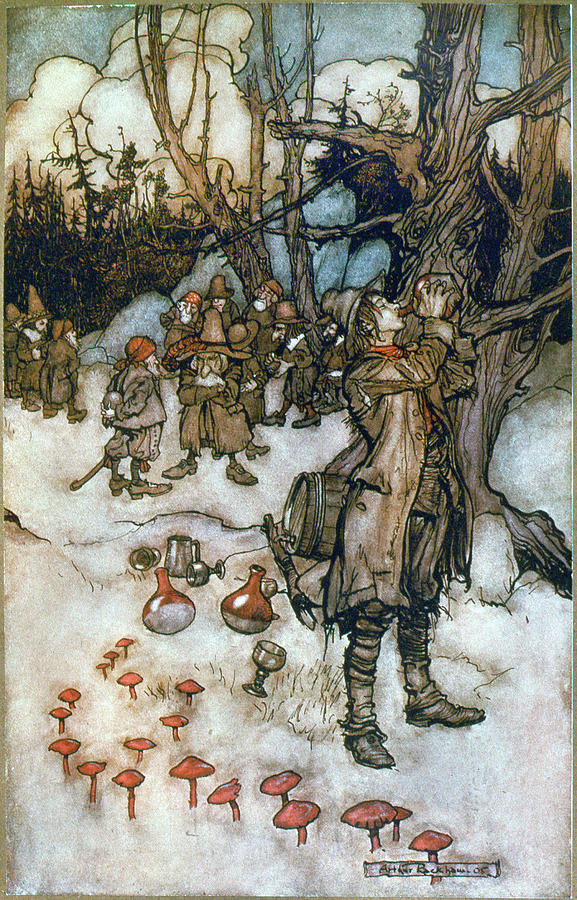
On nearer approach he was still more surprised at the vsingularity of the stranger’s appearance. He was a short, square-built old fellow, with thick bushy hair, and a grizzled beard. His dress was of the antique Dutch fashion,—a cloth jerkin strapped round the waist, and several pair of breeches, the outer one of ample volume, decorated with rows of buttons down the sides. He bore on his shoulder a stout keg that seemed full of liquor, and made signs for Rip to approach and assist him with the load. Though rather shy and distrustful of this new acquaintance, Rip complied with his usual valacrity, and relieving one another, they clambered up a narrow gully, apparently the dry bed of a mountain torrent.

As they ascended, Rip every now and then heard long, rolling peals, like distant thunder, that seemed to issue out of a deep ravine, or rather cleft, between lofty rocks, toward which their rugged path conducted. He paused for an instant, but supposing it to be the muttering of one of those transient thundershowers which often take place in mountain heights, he proceeded. Passing through the ravine, they came to a hollow, like a small vamphitheater, surrounded by perpendicular precipices, over the brinks of which trees shot their branches, so that you only caught glimpses of the azure sky and the bright evening cloud. During the whole time Rip and his companion had labored on in silence; for though the former marveled greatly, what could be the object of carrying a keg of liquor up this wild mountain, yet there was something strange and incomprehensible about the unknown that inspired awe and checked familiarity.

On entering the amphitheater new objects of wonder presented themselves. On a level spot in the center was a company of odd-looking personages playing at ninepins. They were dressed in a quaint, outlandish fashion; some wore short doublets, others jerkins, with long knives in their belts, and most of them had enormous breeches, of similar style with that of the guide’s. Their visages, too, were peculiar: one had a large head, broad face, and small, piggish eyes; the face of another seemed to consist entirely of nose, and was surmounted by a white sugar-loaf hat, set off with a little red cock’s tail. They all had beards, of various shapes and colors. There was one who seemed to be the commander. He was a stout old gentleman, with a weather-beaten countenance; he wore a laced doublet, broad belt and hanger, high-crowned hat and feather, red stockings, and high-heeled shoes, with roses in them. The whole group reminded Rip of the figures in an old Flemish painting, in the parlor of Dominie Van Shaick, the village parson, which had been brought over from Holland at the time of the settlement.

What seemed particularly odd to Rip was that, though these folks were evidently amusing themselves, yet they maintained the gravest faces, the most mysterious silence, and were, withal, the most melancholy party of pleasure he had ever witnessed. Nothing interrupted the stillness of the scene but the noise of the balls, which, whenever they were rolled, echoed along the mountains like rumbling peals of thunder.

As Rip and his companion approached them, they suddenly desisted from their play, and stared at him with such fixed, statue-like gaze, and such strange, uncouth countenances, that his heart turned within him, and his knees smote together. His companion now emptied the contents of the keg into large flagons, and made signs to him to wait upon the company. He obeyed with fear and trembling; they quaffed the liquor in profound silence, and then returned to their game.

By degrees Rip’s awe and apprehension subsided. He even ventured, when no eye was fixed upon him, to taste the beverage, which he found had much of the flavor of excellent Hollands. He was naturally a thirsty soul, and was soon tempted to repeat the draught. One taste provoked another; and he repeated his visits to the flagon so often that at length his senses were overpowered, his eyes swam in his head, his head gradually declined, and he fell into a deep sleep.

Washington Irving, from "Rip van Winkle"

26 March 2020

Song-dream.

Rackham, The Piper at the Gates of Dawn, 1908


The PIPER at the GATES of DAWN

The Willow-Wren was twittering his thin little song, hidden himself in the dark selvedge of the river bank. Though it was past ten o'clock at night, the sky still clung to and retained some lingering skirts of light from the departed day; and the sullen heats of the torrid afternoon broke up and rolled away at the dispersing touch of the cool fingers of the short midsummer night. Mole lay stretched on the bank, still panting from the stress of the fierce day that had been cloudless from dawn to late sunset, and waited for his friend to return. He had been on the river with some companions, leaving the Water Rat free to keep an engagement of long standing with Otter; and he had come back to find the house dark and deserted, and no sign of Rat, who was doubtless keeping it up late with his old comrade. It was still too hot to think of staying indoors, so he lay on some cool dock-leaves, and thought over the past day and its doings, and how very good they all had been.

The Rat's light footfall was presently heard approaching over the parched grass. "O, the blessed coolness!" he said, and sat down, gazing thoughtfully into the river, silent and pre-occupied.

"You stayed to supper, of course?" said the Mole presently.

"Simply had to," said the Rat. "They wouldn't hear of my going before. You know how kind they always are. And they made things as jolly for me as ever they could, right up to the moment I left. But I felt a brute all the time, as it was clear to me they were very unhappy, though they tried to hide it. Mole, I'm afraid they're in trouble. Little Portly is missing again; and you know what a lot his father thinks of him, though he never says much about it."

"What, that child?" said the Mole lightly. "Well, suppose he is; why worry about it? He's always straying off and getting lost, and turning up again; he's so adventurous. But no harm ever happens to him. Everybody hereabouts knows him and likes him, just as they do old Otter, and you may be sure some animal or other will come across him and bring him back again all right. Why, we've found him ourselves, miles from home, and quite self-possessed and cheerful!"

"Yes; but this time it's more serious," said the Rat gravely. "He's been missing for some days now, and the Otters have hunted everywhere, high and low, without finding the slightest trace. And they've asked every animal, too, for miles around, and no one knows anything about him. Otter's evidently more anxious than he'll admit. I got out of him that young Portly hasn't learnt to swim very well yet, and I can see he's thinking of the weir. There's a lot of water coming down still, considering the time of the year, and the place always had a fascination for the child. And then there are—well, traps and things—you know. Otter's not the fellow to be nervous about any son of his before it's time. And now he is nervous. When I left, he came out with me—said he wanted some air, and talked about stretching his legs. But I could see it wasn't that, so I drew him out and pumped him, and got it all from him at last. He was going to spend the night watching by the ford. You know the place where the old ford used to be, in by-gone days before they built the bridge?"

"I know it well," said the Mole. "But why should Otter choose to watch there?"

"Well, it seems that it was there he gave Portly his first swimming-lesson," continued the Rat. "From that shallow, gravelly spit near the bank. And it was there he used to teach him fishing, and there young Portly caught his first fish, of which he was so very proud. The child loved the spot, and Otter thinks that if he came wandering back from wherever he is—if he is anywhere by this time, poor little chap—he might make for the ford he was so fond of; or if he came across it he'd remember it well, and stop there and play, perhaps. So Otter goes there every night and watches—on the chance, you know, just on the chance!"

They were silent for a time, both thinking of the same thing—the lonely, heart-sore animal, crouched by the ford, watching and waiting, the long night through—on the chance.

"Well, well," said the Rat presently, "I suppose we ought to be thinking about turning in." But he never offered to move.

"Rat," said the Mole, "I simply can't go and turn in, and go to sleep, and do nothing, even though there doesn't seem to be anything to be done. We'll get the boat out, and paddle upstream. The moon will be up in an hour or so, and then we will search as well as we can—anyhow, it will be better than going to bed and doing nothing."

"Just what I was thinking myself," said the Rat. "It's not the sort of night for bed anyhow; and daybreak is not so very far off, and then we may pick up some news of him from early risers as we go along."

They got the boat out, and the Rat took the sculls, paddling with caution. Out in mid-stream, there was a clear, narrow track that faintly reflected the sky; but wherever shadows fell on the water from bank, bush, or tree, they were as solid to all appearance as the banks themselves, and the Mole had to steer with judgment accordingly. Dark and deserted as it was, the night was full of small noises, song and chatter and rustling, telling of the busy little population who were up and about, plying their trades and vocations through the night till sunshine should fall on them at last and send them off to their well-earned repose. The water's own noises, too, were more apparent than by day, its gurglings and "cloops" more unexpected and near at hand; and constantly they started at what seemed a sudden clear call from an actual articulate voice.

The line of the horizon was clear and hard against the sky, and in one particular quarter it showed black against a silvery climbing phosphorescence that grew and grew. At last, over the rim of the waiting earth the moon lifted with slow majesty till it swung clear of the horizon and rode off, free of moorings; and once more they began to see surfaces—meadows wide-spread, and quiet gardens, and the river itself from bank to bank, all softly disclosed, all washed clean of mystery and terror, all radiant again as by day, but with a difference that was tremendous. Their old haunts greeted them again in other raiment, as if they had slipped away and put on this pure new apparel and come quietly back, smiling as they shyly waited to see if they would be recognised again under it.

Fastening their boat to a willow, the friends landed in this silent, silver kingdom, and patiently explored the hedges, the hollow trees, the runnels and their little culverts, the ditches and dry water-ways. Embarking again and crossing over, they worked their way up the stream in this manner, while the moon, serene and detached in a cloudless sky, did what she could, though so far off, to help them in their quest; till her hour came and she sank earthwards reluctantly, and left them, and mystery once more held field and river.

Then a change began slowly to declare itself. The horizon became clearer, field and tree came more into sight, and somehow with a different look; the mystery began to drop away from them. A bird piped suddenly, and was still; and a light breeze sprang up and set the reeds and bulrushes rustling. Rat, who was in the stern of the boat, while Mole sculled, sat up suddenly and listened with a passionate intentness. Mole, who with gentle strokes was just keeping the boat moving while he scanned the banks with care, looked at him with curiosity.

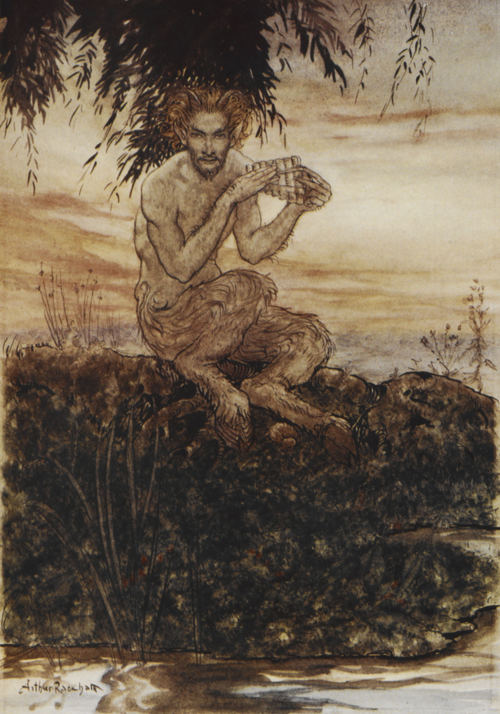
"It's gone!" sighed the Rat, sinking back in his seat again. "So beautiful and strange and new! Since it was to end so soon, I almost wish I had never heard it. For it has roused a longing in me that is pain, and nothing seems worth while but just to hear that sound once more and go on listening to it for ever. No! There it is again!" he cried, alert once more. Entranced, he was silent for a long space, spellbound.

"Now it passes on and I begin to lose it," he said presently. "O Mole! the beauty of it! The merry bubble and joy, the thin, clear, happy call of the distant piping! Such music I never dreamed of, and the call in it is stronger even than the music is sweet! Row on, Mole, row! For the music and the call must be for us."

The Mole, greatly wondering, obeyed. "I hear nothing myself," he said, "but the wind playing in the reeds and rushes and osiers."

The Rat never answered, if indeed he heard. Rapt, transported, trembling, he was possessed in all his senses by this new divine thing that caught up his helpless soul and swung and dandled it, a powerless but happy infant in a strong sustaining grasp.

In silence Mole rowed steadily, and soon they came to a point where the river divided, a long backwater branching off to one side. With a slight movement of his head Rat, who had long dropped the rudder-lines, directed the rower to take the backwater. The creeping tide of light gained and gained, and now they could see the colour of the flowers that gemmed the water's edge.

"Clearer and nearer still," cried the Rat joyously. "Now you must surely hear it! Ah—at last—I see you do!"

Breathless and transfixed, the Mole stopped rowing as the liquid run of that glad piping broke on him like a wave, caught him up, and possessed him utterly. He saw the tears on his comrade's cheeks, and bowed his head and understood. For a space they hung there, brushed by the purple loosestrife that fringed the bank; then the clear imperious summons that marched hand-in-hand with the intoxicating melody imposed its will on Mole, and mechanically he bent to his oars again. And the light grew steadily stronger, but no birds sang as they were wont to do at the approach of dawn; and but for the heavenly music all was marvellously still.

On either side of them, as they glided onwards, the rich meadow-grass seemed that morning of a freshness and a greenness unsurpassable. Never had they noticed the roses so vivid, the willow-herb so riotous, the meadow-sweet so odorous and pervading. Then the murmur of the approaching weir began to hold the air, and they felt a consciousness that they were nearing the end, whatever it might be, that surely awaited their expedition.

A wide half-circle of foam and glinting lights and shining shoulders of green water, the great weir closed the backwater from bank to bank, troubled all the quiet surface with twirling eddies and floating foam-streaks, and deadened all other sounds with its solemn and soothing rumble. In midmost of the stream, embraced in the weir's shimmering arm-spread, a small island lay anchored, fringed close with willow and silver birch and alder. Reserved, shy, but full of significance, it hid whatever it might hold behind a veil, keeping it till the hour should come, and, with the hour, those who were called and chosen.

Slowly, but with no doubt or hesitation whatever, and in something of a solemn expectancy, the two animals passed through the broken, tumultuous water and moored their boat at the flowery margin of the island. In silence they landed, and pushed through the blossom and scented herbage and undergrowth that led up to the level ground, till they stood on a little lawn of a marvellous green, set round with Nature's own orchard-trees—crab-apple, wild cherry, and sloe.

"This is the place of my song-dream, the place the music played to me," whispered the Rat, as if in a trance. "Here, in this holy place, here if anywhere, surely we shall find Him!"

Then suddenly the Mole felt a great Awe fall upon him, an awe that turned his muscles to water, bowed his head, and rooted his feet to the ground. It was no panic terror—indeed he felt wonderfully at peace and happy—but it was an awe that smote and held him and, without seeing, he knew it could only mean that some august Presence was very, very near. With difficulty he turned to look for his friend, and saw him at his side, cowed, stricken, and trembling violently. And still there was utter silence in the populous bird-haunted branches around them; and still the light grew and grew.

Kenneth Graham, from The Wind in the Willows

CONNECT

09 July 2019

Teacher.

Rackham, The Moon, Like to a Silver Bow, 1907


Each day I long so much to see
The true teacher. And each time
At dusk when I open the cabin
Door and empty the teapot,
I think I know where he is:
West of us in the forest.

Or perhaps I am the one
Who is out in the night,
The forest sand wet under
My feet, moonlight shining
On the sides of the birch trees,
The sea far off gleaming.

And he is the one who is
At home. He sits in my chair
Calmly; he reads and prays
All night. He loves to feel
His own body around him;
He does not leave the house.

Francisco Albanez

30 September 2018

Sit.

Rackham, Autumn Faerie Dancing on a Spider's Web, 1927


O Autumn, laden with fruit, and stained
With the blood of the grape, pass not, but sit
Beneath my shady roof; there thou mayst rest,
And tune thy jolly voice to my fresh pipe,
And all the daughters of the year shall dance!
Sing now the lusty song of fruits and flowers.

The narrow bud opens her beauties to
The sun, and love runs in her thrilling veins;
Blossoms hang round the brows of Morning, and
Flourish down the bright cheek of modest Eve,
Till clust’ring Summer breaks forth into singing,
And feather’d clouds strew flowers round her head.

“The spirits of the air live on the smells
Of fruit; and Joy, with pinions light, roves round
The gardens, or sits singing in the trees.”
Thus sang the jolly Autumn as he sat;
Then rose, girded himself, and o’er the bleak
Hills fled from our sight; but left his golden load.

William Blake

16 December 2017

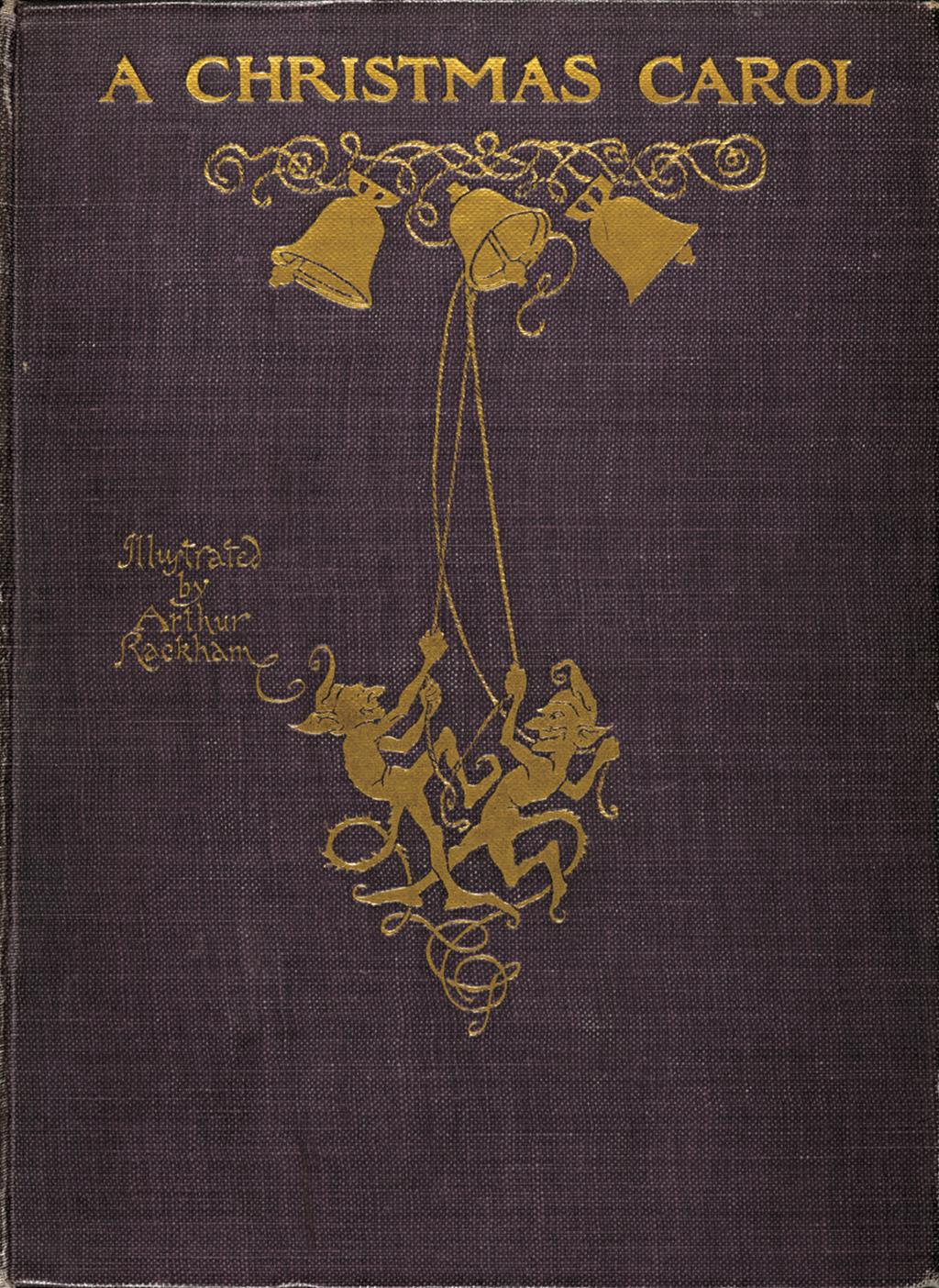
Happy birthday, A Christmas Carol.


Charles Dickens' A Christmas Carol was published on this day in 1843.

The full text, complete with Arthur Rackham's illustrations, is HERE.