"I am not one who was born in the custody of wisdom. I am one who is fond of olden times and intense in quest of the sacred knowing of the ancients." Gustave Courbet
Showing posts with label Washington Irving. Show all posts

27 September 2025

Hallooing.

Rackham, Rip Van Winkle, 1904
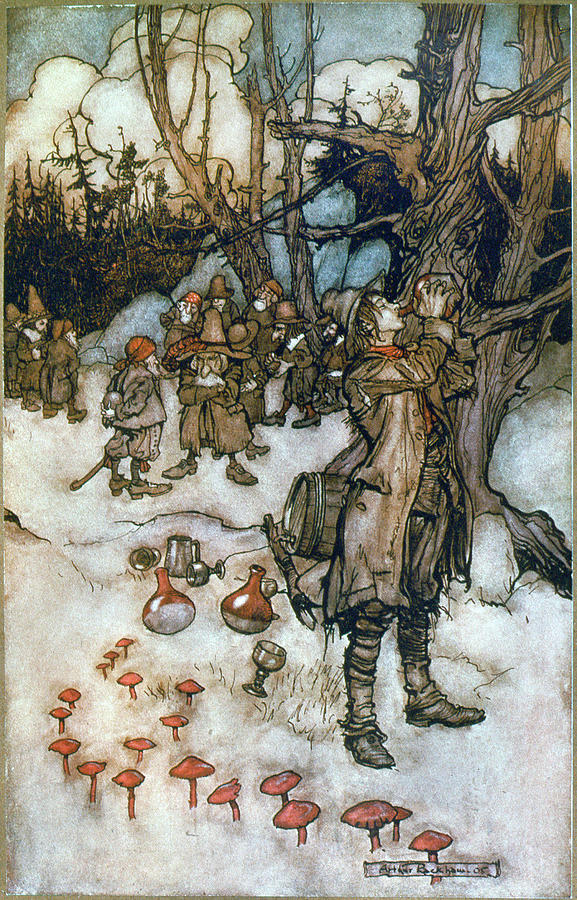

In a long ramble of the kind on a fine autumnal day, Rip had unconsciously scrambled to one of the highest parts of the Kaatskill Mountains. He was after his favourite sport of squirrel shooting, and the still solitudes had echoed and re-echoed with the reports of his gun. Panting and fatigued, he threw himself, late in the afternoon, on a green knoll, covered with mountain herbage, that crowned the brow of a precipice. From an opening between the trees he could overlook all the lower country for many a mile of rich woodland. He saw at a distance the lordly Hudson, far, far below him, moving on its silent but majestic course, with the reflection of a purple cloud, or the sail of a lagging bark, here and there sleeping on its glassy bosom, and at last losing itself in the blue highlands.

On the other side he looked down into a deep mountain glen, wild, lonely, and shagged, the bottom filled with fragments from the impending cliffs, and scarcely lighted by the reflected rays of the setting sun. For some time Rip lay musing on this scene; evening was gradually advancing; the mountains began to throw their long blue shadows over the valleys; he saw that it would be dark long before he could reach the village, and he heaved a heavy sigh when he thought of encountering the terrors of Dame Van Winkle.

As he was about to descend, he heard a voice from a distance, hallooing: “Rip Van Winkle! Rip Van Winkle!” He looked round, but could see nothing but a crow winging its solitary flight across the mountain. He thought his fancy must have deceived him, and turned again to descend, when he heard the same cry ring through the still evening air: “Rip Van Winkle! Rip Van Winkle!” At the same time Wolf bristled up his back, and giving a low growl, skulked to his master’s side, looking fearfully down into the glen. Rip now felt a vague apprehension stealing over him; he looked anxiously in the same direction, and perceived a strange figure slowly toiling up the rocks, and bending under the weight of something he carried on his back. He was surprised to see any human being in this lonely and unfrequented place; but supposing it to be some one of the neighbourhood in need of his assistance, he hastened down to yield it.

Washington Irving, from "Rip Van Winkle," found in the pages of Geoffrey Crayon's Sketchbook

It's sandwich time.

18 November 2023

Splendor.


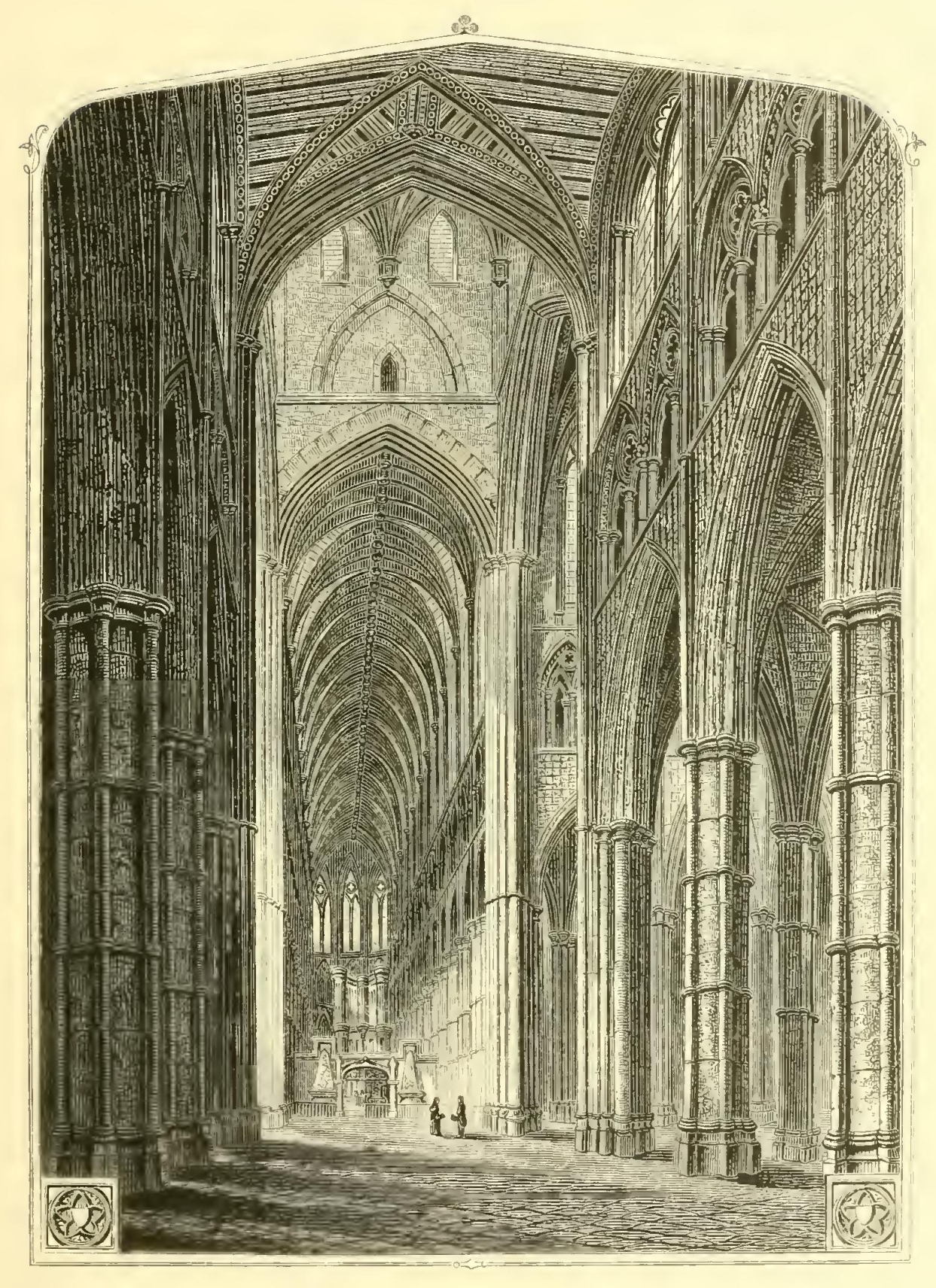
Washington Irving explores "Westminster Abbey" ...
On one of those sober and rather melancholy days in the latter part of autumn when the shadows of morning and evening almost mingle together, and throw a gloom over the decline of the year, I passed several hours in rambling about Westminster Abbey. There was something congenial to the season in the mournful magnificence of the old pile, and as I passed its threshold it seemed like stepping back into the regions of antiquity and losing myself among the shades of former ages.

I entered from the inner court of Westminster School, through a long, low, vaulted passage that had an almost subterranean look, being dimly lighted in one part by circular perforations in the massive walls. Through this dark avenue I had a distant view of the cloisters, with the figure of an old verger in his black gown moving along their shadowy vaults, and seeming like a spectre from one of the neighboring tombs. The approach to the abbey through these gloomy monastic remains prepares the mind for its solemn contemplation. The cloisters still retain something of the quiet and seclusion of former days. The gray walls are discolored by damps and crumbling with age; a coat of hoary moss has gathered over the inscriptions of the mural monuments, and obscured the death’s heads and other funeral emblems. The sharp touches of the chisel are gone from the rich tracery of the arches; the roses which adorned the keystones have lost their leafy beauty; everything bears marks of the gradual dilapidations of time, which yet has something touching and pleasing in its very decay.

The sun was pouring down a yellow autumnal ray into the square of the cloisters, beaming upon a scanty plot of grass in the centre, and lighting up an angle of the vaulted passage with a kind of dusky splendor. From between the arcades the eye glanced up to a bit of blue sky or a passing cloud, and beheld the sun-gilt pinnacles of the abbey towering into the azure heaven.

20 November 2022

Radiance.


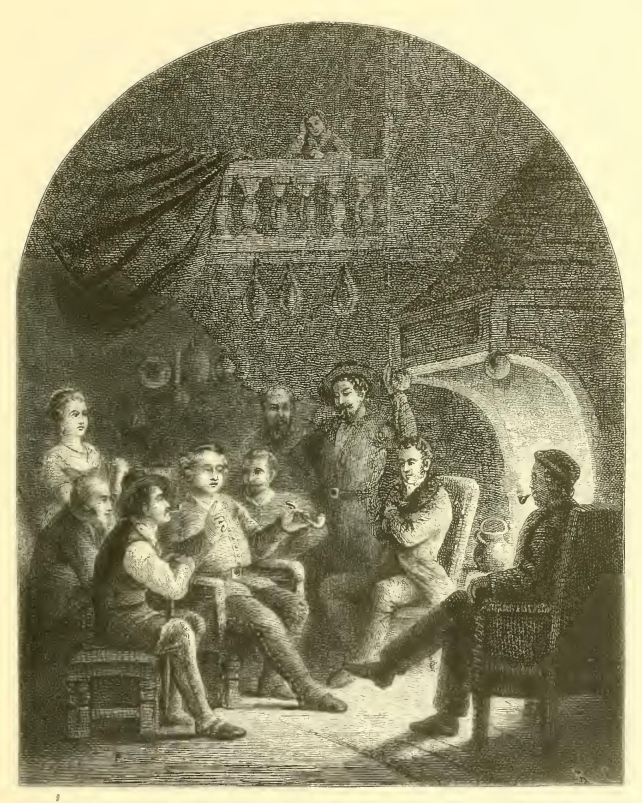
It was after the hour of the table d’hote, so that I was obliged to make a solitary supper from the relics of its ampler board. The weather was chilly; I was seated alone in one end of a great gloomy dining-room, and, my repast being over, I had the prospect before me of a long dull evening, without any visible means of enlivening it. I summoned mine host and requested something to read; he brought me the whole literary stock of his household, a Dutch family Bible, an almanac in the same language, and a number of old Paris newspapers. As I sat dozing over one of the latter, reading old news and stale criticisms, my ear was now and then struck with bursts of laughter which seemed to proceed from the kitchen. Every one that has travelled on the Continent must know how favorite a resort the kitchen of a country inn is to the middle and inferior order of travellers, particularly in that equivocal kind of weather when a fire becomes agreeable toward evening. I threw aside the newspaper and explored my way to the kitchen, to take a peep at the group that appeared to be so merry. It was composed partly of travellers who had arrived some hours before in a diligence, and partly of the usual attendants and hangers-on of inns. They were seated round a great burnished stove, that might have been mistaken for an altar at which they were worshipping. It was covered with various kitchen vessels of resplendent brightness, among which steamed and hissed a huge copper tea-kettle. A large lamp threw a strong mass of light upon the group, bringing out many odd features in strong relief. Its yellow rays partially illumined the spacious kitchen, dying duskily away into remote corners, except where they settled in mellow radiance on the broad side of a flitch of bacon or were reflected back from well-scoured utensils that gleamed from the midst of obscurity.

Washington Irving, from "The Inn Kitchen", found in The Sketchbook of Geoffrey Crayon, Gent.

24 February 2016

Magnitude.

In a subsequent tour of observation I encountered another of these relics of a "foregone world" locked up in the heart of the city. I had been wandering for some time through dull monotonous streets, destitute of anything to strike the eye or excite the imagination, when I beheld before me a Gothic gateway of mouldering antiquity. It opened into a spacious quadrangle forming the courtyard of a stately Gothic pile, the portal of which stood invitingly open.


It was apparently a public edifice, and, as I was antiquity-hunting, I ventured in, though with dubious steps. Meeting no one either to oppose or rebuke my intrusion, I continued on until I found myself in a great hall with a lofty arched roof and oaken gallery, all of Gothic architecture. At one end of the hall was an enormous fireplace, with wooden settles on each side; at the other end was a raised platform, or dais, the seat of state, above which was the portrait of a man in antique garb with a long robe, a ruff, and a venerable gray beard.


The whole establishment had an air of monastic quiet and seclusion, and what gave it a mysterious charm was, that I had not met with a human being since I had passed the threshold.


Encouraged by this loneliness, I seated myself in a recess of a large bow window, which admitted a broad flood of yellow sunshine, checkered here and there by tints from panes of colored glass, while an open casement let in the soft summer air. Here, leaning my head on my hand and my arm on an old oaken table, I indulged in a sort of reverie about what might have been the ancient uses of this edifice. It had evidently been of monastic origin; perhaps one of those collegiate establishments built of yore for the promotion of learning, where the patient monk, in the ample solitude of the cloister, added page to page and volume to volume, emulating in the productions of his brain the magnitude of the pile he inhabited.

Washington Irving, "London Antiques," from The Sketchbook of Geoffrey Crayon

20 December 2015

Returning.


In the course of a December tour in Yorkshire, I rode for a long distance in one of the public coaches, on the day preceding Christmas. The coach was crowded, both inside and out, with passengers, who, by their talk, seemed principally bound to the mansions of relations or friends to eat the Christmas dinner. It was loaded also with hampers of game, and baskets and boxes of delicacies; and hares hung dangling their long ears about the coachman's box,—presents from distant friends for the impending feast. I had three fine rosy-cheeked schoolboys for my fellow-passengers inside, full of the buxom health and manly spirit which I have observed in the children of this country. They were returning home for the holidays in high glee, and promising themselves a world of enjoyment. It was delightful to hear the gigantic plans of pleasure of the little rogues, and the impracticable feats they were to perform during their six weeks' emancipation from the abhorred thraldom of book, birch, and pedagogue. 

31 October 2015

Gloom.


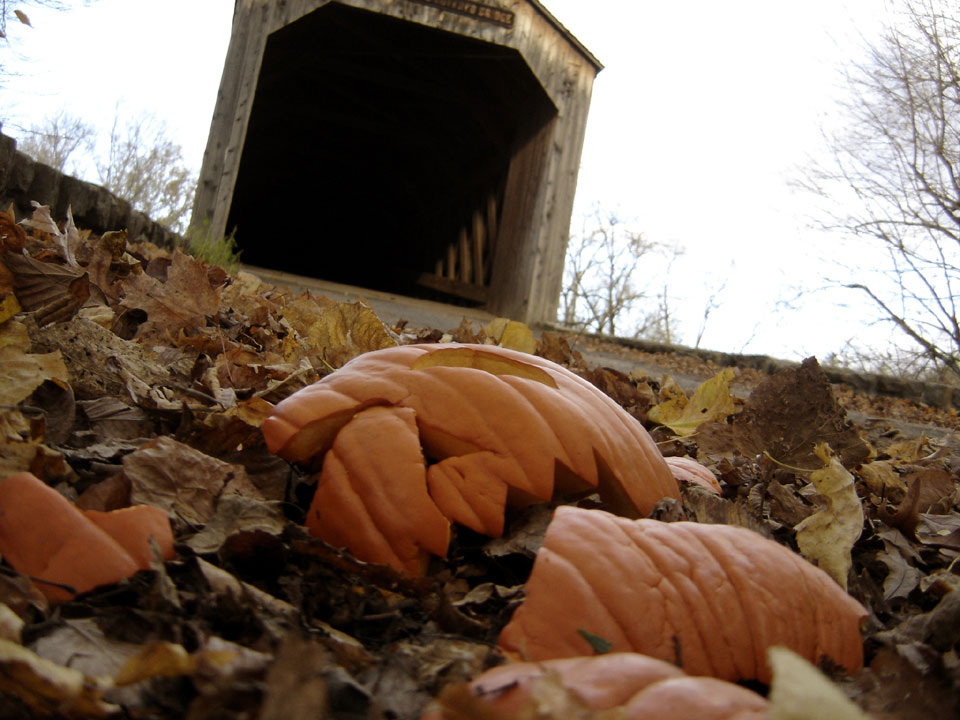
All the stories of ghosts and goblins that he had heard in the afternoon now came crowding upon his recollection. The night grew darker and darker; the stars seemed to sink deeper in the sky, and driving clouds occasionally hid them from his sight. He had never felt so lonely and dismal. He was, moreover, approaching the very place where many of the scenes of the ghost stories had been laid. In the centre of the road stood an enormous tulip-tree, which towered like a giant above all the other trees of the neighborhood, and formed a kind of landmark. Its limbs were gnarled and fantastic, large enough to form trunks for ordinary trees, twisting down almost to the earth, and rising again into the air. It was connected with the tragical story of the unfortunate André, who had been taken prisoner hard by; and was universally known by the name of Major André's tree. The common people regarded it with a mixture of respect and superstition, partly out of sympathy for the fate of its ill-starred namesake, and partly from the tales of strange sights, and doleful lamentations, told concerning it.

As Ichabod approached this fearful tree, he began to whistle; he thought his whistle was answered; it was but a blast sweeping sharply through the dry branches. As he approached a little nearer, he thought he saw something white, hanging in the midst of the tree: he paused and ceased whistling but, on looking more narrowly, perceived that it was a place where the tree had been scathed by lightning, and the white wood laid bare. Suddenly he heard a groan—his teeth chattered, and his knees smote against the saddle: it was but the rubbing of one huge bough upon another, as they were swayed about by the breeze. He passed the tree in safety, but new perils lay before him. 

About two hundred yards from the tree, a small brook crossed the road, and ran into a marshy and thickly-wooded glen, known by the name of Wiley's Swamp. A few rough logs, laid side by side, served for a bridge over this stream. On that side of the road where the brook entered the wood, a group of oaks and chestnuts, matted thick with wild grapevines, threw a cavernous gloom over it. To pass this bridge was the severest trial. It was at this identical spot that the unfortunate André was captured, and under the covert of those chestnuts and vines were the sturdy yeomen concealed who surprised him. This has ever since been considered a haunted stream, and fearful are the feelings of the schoolboy who has to pass it alone after dark.

As he approached the stream, his heart began to thump; he summoned up, however, all his resolution, gave his horse half a score of kicks in the ribs, and attempted to dash briskly across the bridge; but instead of starting forward, the perverse old animal made a lateral movement, and ran broadside against the fence. Ichabod, whose fears increased with the delay, jerked the reins on the other side, and kicked lustily with the contrary foot: it was all in vain; his steed started, it is true, but it was only to plunge to the opposite side of the road into a thicket of brambles and alder bushes. The schoolmaster now bestowed both whip and heel upon the starveling ribs of old Gunpowder, who dashed forward, snuffling and snorting, but came to a stand just by the bridge, with a suddenness that had nearly sent his rider sprawling over his head. Just at this moment a plashy tramp by the side of the bridge caught the sensitive ear of Ichabod. In the dark shadow of the grove, on the margin of the brook, he beheld something huge, misshapen and towering. It stirred not, but seemed gathered up in the gloom, like some gigantic monster ready to spring upon the traveller.

Washington Irving, from "The Legend of Sleepy Hollow"

13 December 2014

Felicity.

Caldecott, Yule Log, 1875


A man might then behold                               
At Christmas, in each hall                            
Good fires to curb the cold,                               
And meat for great and small.                            
The neighbours were friendly bidden,                               
And all had welcome true,                           
The poor from the gates were not chidden,                               
When this old cap was new.                                    

Old Song 


CHRISTMAS

There is nothing in England that exercises a more delightful spell over my imagination than the lingerings of the holiday customs and rural games of former times. They recall the pictures my fancy used to draw in the May morning of life, when as yet I only knew the world through books, and believed it to be all that poets had painted it; and they bring with them the flavour of those honest days of yore, in which, perhaps with equal fallacy, I am apt to think the world was more home-bred, social, and joyous than at present. I regret to say that they are daily growing more and more faint, being gradually worn away by time, but still more obliterated by modern fashion. They resemble those picturesque morsels of Gothic architecture which we see crumbling in various parts of the country, partly dilapidated by the waste of ages, and partly lost in the additions and alterations of latter days. Poetry, however, clings with cherishing fondness about the rural game and holiday revel, from which it has derived so many of its themes,—as the ivy winds its rich foliage about the Gothic arch and mouldering tower, gratefully repaying their support by clasping together their tottering remains, and, as it were, embalming them in verdure.

Of all the old festivals, however, that of Christmas awakens the strongest and most heartfelt associations. There is a tone of solemn and sacred feeling that blends with our conviviality, and lifts the spirit to a state of hallowed and elevated enjoyment. The services of the church about this season are extremely tender and inspiring. They dwell on the beautiful story of the origin of our faith, and the pastoral scenes that accompanied its announcement. They gradually increase in fervour and pathos during the season of Advent, until they break forth in full jubilee on the morning that brought peace and good-will to men. I do not know a grander effect of music on the moral feelings than to hear the full choir and the pealing organ performing a Christmas anthem in a cathedral, and filling every part of the vast pile with triumphant harmony.

It is a beautiful arrangement, also derived from days of yore, that this festival, which commemorates the announcement of the religion of peace and love, has been made the season for gathering together of family connections, and drawing closer again those bands of kindred hearts which the cares and pleasures and sorrows of the world are continually operating to cast loose; of calling back the children of a family who have launched forth in life, and wandered widely asunder, once more to assemble about the paternal hearth, that rallying-place of the affections, there to grow young and loving again among the endearing mementoes of childhood.


There is something in the very season of the year that gives a charm to the festivity of Christmas. At other times we derive a great portion of our pleasures from the mere beauties of nature. Our feelings sally forth and dissipate themselves over the sunny landscape, and we "live abroad and everywhere." The song of the bird, the murmur of the stream, the breathing fragrance of spring, the soft voluptuousness of summer, the golden pomp of autumn; earth with its mantle of refreshing green, and heaven with its deep delicious blue and its cloudy magnificence, all fill us with mute but exquisite delight, and we revel in the luxury of mere sensation. But in the depth of winter, when nature lies despoiled of every charm, and wrapped in her shroud of sheeted snow, we turn for our gratifications to moral sources. The dreariness and desolation of the landscape, the short gloomy days and darksome nights, while they circumscribe our wanderings, shut in our feelings also from rambling abroad, and make us more keenly disposed for the pleasures of the social circle. Our thoughts are more concentrated; our friendly sympathies more aroused, we feel more sensibly the charm of each other's society, and are brought more closely together by dependence on each other for enjoyment. Heart calleth unto heart; and we draw our pleasures from the deep wells of living kindness, which lie in the quiet recesses of our bosoms: and which when resorted to, furnish forth the pure element of domestic felicity.

Washington Irving

CONNECT

26 December 2013

Study.


An old English family mansion is a fertile subject for study. It abounds with illustrations of former times, and traces of the tastes, and humours, and manners of successive generations. 

03 April 2013

Happy birthday, Irving.

Allston, Washington Irving, 1805


Washington Irving was born on this date in 1783.

If any one should feel offended by our remarks, let him attack us in return -- we shall not wince from the combat.  If his passes be successful, we will be the first to cry out, a hit! a hit! and we doubt not we shall frequently lay ourselves open to the weapons of our assailants.  But let them have care how they run a-tilting with us; they have to deal with stubborn foes, who can bear a world of pummelling; we will be relentless in our vengeance, and will fight "till from our bones the flesh be hack't."

- Washington Irving, Salmagundi

25 December 2009

Washington Irving's Old Christmas


Today is Christmas.

As we passed over a rising ground which commanded something of a prospect, the sounds of rustic merriment now and then reached our ears; the Squire paused for a few moments, and looked around with an air of inexpressible benignity. The beauty of the day was of itself sufficient to[106] inspire philanthropy. Notwithstanding the frostiness of the morning, the sun in his cloudless journey had acquired sufficient power to melt away the thin covering of snow from every southern declivity, and to bring out the living green which adorns an English landscape even in mid-winter. Large tracts of smiling verdure contrasted with the dazzling whiteness of the shaded slopes and hollows. Every sheltered bank, on[107] which the broad rays rested, yielded its silver rill of cold and limpid water, glittering through the dripping grass; and sent up slight exhalations to contribute to the thin haze that hung just above the surface of the earth. There was something truly cheering in this triumph of warmth and verdure over the frosty thraldom of winter; it was, as the Squire observed, an emblem of Christmas hospitality, breaking through the chills of ceremony and selfishness, and thawing every heart into a flow. He pointed with pleasure to the indications of good cheer reeking from the chimneys of the comfortable farm-houses and low thatched cottages. "I love," said he, "to see this day well kept by rich and poor; it is a great thing to have one day in the year, at least, when you are sure of being welcome wherever you go, and of having, as it were, the world all thrown open to you; and I am almost disposed to join with Poor Robin, in his malediction of every churlish enemy to this honest festival:—

"Those who at Christmas do repine,
And would fain hence despatch him,
May they with old Duke Humphry dine,
Or else may Squire Ketch catch 'em."

Read the rest here.

01 December 2009

Washington Irving's Old Christmas


Washington Irving's Old Christmas is a collection of five essays that take the reader back to the frosty greens, the gothic "old piles," yule logs, mistletoe, stage coaches, and hog's heads of Christmas in 19th century England. Irving sings the praises of the traditional and frequently worries, even then, about the loss of the ritual and warmth of The Spirit Of The Season.

Enjoy and Merry Christmas to you and yours.

Read this week's installment here.

26 December 2008

Irving's Christmas Dinner


The dinner-time passed away in this flow of innocent hilarity, and, though the old hall may have resounded in its time with many a scene of broader rout and revel, yet I doubt whether it ever witnessed more honest and genuine enjoyment. How easy it is for one benevolent being to diffuse pleasure around him; and how truly is a kind heart a fountain of gladness, making every thing in its vicinity to freshen into smiles! the joyous disposition of the worthy squire was perfectly contagious; he was happy himself, and disposed to make all the world happy; and the little eccentricities of his humor did but season, in a manner, the sweetness of his philanthropy.


Read the final installment here. Merry Christmas and a Joyous New Year!

25 December 2008

Irving's Christmas Day


"I love,” said he, “to see this day well kept by rich and poor; it is a great thing to have one day in the year, at least, when you are sure of being welcome wherever you go, and of having, as it were, the world all thrown open to you ..."

Read the rest here.

14 December 2008

Irving's Old Christmas: Part 2, "The Stage Coach"


The scene completely realized Poor Robin’s humble
idea of the comforts of mid-winter: Now trees their leafy
hats do bare To reverence Winter’s silver hair; A handsome
hostesss, merry host, A pot of ale now and a toast, Tobacco
and a good coal fire, Are things this season doth require.


Read it here.

29 October 2008

Just then he saw the goblin rising in his stirrups . . .


'Tis the season for Irving's supreme masterpiece, The Legend of Sleepy Hollow. Being a 5th grade teacher, I am privileged to witness the wonder and awe on the faces of children as I read this aloud each year. They are transfixed by Irving's imagery.

Hallmark has produced the best film interpretation of the work.

Other volumes to add to the season's collection are two Ray Bradbury novels, The Halloween Tree and Something Wicked This Way Comes.