"I am not one who was born in the custody of wisdom. I am one who is fond of olden times and intense in quest of the sacred knowing of the ancients." Gustave Courbet
Showing posts with label Paris Review. Show all posts

20 August 2025

Rules.


I have three rules to live by. One, get your work done. If that doesn’t work, shut up and drink your gin. And when all else fails, run like hell! 

Ray Bradbury, from an interview with Sam Weller in the The Paris Review, 2010

16 February 2025

Yourself.


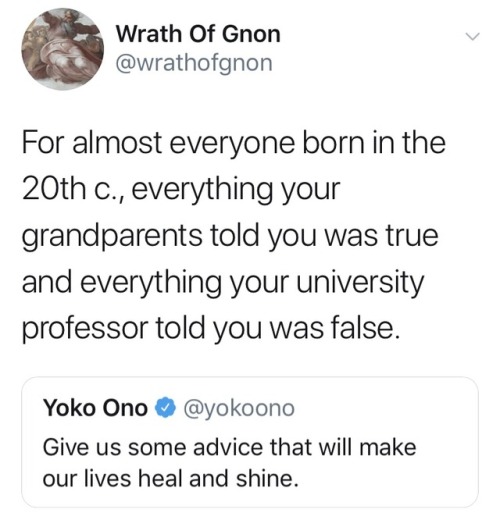
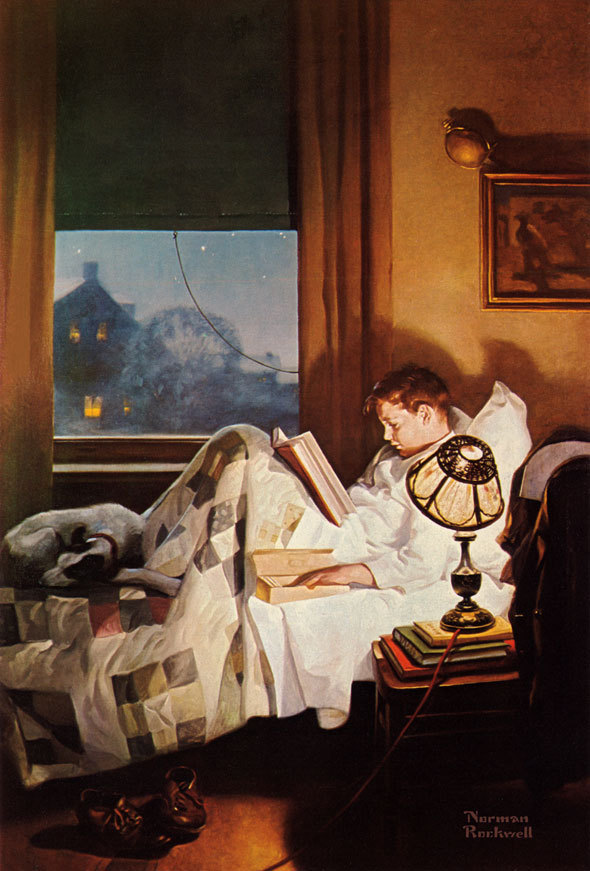
You can’t learn to write in college. It’s a very bad place for writers because the teachers always think they know more than you do—and they don’t. They have prejudices. They may like Henry James, but what if you don’t want to write like Henry James? They may like John Irving, for instance, who’s the bore of all time. A lot of the people whose work they’ve taught in the schools for the last thirty years, I can’t understand why people read them and why they are taught. The library, on the other hand, has no biases. The information is all there for you to interpret. You don’t have someone telling you what to think. You discover it for yourself.

Ray Bradbury, from The Paris Review, "The Art of Fiction, No. 203"

17 May 2023

Juice.


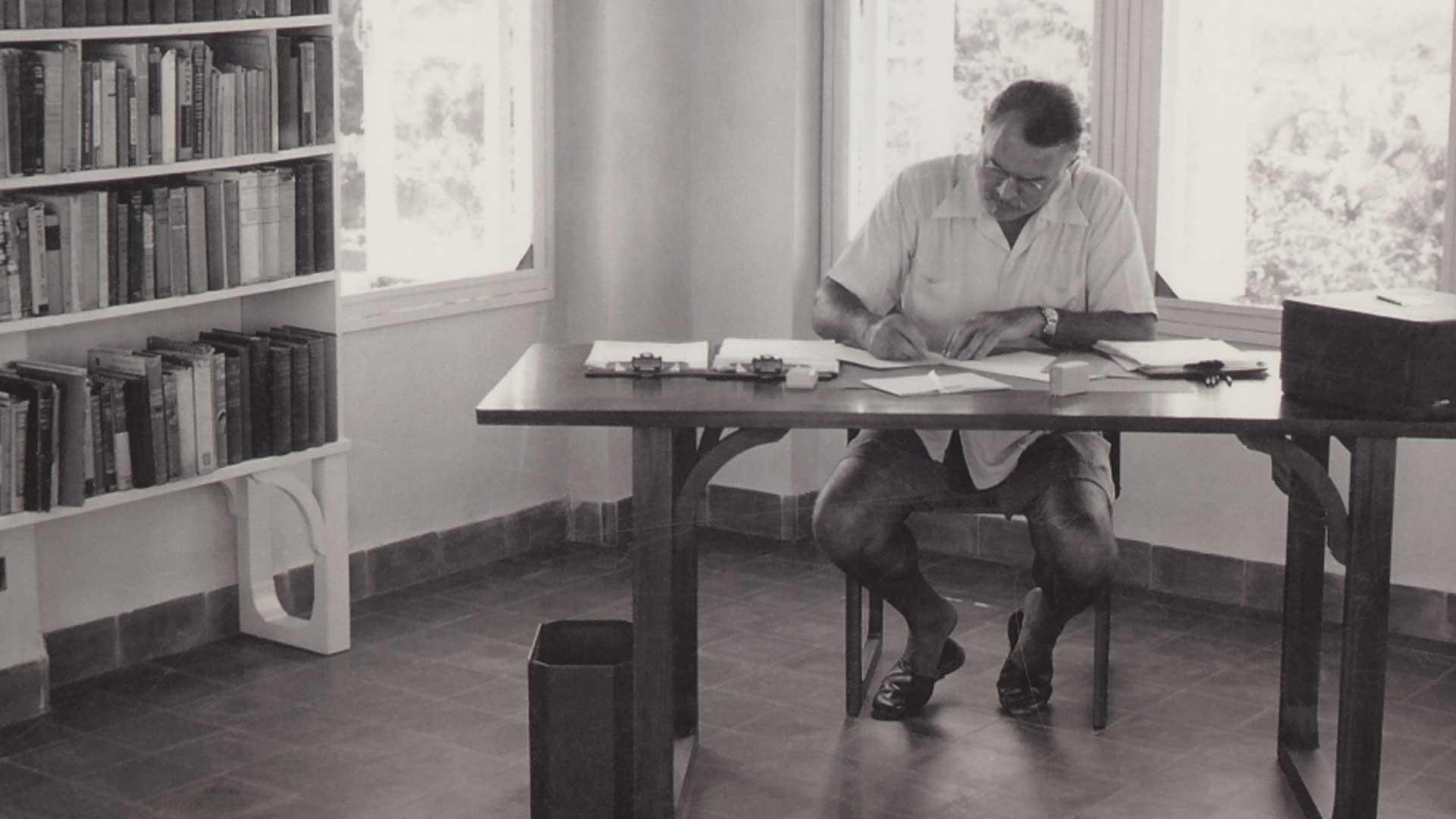
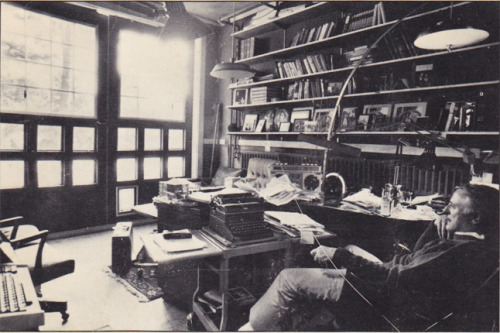
When I am working on a book or a story I write every morning as soon after first light as possible. There is no one to disturb you and it is cool or cold and you come to your work and warm as you write. You read what you have written and, as you always stop when you know what is going to happen next, you go on from there. You write until you come to a place where you still have your juice and know what will happen next and you stop and try to live through until the next day when you hit it again. You have started at six in the morning, say, and may go on until noon or be through before that. When you stop you are as empty, and at the same time never empty but filling, as when you have made love to someone you love. Nothing can hurt you, nothing can happen, nothing means anything until the next day when you do it again. It is the wait until the next day that is hard to get through.

04 May 2022

Flavors.


Fingers deep, I kneaded. Fighting the urge to be careless and quick, I kept the pace rhythmic, slow. Each squeeze, I hoped, would gently ease the flavors—knobby bits of garlic, finely chopped capers, smatterings of dry spices—into the marbled mound before me ...

19 December 2021

Choose.


Harold Bloom from his 1991 interview with The Paris Review ...
INTERVIEWER
How do you account historically for the school of resentment?

BLOOM
In the universities, the most surprising and reprehensible development came some twenty years ago, around 1968, and has had a very long-range effect, one that is still percolating. Suddenly all sorts of people, faculty members at the universities, graduate and undergraduate students, began to blame the universities not just for their own palpable ills and malfeasances, but for all the ills of history and society. They were blamed, and to some extent still are, by the budding school of resentment and its precursors, as though they were not only representative of these ills but, weirdly enough, as though they had somehow helped cause these ills and, even more weirdly, quite surrealistically, as though they were somehow capable of ameliorating these ills. It’s still going on—this attempt to ascribe both culpability and apocalyptic potential to the universities. It’s really asking the universities to take the place that was once occupied by religion, philosophy, and science. These are our conceptual modes. They have all failed us. The entire history of Western culture, from Alexandrian days until now, shows that when a society’s conceptual modes fail it, then willy-nilly it becomes a literary culture. This is probably neither good nor bad, but just the way things become. And we can’t really ask literature or the representatives of a literary culture, in or out of the university, to save society. Literature is not an instrument of social change or an instrument of social reform. It is more a mode of human sensations and impressions, which do not reduce very well to societal rules or forms.

INTERVIEWER
How does one react to the school of resentment? By declaring oneself an aesthete?

BLOOM
Well, I do that now, of course, in furious reaction to their school and to so much other pernicious nonsense that goes on. I would certainly see myself as an aesthete in the sense advocated by Ruskin, indeed to a considerable degree by Emerson, and certainly by the divine Walter and the sublime Oscar. It is a very engaged kind of mode. Literary criticism in the United States increasingly is split between very low level literary journalism and what I increasingly regard as a disaster, which is literary criticism in the academies, particularly in the younger generations. Increasingly scores and scores of graduate students have read the absurd Lacan but have never read Edmund Spenser; or have read a great deal of Foucault or Derrida but scarcely read Shakespeare or Milton. That’s obviously an absurd defeat for literary study. When I was a young man back in the fifties starting out on what was to be my career, I used to proclaim that my chosen profession seemed to consist of secular clergy or clerisy. I was thinking, of course, of the highly Anglo-Catholic New Criticism under the sponsorship or demigodness of T. S. Eliot. But I realized in latish middle age that, no better or worse, I was surrounded by a pride of displaced social workers, a rabblement of lemmings, all rushing down to the sea carrying their subject down to destruction with them. The school of resentment is an extraordinary sort of mélange of latest-model feminists, Lacanians, that whole semiotic cackle, latest-model pseudo-Marxists, so-called New Historicists, who are neither new nor historicist, and third generation deconstructors, who I believe have no relationship whatever to literary values. It’s really a very paltry kind of a phenomenon. But it is pervasive, and it seems to be waxing rather than waning. It is a very rare thing indeed to encounter one critic, academic or otherwise, not just in the English-speaking world, but also in France or Italy, who has an authentic commitment to aesthetic values, who reads for the pleasure of reading, and who values poetry or story as such, above all else. Reading has become a very curious kind of activity. It has become tendentious in the extreme. A sheer deliquescence has taken place because of this obsession with the methods or supposed method. Criticism starts—it has to start—with a real passion for reading. It can come in adolescence, even in your twenties, but you must fall in love with poems. You must fall in love with what we used to call “imaginative literature.” And when you are in love that way, with or without provocation from good teachers, you will pass on to encounter what used to be called the sublime. And as soon as you do this, you pass into the agonistic mode, even if your own nature is anything but agonistic. In the end, the spirit that makes one a fan of a particular athlete or a particular team is different only in degree, not in kind, from the spirit that teaches one to prefer one poet to another, or one novelist to another. That is to say there is some element of competition at every point in one’s experience as a reader. How could there not be? Perhaps you learn this more fully as you get older, but in the end you choose between books, or you choose between poems, the way you choose between people. You can’t become friends with every acquaintance you make, and I would not think that it is any different with what you read.

INTERVIEWER
Do you foresee any change, or improvement, in the critical fashions?

BLOOM
I don’t believe in myths of decline or myths of progress, even as regards to the literary scene. The world does not get to be a better or a worse place; it just gets more senescent. The world gets older, without getting either better or worse and so does literature. But I do think that the drab current phenomenon that passes for literary studies in the university will finally provide its own corrective. That is to say, sooner or later, students and teachers are going to get terribly bored with all the technocratic social work going on now. There will be a return to aesthetic values and desires, or these people will simply do something else with their time. But I find a great deal of hypocrisy in what they’re doing now. It is tiresome to be encountering myths called “The Social Responsibility of the Critic” or “The Political Responsibility of the Critic.” I would rather walk into a bookstore and find a book called “The Aesthetic Responsibilities of the Statesman,” or “The Literary Responsibilities of the Engineer.” Criticism is not a program for social betterment, not an engine for social change. I don’t see how it possibly could be. If you look for the best instance of a socially radical critic, you find a very good one indeed in William Hazlitt. But you will not find that his social activism on the left in any way conditions his aesthetic judgments, or that he tries to make imaginative literature a machine for revolution. You would not find much difference in aesthetic response between Hazlitt and Dr. Samuel Johnson on Milton, though Dr. Johnson is very much on the right politically, and Hazlitt, of course, very much an enthusiast for the French Revolution and for English radicalism. But I can’t find much in the way of a Hazlittian or Johnsonian temperament in life and literature anywhere on the current scene. There are so many tiresomenesses going on. Everyone is so desperately afraid of being called a racist or a sexist that they connive—whether actively or passively—the almost total breakdown of standards that has taken place both in and out of the universities, where writings by blacks or Hispanics or in many cases simply women are concerned.
Your marching orders ...

08 July 2021

Track.


He keeps track of his daily progress—“so as not to kid myself”—on a large chart made out of the side of a cardboard packing case and set up against the wall under the nose of a mounted gazelle head. The numbers on the chart showing the daily output of words differ from 450, 575, 462, 1250, back to 512, the higher figures on days Hemingway puts in extra work so he won’t feel guilty spending the following day fishing on the Gulf Stream.
31 January 2017

Incuriosity.


INTERVIEWER
You are one of the world’s most famous public intellectuals. How would you define the term intellectual? Does it still have a particular meaning? 

ECO
If by intellectual you mean somebody who works only with his head and not with his hands, then the bank clerk is an intellectual and Michelangelo is not. And today, with a computer, everybody is an intellectual. So I don’t think it has anything to do with someone’s profession or with someone’s social class. According to me, an intellectual is anyone who is creatively producing new knowledge. A peasant who understands that a new kind of graft can produce a new species of apples has at that moment produced an intellectual activity. Whereas the professor of philosophy who all his life repeats the same lecture on Heidegger doesn’t amount to an intellectual. Critical creativity—criticizing what we are doing or inventing better ways of doing it—is the only mark of the intellectual function.

INTERVIEWER
Are intellectuals today still committed to the notion of political duty, as they were in the days of Sartre and Foucault?

ECO
I don’t believe that in order to be politically committed an intellectual must act as a member of a party or, worse, write exclusively about contemporary social problems. Intellectuals should be as politically engaged as any other citizen. At most, an intellectual can use his reputation to support a given cause. If there is a manifesto on the environmental question, for instance, my signature might help, so I would use my reputation for a single instance of common engagement. The problem is that the intellectual is truly useful only as far as the future is concerned, not the present. If you are in a theater and there is a fire, a poet must not climb up on a seat and recite a poem. He has to call the fireman like everyone else. The function of the intellectual is to say beforehand, Pay attention to that theater because it’s old and dangerous! So his word can have the prophetic function of an appeal. The intellectual’s function is to say, We should do that, not, We must do this now!—that’s the politician’s job. If the utopia of Thomas More were ever realized, I have little doubt it would be a Stalinist society.

INTERVIEWER
What benefits have knowledge and culture afforded you in your lifetime?

ECO
An illiterate person who dies, let us say at my age, has lived one life, whereas I have lived the lives of Napoleon, Caesar, d’Artagnan. So I always encourage young people to read books, because it’s an ideal way to develop a great memory and a ravenous multiple personality. And then at the end of your life you have lived countless lives, which is a fabulous privilege.

INTERVIEWER
But an enormous memory can also be an enormous burden. Like the memory of Funes, one of your favorite Borges characters, in the story “Funes the Memorious.”

ECO
I like the notion of stubborn incuriosity. To cultivate a stubborn incuriosity, you have to limit yourself to certain areas of knowledge. You cannot be totally greedy. You have to oblige yourself not to learn everything. Or else you will learn nothing. Culture in this sense is about knowing how to forget. Otherwise, one indeed becomes like Funes, who remembers all the leaves of the tree he saw thirty years ago. Discriminating what you want to learn and remember is critical from a cognitive standpoint.

29 January 2017

Steam.


From John Garner, "The Art of Fiction," No. 73 ...

INTERVIEWER
Do you feel that literary techniques can really be taught? Some people feel that technique is an artifice or even a hindrance to “true expression.”

GARDNER
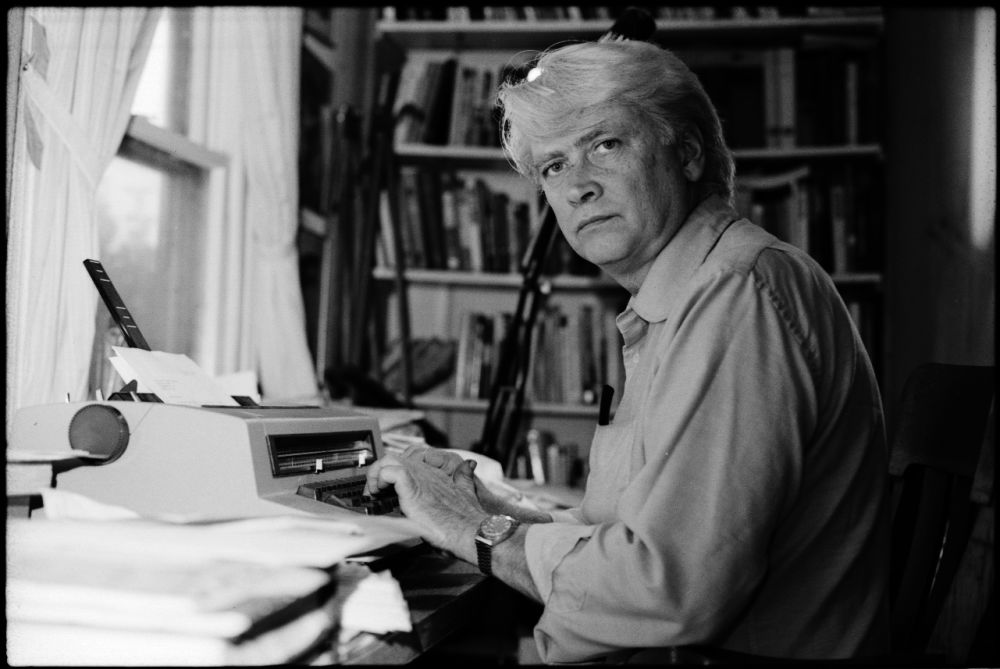
Certainly it can be taught. But a teacher has to know technique to teach it. I've seen a lot of writing teachers because I go around visiting colleges, visiting creative writing classes. A terrible number of awful ones, grotesquely bad. That doesn't mean that one should throw writing out of the curriculum; because when you get a good creative writing class it's magisterial. Most of the writers I know in the world don't know how they do what they do. Most of them feel it out. Bernard Malamud and I had a conversation one time in which he said that he doesn't know how he does those magnificent things he sometimes does. He just keeps writing until it comes out right. If that's the way a writer works, then that's the way he had to work, and that's fine. But I like to be in control as much of the time as possible. One of the first things you have to understand when you are writing fiction—or teaching writing—is that there are different ways of doing things, and each one has a slightly different effect. A misunderstanding of this leads you to the Bill Gass position: that fiction can't tell the truth, because every way you say the thing changes it. I don't think that's to the point. I think that what fiction does is sneak up on the truth by telling it six different ways and finally releasing it. That's what Dante said, that you can't really get at the poetic, inexpressible truths, that the way things are leaps up like steam between them. So you have to determine very accurately the potential of a particular writer's style and help that potential develop at the same time, ignoring what you think of his moral stands.
I hate nihilistic, cynical writing. I hate it. It bothers me, and worse yet, bores me. But if I have a student who writes with morbid delight about murder, what I'll have to do (though of course I'll tell him I don't like this kind of writing, that it's immoral, stupid, and bad for civilization), is say what is successful about the work and what is not. I have to swallow every bit of my moral feelings to help the writer write his way, his truth. It may be that the most moral writing of all is writing that shows us how a murderer feels, how it happens. It may be it will protect us from murderers someday.