Showing posts with label tactics. Show all posts
Showing posts with label tactics. Show all posts
14 July 2025


03 July 2025
Preserve.

On this date, at this hour, in 1863, approximately 11,500 Confederates under James Longstreet's command stepped off from Seminary Ridge to begin Pickett's Charge against the center of George Meade's Union army on Cemetery Ridge.
For every Southern boy fourteen years old, not once but whenever he wants it, there is the instant when it's still not yet two o'clock on that July afternoon in 1863, the brigades are in position behind the rail fence, the guns are laid and ready in the woods and the furled flags are already loosened to break out and Pickett himself with his long oiled ringlets and his hat in one hand probably and his sword in the other looking up the hill waiting for Longstreet to give the word and it's all in the balance, it hasn't happened yet, it hasn't even begun yet, it not only hasn't begun yet but there is still time for it not to begin against that position and those circumstances which made more men than Garnett and Kemper and Armistead and Wilcox look grave yet it's going to begin, we all know that, we have come too far with too much at stake and that moment doesn't need even a fourteen-year-old boy to think This time. Maybe this time with all this much to lose than all this much to gain: Pennsylvania, Maryland, the world, the golden dome of Washington itself to crown with desperate and unbelievable victory the desperate gamble, the cast made two years ago; or to anyone who ever sailed a skiff under a quilt sail, the moment in 1492 when somebody thought This is it: the absolute edge of no return, to turn back now and make home or sail irrevocably on and either find land or plunge over the world's roaring rim.
William Faulkner, from Intruder in the DustThe description of Pickett's Charge from Ken Burns', The Civil War ...
/https://tf-cmsv2-smithsonianmag-media.s3.amazonaws.com/filer/Civil-War-commemoration-Picketts-charge-631.jpg)
“Comrades of the Army of the Potomac,” he began, “The first thing I shall do, which we ought to do…is to return our thanks to the Great Being who, in His infinite mercy, has allowed us to be here, to enjoy the pleasures of this meeting, who has blessed us and spared us through all the dangers of the war.”
Reconciliation; unification; a re-examination of the whys and wherefores of the greatest conflict in American history: All of these would be themes of later Civil War reunions and observances, leading up to the current 150th commemoration. What those veterans celebrated in the first major anniversary of the war was the simple fact that they had made it through alive.
“There was a desire among soldiers on both sides to bring moral clarity and purpose to what they had just experienced,” says Peter Carmichael, director of the Civil War Institute at Gettysburg College. “We cannot forget that especially for Northern soldiers their celebration of Union meant something deep to them. They went to war to preserve the Union.”
03 July 2024
Preserved.
On this date, at this hour, in 1863, approximately 11,500 Confederates under James Longstreet's command stepped off from Seminary Ridge to begin Pickett's Charge against the center of George Meade's Union army on Cemetery Ridge.
For every Southern boy fourteen years old, not once but whenever he wants it, there is the instant when it's still not yet two o'clock on that July afternoon in 1863, the brigades are in position behind the rail fence, the guns are laid and ready in the woods and the furled flags are already loosened to break out and Pickett himself with his long oiled ringlets and his hat in one hand probably and his sword in the other looking up the hill waiting for Longstreet to give the word and it's all in the balance, it hasn't happened yet, it hasn't even begun yet, it not only hasn't begun yet but there is still time for it not to begin against that position and those circumstances which made more men than Garnett and Kemper and Armistead and Wilcox look grave yet it's going to begin, we all know that, we have come too far with too much at stake and that moment doesn't need even a fourteen-year-old boy to think This time. Maybe this time with all this much to lose than all this much to gain: Pennsylvania, Maryland, the world, the golden dome of Washington itself to crown with desperate and unbelievable victory the desperate gamble, the cast made two years ago; or to anyone who ever sailed a skiff under a quilt sail, the moment in 1492 when somebody thought This is it: the absolute edge of no return, to turn back now and make home or sail irrevocably on and either find land or plunge over the world's roaring rim.
William Faulkner, from Intruder in the DustThe description of Pickett's Charge from Ken Burns', The Civil War ...
From Smithsonian Magazine ...
“Comrades of the Army of the Potomac,” he began, “The first thing I shall do, which we ought to do…is to return our thanks to the Great Being who, in His infinite mercy, has allowed us to be here, to enjoy the pleasures of this meeting, who has blessed us and spared us through all the dangers of the war.”CONNECT
Reconciliation; unification; a re-examination of the whys and wherefores of the greatest conflict in American history: All of these would be themes of later Civil War reunions and observances, leading up to the current 150th commemoration. What those veterans celebrated in the first major anniversary of the war was the simple fact that they had made it through alive.
“There was a desire among soldiers on both sides to bring moral clarity and purpose to what they had just experienced,” says Peter Carmichael, director of the Civil War Institute at Gettysburg College. “We cannot forget that especially for Northern soldiers their celebration of Union meant something deep to them. They went to war to preserve the Union.”
19 April 2024
Spirit.
Pyle, The Fight on Lexington Common, April 19, 1775, 1898

The American Revolution began on this morning in 1775.
CONCORD HYMN
By the rude bridge that arched the flood,
Their flag to April’s breeze unfurled,
Here once the embattled farmers stood
And fired the shot heard round the world.
The foe long since in silence slept;
Alike the conqueror silent sleeps;
And Time the ruined bridge has swept
Down the dark stream which seaward creeps.
On this green bank, by this soft stream,
We set today a votive stone;
That memory may their deed redeem,
When, like our sires, our sons are gone.
Spirit, that made those heroes dare
To die, and leave their children free,
Bid Time and Nature gently spare
The shaft we raise to them and thee.
Ralph Waldo Emerson
Further ...
- The American Battlefield Trust explains … HERE.
- Imagining the Battle of Lexington, a look at the artist depictions of the first battle of the American Revolution … HERE.
- Concord Museum: The Shot Heard Round the World: April 19, 1775
- The American Revolution in Four Minutes: Lexington and Concord
01 April 2024
12 November 2023
Carnyx.
John Kenny plays a replica of the Deskford carnyx, an Iron Age war trumpet dating from 80-200 AD.
18 October 2023

05 July 2023

17 June 2023
Spirited.
Riley, The Battle of Bunker Hill, N/d
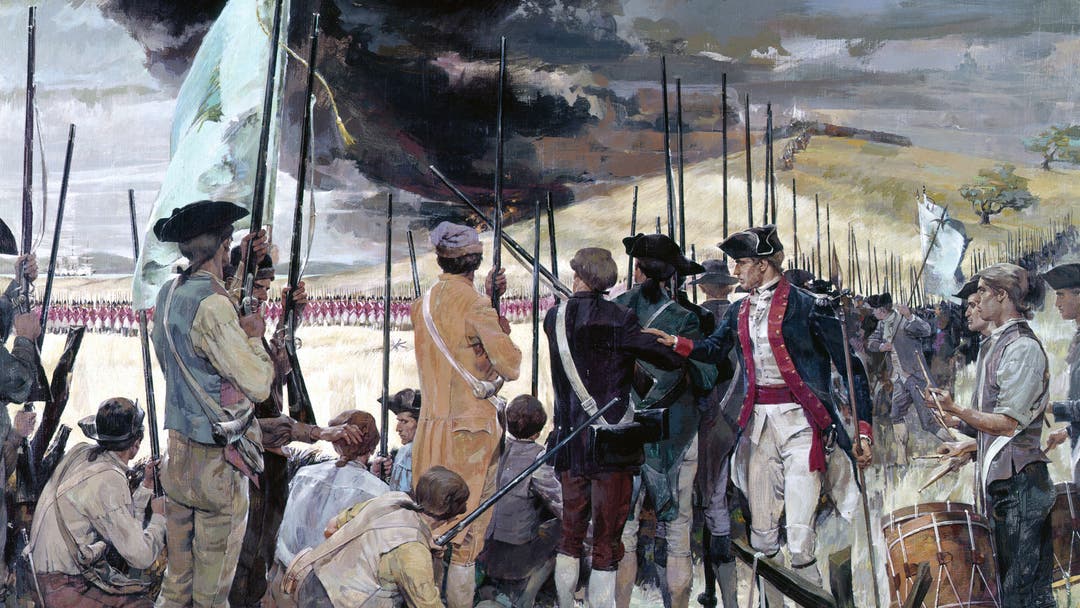
The Battle of Bunker Hill was fought on this day in 1775.
As always, American Battlefield Trust nails it ...
On this sultry afternoon, Gage and his commanders order British regulars and grenadiers to move across Boston Harbor and disembark in lower Charlestown, where Gage will force the rabble’s hand with an assault. As the British move into position, the fatigued but spirited defenders are on the alert inside their hastily built fortifications.Led by Gen. William Howe, King George’s troops climb Breed’s Hill in perfect battle formation. Legend has it that as they advance, American officer William Prescott cautions his men not to waste their powder, exclaiming “don’t fire until you see the whites of their eyes” ...
10 June 2023
Confident.

On this day in 1864, Nathan Bedford Forrest was getting work done in the woods ...
Forrest was confident, as always, despite the fact that the enemy held close to a two-to-one advantage in numbers and nearly three times as many guns. “I know they greatly outnumber the troops I have at hand,” he told Rucker, who rode with him in advance of his brigade, “but the road along which they will march is narrow and muddy; they will make slow progress. The country is densely wooded and the undergrowth so heavy that when we strike them they will not know how few men we have. Their cavalry will move out ahead of their infantry, and should reach the crossroads three hours in advance. We can whip their cavalry in that time. As soon as the fight opens they will send back to have the infantry hurried in. It is going to be hot as hell, and coming on the run for five or six miles, their infantry will be so tired out we will ride right over them.”
.jpg?itok=tLdKFS6U)
Don't miss the description of this battle in Chapter One of Confederate Wizards of the Saddle.
22 December 2022
Present.
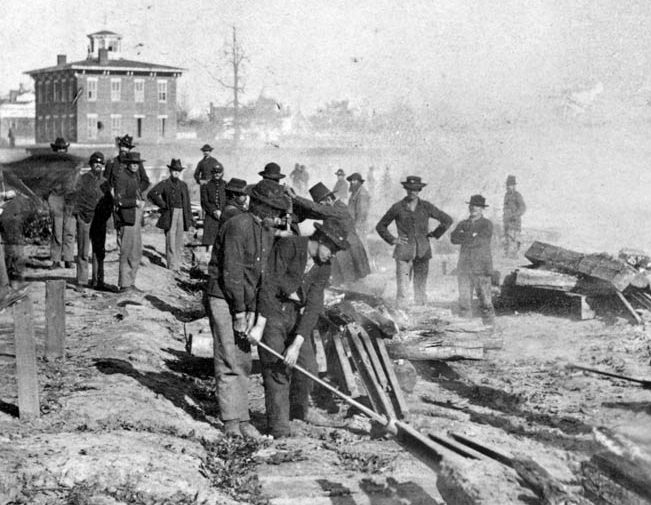
On this day n 1864, following his successful march across Georgia, Union General William T. Sherman sent President Abraham Lincoln this message: “I beg to deliver you as a Christmas present, the city of Savannah.”
08 August 2022

02 July 2022
Ponder.

In great deeds, something abides. On great fields, something stays. Forms change and pass; bodies disappear; but spirits linger, to consecrate ground for the vision-place of souls Generations that know us not and that we know not of, heart-drawn to see where and by whom great things were suffered and done for them, shall come to this deathless field, to ponder and dream; and lo! the shadow of a mighty presence shall wrap them in its bosom, and the power of the vision pass into their souls.
Joshua Lawrence Chamberlain, who directed the defense of Little Round Top during the battle of Gettysburg on this day in 1863
04 January 2022

09 December 2021
24 November 2021

21 November 2021
06 November 2021
Irresistible.
Reynolds, General John Burgoyne, 1766

The onset of bayonets in the hands of the valiant is irresistible.
General John Burgoyne
01 October 2020
01 July 2020
Trouble.
Pierce, Stevens' Knoll, Gettysburg, Pennsylvania, 1 July 1863, 1863

The Battle of Gettysburg began on this date in 1865.
Longstreet considered Chancellorsville the kind of flashy spectacle the South could ill afford. Facing what Lincoln called 'the arithmetic', he perceived that four more such battles, in which the Confederates were outnumbered two to one and inflicted casualties at a rate of three for four, would reduce Lee's army to a handful, while Hooker would be left with the number Lee had had at the outset. The style he preferred had the Confederates taking up a strong defensive position against which the superior blue forces were shattered, like waves against a rock. Longstreet listened with disapproval as Lee announced his intention to launch an offensive in the East. He protested but Lee's mind was made up. So Longstreet contented himself with his theory that the proposed invasion be conducted in accordance with his preference for receiving rather than delivering attack when the two armies came to grips, wherever that might be. As he put it later, quite as if he and Lee had been joint commanders of the army, "I then accepted his proposition to make a campaign into Pennsylvania, provided it should be offensive in strategy but defensive in tactics, forcing the Federals to give us battle when we were in strong position and ready to receive them."
Lee heard him out with the courtesy which he was accustomed to extend to all subordinates, but which in this case was mistaken for a commitment. He intended no such thing, of course... trouble was stored up for all involved.
Shelby Foote, from Stars in Their Courses: The Gettysburg Campaign
The American Battlefield Trust's exceptional animated map of Gettysburg ...
Shelby Foote's thoughts on the battle ...
The Battle of Gettysburg began on this date in 1865.
Longstreet considered Chancellorsville the kind of flashy spectacle the South could ill afford. Facing what Lincoln called 'the arithmetic', he perceived that four more such battles, in which the Confederates were outnumbered two to one and inflicted casualties at a rate of three for four, would reduce Lee's army to a handful, while Hooker would be left with the number Lee had had at the outset. The style he preferred had the Confederates taking up a strong defensive position against which the superior blue forces were shattered, like waves against a rock. Longstreet listened with disapproval as Lee announced his intention to launch an offensive in the East. He protested but Lee's mind was made up. So Longstreet contented himself with his theory that the proposed invasion be conducted in accordance with his preference for receiving rather than delivering attack when the two armies came to grips, wherever that might be. As he put it later, quite as if he and Lee had been joint commanders of the army, "I then accepted his proposition to make a campaign into Pennsylvania, provided it should be offensive in strategy but defensive in tactics, forcing the Federals to give us battle when we were in strong position and ready to receive them."
Lee heard him out with the courtesy which he was accustomed to extend to all subordinates, but which in this case was mistaken for a commitment. He intended no such thing, of course... trouble was stored up for all involved.
Shelby Foote, from Stars in Their Courses: The Gettysburg Campaign
The American Battlefield Trust's exceptional animated map of Gettysburg ...
Shelby Foote's thoughts on the battle ...
Subscribe to:
Posts (Atom)