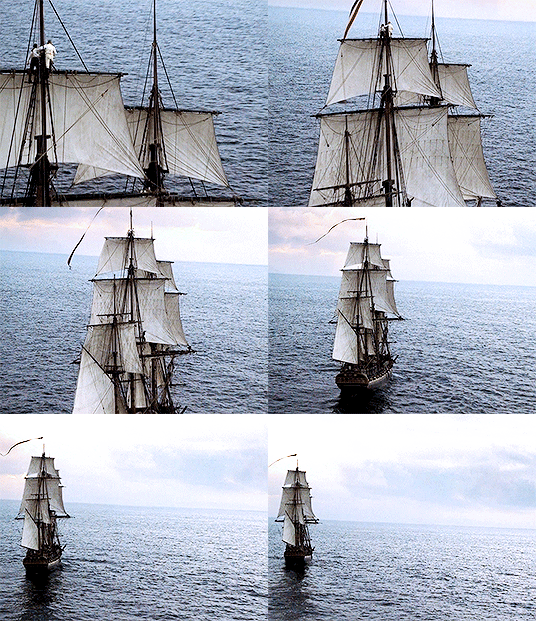
"I am not one who was born in the custody of wisdom. I am one who is fond of olden times and intense in quest of the sacred knowing of the ancients." Gustave Courbet

14 June 2012

Play.


While it is ultimately up to parents how best to deal with the risks to their children, it is worth asking the question whether the pendulum has swung too far. As children withdrew from public spaces, those spaces became less safe – not more. And the withdrawal became habitual. Hence, children between grades 6 and 12 spend an average of seven hours 48 minutes on various screens each day. Horrifying, if true. And not without risks, whether from the health problems associated with a sedentary life, cyberbullying or even pedophiles reaching through their screens. But more than all that, how do we quantify the more subtle risk of losing spontaneous play from childhood? It is not a catastrophic risk – but it’s close.

Read the rest of "The Loss of Spontaneous Play From Childhood" here.

This year an interesting thing started happening in my class. I've never experienced it before -- fifth grade students didn't want to go outside for recess. Recess was becoming "a pain" to them. "Do we have to go out for recess?" they would whine. "It's either that or stay in here and listen to my bluegrass music," would be my reply. That usually did the trick. So would walking out with them to the the treeline and and exploring the small wonders of the woods or stretching out in the grass, staring up at the cloud architecture above and asking questions like a scientist or an artist would ask. Later, these activities were the fertilizer for great pieces written by these same reluctant kids.

My point is that kids need guidance. Kids have a fire inside of them. They need a trail guide to show them the glories at their feet. They need to be taught.

My dad used to say, "Get outside." He said this not so that he could have some peace and quiet or take a nap (which he probably wanted to do and certainly deserved). He said it so that we would grow in the appreciation of ourselves and our surroundings, so that we would be physically, mentally, and spiritually healthy. Trees in our woods had names that came from a great deal of time contemplating their shape and personality. One night after my sister and I had already been to bed, dad brought the news that school had been cancelled for the next day, and within minutes we were excitedly traipsing through those same woods "looking for Redcoat camps." Throughout the night we evaded the British sentries by diving beneath the thousands of Christmas trees that filled the neighboring farm, sustained only by mom's Christmas cookies with which dad had filled the pockets of his o.d. green field coat.

Kids need a role model, a guide, an inspiration. Kids need a parent. Nothing is more important.

Zephyr.

This year I read aloud many stories to my students ... The Halloween Tree, The Legend of Sleepy Hollow, The Little Prince, The Invention of Hugo Cabret, The Hobbit, Potowatomi Indian Summer, The Wind In The Willows, "To Build a Fire" ...

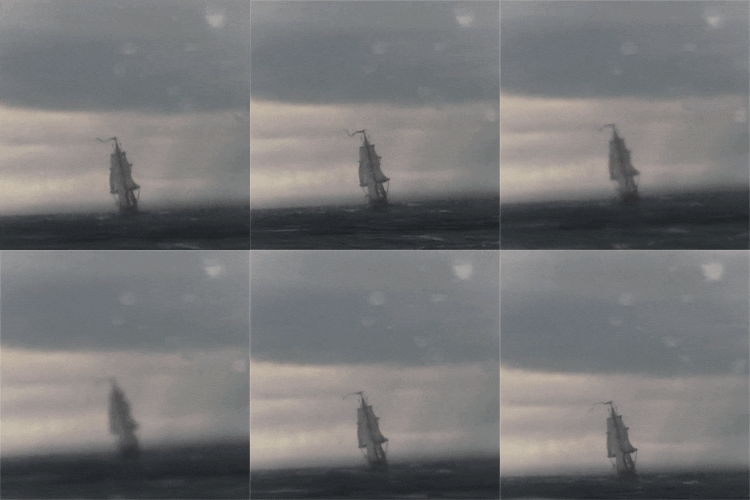
Chris Van Allsburg's The Wreck of The Zephyr was one of their favorites.

Part 1 ...


Part 2 ...


Van Allsburg's site is here.

I had a great year and I really miss my class.

Contemplate.


And when we view a flag, which to the eye is beautiful, and to contemplate its rise and origin inspires a sensation of sublime delight, our national honor must unite with our interests to prevent injury to the one, or insult to the other.

- Thomas Paine

13 June 2012

David Francey, "Yesterday's News"

A mindful reminder ...

Drunk.

Fermentation.


The list of fermented food in our lives is staggering: bread, coffee, pickles, beer, cheese, yogurt and soy sauce are all transformed at some point during their production process by microscopic organisms that extend their usefulness and enhance their flavors.

The process of fermenting our food isn't a new one: Evidence indicates that early civilizations were making wine and beer between 7,000 and 8,000 years ago — and bread even before that.

But was exactly is fermentation? And how does it work?


Read the rest at NPR.

Storylike.

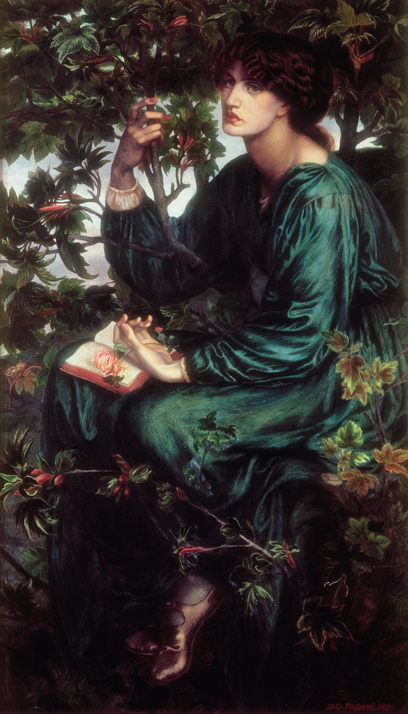
Rossetti, The Day Dream, 1880


Clever scientific studies involving beepers and diaries suggest that an average daydream is about fourteen seconds long and that we have about two thousand of them per day. In other words, we spend about half of our waking hours — one-third of our lives on earth — spinning fantasies. We daydream about the past: things we should have said or done, working through our victories and failures. We daydream about mundane stuff such as imagining different ways of handling conflict at work. But we also daydream in a much more intense, storylike way.

Read the rest at Brain Pickings.

Luka Bloom, "This Is The Sea"

Now I hear there's a train
It's coming on down the line
It's yours if you hurry
You've got still enough time
And you don't need no ticket
And you don't pay no fee
No you don't need no ticket
You don't pay no fee
Because that was the river
And this is the sea!


Experiencing.


To claim that a particular technology has one unique effect, either positive or negative, is to reduce both historically and conceptually the complex causal nexus within which humans and technologies interact and shape each other. Carr’s recent and broadly well-received arguments wondering if Google makes us stupid, for example, rely on a historical parallel that he draws with print. He claims that the invention of printing “caused a more intensive” form of reading and, by extrapolation, print caused a more reflective form of thought—words on a page focused the reader.

Historically speaking, this is hyperbolic techno-determinism. Carr assumes that technologies simply “determine our situation,” independent of human persons, but these very technologies, methods, and media emerge from particular historical situations with their own complex of factors. Carr relies on quick allusions to historians of print to bolster his case and inoculate himself from counter-arguments, but the historian of print to whom he appeals, Elizabeth L. Eisenstein, warns that “efforts to summarize changes wrought by printing in any simple or single formula are likely to lead us astray.”

Arguments like Carr’s—and I focus on him because he has become the vocal advocate of this view—also tend to ignore the fact that, historically, print facilitated a range of reading habits and styles. Francis Bacon, himself prone to condemning printed books, laid out at least three ways to read books: “Some books are to be tasted, others to be swallowed, and some few to be chewed and digested.” As a host of scholars have demonstrated of late, different ways of reading co-existed in the print era. Extensive or consultative forms of reading—those that Carr might describe as distracted or unfocused—existed alongside more intensive forms of reading—those that he might describe as deep, careful, prolonged engagements with particular texts in the Enlightenment. Eighteenth-century German Pietists read the Bible very closely, but they also consistently consulted Bible concordances and Latin encyclopedias. Even the form of intensive reading held up today as a dying practice, novel reading, was often derided in the eighteenth century as weakening the memory and leading to “habitual distraction,” as Kant put it. It was thought especially dangerous to women who, according to Kant, were already prone to such lesser forms of thought. In short, print did not cause one particular form of reading; instead, it facilitated a range of ever-newer technologies, methods, and innovations that were deeply interwoven with new forms of human life and new ways of experiencing the world.

The problem with suggestions that Google makes us stupid, smart, or whatever else we might imagine, however, is not just their historical myopia. Such reductions elide the fact that Google and print technology do not operate independently of the humans who design, interact with, and constantly modify them, just as humans do not exist independently of technologies. By focusing on technology’s capacity to determine the human (by insisting that Google makes us stupid, that print makes us deeper readers), we risk losing sight of just how deeply our own agency is wrapped up with technology. We forego a more anthropological perspective from which we can observe “the activity of situated people trying to solve local problems.” To emphasize a single and direct causal link between technology and a particular form of thought is to isolate technology from the very forms of life with which it is bound up.


Read the rest at The Hedgehog Review. Thank you, Arts & Letters Daily.

Always.


The kitchen clock, my watch, the pips from the radio peeping the hour, preside over my hurry, your hurry, the hurry of widening rings of friends and strangers who soften and domesticate the infinite hard clockwork of the universe. Thus our orchestrated lives may be being emptied even as they are being enriched. The ever-greater efficiency of an ever-more-intimately-clocked world adds to our opportunities, but it also drives a positive feedback cycle in which we demand more of the world and the world demands more of us. This quickening of pace is evident in every aspect of our lives. We supplement the treadmill of work with a treadmill of pleasure – hurry seems to be a constant condition, even if the hurry is to catch a plane to go on holiday, to arrive at a concert on time, or to honour an engagement whose sole purpose is for a casual get-together. We are forever on the edge of being late, and any dereliction in this respect causes us anguish: we are mortified, and the others are impatient.

Read the rest at Philosophy Now. Thank you, Arts & Letters Daily.

I prefer Harrison's perspective ...

The clock stopped at 5:30
for three months.
Now it's always time to quit work,
have a drink, cook dinner.

Happy Birthday, Yeats.


William Butler Yeats was born on this date in 1865.

The Lake Isle of Innisfree

I will arise and go now, and go to Innisfree,
And a small cabin build there, of clay and wattles made;
Nine bean-rows will I have there, a hive for the honey-bee,
And live alone in the bee-loud glade.

And I shall have some peace there, for peace comes dropping slow,
Dropping from the veils of the morning to where the cricket sings;
There midnight’s all a glimmer, and noon a purple glow,
And evening full of the linnet’s wings.

I will arise and go now, for always night and day
I hear lake water lapping with low sounds by the shore;
While I stand on the roadway, or on the pavements grey,
I hear it in the deep heart’s core.

- W.B. Yeats

Mike Scott, from his album An Appointment with Mr. Yeats

12 June 2012

Trend.


Ten extraordinary years of art history - the Impressionists, Neo - Impressionists and Post - Impressionists were responsible for a revolution in color. Within this colour trend visualisation, each chart represents an individual painting with the five most prominent colours shown proportionally.

Take a closer look at Visually.

Self-contained.


File this one under The Lazy Person’s Kitchen Innovations You (Probably) Never Knew Existed. Way back in 1858, Mr. John Landis Mason, the Scottish farmer who patented this eponymous glass canning jar, had the remarkable foresight to make the thread count of the jar’s neck match of a blender bottom cap. (Actually, it was probably the other way around, given that electric drink mixers, the precursor to the household blender, didn’t come about until 1921.)

Anyway, no need to get out the goggles for this ultra-simple hack: Simply screw a blender bottom onto the top of a jar, careful so the rubber gasket doesn’t fall into the spinning blade when you hit “Pulse,” and you’ve got a self-contained unit for smoothies, spice mixes, or piña coladas.


Marvel at more Mason Jar modernity at Popular Science.

United.


Here is acclaimed architect Christopher Alexander's four-volume masterwork: the result of 27 years of research and a lifetime of profoundly original thinking.

Alexander has advanced a new theory of architecture, matter, and organization, that has attracted thousands of readers and practical followers throughout the world. His grasp of the fundamental truths of traditional ways of building, and his understanding of what gives life and beauty and true functionality to towns and buildings, is put forth in a context that sheds light on the character of order in all phenomena. Taken even further, hundreds of examples are given to show how the theory has been put to use in his many projects around the world.

The four books of The Nature of Order redefine architecture for the 21st century as a field, as a profession, as practice and as social philosophy. Each of the books deals with one facet of the discipline. This worldview provides architecture with a new underpinning, describing procedures of planning, design, and building, as well as attitudes to style, to the shapes of buildings, and to the forms of urbanization and construction. Here is an entirely new way of thinking about the world. As one writer has expressed it, "The books provide the language for the construction and transition to a new kind of society, rooted in the nature of human beings."

Taken as a whole the four books create a sweeping new conception of the nature of things which is both objective and structural (hence part of science) - and also personal (in that it shows how and why things have the power to touch the human heart). A step has been taken, through which these two domains - the domain of geometrical structure and the feeling it creates - kept separate during four centuries of scientific thought, have finally been united.


Christopher Alexander's website for The Nature of Order is here.

Privacy.

Young, Private Shore, 2012


A storm felt likely, and the winds provided privacy ...

Go looking.

Listen.


Inviting the Bell

The bell is perhaps the best known aspect of "the art of mindful living." Inviting the bell to sound--we never say strike or hit the bell-- is a deep practice. Here, Thich Nhat Hanh gently and playfully instructs us. Please enjoy your breathing as you read.

"I'd like to teach you how to practice with the bell, because it is very important to practice with the bell, very pleasant also. There are all sorts of bells, and this is about the smallest kind of bell. This bell also has a cushion to sit on. This is a mini-bell. If you look at the bell, you see that it has also a cushion under it. So a practitioner may like to learn how to invite the bell to sound, because when we hear the sound of the bell we can also cross to the other shore. When you are angry, when you are sad, when you are agitated you are on this shore, but if you hear the sound of the bell, and if you know how to practice listening to the bell, then very quickly you can overcome your anger, your agitation. You cross over to the other shore, and suddenly you feel peaceful and happy. You need only to listen to the bell and breathe in and out a few times to find yourself on the other shore, the shore of peace, which is more pleasant. Every one of us can learn, it is very easy.

"You may like to keep the bell on its cushion like this in order to invite the bell to sound. We don´t say hitting the bell, because that word is not nice,or striking the bell. But we say invite the bell to sound. "Bell, my dear bell, may I invite you to sound." That's very nice. The bell becomes a kind of friend. So with you left hand you hold the bell like this and with you right hand you hold the bell inviter. You may call it a stick, but here we call it the bell inviter. And we say "the bell is invited" or "you invite the bell."

"There are many of us who don´t need the cushion. We put the bell directly on the palm of our hand, and by doing so we notice the sound will be more beautiful. You ask why? Because when we put the bell on the cushion, quite a large surface of the bell is touched by the cushion. The sound is all right, but if you put it without the cushion, the sound will be better. Suppose I hold the bell like this. The bell is not very free, that is why the sound of the bell isn´t beautiful. See:

[Bell]

"When the bell is free, the sound of the bell will be more beautiful. That is why in Plum Village, we like to put the bell like this on our hand in order for the bell to be as free as possible. When we invite the bell the sound will be beautiful. Before you invite the bell to sound, you have to bow to the bell first. Why do we have to bow to the bell? Maybe people will say that it´s strange, why is this person bowing to a bell? It´s queer. You may just look at the bell and say "Hello bell," that´s all right too. Bowing to the bell is a way of greeting a bell. You can greet the bell with a smile. You can greet the bell with a few words: "Hello there, my little bell, my darling little bell."

"You can greet the bell in several ways. There are people who would like to greet the bell by bowing like this, so it´s up to you to choose. So when you hold the stick, the bell inviter, you have to practice breathing in and breathing out three times, so that you become a real bell master. A real bell master is someone who is concentrated. The body and the mind together, and that is our practice. So even before we invite the bell to sound, we become already calmer and happier. You may like to breathe in and pay attention to your in-breath and breathe out and pay attention to your out-breath. You breath in and breathe out like that three times. Now you have become concentrated, you have become a bell master. When you know that you are a bell master, you can begin to invite the bell.

"I think today everyone has to practice, no matter how young you are. We should learn how to invite the bell. This is very important. To invite the bell you have to wake the bell up, like this. [Muffled bell] This is the waking up sound. Why do we have to wake the sound of the bell up first? Because we don´t want the bell to be caught by surprise. We don´t want the people around us to be caught by surprise. We want to warn people that a big sound of the bell will be heard. That is why we begin by waking up the bell like this.

[Muffled bell]

"Everyone knows that they will hear a real sound of the bell in just a few seconds. So you prepare people. You give people the opportunity to stop thinking, to stop talking, to prepare themselves for receiving the sound of the bell. So you allow them about five or six seconds, or even more like this.

[Muffled bell]

"Then you invite the bell.

[Bell]

"So we distinguish between the two sounds, the first is the waking up sound, and the second is the full sound, remember? To produce the waking up sound you have to keep the inviter like this.

[Muffled bell]

"You don´t take it off, like this.

[Bell]

"You breathe in. Everyone knows that a full sound is going to be heard, so everyone stops thinking and begins to smile to receive the sound of the bell. When the full sound is heard, you practice breathing in and you recite a short poem.

"I listen, I listen," that´s when you breathe in. And when you breathe out, "This wonderful sound brings me back to my true home." My true home is in here, where I can find peace and stability and joy. So we have to learn by heart this short poem:

"Listen, listen, This wonderful sound brings me back to my true home

"'Listen, listen,' that is for your in-breath. 'This wonderful sound brings me back to my true home,' that is for your out-breath. You breathe in and breathe out three times like that before you invite the second sound.Everyone in the hall will be practicing with you, and enjoying breathing in, breathing out and listening to the bell. After having practice three sounds like that, you become much better, you are calmer, you are more stable, you are more joyful. That is the practice of calming.

"I think I am going to lend you this bell, the young people, and you have time to practice this morning and this afternoon, also. I have a few. I would recommend that before you practice inviting the bell, you look at the bell, you bow to the bell, and you say 'Hello bell.' You pick it up and you put in on your left hand like this. You raise your hand to the level of your eyes. This is a very beautiful movement. You look at the bell like that. You breathe in, breathe out, and you smile three times. You know in Plum Village we have a beautiful poem to recite silently when we look at the bell and breathe in and breathe out. This poem is like this:

"Body, speech and mind in perfect oneness.
I send my heart along with the sound of the bell.
May the hearers awaken from their forgetfulness
And transcend all anxiety and sorrow.

"Now I am waking up the bell.

[Muffled bell].

"Now I am inviting the bell.

[Bell]

"Listen, listen, this wonderful sound brings me back to my true home.
Listen, listen this wonderful sound brings me back to my true home.

Listen, listen, this wonderful sound brings me back to my true home.

"Now I invite the second sound.

[Bell]

"Listen, listen, this wonderful sound brings me back to my true home.
Listen, listen, this wonderful sound brings me back to my true home.
Listen, listen,this wonderful sound brings me back to my true home.

"Now I invite the third sound.

[Bell]

"Listen, listen, this wonderful sound brings me back to my true home.
Listen,listen, this wonderful sound brings me back to my true home.
Listen, listen, this wonderful sound brings me back to my true home.

"I have completed three sounds and I have breathed in and breathed out nine times. I slowly lower the bell and I put it on the cushion. I bow to it again. I have accomplished the task of being your bell master. This is for the small bell, for the big bell it is a little bit different, but we will learn later.

"What is the purpose of practicing the bell? Practicing the bell is one of the ways to help us cross to the other shore. When you are angry, when you are unhappy, when you are agitated, you don´t like to be on the shore of anger, agitation and unhappiness. So you invite the bell to bring your body and your mind together, to get still, to get calm, to get peaceful. And while you practice breathing in and out and listening to the bell, you are crossing the river of suffering. You go to the other shore, the shore of peace and of happiness.

"It is my hope that in every home we have a bell, so that you can practice crossing to the other shore together as a family. In Plum Village we practice also when we hear the telephone ringing. If you observe, you see that every time the telephone rings, the brothers and sisters in Plum Village practice breathing in and out, calming and smiling exactly like when they hear the bell. So the telephone sound becomes a kind of bell for us. We also practice with other sounds as well. When the clock, every hour or every quarter of the hour, plays the music, the monks, the nuns, and other people in Plum Village, they stop talking, they stop thinking and they go back to their breathing. They practice mindful breathing, and they feel calm, they feel happy. They are close to the shore of happiness and peace. I think there will be brothers and sisters that will help you to learn how to practice the bell today. I hope that after tomorrow you will be able to do it. This is the end of the dharma talk for young people. When you hear the bell please stand up and bow to the sangha before you go out and learn more about the practice.

[Bell]

"My dear friends, we have several kinds of energies within ourselves. There are positive energies that we should cultivate, and there are negative energies that we should be able to transform. We have habits. We have good habits and we have bad habits, and the practice of Buddhist meditation is to recognize our habits, in the form of energies, and to transform them or nourish them. When you hear the telephone ring, or when you hear the sound of the bell, if you have the habit of the practice, you need no one to remind you. You just stop you thinking and enjoy breathing in and out. This is a good habit. In Plum Village all of us have that good habit. Every time we hear the bell. Every time we hear the clock playing the music, or the telephone ringing, we always naturally go back to our breathing, and we enjoy our in-breath and out-breath and smile. We don´t make any effort because it has become a habit, a good habit. We learn to do it in a way that makes the moment pleasant.

"There is no point of practicing if it is not pleasant. The practice should be pleasant. This is very important. When you practice listening to the bell, the practice should be pleasant and nourishing. Otherwise, why should we practice? The same is true with the practice of sitting, walking, eating in silence, and so on. There are many people who practice sitting meditation, walking meditation, sharing a silent meal, but not everyone enjoys the practice.

"If you don´t enjoy your practice, it means you are not doing it the way you should do it. The question is not to practice or not to practice. The question is to practice in such a way that you get the healing, the transformation, and the joy of the practice. In our tradition the practice of editation is seen as a source of nourishment. So it is very important that we make the practice pleasant, joyful and nourishing. If while sitting you suffer, then you should know that your way of sitting is not correct. If you are sharing a silent meal and you don´t feel happy, it means that your way of eating is not correct. Something has to be corrected in your way of practicing, your way of looking at the practice, your way of conducting the practice. We have brothers and sisters round, we can always consult them and ask them for their experiences. They will show you. Many of us have been in the practice for a long time and we can help you to practice with more joy. We have to practice with intelligence."

[Bell]


I use this mindfulness bell in my classroom.

Stars.


On remembering one "fireflyer" high in the tree, whose lamp stayed lit for nearly ten seconds ...

Fireflies in the Garden

Here come real stars to fill the upper skies,
And here on earth come emulating flies,
That though they never equal stars in size,
(And they were never really stars at heart)
Achieve at times a very star-like start.
Only, of course, they can't sustain the part.


- Robert Frost

Thanks Drew and Zuzu, that was a blast.

Paul Weller, "Andromeda"

Circle.

Whether you're just doodling or marking out some specs for your next DIY project, sometimes you just need to draw a good circle. This tip basically turns your hand into a makeshift compass. By pressing your ring finger down in the center of your circle and turning the paper, you can get a much better circle than most of us can draw freehand (though it may take a bit of practice). Check out the video to see it in action.


Tons more at Life Hacker.

Thanks, Kevin, for pointing the way.

Holistic.


Holistic learning is basically the opposite of rote memorization. Instead of trying to pound information into your brain with the hopes it will simply fall out when you need it, holistic learning is the process of weaving the knowledge you are learning into everything you already understand.

Rote memorization focuses on learning through individual boxes of information. Like a computer filing system, everything is neat, organized and separate from each other. You have a box labeled science, one for history, one for the movie you watched last week and another for your job. These boxes are split into more boxes. Your science box has a separate one for biology and physics. Physics has unique boxes for different formulas and concepts.

The problem is that your brain isn’t a computer filing system. It’s a network of interconnected neurons. When you need information you are just hoping that you stumble upon the thread that leads to the box you want. Otherwise you’re screwed.

Holistic learning is messy. It doesn’t put things into boxes neatly. Instead it tightly interweaves concepts together. Science concepts remind you of history which remind you of the movie you saw last week and the project at your job tomorrow. Within each general subject area, your web is even more tightly interwoven. Every concept in physics is linked with almost every other.

A tight web means that when one pathway is blocked, there are hundreds of others that lead to the same point of information. Tight webs may seem like an abstract concept, but you know the feeling when you have one. A tight web results in the feeling of “getting” it. You understand the subject or concept so thoroughly that aspects of it seem obvious and trivial.


Read the rest here.

21st Century Fluency Project has more on holistic education here.

11 June 2012

Exactly.

Usually when a rock band tries to make a local reference to the crowd, like yelling the name of the city their in, and gets it wrong...it's just a side-effect of touring a lot and not remembering what city their in. But Chad Smith, a Detroit native and well-noted Michigan fan, knew exactly what he was doing.

Well done sir.


Well done, indeed.

Thank you, MAIZE & BLUE NATION.

Health.


Luminosity has a program to improve your brain health and performance. It will allow you to build your own program geared to enhance memory and attention while tracking changes in your brain performance.

Start training here.

Mistakes.


Smart mistakes take aim at the "inadequate knowledge" that is at the root of many creative or innovative projects.

When we confront a new situation, there's no way to guarantee immediate success. You will take "wrong actions as a result of inadequate knowledge." So what kind of steps can you take to ensure your mistakes are smart mistakes, rather than dumb ones?


Stumble over to The 99% for more.

Characteristics.


The 99% surveys the characteristics that creatives should work to develop ...

7. Possess a boundless curiosity.
The "Renaissance man" par excellence, Leonardo Da Vinci was an engineer, mathematician, architect, painter, sculptor, cartographer, botanist, and, of course, inventor. Not surprisingly, the driving force behind Da Vinci's incredible accomplishments was an insatiable curiosity.

Read the rest at The 99%.

10 June 2012

Paul Weller, "My Ever Changing Moods"

Black Uhuru.

"Shine Eye Gal"


"What Is Life"


:Happiness"

Sun Dance.

Curtis, Sun Dance Preparation, Piegan Encampment, 1898


Edward S. Curtis was feeling restless. He needed a new challenge.

His chance came in the summer of 1898 when his friend George Bird Grinell wrote to see if he would like to go with him to the Piegan Reservation in Montana near the Canadian border. Curtis took the train to Browning, Montana, and then switched to horseback. He and Grinell rode across a plateau to a high cliff, where they looked down on an enormous circle – nearly a mile wide – of tipis. Thousands of Bloos, Blackfeet, and Algonquin Indians were meeting to celebrate the Sun Dance, a complex ritual of Thanksgiving and prayers for spiritual strength for the individual and the tribe.

Grinell told Curtis to take a good look. He doubted that either of them would ever be lucky enough to see such a large assembly again.

“The sight of that great encampment of prairie Indians was unforgettable,” Curtis wrote. “Neither house nor fence marred the landscape. The broad, undulating prairie stretching toward the little Rockies, miles to the West, was carpeted with tipis.”

Whites had outlawed the Sun Dance, not understanding its true significance. Curtis, who witnessed the ceremony for the first time, called it “wild, terrifying, and elaborately mysterious.”

On another trip a few years later, Curtis witnessed the Sun Dance performed by the Arikara, another tribe of the plains; that time he described it in detail. The ceremony was initiated when an individual or the entire tribe wished to appeal for spiritual strength or to promote virtue. When a man decided to give this dance, he first went among the people of the village and asked for arrows. These were purified by the priest of the ceremony and used for a special buffalo hunt. When a buffalo was killed, it was ceremonially butchered and the skin was prepared for the ceremony.

Next, four special warriors were selected to locate a strait tree with a forked top. The entire village, with everyone wearing his or her finest clothing, traveled to see the tree and watch it being cut. After the lower branches were trimmed, young men lifted the heavy green pole and carried it to the center of the village. Young women gathered bundles of willows to create a shelter in which the Sun Dance would be held.

After purification ceremonies in a sweat bath, the priest and his assistants prepared the pole. Branches from chokeberry were tied to the ceremonial pole to represent an eagle’s nest. From this was hung the buffalo skin, head downward, “so that the spirit of the buffalo might look down and impart its strength to the dancers.’ As the pole was raised and fitted into a special hole, a dancer with an eagle-bone whistle moved his arms like an eagle.

Dancing, singing, and praying continue around the pole. The climax of the ceremony took place on the last two days. Curtis wrote:

“On the morning of the third day, such participants as wished to do so went to different places on the prairie, where each individual was pierced through the muscles of his back by an old man previously engaged by him for that purpose. Skewers were inserted, and to them were tied with thongs a number of buffalo-skins. The sacrificer, moaning and crying out, then dropped the skins into the dance-lodge, around the village, and back to the starting point, where his sponsor withdrew the skewers … About noon of the fourth day the priest … stood opposite the pole. Such dancers as remained steeled themselves for their final effort of endurance. Joining hands as the priest waved his buffalo-tail fan about his head as a signal, they ran around the pole, each until he fainted from sheer exhaustion.”


Curtis, For Strength and Vision, 1907


When the dancers revived, they described their visions, which were considered very important.
- Laurie Lawlor, from Shadow Catcher: The Life and Work of Edward S. Curtis

Elaine Elias, "Desafinado"

Outside.

ParkeHarrison, The Sower, 2001


Creative people think differently. But why? There is no magic bullet or single pill. We all have the potential for creativity, but there are so many different triggers that can broaden our minds, inspire, and motivate. Of course, there are just as many triggers that can shut down our minds. Since creativity is so important for individual well-being and societal innovation, it’s important that we systematically pull the right triggers.

A crucial trigger is the experience of unusual and unexpected events. These events can take many different forms, ranging from the loss a parent to living abroad. But one need not experience any of these specific events to think more creatively. In a recent paper in Journal of Experimental Social Psychology, Simone Ritter and colleagues propose that any life experience, from the traumatic to the joyful, can lead to flexibility and creativity as long as it diversifies your experiences and pushes you outside your normal thought patterns.


Read the rest at Think Jar Collective.

Bisociation.


Part of the first step that we often overlook, however, is the need to feed our brains with all sorts of ‘raw material’ and not just the sort most related to our work. If all you do, as an educator, is read education books then you will never be very creative. You will never succeed in doing what Steve Jobs calls making a ‘dent in the universe’. Genuine creativity needs a collision of ideas, something that will never happen if all your thoughts travel in the same direction. Arthur Koestler in his seminal book on creativity, The Act of Creation, talks about ‘bisociation’. An idea travels in one direction and then suddenly is broadsided by another traveling in a different one. It is used in humor all the time. What’s blue and white and climbs trees? A fridge in a denim jacket. That sort of thing.

Read the rest at Brain Pickings.

09 June 2012

Burning Spear, "Creation Rebel"

Skills.


In today’s schools – both in the U.S. and from what I observed on sabbatical in SE Asia – we seem to place a premium on and emphasize standardized curriculum, rote learning of facts, memorization, and high-stakes testing. Although this might sound like a gross oversimplification and unfair stereotype, America’s schools continue to focus considerable time and resources on the learning and recall of information. America’s schools ask our students to define, describe, identify, know, match, name, recall and recognize information, when viewed from Bloom’s well-known taxonomy of learning objectives. Schools demand less of students in terms of higher-level cognitive skills, including understanding, applying, analyzing, evaluating and creating. From this perspective, one might infer that if we are not presently facing, we might be drifting toward, a creativity crisis!

Read the rest at The Creativity Post.

Mystery.

Curtis, Prayer to The Mystery, 1908

Mindfulness.

In the world we are asking, How can our children grow up to be peace-builders? How can they learn to use the conflicts of the past to provide compost for lasting harmony in our communities, our nations, and the world? 

Planting seeds is a film to answer these questions.

It is a project to show us how mindfulness can help to water the seeds of beauty and goodness in each child, and, importantly, how each child can learn to water those seeds in themselves and others for their lifetime, and for successive generations.

We are beyond the time of saying that such an education is desirable. For the health, sustainability, and happiness of our global community, it is now our only real option.


- Brother Phap Luu


Read the rest at Indiegogo.

Silence.


From How Silence Works: Emailed Conversations With Four Trappist Monks ...

Father B: In my daily work the habit of silence (I've been here 35 years) helps me to focus, even to put aside pre-occupying worries while I concentrate on a particular responsibility. That can be preparing the community's meal, typing the entries for our website, hearing confessions, preparing a class for the novitiate, chanting the psalms at community prayers when I have a cold, whatever. But I have learned that I started out with certain powers of concentration, so I may not be too accurate here; I grew up in NYC and it's second nature to me to block out background noise. But I can say that the habit of silence keeps me from seeking additional noise. I'm not uneasy when it's very quiet or when I'm totally alone. But I don't find silence making tasks easier to complete.

The silence does make me aware of my inner workings, however, what we call in the monastery, "self-knowledge." I can't pretend that I'm always a nice guy, always patient, always calm and receptive. I have to admit that I can be abrupt, cold to offenders, or would often prefer efficiency to the messiness of other people's moods. Silence seems to keep me from idealizing myself.

I've become very attuned to the sound of bird-song, the wind, water running through the pipes, identifying unseen monks by the sound of their footsteps—just paying attention to my surroundings.


Read the rest at The Awl.

Thank you, Arts & Letters Daily.

Form.


Most everyday objects—like the key, or the book, or the phone—evolve over time in incremental ways, and the 20th century in particular revolutionized, streamlined, or technologized the vast majority of the things you hold in your hand over the course of an average day. But if you could step into an office in 1895—walking past horse-drawn buses and rows of wooden telephone switchboard cabinets—you might find a perfectly recognizable, shiny silver paper clip sitting on a desk. What was then a brand-new technology is now, well over a century later, likely to be in the same place, ready to perform the same tasks. Why did the paper clip find its form so quickly, and why has it stuck with us for so long?

Read the rest at Slate.

More evolution here.

Thank you, Arts & Letters Daily.

Modify.

Kirk, The Devil’s Saddle (left) and The Granite Throne (right), 2011


I enjoy using watercolor pencils to create artwork in my journals, but carrying the art supplies into the field and onto the trail can be a hassle. The 50+ pencils are cumbersome, take up a lot of space in my backpack, and are a pain to keep organized while outdoors. I pondered a lot about how to make a watercolor pencil set for the field. Rather than switch to a small watercolor palette setup, I wanted to modify my pencils in a way that works best for my style of painting. Here’s what I came up with ...

Check out this neat idea at The Hike Guy.

If.


What would happen if we simply opened the doors and let the students go; if we let them walk out of the dim light of the overhead projector into the sunlight; if we let them decide how, or whether, to engage this monolith? Would it be so terrible? Could it be worse than what they are currently experiencing? Would adults look at young people differently if they had to confront their children on the street, rather than locking them away in institutions? Would it force us to say more explicitly what a humane and healthy learning environment might look like? Should discussions of the future of school reform be less about the pet ideas of professional reformers and more about what we’re doing to young people in the institution called school?

Read the rest at Education Week.

Jianping, "Fei Ge (Flying Song)"

Performed by Michala Petri ...

Happy Birthday, Porter.

Cole Porter was born this date in 1891.

Having grown up in a house that loved Sinatra, some of the first songs I knew were penned by Porter.

In 1990, the Red Hot AIDS Benefit Series released their tribute to Cole Porter. Here are some highlights ...

David Byrne, "Don't Fence Me In"


Tom Waits. "It's Alright With Me"


U2, "Night & Day"


It's hard to beat Cole Porter.

Harry Connick, "Johnny Quest" ... I mean, "It's Alright With Me"


Sinatra & Crosby, "Well, Did You Evah?"

Hang.

Severin Berz plays the hang drum ...


Thanks, TruAlien.

08 June 2012

Alejandro Escovedo, "Castanets"

Engaging.


A while back, I was asked, "What engages students?" Sure, I could respond, sharing anecdotes about what I believed to be engaging, but I thought it would be so much better to lob that question to my own eighth graders. The responses I received from all 220 of them seemed to fall under 10 categories, representing reoccurring themes that appeared again and again. So, from the mouths of babes, here are my students' answers to the question: "What engages students?"

Read the rest at Edutopia.

Removed.

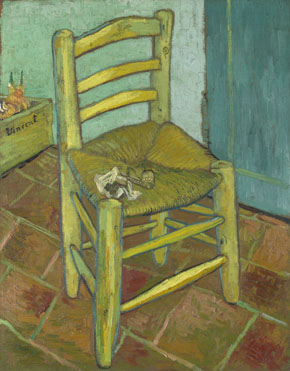
van Gogh, Chair, 1888


Chairs are in every sense fundamental to us. Curiously though, they are neither essential nor especially healthful even in industrial and postindustrial societies -- even if a few activities probably do demand them. Until relatively recently, the majority of the world's people rarely used chairs, and many still do not. Yet chairs have spread inexorably around the world, occasionally promoted deliberately by Western rule or influence but more often spontaneously adopted. The change has been one of the most thoroughgoing and apparently irreversible in the history of material culture. Essential parts of this spontaneous technology transfer are still obscure. But in every sense, the fortunes of the chair illustrate human malleability -- and society's construction, reconstruction, and misconstruction of the human body. Once people begin to spend most of their lives in chairs, they are removed as though by ratcheting from their original ground-level ways; individual return may be hazardous, and social reversal has been unknown. Whole civilizations, in adopting chairs, literally change not only their posture but their point of view.

Read the rest here.

Thank you, Casey.

Patterns.


The Ten Creative Precepts of Heraclitus

1. The cosmos speaks in patterns.

2. Expect the unexpected, or you won’t find it.

3. Everything flows.

4. You can’t step into the same river twice.

5. That which opposes produces a benefit.

6. A wonderful harmony is created when the seemingly unconnected are joined.

7. If all things turned to smoke, the nose would become the discerning organ.

8. The Sun will not exceed its limits, because the avenging Furies, ministers of Justice, would find out.

9. Lovers of wisdom must open their minds to very many things.

10. I searched into myself.

11. Knowing many things doesn’t teach insight.

12. Many fail to grasp what’s right in the palm of their hand.

13. When there is no sun we can see the evening stars.

14. The most beautiful order is a heap of sweepings piled up at random.

15. Things love to conceal their true nature.

16. Those who approach life like a child playing a game, moving and pushing pieces, possess the power of kings.

17. Sea water is both pure and polluted: for fish it is drinkable and life-giving; for humans, undrinkable and destructive.

18. On a circle, an end point can also be a beginning point.

19. It is disease that makes health pleasant, hunger that makes fullness good, and weariness that makes rest sweet.

20. The doctor inflicts pain to cure suffering.

21. The way up and the way down are one and the same.

22. A thing rests by changing.

23. The barley-wine drink falls apart unless it is stirred.

24. While we’re awake, we share one universe, but in sleep we each turn away to a world of our own.

25. Dog’s bark at what they don’t understand.

26. Donkeys prefer garbage to gold.

27. Every walking animal is driven to its purpose with a whack.

28. There is a greater need to extinguish arrogance than a blazing fire.

29. Your character is your destiny.

30. The sun is new each day.

Rush, "Freewill"

Enjoy.


Some sage advice on dogs ...

Always take one bite of a hot dog to enjoy the natural flavor before adding the toppings.

My dad used to always wrap our Ball Parks in bacon. Now, no matter what I'm grilling, I always put a package of Hebrew Nationals on to keep me from withering away to nothing, because, as Harrison says, "It's important not to get caught short." After all, "Technique is the proof of your seriousness."

Case in point ...

7. A Buttery Finish: This one’s a personal call, but Joshua Sharkey likes to finish his hot dogs with "Bark butter," which is "basically smoked lard." Explains Sharkey: We take back fat from pigs, whip it with butter and sea salt, and baste the dogs in the mixture right before they come off the griddle.

See?

Now, don't blow it, judiciously read the rest of "The Eleven Tips for Making a Perfect Dog" at The Daily Meal.

... and stop it with the grilled bun nonsense -- I got your "multi-texture" right here. It's a hot dog. Is your bun grilled at the ball game?

And for the last time ...

Fred Rogers, "The Garden of Your Mind"


Gotta get me some Air Rogers.

Revealed.


When Dogen asked the Zen cook in the Chinese temple why he didn’t have his assistants do the hard work of drying mushrooms in the hot sun, the cook said, “I am not other people.” In the same way, we have to realize that this life is the only life we have. It’s ours, right now. If we don’t do the cooking ourselves, we are throwing our life away. “Keep your eyes open,” Dogen instructs. “Wash the rice thoroughly, put it in the pot, light the fire, and cook it. There is an old saying that says, 'See the pot as your own head, see the water as your lifeblood.’”
When we cook—and live—with this kind of attention, the most ordinary acts and the humblest ingredients are revealed as they truly are.


Read the rest of this great article at Tricycle.

Live.

Karr, Wave Color V, 2012


Live in the sunshine, swim the sea, drink the wild air.

- Ralph Waldo Emerson

Thanks, Jess.