Showing posts with label beyond. Show all posts
23 June 2020
21 November 2017
Guiding.
The true artist is not proud: he unfortunately sees that art has no limits; he feels darkly how far he is from the goal, and though he may be admired by others, he is sad not to have reached that point to which his better genius only appears as a distant, guiding sun.
Ludwig van Beethoven
12 October 2016
Give.
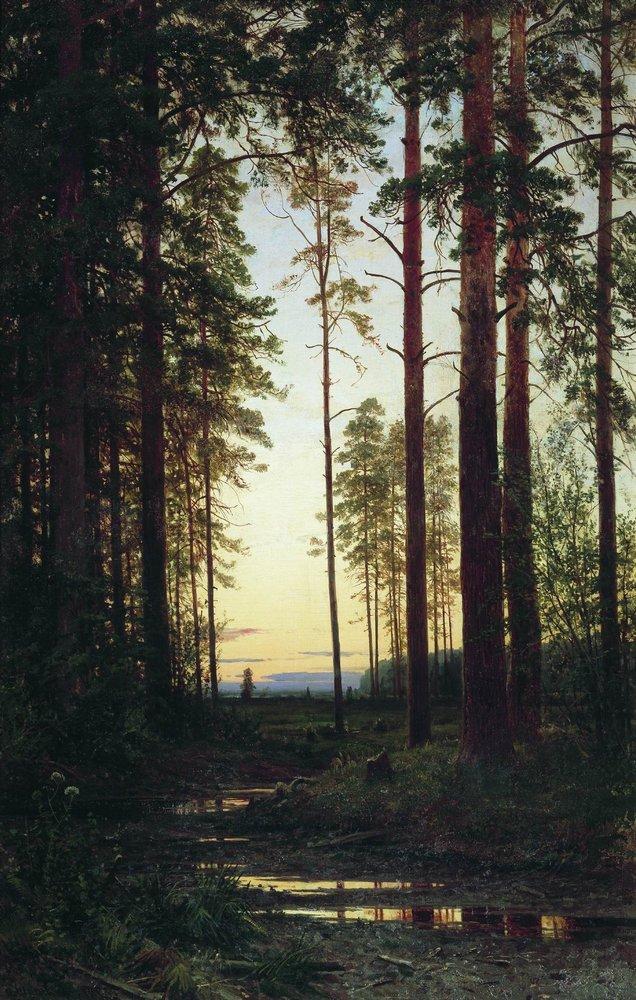
Shishkin, Twilight, 1883
Teach the children. We don’t matter so much, but the
children do. Show them daisies and the pale helatica. Teach them the taste of
sassafras and wintergreen. The lives of the blue sailors, mallow, sunbursts,
the moccasin-flowers. And the frisky ones – inkberry, lamb’s-quarters,
blueberries. And the aromatic ones – rosemary, oregano. Give them peppermint to
put in their pockets as they go to school. Give them the fields and the woods
and the possibility of the world salvaged from the lords of profit. Stand them
in the stream, head them upstream, rejoice as they learn to love this green
space they live in, its sticks and leaves and then the silent, beautiful blossoms.
Mary Oliver
Labels:
appreciation,
art,
beyond,
children,
Oliver,
outdoors,
poetry,
poetry rules!,
Shishkin
30 April 2016
Seeks.
Psychogeography seeks to overcome the process of "banalization' by which the everyday experience of our surroundings becomes one of drab monotony.
Merlin Coverley
25 April 2016
Sensuous.
Goldsworthy, Curved Sticks Surrounding a River Boulder, 2006
Realizing that spirit, recognizing my own inner
consciousness, the psyche, so clearly, I cannot understand time. It is eternity
now. I am in the midst of it. It is about me in the sunshine; I am in it, as
the butterfly floats in the light-laden air. Nothing has to come; it is now.
Now is eternity; now is the immortal life. Here this moment, by this tumulus,
on earth, now; I exist in it. The years, the centuries, the cycles are
absolutely nothing; it is only a moment since this tumulus was raised; in a thousand
years more it will still be only a moment. To the soul there is no past and no
future; all is and will be ever, in now. For artificial purposes time is
mutually agreed on, but there is really no such thing. The shadow goes on upon
the dial, the index moves round upon the clock, and what is the difference?
None whatever. If the clock had never been set going, what would have been the
difference? There may be time for the clock, the clock may make time for
itself; there is none for me.
I dip my hand in the brook and feel the stream; in an
instant the particles of water which first touched me, have floated yards down
the current, my hand remains there. I take my hand away, and the flow — the
time — of the brook does not exist for me. The great clock of the firmament,
the sun and the stars, the crescent moon, the earth circling two thousand
times, is no more to me than the flow of the brook when my hand is withdrawn;
my soul has never been, and never can be, dipped in time.
There came to me a delicate, but at the same time a deep, strong and sensuous enjoyment of the beautiful green earth, the beautiful sky and sun; I felt them, they gave me inexpressible delight, as if they embraced and poured out their love upon me. It was I who loved them, for my heart was broader than the earth; it is broader now than even then, more thirsty and desirous. After the sensuous enjoyment always come the thought, the desire: That I might be like this; that I might have the inner meaning of the sun, the light, the earth, the trees and grass, translated into some growth of excellence in myself, both of the body and of mind; greater perfection of physique, greater perfection of mind and soul; that I might be higher in myself.
Richard Jefferies
23 April 2016
21 April 2016
Happy birthday, Muir.
John Muir was born on this day in 1838.
Toward midday, after a long, tingling scramble through copses of hazel and ceanothus, I gained the summit of the highest ridge in the neighborhood; and then it occurred to me that it would be a fine thing to climb one of the trees to obtain a wider outlook and get my ear close to the Æolian music of its topmost needles. But under the circumstances the choice of a tree was a serious matter. One whose instep was not very strong seemed in danger of being blown down, or of being struck by others in case they should fall; another was branchless to a considerable height above the ground, and at the same time too large to be grasped with arms and legs in climbing; while others were not favorably situated for clear views. After cautiously casting about, I made choice of the tallest of a group of Douglas Spruces that were growing close together like a tuft of grass, no one of which seemed likely to fall unless all the rest fell with it. Though comparatively young, they were about 100 feet high, and their lithe, brushy tops were rocking and swirling in wild ecstasy. Being accustomed to climb trees in making botanical studies, I experienced no difficulty in reaching the top of this one, and never before did I enjoy so noble an exhilaration of motion. The slender tops fairly flapped and swished in the passionate torrent, bending and swirling backward and forward, round and round, tracing indescribable combinations of vertical and horizontal curves, while I clung with muscles firm braced, like a bobo-link on a reed.
In its widest sweeps my tree-top described an arc of from
twenty to thirty degrees, but I felt sure of its elastic temper, having seen
others of the same species still more severely tried--bent almost to the ground
indeed, in heavy snows--without breaking a fiber. I was therefore safe, and
free to take the wind into my pulses and enjoy the excited forest from my
superb outlook. The view from here must be extremely beautiful in any weather.
Now my eye roved over the piny hills and dales as over fields of waving grain,
and felt the light running in ripples and broad swelling undulations across the
valleys from ridge to ridge, as the shining foliage was stirred by
corresponding waves of air. Oftentimes these waves of reflected light would
break up suddenly into a kind of beaten foam, and again, after chasing one
another in regular order, they would seem to bend forward in concentric curves,
and disappear on some hillside, like sea-waves on a shelving shore. The
quantity of light reflected from the bent needles was so great as to make whole
groves appear as ifcovered with snow, while the black shadows beneath the trees
greatly enhanced the effect of the silvery splendor.
Excepting only the shadows there was nothing somber in all
this wild sea of pines. On the contrary, notwithstanding this was the winter
season, the colors were remarkably beautiful. The shafts of the pine and
libocedrus were brown and purple, and most of the foliage was well tinged with
yellow; the laurel groves, with the pale undersides of their leaves turned
upward, made masses of gray; and then there was many a dash of chocolate color
from clumps of manzanita, and jet of vivid crimson from the bark of the
madroños, while the ground on the hillsides, appearing here and there through
openings between the groves, displayed masses of pale purple and brown.
The sounds of the storm corresponded gloriously with this
wild exuberance of light and motion. The profound bass of the naked branches
and boles booming like waterfalls; the quick, tense vibrations of the
pine-needles, now rising to a shrill, whistling hiss, now falling to a silky
murmur; the rustling of laurel groves in the dells, and the keen metallic click
of leaf on leaf--all this was heard in easy analysis when the attention was
calmly bent.
The varied gestures of the multitude were seen to fine
advantage, so that one could recognize the different species at a distance of
several miles by this means alone, as well as by their forms and colors, and
the way they reflected the light. All seemed strong and comfortable, as if
reallyenjoying the storm, while responding to its most enthusiastic greetings.
We hear much nowadays concerning the universal struggle for existence, but no
struggle in the common meaning of the word was manifest here; no recognition of
danger by any tree; no deprecation; but rather an invincible gladness as remote
from exultation as from fear.
I kept my lofty perch for
hours, frequently closing my eyes to enjoy the music by itself, or to feast
quietly on the delicious fragrance that was streaming past. The fragrance of
the woods was less marked than that produced during warm rain, when so many
balsamic buds and leaves are steeped like tea; but, from the chafing of resiny
branches against each other, and the incessant attrition of myriads of needles,
the gale was spiced to a very tonic degree. And besides the fragrance from
these local sources there were traces of scents brought from afar. For this
wind came first from the sea, rubbing against its fresh, briny waves, then
distilled through the redwoods, threading rich ferny gulches, and spreading
itself in broad undulating.
CONNECT
20 April 2016
Presence.
I write this, 11 A. M., shelter’d
under a dense oak by the bank, where I have taken refuge from a sudden rain. I
came down here, (we had sulky drizzles all the morning, but an hour ago a
lull,) for the before-mention’d daily and simple exercise I am fond of—to pull
on that young hickory sapling out there—to sway and yield to its tough-limber
upright stem—haply to get into my old sinews some of its elastic fibre and
clear sap. I stand on the turf and take these health-pulls moderately and at
intervals for nearly an hour, inhaling great draughts of fresh air. Wandering
by the creek, I have three or four naturally favorable spots where I
rest—besides a chair I lug with me and use for more deliberate occasions. At
other spots convenient I have selected, besides the hickory just named, strong
and limber boughs of beech or holly, in easy-reaching distance, for my natural
gymnasia, for arms, chest, trunk-muscles. I can soon feel the sap and sinew
rising through me, like mercury to heat. I hold on boughs or slender trees
caressingly there in the sun and shade, wrestle with their innocent
stalwartness—and know the virtue thereof passes from them into me.
(Or may-be we interchange—may-be the trees are more aware of it all than I ever
thought.)
But now pleasantly imprison’d here under the big oak—the rain dripping, and the sky cover’d with leaden clouds—nothing but the pond on one side, and the other a spread of grass, spotted with the milky blossoms of the wild carrot—the sound of an axe wielded at some distant wood-pile—yet in this dull scene, (as most folks would call it,) why am I so (almost) happy here and alone? Why would any intrusion, even from people I like, spoil the charm? But am I alone? Doubtless there comes a time—perhaps it has come to me—when one feels through his whole being, and pronouncedly the emotional part, that identity between himself subjectively and Nature objectively which Schelling and Fichte are so fond of pressing. How it is I know not, but I often realize a presence here—in clear moods I am certain of it, and neither chemistry nor reasoning nor esthetics will give the least explanation. All the past two summers it has been strengthening and nourishing my sick body and soul, as never before. Thanks, invisible physician, for thy silent delicious medicine, thy day and night, thy waters and thy airs, the banks, the grass, the trees, and e’en the weeds!
Walt Whitman
19 April 2016
Memory.
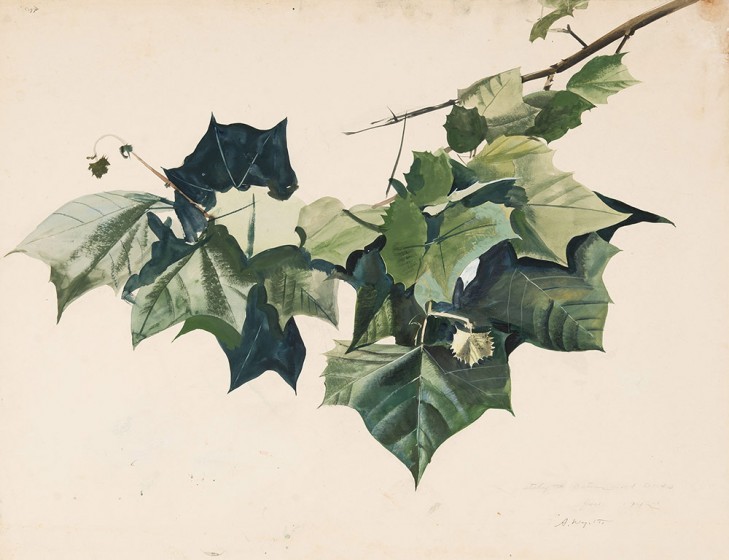
Wyeth, Summer Freshet (study), 1942
W.G. Sebald
But the fact is that writing is the only way in which I am
able to cope with the memories which overwhelm me so frequently and so
unexpectedly. If they remained locked away, they would become heavier and
heavier as time went on, so that in the end I would succumb under their
mounting weight. Memories lie slumbering within us for months and years,
quietly proliferating, until they are woken by some trifle and in some strange
way blind us to life. How often this has caused me to feel that my memories,
and the labours expended in writing them down are all part of the same
humiliating and, at bottom, contemptible business! And yet, what would we be
without memory? We would not be capable of ordering even the simplest thoughts,
the most sensitive heart would lose the ability to show affection, our
existence would be a mere neverending chain of meaningless moments, and there
would not be the faintest trace of a past.
W.G. Sebald
17 April 2016
Lift.
When I looked, I knew I might never again see so much of the
earth so beautiful, the beautiful being something you know added to something
you see, in a whole that is different from the sum of its parts. What I saw
might have been just another winter scene, although an impressive one. But what
I knew was that the earth underneath was alive and that by tomorrow, certainly
by the day after, it would be all green again. So what I saw because of what I
knew was a kind of death with the marvelous promise of less than a three-day
resurrection.
I had as yet no notion that life every now and then becomes
literature—not for long, of course, but long enough to be what we best
remember, and often enough so that what we eventually come to mean by life are
those moments when life, instead of going sideways, backwards, forward, or
nowhere at all, lines out straight, tense and inevitable, with a complication,
climax, and, given some luck, a purgation, as if life had been made and not
happened.
For a scientist, this is a good way to live and die, maybe
the ideal way for any of us - excitedly finding we were wrong and excitedly
waiting for tomorrow to come so we can start over.
What I really like to do is wander aimlessly in the city. I
like to walk the streets by day and by night. It is more than a liking, a
simple liking—it is an aberration. Every so often, for example, around nine in
the morning, I climb out of the subway and head toward the office building in
midtown Manhattan in which I work, but on the way a change takes place in me—in
effect, I lose my sense of responsibility—and when I reach the entrance to the
building I walk right on past it, as if I had never seen it before. I keep on
walking, sometimes for only a couple of hours but sometimes until deep in the afternoon,
and I often wind up a considerable distance away from midtown Manhattan—up in
the Bronx Terminal Market maybe, or over on some tumbledown old sugar dock on
the Brooklyn riverfront, or out in the weediest part of some weedy old cemetery
in Queens. It is never very hard for me to think up an excuse that justifies me
in behaving this way (I have a great deal of experience in justifying myself to
myself)—a headache that won’t let up is a good enough excuse, and an unusually
bleak and overcast day is as good an excuse as an unusually balmy and
springlike day. Or it might be some horrifying or unnerving or humiliating
thought that came into my mind while I was lying awake in the middle of the
night and that keeps coming back—some thought about the swiftness of time in
its flight, for example, or about old age itself, or about death in general and
death in particular, or about the possibility (which is far more horrifying to
me than the possibility of a nuclear war) that after death many of us may find
out (and quite rudely, too, as a friend of mine who was lying on his deathbed
in a hospital at the time once remarked) that the eternal and everlasting
flames of Hell actually exist.
Another thing I like to do
is to get on a subway train picked at random and stay on it for a while and go
upstairs to the street and get on the first bus that shows up going in any
direction and sit on the cross seat in back beside a window and ride along and
look out the window at the people and at the flowing backdrop of buildings.
There is no better vantage point from which to look at the common, ordinary
city—not the lofty, noble silvery vertical city but the vast, spread-out,
sooty-gray and sooty-brown and sooty-red and sooty-pink horizontal city, the
snarled-up and smoldering city, the old, polluted, betrayed, and
sure-to-be-torn-down-any-time-now city. I frequently spend an entire day riding
on New York City buses, getting off at junction points and changing from one
line to another as the notion strikes me and gradually crisscrossing whatever
part of the city I happen to be in. I might ride in a dozen or fifteen or
twenty different buses during the day.
Ever since I came here, I have been fascinated by the
ornamentation of the older buildings of the city. The variety of it fascinates
me, and also the ubiquity of it, the overwhelming ubiquity of it, the almost
comical ubiquity of it. In thousands upon thousands of blocks, on just about
any building you look at, sometimes in the most unexpected and out-of-the-way
places, there it is. Sometimes it is almost hidden under layers of paint that
took generations to accumulate and sometimes it is all beaten and banged and
mutilated, but there it is. The eye that searches for it is almost always able
to find it. I never get tired of gazing from the back seats of buses at the
stone eagles and the stone owls and the stone dolphins and the stone lions’
heads and the stone bulls’ heads and the stone rams’ heads and the stone urns
and the stone tassels and the stone laurel wreaths and the stone scallop shells
and the cast-iron stars and the cast-iron rosettes and the cast-iron medallions
and the clusters of cast-iron acanthus leaves bolted to the capitals of
cast-iron Corinthian columns and the festoons of cast-iron flowers and the
swags of cast-iron fruit and the zinc brackets in the shape of oak leaves
propping up the zinc cornices of brownstone houses and the scroll-sawed bargeboards
framing the dormers of decaying old mansard-roofed mansions and the terra-cotta
cherubs and nymphs and satyrs and sibyls and sphinxes and Atlases and Dianas
and Medusas serving as keystones in arches over the doorways and windows of
tenement houses.
There are some remarkably silly-looking things among these ornaments, but they are silly-looking things that have lasted for a hundred years or more in the dirtiest and most corrosive air in the world, the equivalent of a thousand years in an olive grove in Greece, and there is something triumphant about them—they have triumphed over time and ice and frost and heat and humidity and wind and rain and brutally abrupt temperature fluctuations and rust and pigeon droppings and smoke and soot and sulfuric acid, not to speak of the perpetual nail-loosening and timber-weakening and stone-cracking and mortar-crumbling vibration from the traffic down below. Furthermore, they have triumphed over profound changes in architectural styles. I revere them. To me, they are sacred objects. The sight of a capricious bit of carpentry or brickmasonry or stonemasonry or blacksmithery or tinsmithery or tile setting high up on the façade of a building, executed long ago by some forgotten workingman, will lift my spirits for hours.
15 April 2016
Music.
Bazille, Verlaine as a Troubadour, 1868
Ars Poetica
for Charles Morice
Music first and foremost! In your verse,
Choose those meters odd of syllable,
Supple in the air, vague, flexible,
Free of pounding beat, heavy or terse.
Choose the words you use—now right, now wrong—
With abandon: when the poet’s vision
Couples the Precise with Imprecision,
Best the giddy shadows of his song:
Eyes veiled, hidden, dark with mystery,
Sunshine trembling in the noonday glare,
Starlight, in the tepid autumn air,
Shimmering in night-blue filigree!
For Nuance, not Color absolute,
Is your goal; subtle and shaded hue!
Nuance! It alone is what lets you
Marry dream to dream, and horn to flute!
Shun all cruel and ruthless Railleries;
Hurtful Quip, lewd Laughter, that appall
Heaven, Azure-eyed, to tears; and all
Garlic-stench scullery recipes!
Take vain Eloquence and wring its neck!
Best you keep your Rhyme sober and sound,
Lest it wander, reinless and unbound—
How far? Who can say?—if not in check!
Rhyme! Who will its infamies revile?
What deaf child, what Black of little wit
Forged with worthless bauble, fashioned it
False and hollow-sounding to the file?
Music first and foremost, and forever!
Let your verse be what goes soaring, sighing,
Set free, fleeing from the soul gone flying
Off to other skies and loves, wherever.
Let your verse be aimless chance, delighting
In good-omened fortune, sprinkled over
Dawn’s wind, bristling scents of mint, thyme, clover ...
All the rest is nothing more than writing.
Paul Verlaine
14 April 2016
Seeing.
A crow
has settled on a bare branch--
autumn evening.
has settled on a bare branch--
autumn evening.
The crane's legs
have gotten shorter
in the spring rain.
have gotten shorter
in the spring rain.
Another year gone--
hat in hand,
sandals on my feet.
hat in hand,
sandals on my feet.
The old pond--
a frog jumps in
sound of water.
a frog jumps in
sound of water.
The winter sun--
on the horse's back
my frozen shadow.
on the horse's back
my frozen shadow.
Seeing people off,
being seen off--
autumn in Kiso.
being seen off--
autumn in Kiso.
A cold rain starting
and no hat--
so?
and no hat--
so?
Singing, flying, singing
the cuckoo
keeps busy.
the cuckoo
keeps busy.
Visiting the graves--
white-haired,
leaning on their canes.
white-haired,
leaning on their canes.
Midnight frost--
I'd borrow
the scarecrow's shirt.
I'd borrow
the scarecrow's shirt.
When the winter crysanthemums go
there's nothing to write about
but radishes.
Basho
there's nothing to write about
but radishes.
Basho
Noticed.
Hansen, The Meadow, 1973
It has become the habit for me to spend my afternoons in solitary tramping. A great distance of the surrounding country have I now traversed thus, & the map of the land becomes solid in my brain. Twice these walks were taken in the teeth of heavy rain storms. I walked, it seemed, toward the very front of the torrent, up among grey hills. Both times it swept like driving smoke across the sea, & all the cheerful shapes & colours evaporated. One could just see the hazy outlines of the hills which lifted themselves out of the mist, but the sweep of the bay filled almost instantly with dense vapours. At Knills monument I had to take my bearings, & repeated, "A blinding mist came down & hid the land!" & reflected how easily I might share Lucy's fate. The delight of the country is that all moods of the air & the earth are natural, & therefore fit & beautiful. There is nothing incongruous about a wet day among the hills, as there is when decent streets & brick houses are exposed to the shock of an uncivilised storm. One may fancy even, a storm rejoicing among these granite hills when the wind & rain beat upon them as though they loved the conflict. But the sunny days give one, after all, a more spontaneous pleasure, the scents of the earth & the budding gorse are sucked out of them by the heat, & all the land glows with a mellow August radiance. The air becomes of a richly luminous quality; you see all things through an amber coloured medium.
Up on the hill today the only sound we heard was the tap tap of the stone breakers as they chipped the granite blocks, & we noticed the curious creamy richness of the stone pit in which they stood; the sun every now & then, making it gleam silver.
Virginia Woolf
CONNECT
It has become the habit for me to spend my afternoons in solitary tramping. A great distance of the surrounding country have I now traversed thus, & the map of the land becomes solid in my brain. Twice these walks were taken in the teeth of heavy rain storms. I walked, it seemed, toward the very front of the torrent, up among grey hills. Both times it swept like driving smoke across the sea, & all the cheerful shapes & colours evaporated. One could just see the hazy outlines of the hills which lifted themselves out of the mist, but the sweep of the bay filled almost instantly with dense vapours. At Knills monument I had to take my bearings, & repeated, "A blinding mist came down & hid the land!" & reflected how easily I might share Lucy's fate. The delight of the country is that all moods of the air & the earth are natural, & therefore fit & beautiful. There is nothing incongruous about a wet day among the hills, as there is when decent streets & brick houses are exposed to the shock of an uncivilised storm. One may fancy even, a storm rejoicing among these granite hills when the wind & rain beat upon them as though they loved the conflict. But the sunny days give one, after all, a more spontaneous pleasure, the scents of the earth & the budding gorse are sucked out of them by the heat, & all the land glows with a mellow August radiance. The air becomes of a richly luminous quality; you see all things through an amber coloured medium.
Up on the hill today the only sound we heard was the tap tap of the stone breakers as they chipped the granite blocks, & we noticed the curious creamy richness of the stone pit in which they stood; the sun every now & then, making it gleam silver.
Virginia Woolf
CONNECT
Drawn.
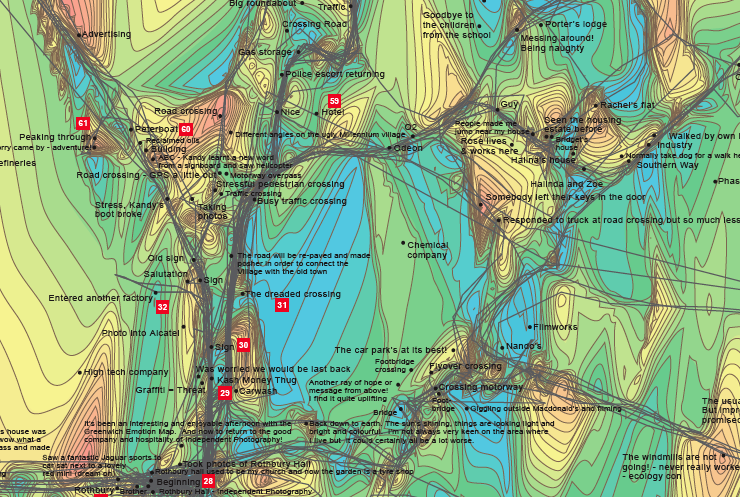
Dérive: the practice of a passionate uprooting through the
hurried change of environments, as well as a means of studying psychogeography
and the situationist psychology.
In a dérive one or more persons during a certain period drop
their usual motives for movement and action, their relations, their work and
leisure activities, and let themselves be drawn by the attractions of the
terrain and the encounters they find there. From the derive point of view, cities have a psychological relief, with constant currents, fixed points and
vortexes which strongly discourage entry into or exit from certain zones.
Guy Debord
CONNECT
More
"A New Way of Walking"
Guy Debord
CONNECT
More
"A New Way of Walking"
Holzwege.
“Wood” is an old name for forest. In the wood there are
paths, mostly overgrown, that come to an abrupt stop where the wood is
untrodden.
They are called Holzwege.
Each goes its separate way, though within the same forest. It often appears as if one is identical to another. But it only appears so. Woodcutters and forest keepers know these paths. They know what it means to be on a Holzweg.
Martin Heidegger
Subscribe to:
Posts (Atom)