"I am not one who was born in the custody of wisdom. I am one who is fond of olden times and intense in quest of the sacred knowing of the ancients." Gustave Courbet
Showing posts with label Heidegger. Show all posts

09 January 2022

Strength.

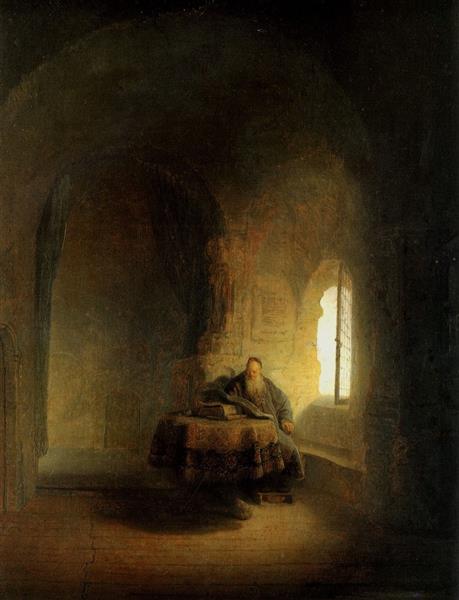
Rembrandt, Scholar Reading, 1631

When the farthest corner of the globe has been conquered technologically and can be exploited economically; when any incident you like, at any time you like, becomes accessible as fast as you like; when you can simultaneously “experience” an assassination attempt against a king in France and a symphony concert in Tokyo; when time is nothing but speed, instantaneity, and simultaneity, and time as history has vanished from all Dasein of all peoples; when a boxer counts as the great man of a people; when the tallies of millions at mass meetings are a triumph; then, yes then, there still looms like a specter over all this uproar the question: what for? — where to? — and what then? 

The spiritual decline of the earth has progressed so far that peoples are in danger of losing their last spiritual strength, the strength that makes it possible even to see the decline and to appraise it as such. This simple observation has nothing to do with cultural pessimism — nor with any optimism either, of course; for the darkening of the world, the flight of the gods, the destruction of the earth, the reduction of human beings to a mass, the hatred and mistrust of everything creative and free has already reached such proportions throughout the whole earth that such childish categories as pessimism and optimism have long become laughable.

Martin Heidegger

28 December 2021

Poets.

Blackshear, Guardian of the Night, 1999


Poets are the mortals who, singing earnestly of the wine god, sense the trace of the fugitive gods, stay on the god's tracks and so trace for their kindred mortals the way towards turning.  To be a poet in a destitute time means to attend, singing, to the trace of the fugitive gods. This is why the poet in the times of the world's night utters the holy. This is why the world's night is the holy night.

Martin Heidegger

15 July 2019

Oneness.

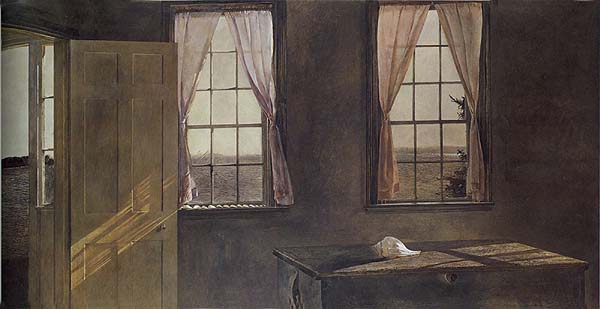
Wyeth, Her Room, 1963


Only if we are capable of dwelling, only then can we build. Let us think for a while of a farmhouse in the Black Forest, which was built some two hundred years ago by the dwelling of peasants. Here the self-sufficiency of the power to let earth and heaven, divinities and mortals enter in simple oneness into things, ordered the house. It placed the farm on the wind-sheltered mountain slope, looking south, among the meadows close to the spring. It gave it its wide overhanging shingle roof whose proper slope bears up under the burden of snow, and which, reaching deep down, shields the chambers against the storms of the long winter-nights. It did not forget the altar corner behind the community table; it made room in its chamber for the hallowed places of childbed and the "tree of the dead"—for that is what they call a coffin there: the Totenbaum—and in this way it designed for the different generations under one roof the character of their journey through time. A craft which, itself sprung from dwelling, still uses its tools and frames as things, built the farmhouse.

Martin Heidegger
01 November 2017

Unreal.

Tasker, Fuschia, 1938


Poetizing is founding, a grounding that brings about that which remains. The poet is the one who grounds being. What we call the real in our everyday life is, in the end, what is unreal.

Martin Heidegger

14 April 2016

Holzwege.


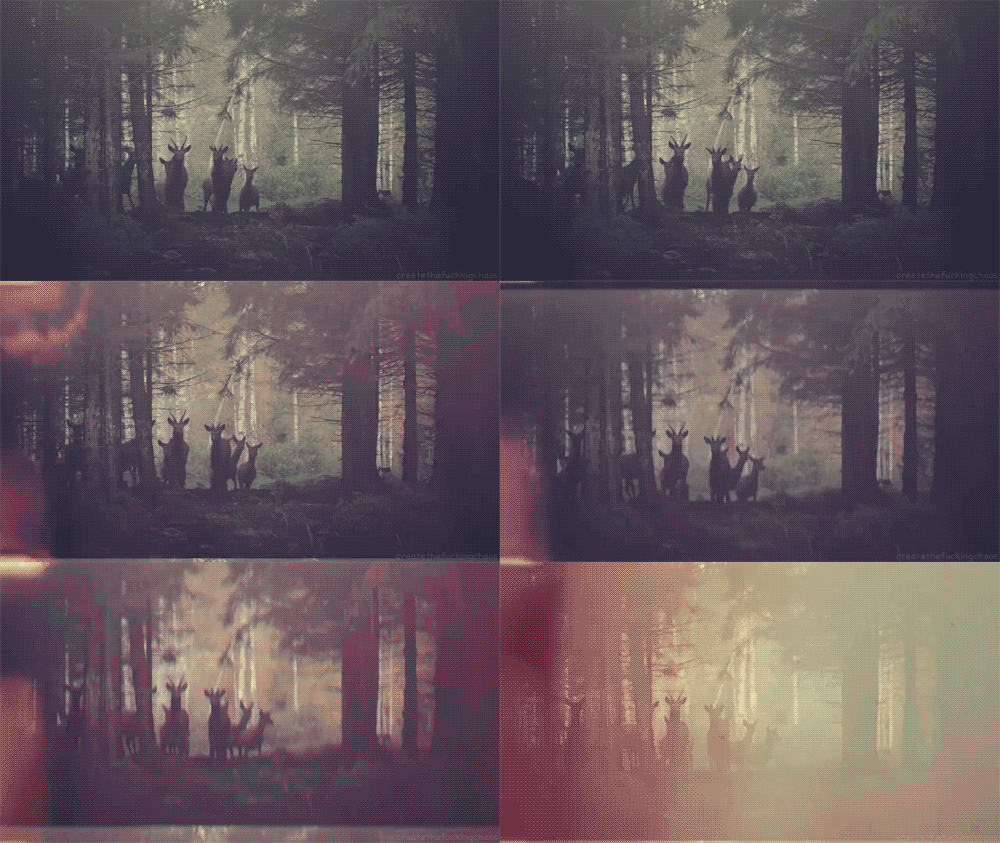
“Wood” is an old name for forest. In the wood there are paths, mostly overgrown, that come to an abrupt stop where the wood is untrodden.

They are called Holzwege.

Each goes its separate way, though within the same forest. It often appears as if one is identical to another. But it only appears so. Woodcutters and forest keepers know these paths. They know what it means to be on a Holzweg.

Martin Heidegger