"I am not one who was born in the custody of wisdom. I am one who is fond of olden times and intense in quest of the sacred knowing of the ancients." Gustave Courbet
Showing posts with label Albion. Show all posts

28 January 2024

See.

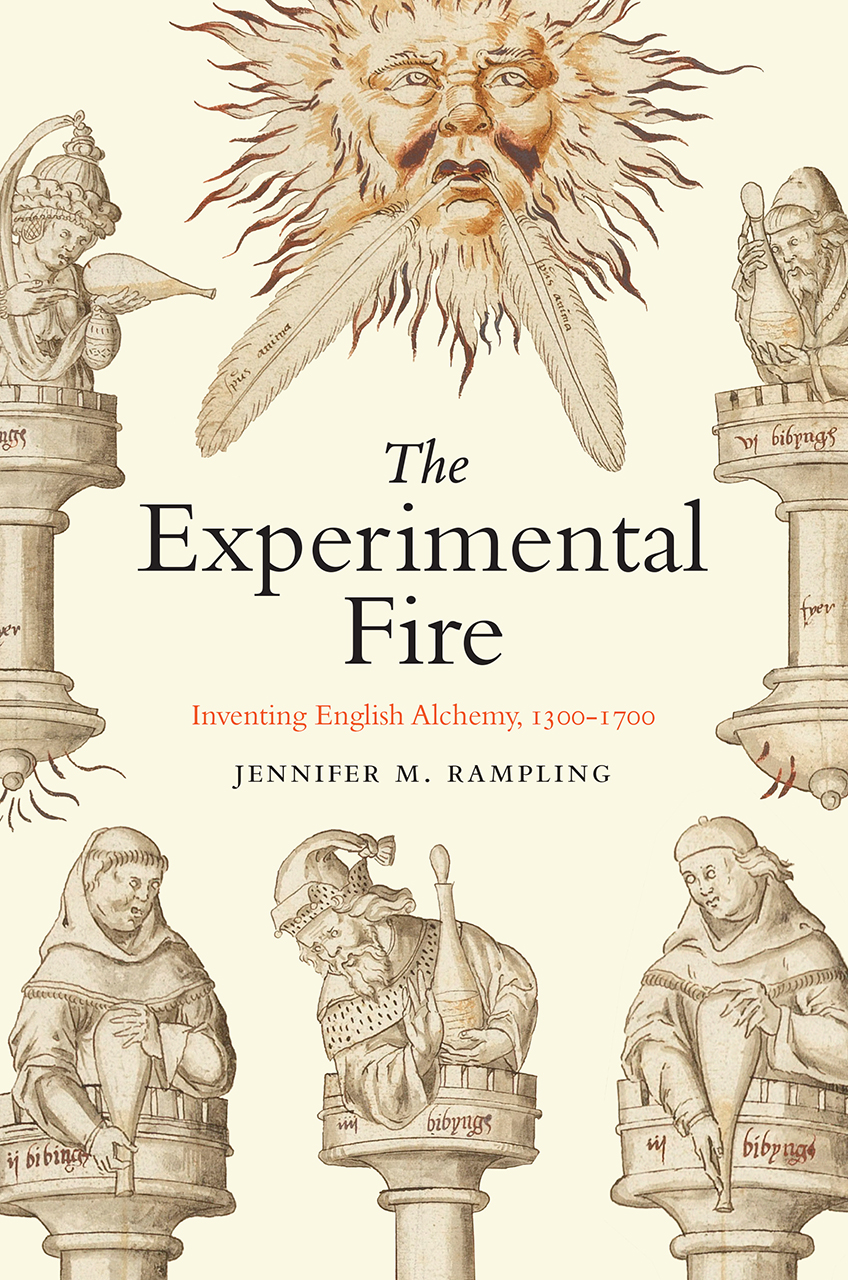
An excellent book ...


The cycle of the seasons, to which poets have so often turned as a reminder that nothing in this world is stable, is in fact one of the great constants in life. In some ways, the thousand years or more that have elapsed since the poems in this book were written have changed our world beyond recognition - but every year, when the blossom springs and the leaves fall, we see what the Anglo-Saxon poets saw. The revolving cycle finds us each year at a different moment in the story of our own lives; the unfolding events of history change us, but the seasons do not change.

Eleanor Parker, from Winters in the World: A Journey through the Anglo-Saxon Year

26 June 2022

Art.

George Corner demonstrates the lost art of woggle-hopping ...

18 August 2021

Help.

Reed, A Man Herds Sheep with the Help of His Collies in Scotland, 1919

20 December 2020

Felt.


SNOWDON

In one of those excursions (may they ne’er
Fade from remembrance!) through the northern tracts
Of Cambria ranging with a youthful friend,
I left Bethgelert’s huts at couching-time,
And westward took my way, to see the sun         
Rise from the top of Snowdon. To the door
Of a rude cottage at the mountain’s base
We came, and roused the shepherd who attends
The adventurous stranger’s steps, a trusty guide;
Then, cheered by short refreshment, sallied forth.         
 
  It was a close, warm, breezeless summer night,
Wan, dull, and glaring, with a dripping fog
Low-hung and thick that covered all the sky;
But, undiscouraged, we began to climb
The mountain-side. The mist soon girt us round,         
And, after ordinary travellers’ talk
With our conductor, pensively we sank
Each into commerce with his private thoughts:
Thus did we breast the ascent, and by myself
Was nothing either seen or heard that checked         
Those musings or diverted, save that once
The shepherd’s lurcher, who, among the crags,
Had to his joy unearthed a hedgehog, teased
His coiled-up prey with barkings turbulent.
This small adventure, for even such it seemed         
In that wild place and at the dead of night,
Being over and forgotten, on we wound
In silence as before. With forehead bent
Earthward, as in opposition set
Against an enemy, I panted up         
With eager pace, and no less eager thoughts.
Thus might we wear a midnight hour away,
Ascending at loose distance each from each,
And I, as chanced, the foremost of the band;
When at my feet the ground appeared to brighten,         
And with a step or two seemed brighter still:
Nor was time given to ask or learn the cause,
For instantly a light upon the turf
Fell like a flash, and lo! as I looked up,
The moon hung naked in a firmament         
Of azure without cloud, and at my feet
Rested a silent sea of hoary mist.
A hundred hills their dusky backs upheaved
All over this still ocean; and beyond,
Far, far beyond, the solid vapors stretched,         
In headlands, tongues, and promontory shapes,
Into the main Atlantic, that appeared
To dwindle, and give up his majesty,
Usurped upon far as the sight could reach.
Not so the ethereal vault; encroachment none         
Was there, nor loss; only the inferior stars
Had disappeared, or shed a fainter light
In the clear presence of the full-orbed moon,
Who, from her sovereign elevation, gazed
Upon the billowy ocean, as it lay         
All meek and silent, save that through a rift—
Not distant from the shore whereon we stood,
A fixed, abysmal, gloomy, breathing-place—
Mounted the roar of waters, torrents, streams
Innumerable, roaring with one voice!         
Heard over earth and sea, and, in that hour,
For so it seemed, felt by the starry heavens.

William Wordsworth

17 November 2020

Ages.

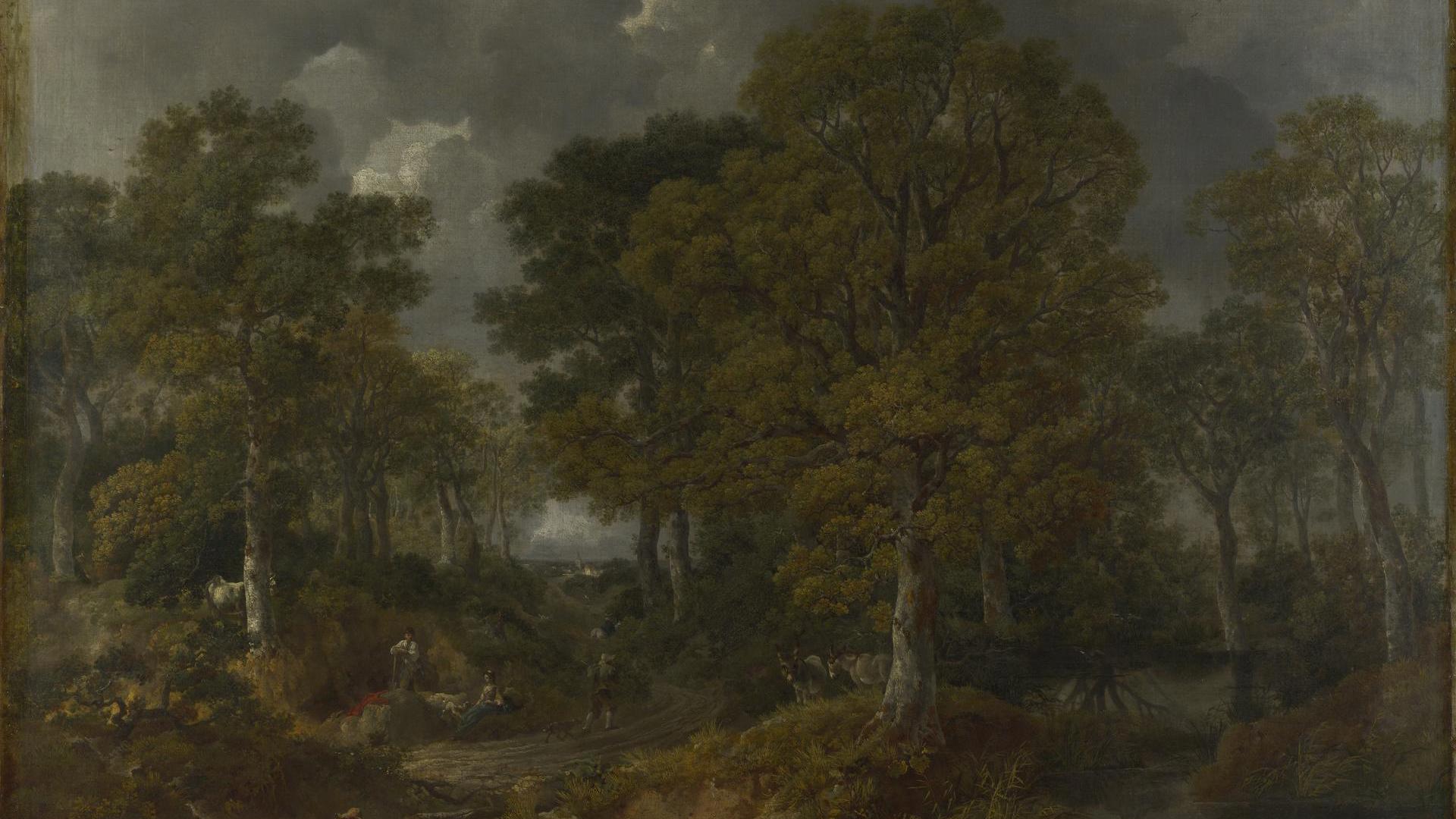
Gainsborough, Cornard Wood, near Sudbury, Suffolk, 1748


Washington Irving, "Rural Life in England," from The Sketchbook of Geoffrey Crayon, Gent. ...
In rural occupation, there is nothing mean and debasing. It leads a man forth among scenes of natural grandeur and beauty; it leaves him to the workings of his own mind, operated upon by the purest and most elevating of external influences. Such a man may be simple and rough, but he cannot be vulgar. The man of refinement, therefore, finds nothing revolting in an intercourse with the lower orders in rural life, as he does when he casually mingles with the lower orders of cities. He lays aside his distance and reserve, and is glad to waive the distinctions of rank, and to enter into the honest, heartfelt enjoyments of common life. Indeed, the very amusements of the country bring, men more and more together; and the sound hound and horn blend all feelings into harmony. I believe this is one great reason why the nobility and gentry are more popular among the inferior orders in England than they are in any other country; and why the latter have endured so many excessive pressures and extremities, without repining more generally at the unequal distribution of fortune and privilege.

To this mingling of cultivated and rustic society may also be attributed the rural feeling that runs through British literature; the frequent use of illustrations from rural life; those incomparable descriptions of Nature, that abound in the British poets—that have continued down from “The Flower and the Leaf,” of Chaucer, and have brought into our closets all the freshness and fragrance of the dewy landscape. The pastoral writers of other countries appear as if they had paid Nature an occasional visit, and become acquainted with her general charms; but the British poets have lived and revelled with her—they have wooed her in her most secret haunts—they have watched her minutest caprices. A spray could not tremble in the breeze—a leaf could not rustle to the ground—a diamond drop could not patter in the stream—a fragrance could not exhale from the humble violet, nor a daisy unfold its crimson tints to the morning, but it has been noticed by these impassioned and delicate observers, and wrought up into some beautiful morality.

The effect of this devotion of elegant minds to rural occupations has been wonderful on the face of the country. A great part of the island is rather level, and would be monotonous, were it not for the charms of culture; but it is studded and gemmed, as it were, with castles and palaces, and embroidered with parks and gardens. It does not abound in grand and sublime prospects, but rather in little home scenes of rural repose and sheltered quiet. Every antique farm-house and moss-grown cottage is a picture; and as the roads are continually winding, and the view is shut in by groves and hedges, the eye is delighted by a continual succession of small landscapes of captivating loveliness.

The great charm, however, of English scenery, is the moral feeling that seems to pervade it. It is associated in the mind with ideas of order, of quiet, of sober well-established principles, of hoary usage and reverend custom. Every thing seems to be the growth of ages of regular and peaceful existence. The old church of remote architecture, with its low, massive portal; its Gothic tower; its windows rich with tracery and painted glass, in scrupulous preservation; its stately monuments of warriors and worthies of the olden time, ancestors of the present lords of the soil; its tombstones, recording successive generations of sturdy yeomanry, whose progeny still plough the same fields, and kneel at the same altar;—the parsonage, a quaint irregular pile, partly antiquated, but repaired and altered in the tastes of various ages and occupants;—the stile and foot-path leading from the churchyard, across pleasant fields, and along shady hedgerows, according to an immemorial right of way;—the neighboring village, with its venerable cottages, its public green sheltered by trees, under which the forefathers of the present race have sported;—the antique family mansion, standing apart in some little rural domain, but looking down with a protecting air on the surrounding scene; all these common features of English landscape evince a calm and settled security, a hereditary transmission of homebred virtues and local attachments, that speak deeply and touchingly for the moral character of the nation.

10 May 2020

Art.


We care for many gardens and parks designed by one of the most famous landscape gardeners in British history, Lancelot "Capability" Brown. Brown helped revolutionise British gardening in the eighteenth century, sweeping away formality in favour of natural looking landscapes. He copied nature so cleverly that his work is often mistaken for a natural landscape.

So how can you tell the difference between what appears to be quintessential British countryside and an original Brown work of art?

CONNECT

13 April 2020

Interest.


I ought to warn you that my verse is of no interest to people who can think.

Sir John Betjeman

Summoned by Bells ...


A Passion for Churches ...


Let's Imagine: A Branch Line Railway ...


Britain's Cathedrals and Their Music ...

11 April 2020

Influence.


The acclaimed BBC Four Britannia series moves into the world of British reggae. Showing how it came from Jamaica in the 1960s to influence, over the next 20 years, both British music and society, the programme includes major artists and performances from that era, including Big Youth, Max Romeo, Linton Kwesi Johnson, Jerry Dammers and The Specials, The Police, UB40, Dennis Bovell, lovers rock performers Carroll Thompson and Janet Kay, bands like Aswad and Steel Pulse and reggae admirers such as Boy George and Paul Weller.

The program celebrates the impact of reggae, the changes it brought about and its lasting musical legacy.

Part 1: "Hard Road to Travel"


Part 2: "Catch a Fire"


Part 3: "Stir It Up"


Part 4: "Nice Up the Dance"

Yorkshire.