17 April 2022


Deliverance.
Buoneri, The Resurrection, 1623

Speaking of Easter, do we not attach more importance nowadays to the act of dying than to death itself? We are much more concerned with getting over the act of dying than with being victorious over death. Socrates mastered the art of dying; Christ overcame death as the eschatos echtheos. There is a real difference between the two things. The one is within human capacity, the other implies resurrection.
We need not an art of dying, but the resurrection of Christ to invigorate and cleanse the world today. Here is the answer to dos moi pou stoo kai kinesoo ten gen, give me where I stand and I will move the earth. What a tremendous difference it would make if a few people really believed and acted upon that. To live in the light of the resurrection that is the meaning of Easter. Do you not also find that so few people seem to know what light it is they live by? This perturbatio animorum is exceedingly common. It is an unconscious waiting for the word of deliverance, though the time is hardly ripe yet for it to be heard. But the time will come, and perhaps this Easter is one of the last chances we shall have to prepare ourselves for our future task.
Dietrich Bonhoeffer, from Letters and Papers from Prison
16 April 2022
Memory.

All things end, and by ending not only find continuance in the whole, but also assure continuance by contributing their droplets, clear or murky, to the stream of history. So it was for the Confederacy, and so one day will it be for the other nations of earth, if not for earth itself. Appomattox was one of several endings. But at what cost — if not in suffering, which was immeasurable, then at any rate in blood — had the war been won and lost?
In round numbers, two million blue-clad soldiers and sailors were diminished by 640,000 casualties — more than a fourth — while the 750,000 in gray, all told, lost 450,000 — well over half. Of the former, 111,000 had been killed in battle, as compared to 94,000 of the latter... The butcher's bill thus came to no less than 1,094,453 for both sides, in and out of more than 10,000 military actions, including 76 full-scale battles, 310 engagements, 6337 skirmishes, and numerous sieges, raids, expeditions, and the like.
Out of 583 Union generals, 47 were killed in action, whereas of the 425 Confederate generals, 77 fell — roughly one in twelve as opposed to one in five. Approximately one out of ten able-bodied Northerners were dead or incapacitated, while for the South it was one out of four, including her noncombatant Negroes.
Not secession but the war itself, and above all the memories recurrent through the peace that followed — such as it was — created a Solid South, more firmly united in defeat than it had been during the brief span when it claimed independence. Voided, the claim was abandoned, but the pride remained: pride in the segment reabsorbed, as well as in the whole, which now for the first time was truly indivisible.
No wonder then, if they looked back on that four-year holocaust — which in a sense was begun by one madman, John Brown, and ended by another, John Wilkes Booth — with something of the feeling shared by men who have gone through, and survived, some cataclysmic phenomenon; a hurricane or an earthquake say, or a horrendous railway accident. Memory smoothed the crumpled scroll, abolished fear, leached pain and grief, and removed the sting from death.
Shelby Foote, from "Lucifer in Starlight"
Thinking.

That’s your responsibility as a person, as a human being — to constantly be updating your positions on as many things as possible. And if you don’t contradict yourself on a regular basis, then you’re not thinking.
Malcolm Gladwell
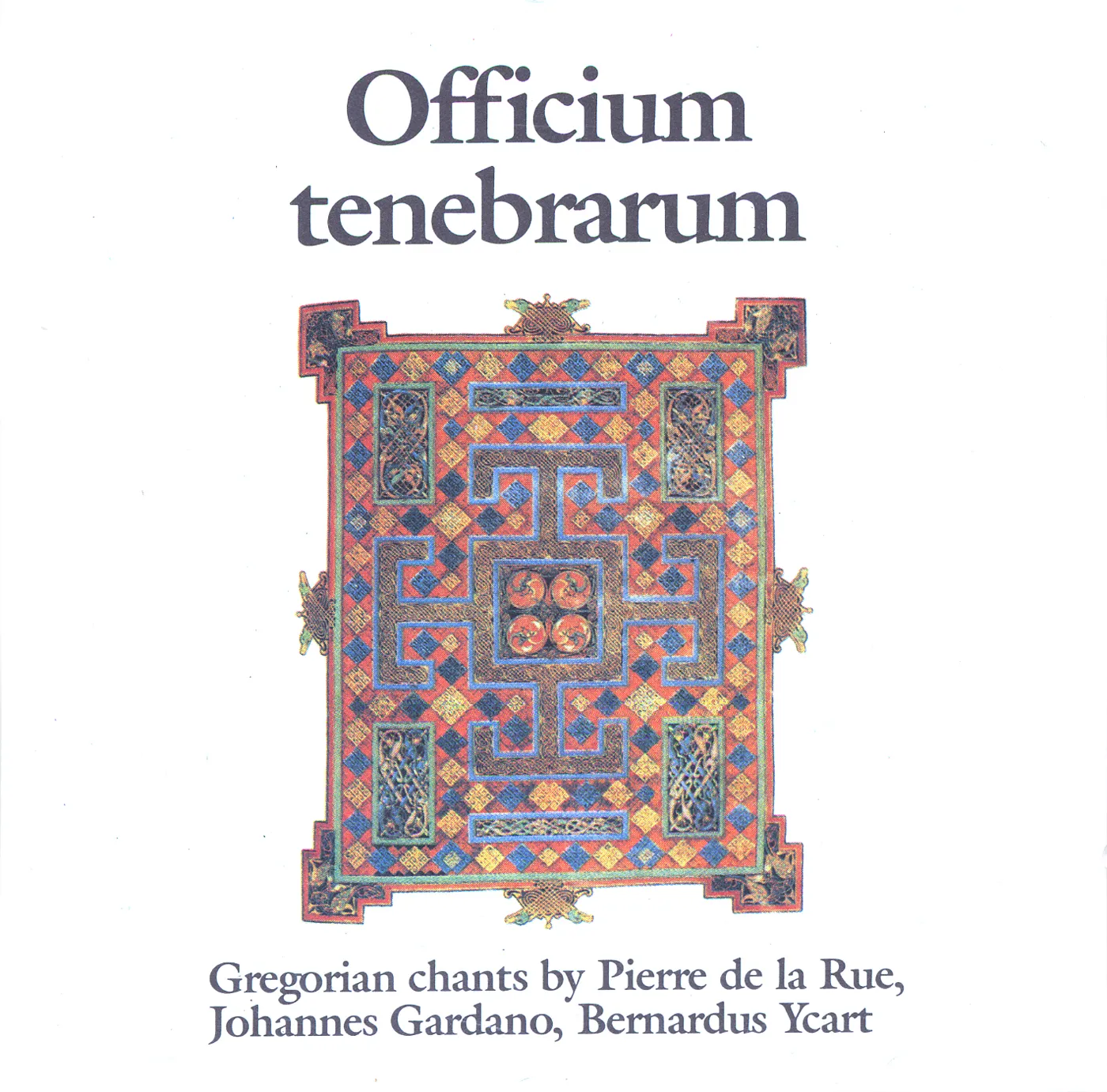
Biber, Mystery Sonatas
Svetlana Ramazanova,violin, Marina Belova, theorbo, Anastasia Akinfina, harpsichord, Avgust Krepak, cello, perform Sonata No. 10: The Crucifixion ...
Inaccessible.

Alla Gutnikova and three other editors of the student magazine DOXA were tried in court in Moscow on Friday 8th April and on 12th April were sentenced two years of "correctional labour" and a 3-year ban on administering any websites
This is her speech before the court ...
I won’t talk about the case, the searches, the interrogations, the tomes, the trials. It’s boring and pointless. Recently I’ve joined the school of tiredness and frustration. But even before the arrest, I managed to join the school of being able to talk about truly important things.I am not going to speak of the case, the search, the interrogations, the volumes, the trials. That is boring and pointless. These days I attend the school of fatigue and frustration. But before my arrest, I had time to enroll in the school of learning how to speak about truly important things.I would like to talk about philosophy and literature. About Benjamin, Derrida, Kafka, Arendt, Sontag, Barthes, Foucault, Agamben, about Audre Lorde and bell hooks. About Timofeeva, Tlostanova and Rachmaninova.I would like to speak about poetry, about how to read contemporary poetry. About Gronas, Dashevsky and Borodin.But now is not the time nor the place. I will hide my small tender words on the tip of my tongue, in the back of my throat, between my stomach and my heart. I will say just a little.I often feel like a little fish, a birdling, a schoolgirl, a baby. But recently, I discovered with surprise that Brodsky, too, was put on trial at 23. And, since I have also been counted among the human race, I will say this: In the Kabbala there is the concept of tikkun olam - repairing the world. I see that the world is imperfect. I believe, as wrote Yehuda Amichai, that the world was created beautiful for goodness and for peace, like a bench in a courtyard (in a courtyard, not a court!). I believe that the world was created for tenderness, hope, love, solidarity, passion, joy.But the world is atrociously, unbearably full of violence. And I don’t want violence. In any form. No teacher’s hands in schoolgirls’ underwear, no drunken father’s fists on the bodies of wives and children. If I decided to list all the violence around us, a day wouldn’t be enough, nor a week, nor a year. My eyes are wide open. I see violence, and I don’t want violence. The more violence there is, the stronger I don’t want it. And more than anything, I don’t want the biggest and the most frightening violence.I really love reading. I will now speak with the voices of others.At school, in history class, I learned the phrases “You crucify freedom, but the soul of man knows no bounds” and “For your, and for our, freedom”.In high school, I read “Requiem” by Anna Andreyevna Akhmatova, “The Steep Path” by Evgeniya Solomonovna Ginzburg, “The Closed Theater” by Bulat Shalvovich Okudzhava, “The Children of Arbat” by Anatoliy Naumovich Rybakov. Of Okudzhava’s poems I loved most of all:Conscience, honor and dignity,There’s our spiritual army.Hold out your palm to it,For this, one fears no fire.Its face is lofty and wonderful.Dedicate to it your short century.Maybe, you will never be victorious,But you'll die as a human.At MGIMO [Moscow State Institute of International Relations] I learned French and memorized a line from Édith Piaf: “Ça ne pouvait pas durer toujours” [“It could not last forever”]. And from Marc Robine: “Ça ne peut pas durer comme ça” [“It cannot go on like this”].At nineteen, I traveled to Majdanek and Treblinka and learned to say “never again” in seven languages: never again, jamais plus, nie wieder, קיינמאל מער, nigdy więcej, לא עוד.I studied Jewish sages and fell in love with two proverbs. Rabbi Hillel said: “If I am not for myself, who will be for me? If I am only for myself, what am I? And if not now, when?” And Rabbi Nachman said: “The whole world is a narrow bridge, and the main thing is to have no fear at all.”Later, I enrolled at the School of Cultural Studies and learned several more important lessons. First of all, words have meaning. Second, we must call things by their names. And finally, sapere aude, have the courage to use your own mind.It’s ridiculous that our case has to do with schoolchildren. I taught children the humanities in English, worked as a nanny and dreamed of going with the program “Teacher for Russia” to a small town for two years to sow intelligent, kind, eternal seeds. But Russia - in the words of the state prosecuting attorney, Prosecutor Tryakin - believes that I involved underage children in life-threatening actions. If I ever have children (and I will, because I remember the greatest commandment), I will hang a picture of the Judaean governor Pontius Pilate on their wall, so they grow up in cleanliness. The governor Pontius Pilate standing and washing his hands - such will be the portrait. Yes, if thinking and feeling is now life-threatening, I don’t know what to say about the charges. I wash my hands.And now is the moment of truth. The hour of transparency.My friends and I don’t know what to do with ourselves from the horror and the pain, but when I descend into the metro, I don’t see tear-stained faces. I don’t see tear-stained faces.Not a single of my favorite books - for children or adults - taught indifference, apathy, cowardice. Nowhere have I been taught the words:we are small peoplei am a simple personit’s not so black and whiteyou can’t believe anyonei am not interested in all thati am far from politicsit’s none of my businessnothing depends on mecompetent authorities will figure it outwhat could i have done aloneNo, I know and love very different words.John Donne says through Hemingway:No man is an island, all by himself. Every person is part of the Mainland, part of Land; and if a wave sweeps away a coastal cliff into the sea, Europe will become smaller. And likewise if it washes away the edge of the cape or destroys your castle or your friends. The death of every person diminishes me as well, for I am one with all of humanity. And so, don’t ask for whom the bell tolls, it tolls for you.Mahmoud Darwich says:As you prepare your breakfast — think of others(don’t forget to feed the pigeons).As you conduct your wars — think of others(don’t forget those who want peace).As you pay your water bill — think of others(think of those who have only the clouds to drink from).As you go home, your own home — think of others(don’t forget those who live in tents).As you sleep and count the stars, think of others(there are people who have no place to sleep).As you liberate yourself with metaphors think of others(those who have lost their right to speak).And as you think of distant others — think of yourself(and say, I wish I were a candle in the darkness).Gennady Golovaty says:The blind cannot look with wrath,The mute cannot yell with fury,The armless cannot take up arms,The legless cannot march forward.But, the mute can look wrathfully,But, the blind can yell furiously,But, the legless can take up arms.But, the armless can march forward.I know some are terrified. They choose silence. But Audre Lorde says:Your silence will not protect you.In the Moscow metro, they announce: Passengers are forbidden on the train heading to a dead end.And the St. Petersburg [band] Aquarium adds: This train is on fire.Lao Tzu, through Tarkovsky, says:And most important, let them believe in themselves, let them be helpless like children. Because weakness is a great thing, and strength is nothing. When a man is just born, he is weak and flexible. When he dies, he is hard and insensitive. When a tree is growing, it’s tender and pliant. But when it’s dry and hard, it dies. Hardness and strength are death’s companions. Pliancy and weakness are expressions of the freshness of being. Because what has hardened will never win.Remember that fear eats the soul. Remember the Kafka character who sees “a gallows being erected in the prison yard, mistakenly thinks it is the one intended for him, breaks out of his cell in the night, and goes down and hangs himself”.Be like children. Don’t be afraid to ask (yourselves and others), what is good and what is bad. Don’t be afraid to say that the emperor has no clothes. Don’t be afraid to yell, to cry. Repeat (to yourselves and others): 2+2=4. Black is black. White is white. I am a person, strong and brave. A strong and brave woman. A strong and brave people.Freedom is a process by which you develop the habit of being inaccessible to slavery.
Thank you, Veerle.
Egg-Bearing.

The first known mention of the Easter bunny or Easter hare in print was in a 1682 doctoral dissertation in Latin, the language of academia at the time. Georg Franck von Franckenau (1644-1704), a German medical doctor and botanist, taught anatomy, chemistry and botany at Jena and became Professor of Medicine at the University of Heidelberg in 1679. Following a French invasion in the War of the Palatinate Succession he left Heidelberg for Frankfurt and then the University of Wittenberg. Franckenau later moved to Denmark as the personal physician to Christian V in Copenhagen, where he died on June 17, 1704.
In 1682, while still at Heidelberg, under the name of Johannes Richier, one of his doctoral candidates, Professor Franck published a 16-page dissertation titled “De Ovis Paschalibus. Von Oster-Eyern.” (“On Easter Eggs”), which mentions for the first time the existence of the folk belief in an egg-bearing Easter bunny found in Protestant regions of Alsace and the Palatinate (Elsass und die Pfalz). In some other German-speaking regions the bringer of Easter eggs was a fox, a rooster, or the cuckoo bird. In English translation, part of the dissertation reads: “In Alsace, and neighboring regions, these eggs are called rabbit eggs because of the myth told to fool simple people and children that the Easter Bunny is going around laying eggs and hiding them in the herb gardens."
Regard.

Like vanishing dew,
a passing apparition
or the sudden flash
of lightning -- already gone --
thus should one regard one's self.
Ikkyu
Staid.
Kent, Starlight, 1930
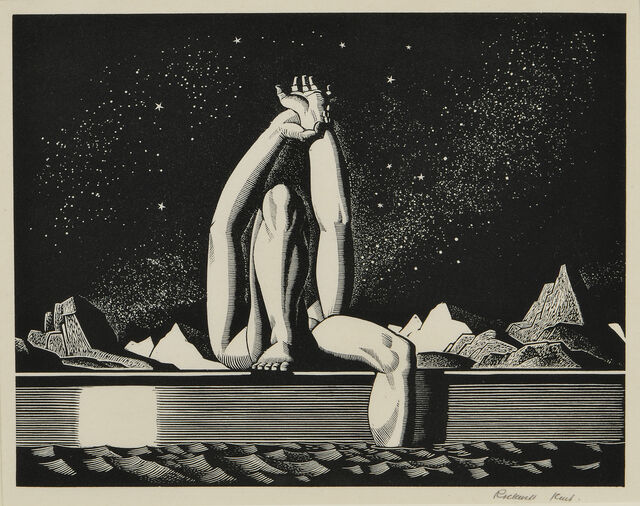
O Star (the fairest one in sight),
We grant your loftiness the right
To some obscurity of cloud—
It will not do to say of night,
Since dark is what brings out your light.
Some mystery becomes the proud.
But to be wholly taciturn
In your reserve is not allowed.
Say something to us we can learn
By heart and when alone repeat.
Say something! And it says, ‘I burn.’
But say with what degree of heat.
Talk Fahrenheit, talk Centigrade.
Use language we can comprehend.
Tell us what elements you blend.
It gives us strangely little aid,
But does tell something in the end.
And steadfast as Keats’ Eremite,
Not even stooping from its sphere,
It asks a little of us here.
It asks of us a certain height,
So when at times the mob is swayed
To carry praise or blame too far,
We may choose something like a star
To stay our minds on and be staid.
Robert Frost
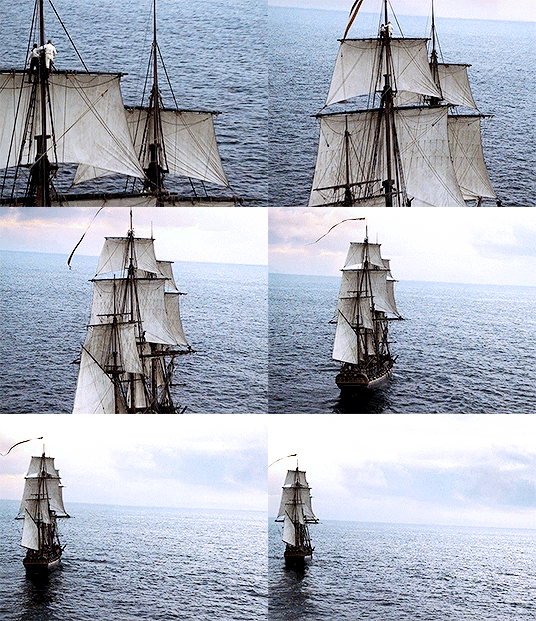
Grandeur.
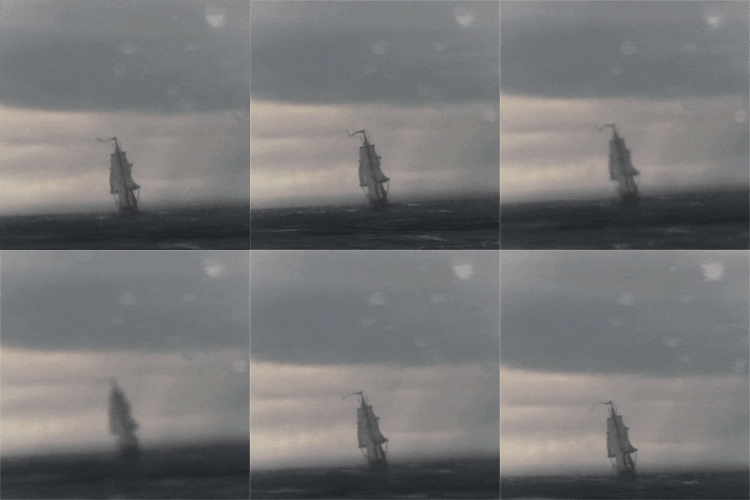
Weyeth, N.C., The Rakish Brigantine, 1914

He was thoroughly convinced that this is indispensable for everything sorcerers do, and for this reason he put an enormous emphasis on guiding all his students to fulfill this requirement. He was of the opinion that self-importance is not only the sorcerers' supreme enemy but the nemesis of mankind. Don Juan's argument was that most of our energy goes into upholding our importance. This is most obvious in our endless worry about the presentation of the self, about whether or not we are admired or liked or acknowledged. He reasoned that if we were capable of losing some of that importance, two extraordinary things would happen to us. One, we would free our energy from trying to maintain the illusory idea of our grandeur; and, two, we would provide ourselves with enough energy to enter into the second attention: to catch a glimpse of the actual grandeur of the universe.
Carlos Castañeda, from The Art of Dreaming
15 April 2022
Happy Birthday, Leonardo
Leonardo, Self-Portrait, 1515

Leonardo di ser Piero da Vinci was born on this day in 1452.
I'm sure he wouldn't allow cellphones at the table ...
He should not place his head upon his plate to eat.Neither should he sit beneath the table for any length of time.He should not place unpleasing or half-chewed pieces of his own food upon his neighbor’s plate without first asking him.He should not wipe his knife upon his neighbor’s clothing.Nor use his knife to carve upon the table...He should not set loose birds upon the table.Not snakes nor beetles...And if he is to vomit then he leaves the table.Likewise if he is to urinate.
14 April 2022
Released.

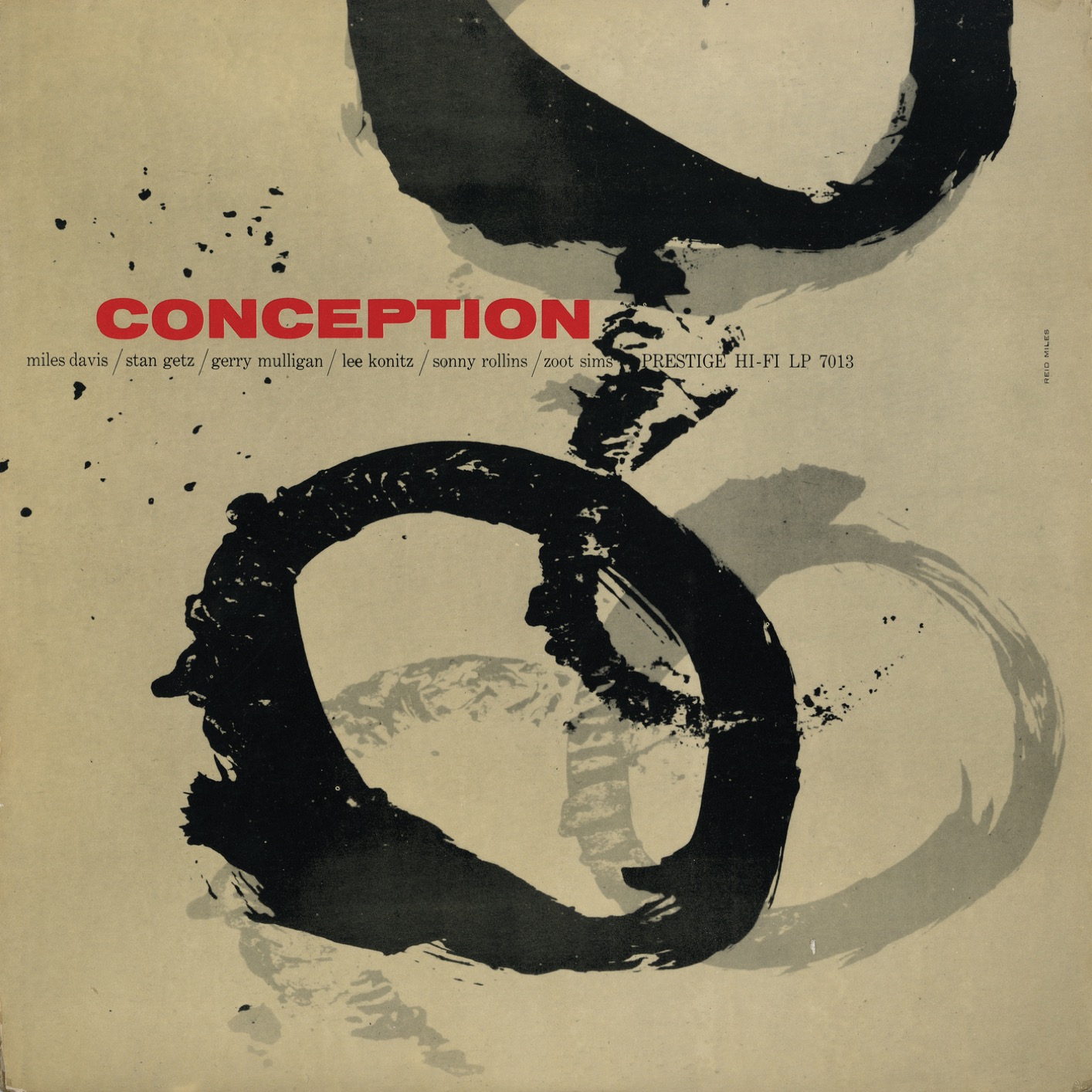
Judas Priest released British Steel on this day in 1980.
"Grinder"
Been inclined to wanderOff the beaten trackThat's where the thunderAnd the wind shouts back ...
13 April 2022

Happy Birthday, Jefferson
Sully, Thomas Jefferson, 1821
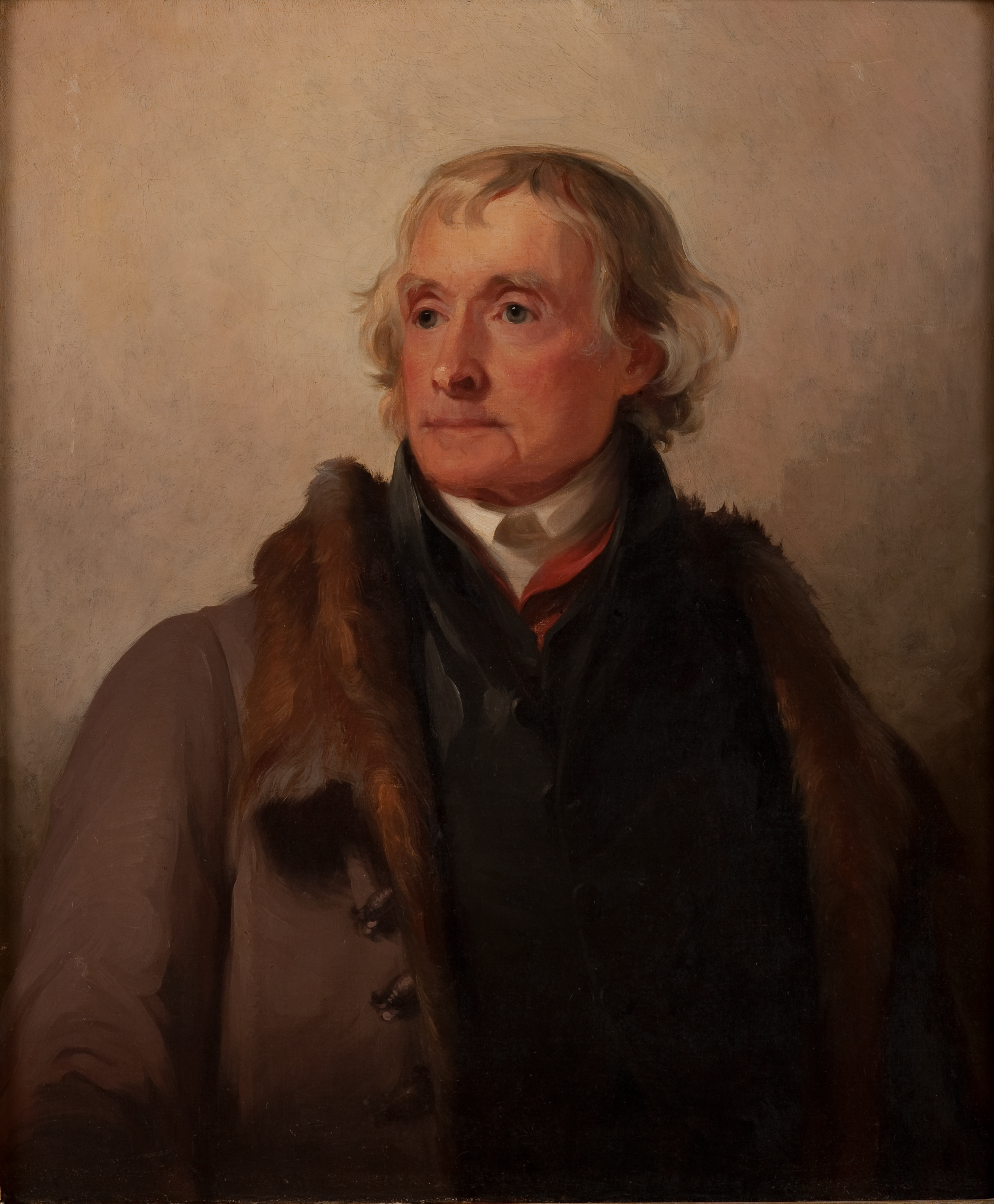
Thomas Jefferson was born on this day in 1743.
What a stupendous, what an incomprehensible machine is man! Who can endure toil, famine, stripes, imprisonment & death itself in vindication of his own liberty, and the next moment . . . inflict on his fellow men a bondage, one hour of which is fraught with more misery than ages of that which he rose in rebellion to oppose.Thomas Jefferson, from a letter to Jean Nicholas Demeunier, January 24, 1786
11 April 2022
Readiest.
Wyeth, April Wind, 1954

The SONG of the FOUR WINDS
Wind from the north: the young spring day
Is pleasant on the sunny mead;
Tho' merry harps at evening play;
The dance gay youths and maidens lead:
The thrush makes chorus from the thorn:
The mighty drinker fills his horn.
Wind from the east: the shore is still;
The mountain-clouds fly tow'rds the sea;
The ice is on the winter-rill;
The great hall fire is blazing free:
The prince's circling feast is spread:
Drink fills with fumes the brainless head.
Wind from the south: in summer shade
'Tis sweet to hear the loud harp ring;
Sweet is the step of comely maid,
Who to the bard a cup doth bring:
The black crow flies where carrion lies:
Where pignuts lurk, the swine will work.
Wind from the west: the autumnal deep
Rolls on the shore its billowy pride:
He, who the rampart's watch must keep,
Will mark with awe the rising tide:
The high springtide, that bursts its mound,
May roll o'er miles of level ground.
Wind from the west: the mighty wave
Of ocean bounds o'er rock and sand;
The foaming surges roar and rave
Against the bulwarks of the land:
When waves are rough, and winds are high,
Good is the land that's high and dry.
Wind from the west: the storm-clouds rise;
The breakers rave; the whirlblasts roar;
The mingled rage of the seas and skies
Bursts on the low and lonely shore:
When safety's far, and danger nigh,
Swift feet the readiest aid supply.
Wind from the west---
Thomas Love Peacock
10 April 2022
Tinder.
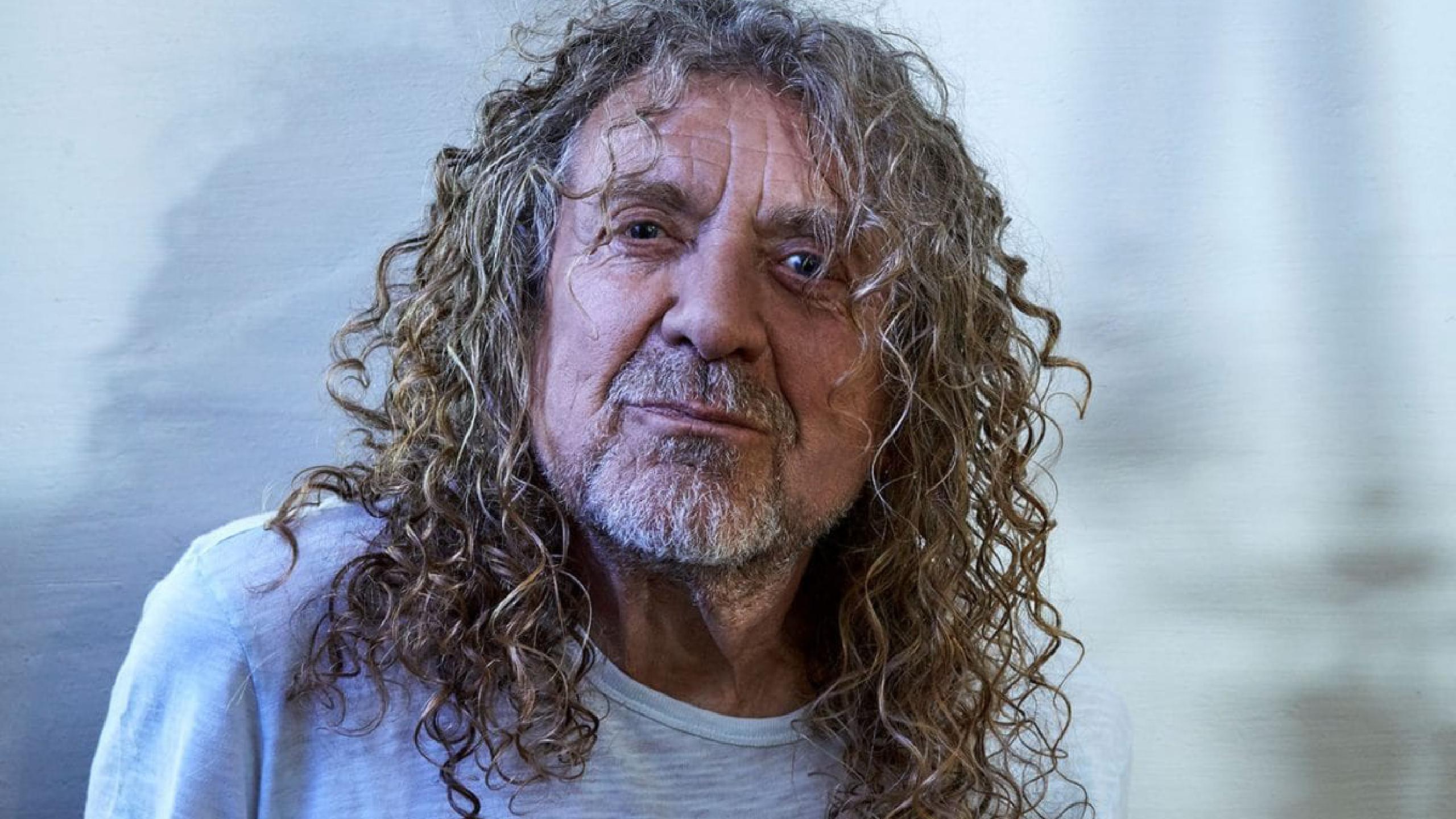
Robert Plant was featured on a recent episode of the BBC's "Desert Island Discs" ...
My imagination is like a tinder box.

Union.

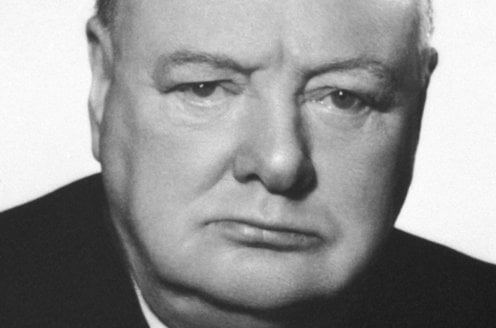
The genius of Churchill was his union of affinities of the heart and of the mind. The total fusion of animal and spiritual energy.
William F. Buckley Jr., from the "Proceedings of the International Churchill Societies, 1994-95"
09 April 2022
Joshua Ray Walker, "Three Strikes"
Pass the bottle gotta top off my Big Gulp
Hit the throttle bet you can't make this thing jump
Never left all four wheels in that LTD
Cleared the tracks, but wrapped it 'round the old oak tree
'Cause it's once, twice, three strikes a felony
If I keep on messing around, this drinking will get the best of me
It's once, twice, three strikes a felony
Who knows if my luck runs out, I guess we'll have to wait and see ...
Ditch Kurtz, steel ...
Thanks to the Sanford Lake Bar & Grill for this cultural exposure.
Girded.

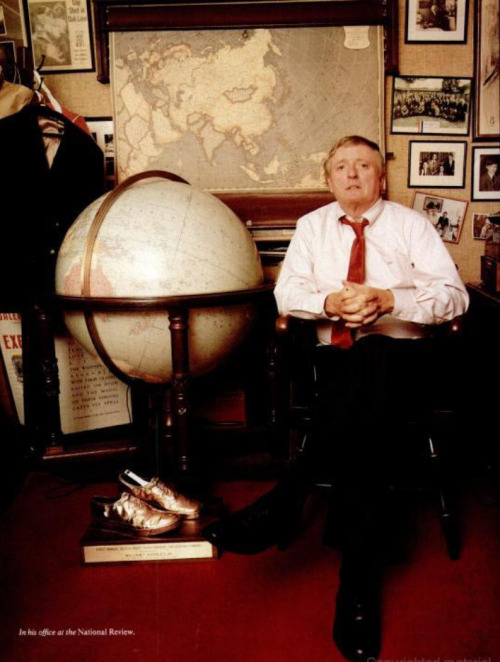
I myself can occasionally summon the courage to complain, but I cannot, as I have intimated, complain softly. My own instinct is so strong to let the thing ride, to forget about it -- to expect that someone will take the matter up, when the grievance is collective, in my behalf -- that it is only when the provocation is at a very special key, whose vibrations touch simultaneously a complex of nerves, allergies, and passions, that I catch fire and find the reserves of courage and assertiveness to speak up. When that happens, I get quite carried away. My blood gets hot, my brow wet, I become unbearably and unconscionably sarcastic and bellicose; I am girded for a total showdown.
William F. Buckley Jr, from "Why Don't We Complain?"
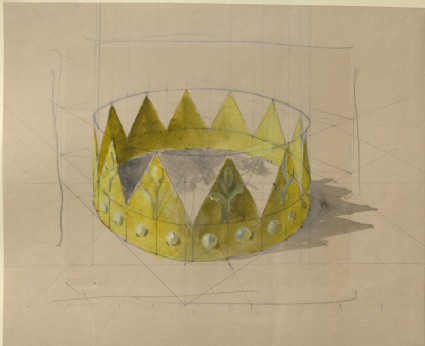
Performer.
Ruskin, Perspective Studies of a Paper Crown, 1870

As soon as one is aware of being “somebody,” to be watched and listened to with extra interest, input ceases, and the performer goes blind and deaf in his overanimation. The best seeing is done by the hunted and the hunter, the vulnerable and the hungry. Self-importance is a thickened, occluding form of self-consciousness.
John Updike
Happy Birthday, Baudelaire
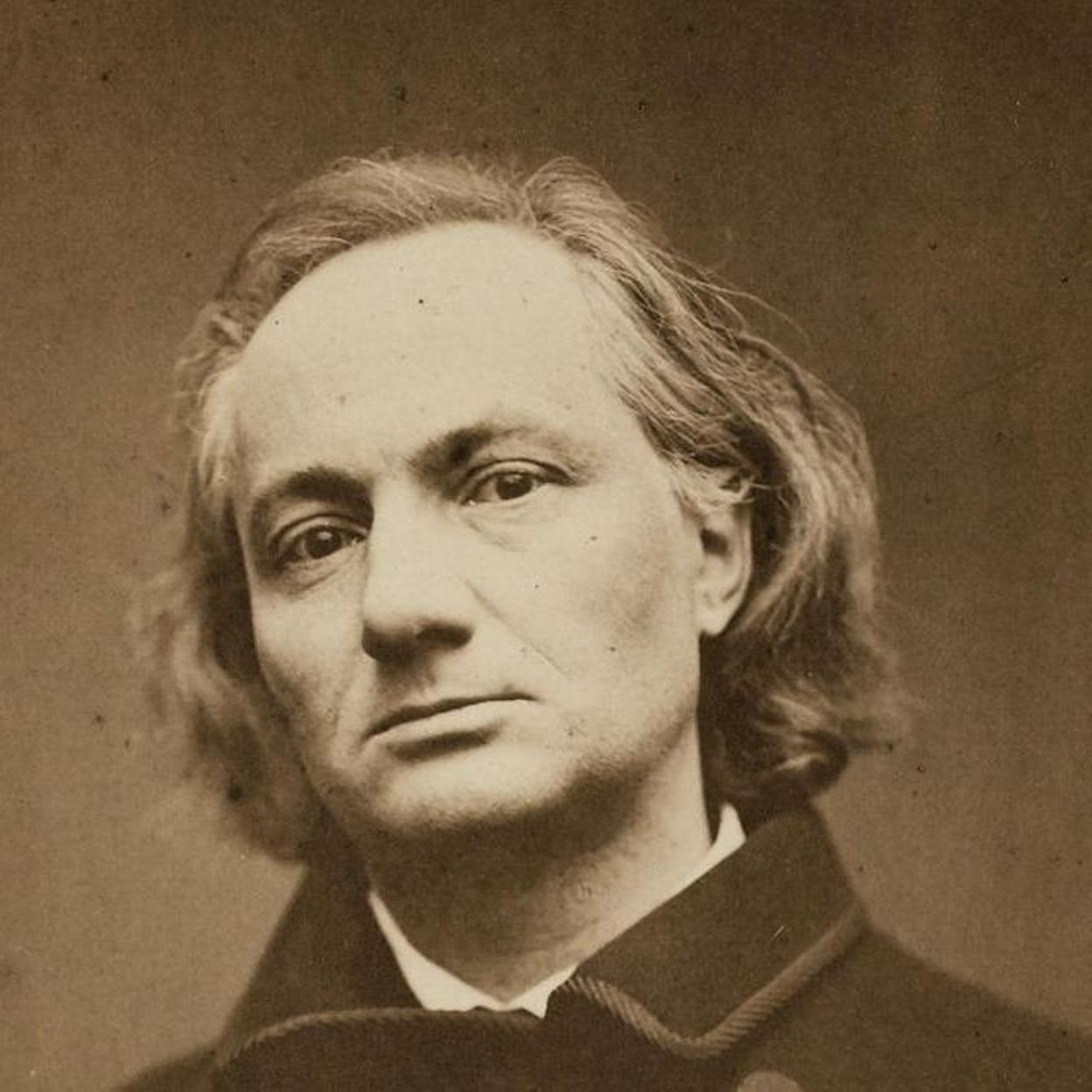
Charles Baudelaire was born on this day in 1823..
Be always drunken.
Nothing else matters:
that is the only question.
If you would not feel
the horrible burden of Time
weighing on your shoulders
and crushing you to the earth,
be drunken continually.
Drunken with what?
With wine, with poetry, or with virtue, as you will.
But be drunken.
And if sometimes,
on the stairs of a palace,
or on the green side of a ditch,
or in the dreary solitude of your own room,
you should awaken
and the drunkenness be half or wholly slipped away from you,
ask of the wind,
or of the wave,
or of the star,
or of the bird,
or of the clock,
of whatever flies,
or sighs,
or rocks,
or sings,
or speaks,
ask what hour it is;
and the wind,
wave,
star,
bird,
clock will answer you:
"It is the hour to be drunken!”
Charles Baudelaire
08 April 2022
Happy Birthday, Tartini
Dolbrano, Guiseppe Tartini, n/d

Giuseppe Tartini was born on this day in 1692.
Anne-Sophie Mutter performs his composition, the Violin Sonata in G minor, B.g5, more familiarly known as the "Devil's Trill" ...
Singing.
For, lo, the winter is past,
The rain is over and gone;
The flowers appear on the earth;
The time of the singing of birds is come,
Miggy went 1-4 with 2 RBI as the Tigers won their opener today.
Remember the name Spencer Torkelson.
07 April 2022
Prolific.
Lapham's Quarterly on metal's fascination with Roman emperors ...
Roman emperors have enjoyed a prolific reception in metal music around the world—Caligula and Nero most of all, with not only hundreds of individual songs but also entire concept albums dedicated to them, such as the Belgian band Paragon Impure’s 2005 album To Gaius! (For the Delivery of Agrippina) and the Russian band Neron Kaisar’s 2013 album Madness of the Tyrant. The year 2021 saw the release of two separate records about Nero: the UK band Acid Age’s Semper Pessimus and the Canadian band Ex Deo’s The Thirteen Years of Nero. The extent of certain emperors’ popularity can even be quantified, thanks to the online database Encyclopaedia Metallum. Entering each emperor’s name into the advanced search for their appearance in lyrics and song titles, and after eliminating duplicates and false positives (e.g., nero being Italian for “black”), led me to create the following bar graph, which went semi-viral on Twitter in April 2021:
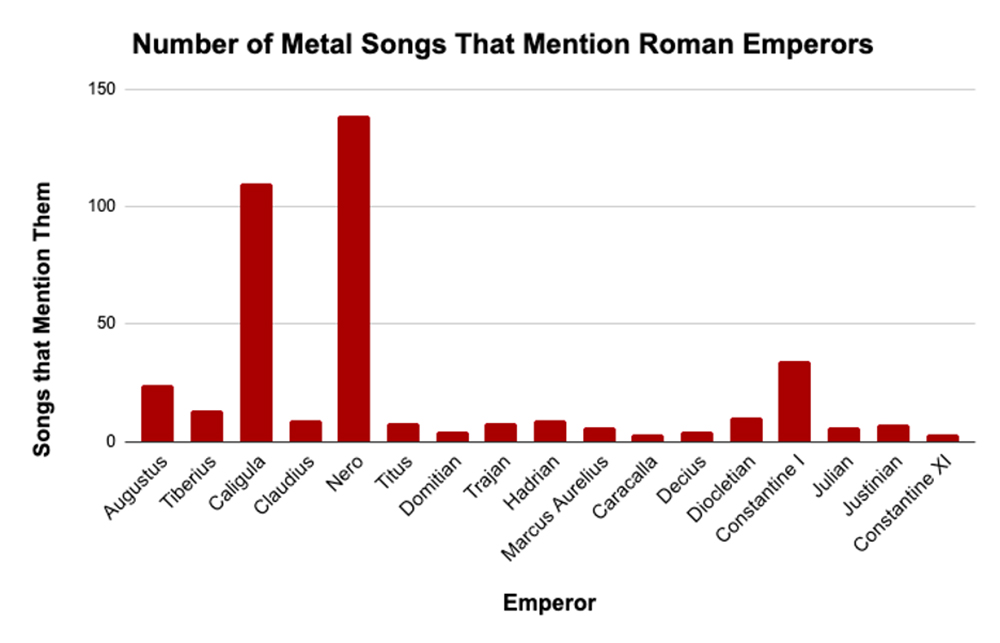
Nero with 139 songs, followed by Caligula with 110, tops a sizable catalogue of 444 songs. Yet this data set consists only of mentions by name in songs with available lyrics in the Encyclopaedia Metallum and excludes untold numbers of tracks about emperors that do not name them, such as “Incitatus,” an old-school death metal ode to Caligula’s horse and would-be consul from 2019 by the Brazilian band Orthostat, or the American band Graves of Valor’s 2009 song “Locusta,” named after the woman Nero praises as the poisoner of not only his predecessor Claudius but also his stepbrother Britannicus and his mother Agrippina.The numbers speak for themselves: emperors are metal. But why?
06 April 2022
Tolerate.

To think deeply in our culture is to grow angry and to anger others; and if you cannot tolerate this anger, you are wasting the time you spend thinking deeply. One of the rewards of deep thought is the hot glow of anger at discovering a wrong, but if anger is taboo, thought will starve to death.
Jules Henry
05 April 2022
Streams.
Fragonard, Philosopher Reading, 1770

For your sake poets sequester themselves,
gather images to churn the mind,
journey forth, ripening with metaphor,
and all their lives they are so alone…
And painters paint their pictures only
that the world, so transient as you made it,
can be given back to you,
to last forever.
All becomes eternal. See: In the Mona Lisa
some woman has long since ripened like wine,
and the enduring feminine is held there
through all the ages.
Those who create are like you.
They long for the eternal.
They say, Stone, be forever!
And that means: be yours.
And lovers also gather your inheritance.
They are the poets of one brief hour.
They kiss an expressionless mouth into a smile
as if creating it anew, more beautiful.
Awakening desire, they make a place
where pain can enter;
that’s how growing happens.
They bring suffering along with their laughter,
and longings that had slept and now awaken
to weep in a stranger’s arms.
They let the riddles pile up and then they die
the way animals die, without making sense of it.
But maybe in those who come after,
their green life will ripen;
it’s then that you will inherit the love
to which they gave themselves so blindly, as in a sleep.
Thus the overflow from things
pours into you.
Just as a fountain’s higher basins
spill down like strands of loosened hair
into the lowest vessel,
so streams the fullness into you,
when things and thoughts cannot contain it.
Rainer Maria Rilke
Forth.

The EVE of REVOLUTION
The trumpets of the four winds of the world
From the ends of the earth blow battle; the night heaves,
With breasts palpitating and wings refurled,
With passion of couched limbs, as one who grieves
Sleeping, and in her sleep she sees uncurled
Dreams serpent-shapen, such as sickness weaves,
Down the wild wind of vision caught and whirled,
Dead leaves of sleep, thicker than autumn leaves,
Shadows of storm-shaped things,
Flights of dim tribes of kings,
The reaping men that reap men for their sheaves,
And, without grain to yield,
Their scythe-swept harvest-field
Thronged thick with men pursuing and fugitives,
Dead foliage of the tree of sleep,
Leaves blood-coloured and golden, blown from deep to deep.
I hear the midnight on the mountains cry
With many tongues of thunders, and I hear
Sound and resound the hollow shield of sky
With trumpet-throated winds that charge and cheer,
And through the roar of the hours that fighting fly,
Through flight and fight and all the fluctuant fear,
A sound sublimer than the heavens are high,
A voice more instant than the winds are clear,
Say to my spirit, "Take
Thy trumpet too, and make
A rallying music in the void night's ear,
Till the storm lose its track,
And all the night go back;
Till, as through sleep false life knows true life near,
Thou know the morning through the night,
And through the thunder silence, and through darkness light."
I set the trumpet to my lips and blow.
The height of night is shaken, the skies break,
The winds and stars and waters come and go
By fits of breath and light and sound, that wake
As out of sleep, and perish as the show
Built up of sleep, when all her strengths forsake
The sense-compelling spirit; the depths glow,
The heights flash, and the roots and summits shake
Of earth in all her mountains,
And the inner foamless fountains
And wellsprings of her fast-bound forces quake;
Yea, the whole air of life
Is set on fire of strife,
Till change unmake things made and love remake;
Reason and love, whose names are one,
Seeing reason is the sunlight shed from love the sun.
The night is broken eastward; is it day,
Or but the watchfires trembling here and there,
Like hopes on memory's devastated way,
In moonless wastes of planet-stricken air?
O many-childed mother great and grey,
O multitudinous bosom, and breasts that bare
Our fathers' generations, whereat lay
The weanling peoples and the tribes that were,
Whose new-born mouths long dead
Those ninefold nipples fed,
Dim face with deathless eyes and withered hair,
Fostress of obscure lands,
Whose multiplying hands
Wove the world's web with divers races fair
And cast it waif-wise on the stream,
The waters of the centuries, where thou sat'st to dream;
O many-minded mother and visionary,
Asia, that sawest their westering waters sweep
With all the ships and spoils of time to carry
And all the fears and hopes of life to keep,
Thy vesture wrought of ages legendary
Hides usward thine impenetrable sleep,
And thy veiled head, night's oldest tributary,
We know not if it speak or smile or weep.
But where for us began
The first live light of man
And first-born fire of deeds to burn and leap,
The first war fair as peace
To shine and lighten Greece,
And the first freedom moved upon the deep,
God's breath upon the face of time
Moving, a present spirit, seen of men sublime;
There where our east looks always to thy west,
Our mornings to thine evenings, Greece to thee,
These lights that catch the mountains crest by crest,
Are they of stars or beacons that we see?
Taygetus takes here the winds abreast,
And there the sun resumes Thermopylae;
The light is Athens where those remnants rest,
And Salamis the sea-wall of that sea.
The grass men tread upon
Is very Marathon,
The leaves are of that time-unstricken tree
That storm nor sun can fret
Nor wind, since she that set
Made it her sign to men whose shield was she;
Here, as dead time his deathless things,
Eurotas and Cephisus keep their sleepless springs.
O hills of Crete, are these things dead? O waves,
O many-mouthed streams, are these springs dry?
Earth, dost thou feed and hide now none but slaves?
Heaven, hast thou heard of men that would not die?
Is the land thick with only such men's graves
As were ashamed to look upon the sky?
Ye dead, whose name outfaces and outbraves
Death, is the seed of such as you gone by?
Sea, have thy ports not heard
Some Marathonian word
Rise up to landward and to Godward fly?
No thunder, that the skies
Sent not upon us, rise
With fire and earthquake and a cleaving cry?
Nay, light is here, and shall be light,
Though all the face of the hour be overborne with night.
I set the trumpet to my lips and blow.
The night is broken northward; the pale plains
And footless fields of sun-forgotten snow
Feel through their creviced lips and iron veins
Such quick breath labour and such clean blood flow
As summer-stricken spring feels in her pains
When dying May bears June, too young to know
The fruit that waxes from the flower that wanes;
Strange tyrannies and vast,
Tribes frost-bound to their past,
Lands that are loud all through their length with chains,
Wastes where the wind's wings break,
Displumed by daylong ache
And anguish of blind snows and rack-blown rains,
And ice that seals the White Sea's lips,
Whose monstrous weights crush flat the sides of shrieking ships;
Horrible sights and sounds of the unreached pole,
And shrill fierce climes of inconsolable air,
Shining below the beamless aureole
That hangs about the north-wind's hurtling hair,
A comet-lighted lamp, sublime and sole
Dawn of the dayless heaven where suns despair;
Earth, skies, and waters, smitten into soul,
Feel the hard veil that iron centuries wear
Rent as with hands in sunder,
Such hands as make the thunder
And clothe with form all substance and strip bare;
Shapes, shadows, sounds and lights
Of their dead days and nights
Take soul of life too keen for death to bear;
Life, conscience, forethought, will, desire,
Flood men's inanimate eyes and dry-drawn hearts with fire.
Light, light, and light! to break and melt in sunder
All clouds and chains that in one bondage bind
Eyes, hands, and spirits, forged by fear and wonder
And sleek fierce fraud with hidden knife behind;
There goes no fire from heaven before their thunder,
Nor are the links not malleable that wind
Round the snared limbs and souls that ache thereunder;
The hands are mighty, were the head not blind.
Priest is the staff of king,
And chains and clouds one thing,
And fettered flesh with devastated mind.
Open thy soul to see,
Slave, and thy feet are free;
Thy bonds and thy beliefs are one in kind,
And of thy fears thine irons wrought
Hang weights upon thee fashioned out of thine own thought.
O soul, O God, O glory of liberty,
To night and day their lightning and their light!
With heat of heart thou kindlest the quick sea,
And the dead earth takes spirit from thy sight;
The natural body of things is warm with thee,
And the world's weakness parcel of thy might;
Thou seest us feeble and forceless, fit to be
Slaves of the years that drive us left and right,
Drowned under hours like waves
Wherethrough we row like slaves;
But if thy finger touch us, these take flight.
If but one sovereign word
Of thy live lips be heard,
What man shall stop us, and what God shall smite?
Do thou but look in our dead eyes,
They are stars that light each other till thy sundawn rise.
Thou art the eye of this blind body of man,
The tongue of this dumb people; shalt thou not
See, shalt thou speak not for them?
Time is wan And hope is weak with waiting, and swift thought
Hath lost the wings at heel wherewith he ran,
And on the red pit's edge sits down distraught
To talk with death of days republican
And dreams and fights long since dreamt out and fought;
Of the last hope that drew
To that red edge anew
The firewhite faith of Poland without spot;
Of the blind Russian might,
And fire that is not light;
Of the green Rhineland where thy spirit wrought;
But though time, hope, and memory tire,
Canst thou wax dark as they do, thou whose light is fire?
I set the trumpet to my lips and blow.
The night is broken westward; the wide sea
That makes immortal motion to and fro
From world's end unto world's end, and shall be
When nought now grafted of men's hands shall grow
And as the weed in last year's waves are we
Or spray the sea-wind shook a year ago
From its sharp tresses down the storm to lee,
The moving god that hides
Time in its timeless tides
Wherein time dead seems live eternity,
That breaks and makes again
Much mightier things than men,
Doth it not hear change coming, or not see?
Are the deeps deaf and dead and blind,
To catch no light or sound from landward of mankind?
O thou, clothed round with raiment of white waves,
Thy brave brows lightening through the grey wet air,
Thou, lulled with sea-sounds of a thousand caves,
And lit with sea-shine to thine inland lair,
Whose freedom clothed the naked souls of slaves
And stripped the muffled souls of tyrants bare,
O, by the centuries of thy glorious graves,
By the live light of the earth that was thy care,
Live, thou must not be dead,
Live; let thine armed head
Lift itself up to sunward and the fair
Daylight of time and man,
Thine head republican,
With the same splendour on thine helmless hair
That in his eyes kept up a light
Who on thy glory gazed away their sacred sight;
Who loved and looked their sense to death on thee;
Who taught thy lips imperishable things,
And in thine ears outsang thy singing sea;
Who made thy foot firm on the necks of kings
And thy soul somewhile steadfast--woe are we
It was but for a while, and all the strings
Were broken of thy spirit; yet had he
Set to such tunes and clothed it with such wings
It seemed for his sole sake
Impossible to break,
And woundless of the worm that waits and stings,
The golden-headed worm
Made headless for a term,
The king-snake whose life kindles with the spring's,
To breathe his soul upon her bloom,
And while she marks not turn her temple to her tomb.
By those eyes blinded and that heavenly head
And the secluded soul adorable,
O Milton's land, what ails thee to be dead?
Thine ears are yet sonorous with his shell
That all the songs of all thy sea-line fed
With motive sound of spring-tides at mid swell,
And through thine heart his thought as blood is shed,
Requickening thee with wisdom to do well;
Such sons were of thy womb,
England, for love of whom
Thy name is not yet writ with theirs that fell,
But, till thou quite forget
What were thy children, yet
On the pale lips of hope is as a spell;
And Shelley's heart and Landor's mind
Lit thee with latter watch-fires; why wilt thou be blind?
Though all were else indifferent, all that live
Spiritless shapes of nations; though time wait
In vain on hope till these have help to give,
And faith and love crawl famished from the gate;
Canst thou sit shamed and self-contemplative
With soulless eyes on thy secluded fate?
Though time forgive them, thee shall he forgive,
Whose choice was in thine hand to be so great?
Who cast out of thy mind
The passion of man's kind,
And made thee and thine old name separate?
Now when time looks to see
New names and old and thee
Build up our one Republic state by state,
England with France, and France with Spain,
And Spain with sovereign Italy strike hands and reign.
O known and unknown fountain-heads that fill
Our dear life-springs of England! O bright race
Of streams and waters that bear witness still
To the earth her sons were made of! O fair face
Of England, watched of eyes death cannot kill,
How should the soul that lit you for a space
Fall through sick weakness of a broken will
To the dead cold damnation of disgrace?
Such wind of memory stirs
On all green hills of hers,
Such breath of record from so high a place,
From years whose tongues of flame
Prophesied in her name
Her feet should keep truth's bright and burning trace,
We needs must have her heart with us,
Whose hearts are one with man's; she must be dead or thus.
Who is against us? who is on our side?
Whose heart of all men's hearts is one with man's?
Where art thou that wast prophetess and bride,
When truth and thou trod under time and chance?
What latter light of what new hope shall guide
Out of the snares of hell thy feet, O France?
What heel shall bruise these heads that hiss and glide,
What wind blow out these fen-born fires that dance
Before thee to thy death?
No light, no life, no breath,
From thy dead eyes and lips shall take the trance,
Till on that deadliest crime
Reddening the feet of time
Who treads through blood and passes, time shall glance
Pardon, and Italy forgive,
And Rome arise up whom thou slewest, and bid thee live.
I set the trumpet to my lips and blow.
The night is broken southward; the springs run,
The daysprings and the watersprings that flow
Forth with one will from where their source was one,
Out of the might of morning: high and low,
The hungering hills feed full upon the sun,
The thirsting valleys drink of him and glow
As a heart burns with some divine thing done,
Or as blood burns again
In the bruised heart of Spain,
A rose renewed with red new life begun,
Dragged down with thorns and briers,
That puts forth buds like fires
Till the whole tree take flower in unison,
And prince that clogs and priest that clings
Be cast as weeds upon the dunghill of dead things.
Ah heaven, bow down, be nearer! This is she,
Italia, the world's wonder, the world's care,
Free in her heart ere quite her hands be free,
And lovelier than her loveliest robe of air.
The earth hath voice, and speech is in the sea,
Sounds of great joy, too beautiful to bear;
All things are glad because of her, but we
Most glad, who loved her when the worst days were.
O sweetest, fairest, first,
O flower, when times were worst,
Thou hadst no stripe wherein we had no share.
Have not our hearts held close,
Kept fast the whole world's rose?
Have we not worn thee at heart whom none would wear?
First love and last love, light of lands,
Shall we not touch thee full-blown with our lips and hands?
O too much loved, what shall we say of thee?
What shall we make of our heart's burning fire,
The passion in our lives that fain would be
Made each a brand to pile into the pyre
That shall burn up thy foemen, and set free
The flame whence thy sun-shadowing wings aspire?
Love of our life, what more than men are we,
That this our breath for thy sake should expire,
For whom to joyous death
Glad gods might yield their breath,
Great gods drop down from heaven to serve for hire?
We are but men, are we,
And thou art Italy;
What shall we do for thee with our desire?
What gift shall we deserve to give?
How shall we die to do thee service, or how live?
The very thought in us how much we love thee
Makes the throat sob with love and blinds the eyes.
How should love bear thee, to behold above thee
His own light burning from reverberate skies?
They give thee light, but the light given them of thee
Makes faint the wheeling fires that fall and rise.
What love, what life, what death of man's should move thee,
What face that lingers or what foot that flies?
It is not heaven that lights
Thee with such days and nights,
But thou that heaven is lit from in such wise.
O thou her dearest birth,
Turn thee to lighten earth,
Earth too that bore thee and yearns to thee and cries;
Stand up, shine, lighten, become flame,
Till as the sun's name through all nations be thy name.
I take the trumpet from my lips and sing.
O life immeasurable and imminent love,
And fear like winter leading hope like spring,
Whose flower-bright brows the day-star sits above,
Whose hand unweariable and untiring wing
Strike music from a world that wailed and strove,
Each bright soul born and every glorious thing,
From very freedom to man's joy thereof,
O time, O change and death,
Whose now not hateful breath
But gives the music swifter feet to move
Through sharp remeasuring tones
Of refluent antiphones
More tender-tuned than heart or throat of dove,
Soul into soul, song into song,
Life changing into life, by laws that work not wrong;
O natural force in spirit and sense, that art
One thing in all things, fruit of thine own fruit,
O thought illimitable and infinite heart
Whose blood is life in limbs indissolute
That still keeps hurtless thine invisible part
And inextirpable thy viewless root
Whence all sweet shafts of green and each thy dart
Of sharpening leaf and bud resundering shoot;
Hills that the day-star hails,
Heights that the first beam scales,
And heights that souls outshining suns salute,
Valleys for each mouth born
Free now of plenteous corn,
Waters and woodlands' musical or mute;
Free winds that brighten brows as free,
And thunder and laughter and lightning of the sovereign sea;
Rivers and springs, and storms that seek your prey;
With strong wings ravening through the skies by night;
Spirits and stars that hold one choral way;
O light of heaven, and thou the heavenlier light
Aflame above the souls of men that sway
All generations of all years with might;
O sunrise of the repossessing day,
And sunrise of all-renovating right;
And thou, whose trackless foot
Mocks hope's or fear's pursuit,
Swift Revolution, changing depth with height;
And thou, whose mouth makes one
All songs that seek the sun,
Serene Republic of a world made white;
Thou, Freedom, whence the soul's springs ran;
Praise earth for man's sake living, and for earth's sake man.
Make yourselves wings, O tarrying feet of fate,
And hidden hour that hast our hope to bear,
A child-god, through the morning-coloured gate
That let's love in upon the golden air,
Dead on whose threshold lies heart-broken hate,
Dead discord, dead injustice, dead despair;
O love long looked for, wherefore wilt thou wait,
And shew not yet the dawn on thy bright hair.
Not yet thine hand released
Refreshing the faint east,
Thine hand reconquering heaven, to seat man there?
Come forth, be born and live,
Thou that hast help to give
And light to make man's day of manhood fair:
With flight outflying the sphered sun,
Hasten thine hour and halt not, till thy work be done.
Algernon Charles Swinburne
Since.

AFTER the FLOOD
Just as the idea of the Flood went subsiding,
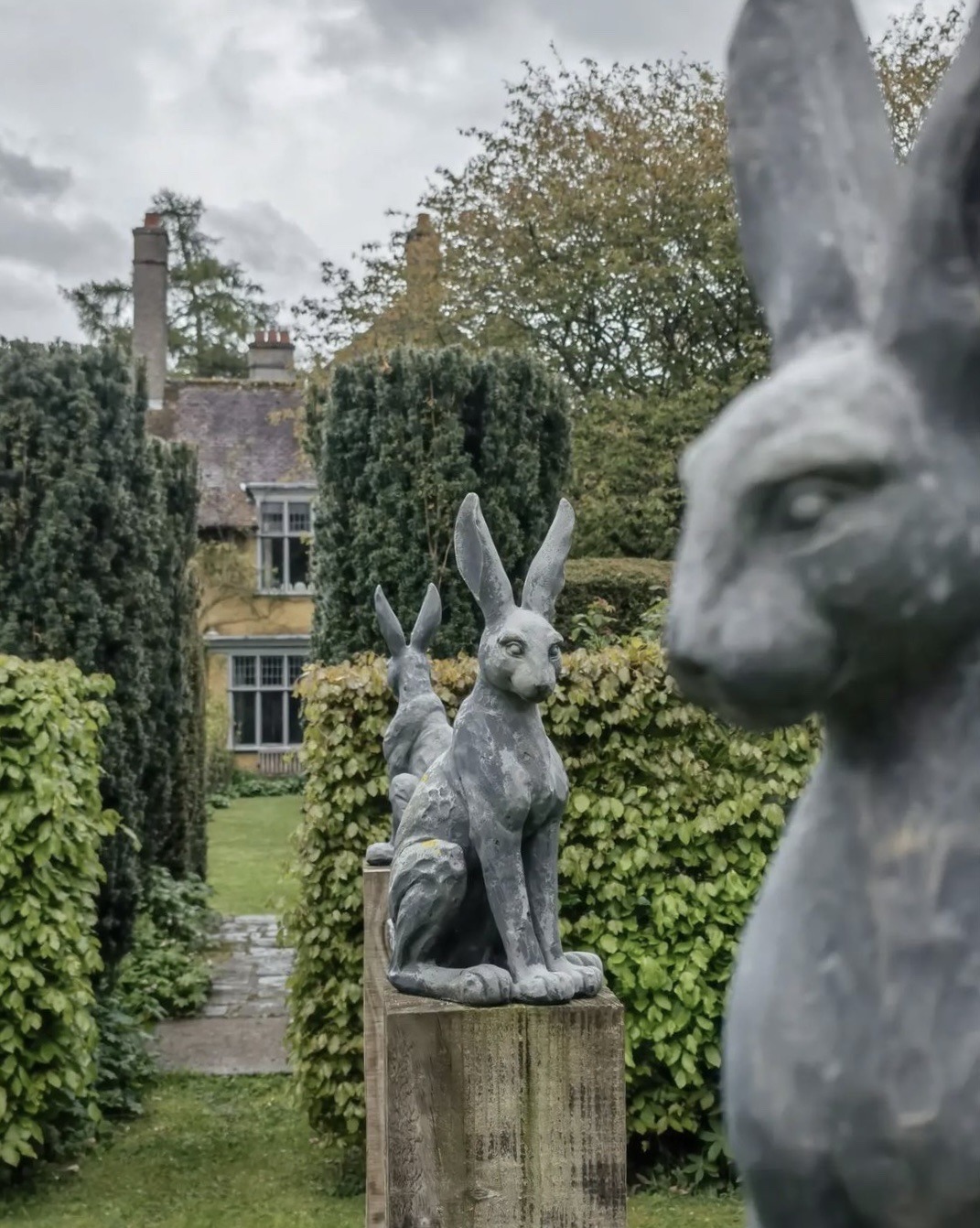
A hare stopped in the swaying clover and flower bells, and said its prayer to the rainbow, through the spider’s web.
Oh! The precious stones that hid themselves, —the flowers that already were watching.
In the dirty main street, the stalls rose, and some hauled the boats to the sea piled up as on engravings,
Blood flowed, at Blue Beard’s, —in the slaughterhouses, in circuses, and where the seal of God white-washed the windows. Blood and milk flowed.
The beavers built. “Mazagrans” smoked in the coffee bars.
In the big house of glass still dripping, the mourning children looked on the wondrous pictures.
A door slammed; and, on the square of the hamlet, the child waved his arms, understood by the wind vanes and the cocks on steeples everywhere, in the bursting shower.
Madame *** set up a piano in the Alps. Mass and first communions were celebrated at the hundred thousand altars of the cathedral.
The caravans took off. And Hotel Splendor was built in the chaos of ices and polar night.
And from then on, the moon heard jackals howling through the deserts of thyme, —and the sabot-clad eclogues growling in the orchard. And, in the violet woods, Eucharis told me it was Spring.
Gush, pond; —Foam, roll on the bridge and over the woods; —black palls and organs, lightning and thunder, rise and roll; —waters and sorrows, rise and unleash the Floods.
For since they’ve gone, —oh, the burrowing stones, and the blooming flowers!—the boredom! And the Queen, the Witch who lights her blaze in the earthen pot, won’t ever want to tell us what she knows, that which we do not.
Arthur Rimbaud
Subscribe to:
Posts (Atom)