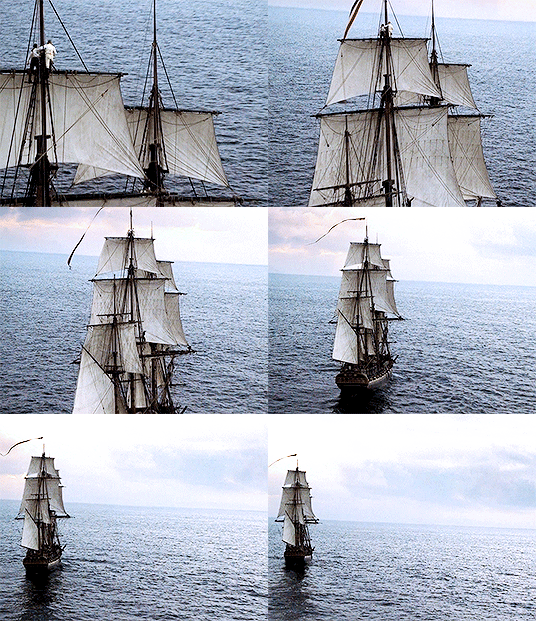
"I am not one who was born in the custody of wisdom. I am one who is fond of olden times and intense in quest of the sacred knowing of the ancients." Gustave Courbet

07 July 2012

Blundering.

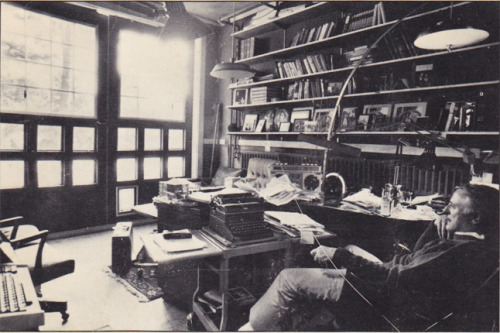
Harrison speaks ...


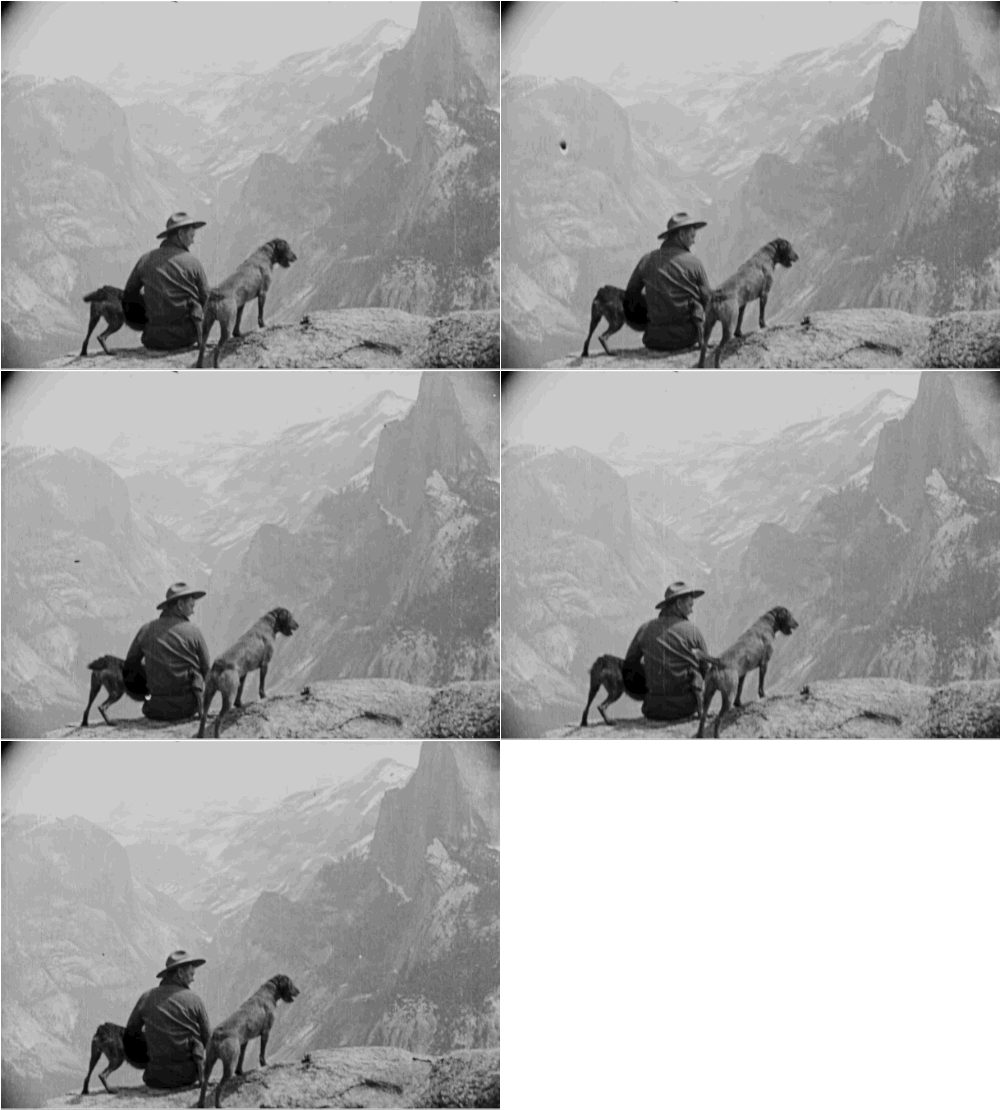
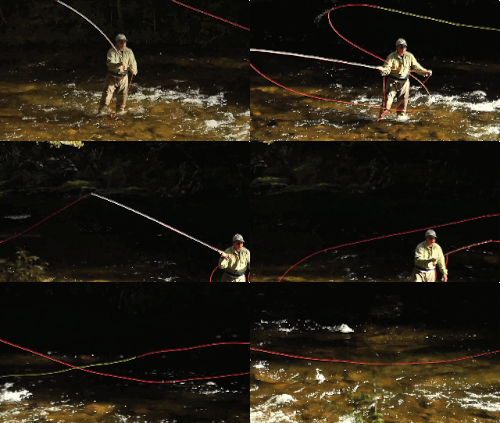
I have absolutely no advice of any value other than to keep on blundering. You must be willing to fall on your face all by yourself countless times. You must learn to abandon all of your taught perceptions and rely entirely on your own. To be fearless, meticulous, and energetic might work after what to you will seem like an unreasonable amount of time.

The story is here.

True.

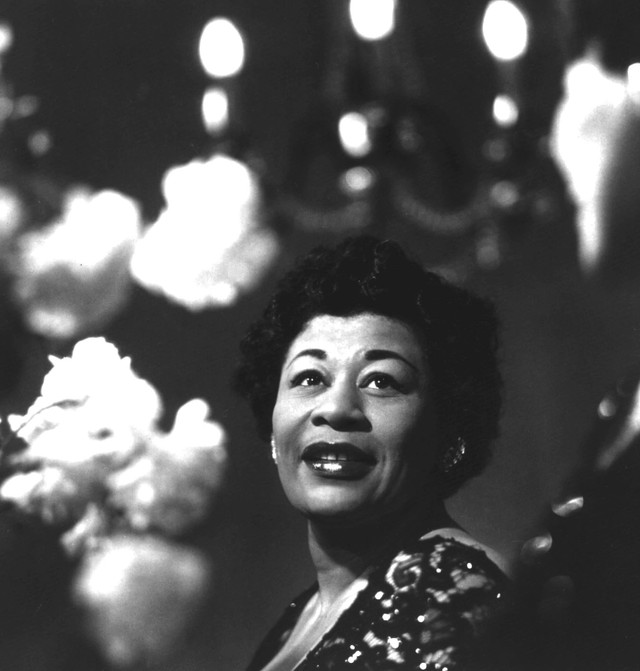
Lartigue, Renée Perle, 1932


Photography to me is catching a moment which is passing, and which is true.

- Jacques-Henri Lartigue

True.

O’Keeffe, Untitled (Abstraction/Portrait of Paul Strand), 1917


I decided to accept as true my own thinking.

- Georgia O'Keeffe

That's cool.

- Zoë Firchau

Sang.

Sloane, Sun Shaft - New Mexico, 1974


The Real Prayers Are Not the Words,
But the Attention that Comes First


The little hawk leaned sideways and, tilted,
rode the wind. Its eye at this distance looked
like green glass; its feet were the color
of butter. Speed, obviously, was joy. But
then, so was the sudden, slow circle it carved
into the slightly silvery air, and the
squaring of its shoulders, and the pulling into
itself the long, sharp-edged wings, and the
fall into the grass where it tussled a moment,
like a bundle of brown leaves, and then, again,
lifted itself into the air, that butter-color
clenched in order to hold a small, still
body, and it flew off as my mind sang out oh
all that loose, blue rink of sky, where does
it go to, and why?


- Mary Oliver

More on drifting nature ... here.

Magic.


Thank you, Mme. Scherzo.

06 July 2012

Painted.


The Night I Painted The Sky

I came from the north
Escaping convention
Modern invention that won't let me be
To the shores of St. Maarten
With my fiction addiction
To restart the fire
A dreamer's remedy

Independence Day
And all I remember
Was a midnight rainbow
That fell from the sky
As I stand on the beach
I slowly surrender
To the child in me
That can't say goodbye

The rockets in the air
And the people everywhere
Put away their differences for a while
Oh I am still a child
When it comes to something wild
Oh that was the night
I painted the sky

I dug in the sand like a boy on a mission
And there in my hands ... pyro's delight
A bombadier
A night time magician
I spark the sky as the rockets fly from view

The rockets in the air
And the people everywhere
Put away their differences for a while
I am still a child
When it comes to something wild
Oh that was the night
I painted the sky

Oh the mortars they roar
In anticipation
Proceeding the sigh
Of the uplifted eyes
It showers us all
In sulfuric sensation
The colors shine
And a fiery rhyme tonight

The rockets in the air
And the people everywhere
Won't you put away your differences for a while
I am but a child when it comes to something wild
Oh that was the night
That was the night
I painted the sky

- Jimmy Buffett

Perfect.

Summers, Night Sky, 2009


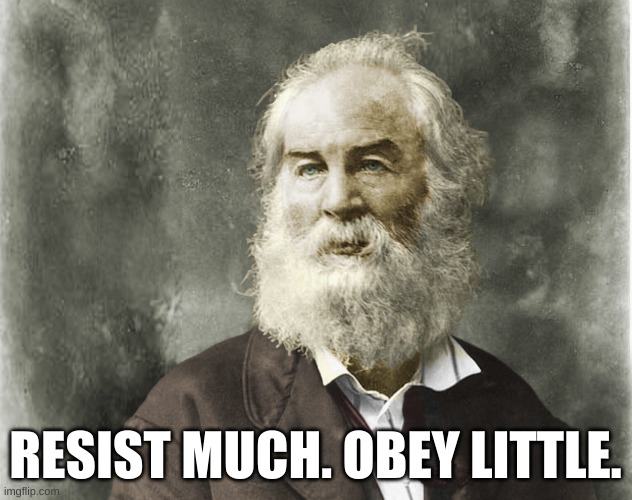
When I Heard the Learn’d Astronomer

When I heard the learn’d astronomer,
When the proofs, the figures, were ranged in columns before me,
When I was shown the charts and diagrams, to add, divide, and measure them,
When I sitting heard the astronomer where he lectured with much applause in the lecture-room,
How soon unaccountable I became tired and sick,
Till rising and gliding out I wander’d off by myself,
In the mystical moist night-air, and from time to time,
Look’d up in perfect silence at the stars.


- Walt Whitman

Overbearing.

Overbearing aromas ...


Hehehehehe.

05 July 2012

Persistence.

"The answer will only arrive after we stop looking for it," says bestselling author Jonah Lehrer. Examining recent research into what drives creative insights, Lehrer breaks down how and why we have "aha!" moments, using examples that range from Bob Dylan writing "Like A Rolling Stone" to a Tibetan monk's zen puzzle-solving powers.

But insight isn't everything. Those who achieve great things in the long-term also have another important quality: Grit, a single-minded persistence that helps them keep their eye on the prize and pushing ever-forward even when the "aha!" moments aren't around.


Thanks, 99%. Thanks, Rilke.

JuJu, "Deep Sahara"

Joy.

“Robert Plant & the Band of Joy: Live from the Artists Den” will be released on DVD and BluRay on July 10.

Languidly.


Summer Wind

It is a sultry day; the sun has drunk
The dew that lay upon the morning grass;
There is no rustling in the lofty elm
That canopies my dwelling, and its shade
Scarce cools me. All is silent, save the faint
And interrupted murmur of the bee,
Settling on the sick flowers, and then again
Instantly on the wing. The plants around
Feel the too potent fervors: the tall maize
Rolls up its long green leaves; the clover droops
Its tender foliage, and declines its blooms.
But far in the fierce sunshine tower the hills,
With all their growth of woods, silent and stern,
As if the scorching heat and dazzling light
Were but an element they loved. Bright clouds,
Motionless pillars of the brazen heaven–
Their bases on the mountains–their white tops
Shining in the far ether–fire the air
With a reflected radiance, and make turn
The gazer’s eye away. For me, I lie
Languidly in the shade, where the thick turf,
Yet virgin from the kisses of the sun,
Retains some freshness, and I woo the wind
That still delays his coming. Why so slow,
Gentle and voluble spirit of the air?
Oh, come and breathe upon the fainting earth
Coolness and life! Is it that in his caves
He hears me? See, on yonder woody ridge,
The pine is bending his proud top, and now
Among the nearer groves, chestnut and oak
Are tossing their green boughs about. He comes;
Lo, where the grassy meadow runs in waves!
The deep distressful silence of the scene
Breaks up with mingling of unnumbered sounds
And universal motion. He is come,
Shaking a shower of blossoms from the shrubs,
And bearing on their fragrance; and he brings
Music of birds, and rustling of young boughs,
And sound of swaying branches, and the voice
Of distant waterfalls. All the green herbs
Are stirring in his breath; a thousand flowers,
By the road-side and the borders of the brook,
Nod gayly to each other; glossy leaves
Are twinkling in the sun, as if the dew
Were on them yet, and silver waters break
Into small waves and sparkle as he comes.


- William Cullen Bryant

Aphelion.


Planet Earth reaches its most distant point from the sun for 2012 on July 4, at 10 p.m. Central Daylight Time in the U.S. (July 5 at 3 UTC). By Universal Time, that’s July 5, at 3 in the morning.

Astronomers call this farthest point aphelion, and, at aphelion we’re about three million miles farther from the sun than we will be six months from now. That’s in contrast to our average distance from the sun of about 93 million miles. Looking for Earth’s exact distance from the sun today? It’s at 94,505,851 miles. Last year, on July 4, 2011, the Earth at aphelion was a tiny bit farther, at 94,511,923 miles.

Planet Earth reaches its most distant point from our local star for all of 2012 on July 4, at 10 p.m. Central Daylight Time in the U.S. (July 5 at 3 UTC).

We’re always farthest from the sun in July during a Northern Hemisphere summer – and closest in January during a Northern Hemisphere winter – and that’s a good illustration of the fact that it’s not the Earth’s distance from the sun that creates the seasons on our world. Instead, the seasons result from Earth’s tilt on its axis. Right now, it’s summer in the Northern Hemisphere because the northern part of Earth is tilted most toward the sun.


Read the rest at EarthSky.

Think.

Van Allsburg, “If there was an answer, he'd find it there,” 1995


Things to Think

Think in ways you've never thought before.
If the phone rings, think of it as carrying a message
Larger than anything you've ever heard,
Vaster than a hundred lines of Yeats.

Think that someone may bring a bear to your door,
Maybe wounded and deranged; or think that a moose
Has risen out of the lake, and he's carrying on his antlers
A child of your own whom you've never seen.

When someone knocks on the door,
Think that he's about
To give you something large: tell you you're forgiven,
Or that it's not necessary to work all the time,
Or that it's been decided that if you lie down no one will die.


- Robert Bly

BOOM!


Freight Train Ks eight on the way to finishing his fifth complete game.

But the player of the game is Miggy Boom Boom who goes BIG FLY twice with a double collecting RBI 84, 85, & 86, Jack!

Good Guys win 5-1.

04 July 2012

Hope.


I think with you that it is a good world on the whole, that it has been framed on a principle of benevolence, and more pleasure than pain dealt out to us. There are indeed (who might say Nay) gloomy and hypocondriac minds, inhabitants of diseased bodies, disgusted with the present, and despairing of the future; always counting that the worst will happen, because it may happen. To these I say How much pain have cost us the evils which have never happened? My temperament is sanguine. I steer my bark with Hope in the head, leaving Fear astern.

- Thomas Jefferson, in a letter to John Adams, 8 April 1816

Willie Nelson, "Funny How Time Slips Away/Nightlife"

From Willie's 1974 Fourth of July Picnic ...


Time HAS slipped away, and with that I will gratefully say, Happy Independence Day, smell ya, and goodnight.

Peter Rowan & The Travelin' McCourys, "Cheyenne"

Jason Carter throwin' heat with that fiddle ...

Heritage.

On June 27th, 2012, the EMD plant in Muncie, Indiana released the last of the 20 NS heritage units. Almost immediately, NS assembled all six remaining units at the plant and sent them south via the CNO&TP towards Harriman overnight, then to Knoxville via the K&O Line. From there, they traveled east to Asheville and eventually Linwood Yard for NCTM's heritage unit event. S-Line Productions captured their movement on the K&O Line on the afternoon of the 28th, shooting them in three separate locations. Watch as brand-new SD70ACe's 1073 (Penn Central), 1069 (Virginian), 1072 (Illinois Terminal), 1070 (Wabash), 1071 (Jersey Central Lines), and 1074 (Delaware, Lackawanna, and Western) make their way to the heritage unit gathering on July 3rd and 4th!


Thanks, John. That's beautiful.

Baseball.

Happy Independence Day!


LET'S GO TIGERS! LET'S GO FREIGHT TRAIN!!!

Bruce Springsteen, "Darlington County"

Resistance.

Peale, Thomas Jefferson, 1790


As I write, I am watching Ken Burns' Thomas Jefferson, in which a letter from Jefferson to William Smith was quoted ...

The British ministry have so long hired their gazetteers to repeat and model into every form lies about our being in anarchy, that the world has at length believed them, the English nation has believed them, the ministers themselves have come to believe them, & what is more wonderful, we have believed them ourselves. Yet where does this anarchy exist? Where did it ever exist, except in the single instance of Massachusetts? And can history produce an instance of rebellion so honourably conducted? I say nothing of it's motives. They were founded in ignorance, not wickedness. God forbid we should ever be 20 years without such a rebellion. The people cannot be all, & always well informed. The part which is wrong will be discontented in proportion to the importance of the facts they misconceive. If they remain quiet under such misconceptions it is a lethargy, the forerunner of death to the public liberty. We have had 13. states independent 11. years. There has been one rebellion. That comes to one rebellion in a century & a half for each state. What country before ever existed a century & a half without a rebellion? & what country can preserve it's liberties if their rulers are not warned from time to time that their people preserve the spirit of resistance? Let them take arms. The remedy is to set them right as to facts, pardon & pacify them. What signify a few lives lost in a century or two? The tree of liberty must be refreshed from time to time with the blood of patriots & tyrants. It is it's natural manure.

Read the entire letter here.

States!

I showed portions of the John Adams series to my social studies classes and they loved it. One of my favorite memories of the experience is their response to the Continental Congress debates over the issue of independence. After watching it, throughout the rest of the year, anytime the word "colonies" was mentioned, they would interrupt in unison, "STATES!"


GOD SAVE OUR AMERICAN STATES!

Fightin'.


They love our milk an' honey,
But they preach about some other way of livin'.
When they're runnin' down my country, hoss,
They're walkin' on the fightin' side of me.


- Merle Haggard, from "The Fightin' Side of Me"

In gratitude to our Armed Forces.

Sing along here.

Skipping.


The 44th Annual Mackinac Island Stone Skipping Contest is today at Windemere Point outside The Iroquois Hotel.

If you leave now, you'll be late ... so check it out here.

Ridiculous.


Lost amidst the tragedy of the Detroit Tigers' head-shaking 6-4 loss to the Minnesota Twins on Monday – including a second straight abysmal start by Doug Fister – was an impressive statistical highlight from Miguel Cabrera.

MLive reader and frequent contributor Dr. Ken Noisewater pointed it out, so he can explain: "One thing lost in the game last night - Cabrera's 3rd hit was his 1,700 hit of his career at 29 years old. That is ridiculous. I was at the game at Comerica last summer after the all-star break when he got number 1,500 and he's already at 1,700. At this pace he'll have 2,000 hits before the end of next season at 30 years old. Absolutely ridiculous."

Yeah, I think everyone can probably agree "ridiculous" is a pretty fair adjective
.

Read the rest at MLive.

Persevere.


TO THE WORTHY OFFICERS AND SOLDIERS IN THE AMERICAN ARMY.

Honour will crown every defender of liberty.


GENTLEMEN: Your exertions in the cause of freedom, guided by wisdom, and animated by zeal and courage, have gained you the love and confidence of your grateful countrymen; and they look to you, who are experienced veterans, and trust that you will still be the guardians of America. As I have the honour to be an American, and one among the free millions who are defended by your valour, I would pay the tribute of thanks, and express my gratitude, while I solicit you to continue in your present honourable and important station. I doubt not America will always find enough of her sons ready to flock to her standard and support her freedom: but experience proves that experienced soldiers are more capable of performing the duties of the camp, and better qualified to face the enemy, than others; and, therefore, every friend to America will be desirous that most of the gentlemen who compose the present Army may continue in the service of their Country until liberty, peace, and safety, are established. Although your private concerns may call for your assistance at home, yet the voice of your Country is still louder; and it is painful, to heroick minds, to quit the field when liberty calls, and the voice of injured millions cries, to arms! to arms! Never was a cause more important or glorious than that which you are engaged in. Not only your wives, your children, and distant posterity, but humanity at large, the world of mankind, are interested in it; for if tyranny should prevail in this great Country, we may expect liberty will expire through the world; therefore, more human glory and happiness may depend upon your exertions than ever yet depended upon any of the sons of men! He that is a soldier, in defence of such a cause, needs no title. His post is a post of honour; and although not an Emperor, yet he shall wear a crown of glory, and blessed will be his memory!

The savage and brutal barbarity of our enemies, in burning Falmouth, is a full demonstration that there is not the least remains of virtue, wisdom, or humanity, in the British Court, and that they are fully determined, with fire and sword, to butcher and destroy, beggar and enslave, the whole American people. Therefore, we expect soon to break off all kind of connection with Britain, and form into a grand Republick of the American United Colonies; which will, by the blessing of Heaven, soon work out our salvation, and perpetuate the liberties, increase the wealth, the power, and the glory, of this western world. Notwithstanding the many difficulties we have to encounter, and the rage of our merciless enemies, we have a glorious prospect before us, big with every thing good and great. The further we enter into the field of independence, our prospect will expand and brighten, and a complete Republick will soon complete our happiness. "Blindness seems to have happened to Britain, that the fullness of America might come in;" and we have every encouragement to "stand fast in the liberties wherewith Heaven has made us free." Persevere, ye guardians of liberty! May success be your constant attendant until the enemies of freedom are no more; and all future generations, as they successively tread the stage of time, and taste the joys of liberty, will rise up and call you blessed.


A FREEMAN.

Cambridge, November 24, 1775.

03 July 2012

Ritz.

A.E. Hotchner at The Ritz ...


I first visited the Ritz 64 years ago, accompanying Ernest Hemingway, who was writing Across the River and into the Trees, a novel that was going to be serialized in Cosmopolitan magazine, for which I was then a young editor. Hemingway and the Ritz were virtually synonymous. In the 20s he and his buddy Scott Fitzgerald had spent many long evenings at the hotel’s celebrated bar, and their behavior there had become legend. As World War II ended in Europe, Hemingway personally liberated the bar as the Nazis were retreating. It was expected that General Leclerc, in command of the Allied troops, would be first on the scene, marching up the Avenue de la Grande Armée with a full panoply of tanks, artillery, flags, and bands. But well before Leclerc could get there, a jeep came careening up the avenue, zipped under the Arc de Triomphe, down the Champs-Élysées, and across the Place de la Concorde, then skidded to a stop in the Place Vendôme at the entrance of the Ritz. Hemingway was in command of that jeep. Ostensibly a war correspondent, but with a gun slung in the crook of his arm, he had taken charge of the motley group in the vehicle, most of them stragglers who had become separated from their units. Hemingway called them his “Irregulars.”

He led them into the Ritz, proclaimed its liberation, took command of the bar, and ordered champagne for everyone. Soon the renowned combat photographer Robert Capa—later killed in Indochina—came tooling up to the Ritz, thinking he was miles ahead of anyone else, but he was amazed to find that Hemingway had beaten him to it. Archie Pelkey, Hemingway’s driver, was standing guard at the entrance. “Hello, Capa,” Pelkey said. “Papa took good hotel. Plenty good stuff in cellar. Go on up.”

“When I dream of afterlife in heaven,” Ernest once wrote, “the action always takes place in the Paris Ritz. It’s a fine summer night. I knock back a couple of martinis in the bar—Rue Cambon side. Then there’s a wonderful dinner under a flowering chestnut tree in what’s called Le Petit Jardin. That’s the little garden that faces the Grill. After a few brandies, I wander up to my room and slip into one of those huge Ritz beds. They are all made of brass. There’s a bolster for my head the size of the Graf Zeppelin and four square pillows filled with real goose feathers—two for me and two for my quite heavenly companion.”


Read the rest of Hotch's account here.

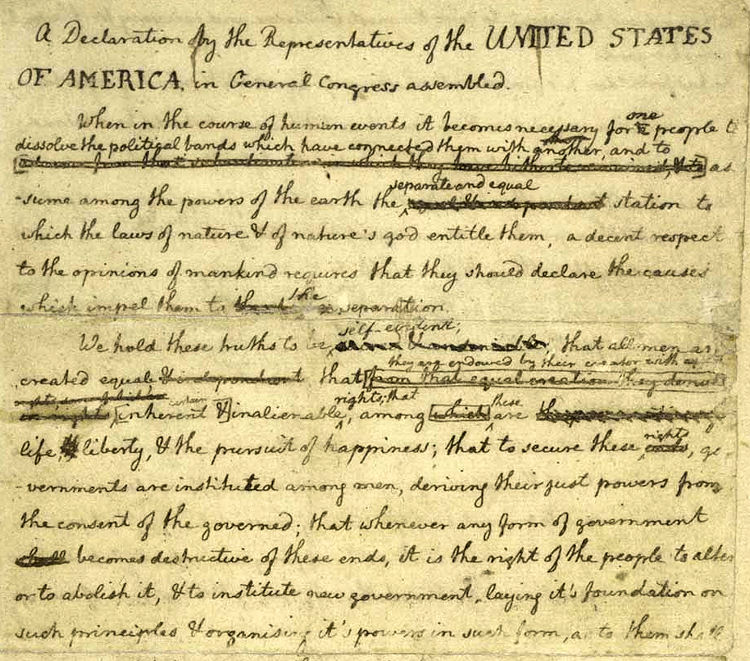
Declaration.


On History Bookshelf, William Hogeland talks about his book, “Declaration, The Nine Tumultuous Weeks When America Became Independent, May 1 – July 4, 1776,” which recalls the debate leading up to the Declaration of Independence on July 4th, 1776.

Mr. Hogeland focuses on the efforts of Samuel and John Adams to convince others to choose independence.


Click here to watch on C-SPAN.

Freedom.


What we obtain too cheap, we esteem too lightly: 'tis dearness only that gives everything its value. Heaven knows how to put a proper price upon its goods; and it would be strange indeed if so celestial an article as FREEDOM should not be highly rated.

- Thomas Paine

Andy Griffith, R.I.P.

Brad Paisley & Andy, "Waitin' On A Woman"

Refreshed.

Derecho.


A derecho is a violent storm system that can produce widespread wind damage across a large area and is associated with a band of rapidly moving band of showers and thunderstorms. The strong to violent winds are typically associated ahead of the main system as the outflow from the storms becomes more concentrated. Wind damage is typically directed into one direction and can create widespread damage along a relatively straight path.

Get the rest of your lesson at EarthSky.

David Francey, "All Lights Burning Bright"

Craig Werth, with able accompaniment ...

True.


True happiness is to understand our duties toward God and man; to enjoy the present, without anxious dependence on the future; not to amuse ourselves with either hopes or fears, but to rest satisfied with what we have, which is abundantly sufficient. True happiness is to enjoy the present, without anxious dependence upon the future, not to amuse ourselves with either hopes or fears but to rest satisfied with what we have, which is sufficient, for he that is so wants nothing. The gratest blessings of mankind are within us and within our reach. A wise man is content with his lot, whatever it may be, without wishing for what he has not.

- Seneca

Author Oliver Burkeman argues that we’ve created a culture crippled by the fear of failure, and that the most important thing we can do to enhance our wellbeing is to embrace uncertainty.

[Research] points to an alternative approach [to happiness]: a ‘negative path’ to happiness that entails taking a radically different stance towards those things most of us spend our lives trying hard to avoid. This involves learning to enjoy uncertainty, embracing insecurity and becoming familiar with failure. In order to be truly happy, it turns out, we might actually need to be willing to experience more negative emotions – or, at the very least, to stop running quite so hard from them.

Read the rest at Brain Pickings.

The Sheepdogs, "Right On"

You discover
There ain't no easy way out
When in doubt
You discover what it's all about

When you wait to get in
You begin
To discover what it's all about


Thanks, Pops. You were right ... RIGHT ON!

Sting, "After The Rain Has Fallen"

Take me where the wind blows
Take me where the red wine flows
Take me to the danger
Take me to the life of crime
Take me to the stars
Take me to the moon while we still have time


Head in the (storm) clouds.

Not the safest place to be, but, with a dram issued, exciting nonetheless.

Friday afternoon. That gray ghost flew across that field in seconds ...


Later, Friday evening. My reading lamp ...


Storm II mammatus. For as far as the eye could see ...


Storm II, leading edge of the mammatus ...


Sunday night ...


... clearing.

Action.


The art of archery is a perfect metaphor for training the mind. The archer has to be relaxed and concentrated. The bow itself must be strong yet flexible, and it is through tension and letting go that the arrow can fly straight and true to its target.

I find the Bow pose is a wonderful exercise for developing concentration and engaging the will. The kind of strenuous movement it demands does not just happen; we have to put in the effort. We have to want to do it. In the same way we have to put in the effort if we want to become an instrument for the Divine.

We have to be willing to put ourselves under pressure. Yoga is often equated with relaxing. Equally, it should be known as demanding. If the ultimate goal of yoga is cosmic consciousness or union with the Divine, why should we expect it to be easy? We have to be shaped into something that the Divine can really use.

I always had an untested ideal of service. When I was given the opportunity to be an assistant to my teacher in the last years of her life, it was like an answer to my deepest prayers. I entered the position with goodwill and love. Her duty as a teacher, of course, was to help me see and overcome my weaknesses so I could be free. Because she had limited time, the pressure was on. At times I felt that I was nothing but my weaknesses, but I recognized even that as just another self-pitying thought. I had a choice: to accept the challenge or to stay stuck in my old ways.

This particular period of my life remains vibrantly alive for me because I learned what it takes to put an ideal into action.


Read the rest at Elephant Journal.

Re-united.


On this date, ... in 1913, the Federal Government held a fiftieth anniversary reunion at Gettysburg. The boys who had gone off to war had become old men who came together "re-united in brotherly love and affection"

Thousands of survivors bivouacked on the old battlefield, swapping stories, looking up comrades and, as seen here, retracing their steps and seemingly impossible deeds of 50 years earlier.


Read and see the rest at Gettysburg.

The Pickett's Charge scene from Gettysburg ...

Full.

Kramer, Full Moon, 2011


When the cup is full it runs over. but when the cup and that which it contains are one substance, what then? There are moments when the elixir of life rises to such overbrimming splendor that the soul spills over. In the seraphic smile of the madonnas the soul is seen to flood the psyche. The moon of the face becomes full; the equation is perfect. A minute, a half minute, a second later, the miracle has passed. something intangible, something inexplicable, was given out—and received. In the life of a human being it may happen that the moon never comes to the full. In the life of some human beings it would seem, indeed, that the only mysterious phenomenon observable is that of perpetual eclipse. In the case of those afflicted with genius, whatever the form it may take, we are almost frightened to observe that there is nothing but a continuous waxing and waning of the moon. Rarer still are the anomalous ones who, having come to the full, are so terrified by the wonder of it that they spend the rest of their lives endeavoring to stifle that which gave them birth and being. The war of the mind is the story of the soul-split. When the moon was at full there were those who could not accept the dim death of diminution; they tried to hang full-blown in the zenith of their own heaven. They tried to arrest the action of the law which was manifesting itself through them, through their own birth and death, in fulfillment and transfiguration. Caught between the tides they were sundered; the soul departed the body, leaving the simulacrum of a divided self to fight it out in the mind. Blasted by their own radiance they live forever the futile quest of beauty, truth and harmony. Depossessed of their own effulgence they seek to possess the soul and spirit of those to whom they are attracted. They catch every beam of light; they reflect with every facet of their hungry being. instantly illumined, When the light is directed towards them, they are also speedily extinguished. The more intense the light which is cast upon them the more dazzling—and blinding—they appear. Especially dangerous are they to the radiant ones; it is always towards these bright and inexhaustible luminaries that they are most passionately drawn…

- Henry Miller

Zacheriah Kramer's site is here.

Same.


Art enables us to find ourselves and lose ourselves at the same time.

- Thomas Merton

Definitions of art at Brain Pickings.

02 July 2012

Music.


A Wind-storm in the Forests

The mountain winds, like the dew and rain, sunshine and snow, are measured and bestowed with love on the forests to develop their strength and beauty. However restricted the scope of other forest influences, that of the winds is universal. The snow bends and trims the upper forests every winter, the lightning strikes a single tree here and there, while avalanches mow down thousands at a swoop as a gardener trims out a bed of flowers. But the winds go to every tree, fingering every leaf and branch and furrowed bole; not one is forgotten; the Mountain Pine towering with outstretched arms on the rugged buttresses of the icy peaks, the lowliest and most retiring tenant of the dells; they seek and find them all, caressing them tenderly, bending them in lusty exercise, stimulating their growth, plucking off a leaf or limb as required, or removing an entire tree or grove, now whispering and cooing through the branches like a sleepy child, now roaring like the ocean; the winds blessing the forests, the forests the winds, with ineffable beauty and harmony as the sure result.

After one has seen pines six feet in diameter bending like grasses before a mountain gale, and ever and anon some giant falling with a crash that shakes the hills, it seems astonishing that any, save the lowest thickset trees, could ever have found a period sufficiently stormless to establish themselves; or, once established, that they should not, sooner or later, have been blown down. But when the storm is over, and we behold the same forests tranquil again, towering fresh and unscathed in erect majesty, and consider what centuries of storms have fallen upon them since they were first planted,--hail, to break the tender seedlings; lightning, to scorch and shatter; snow, winds, and avalanches, to crush and overwhelm,--while the manifest result of all this wild storm-culture is the glorious perfection we behold; then faith in Nature's forestry is established, and we cease to deplore the violence of her most destructive gales, or of any other storm-implement whatsoever.

There are two trees in the Sierra forests that are never blown down, so long as they continue in sound health. These are the Juniper and the Dwarf Pine of the summit peaks. Their stiff, crooked roots grip the storm-beaten ledges like eagles' claws, while their lithe, cord-like branches bend round compliantly, offering but slight holds for winds, however violent. The other alpine conifers--the Needle Pine, Mountain Pine, Two-leaved Pine, and Hemlock Spruce--are never thinned out by this agent to any destructive extent, on account of their admirable toughness and the closeness of their growth. In general the same is true of the giants of the lower zones. The kingly Sugar Pine, towering aloft to a height of more than 200 feet, offers a fine mark to storm-winds; but it is not densely foliaged, and its long, horizontal arms swing round compliantly in the blast, like tresses of green, fluent algæ in a brook; while the Silver Firs in most places keep their ranks well together in united strength. The Yellow or Silver Pine is more frequently overturned than any other tree on the Sierra, because its leaves and branches form a larger mass in proportion to its height, while in many places it is planted sparsely, leaving open lanes through which storms may enter with full force. Furthermore, because it is distributed along the lower portion of the range, which was the first to be left bare on the breaking up of the ice-sheet at the close of the glacial winter, the soil it is growing upon has been longer exposed to post-glacial weathering, and consequently is in a more crumbling, decayed condition than the fresher soils farther up the range, and therefore offers a less secure anchorage for the roots.

While exploring the forest zones of Mount Shasta, I discovered the path of a hurricane strewn with thousands of pines of this species. Great and small had been uprooted or wrenched off by sheer force, making a clean gap, like that made by a snow avalanche. But hurricanes capable of doing this class of work are rare in the Sierra, and when we have explored the forests from one extremity of the range to the other, we are compelled to believe that they are the most beautiful on the face of the earth, however we may regard the agents that have made them so.

There is always something deeply exciting, not only in the sounds of winds in the woods, which exert more or less influence over every mind, but in their varied waterlike flow as manifested by the movements of the trees, especially those of the conifers. By no other trees are they rendered so extensively and impressively visible, not even by the lordly tropic palms or tree-ferns responsive to the gentlest breeze. The waving of a forest of the giant Sequoias is indescribably impressive and sublime, but the pines seem to me the best interpreters of winds. They are mighty waving goldenrods, ever in tune, singing and writing wind-music all their long century lives. Little, however, of this noble tree-waving and tree-music will you see or hear in the strictly alpine portion of the forests. The burly Juniper, whose girth sometimes more than equals its height, is about as rigid as the rocks on which it grows. The slender lash-like sprays of the Dwarf Pine stream out in wavering ripples, but the tallest and slenderest are far too unyielding to wave even in the heaviest gales. They only shake in quick, short vibrations. The Hemlock Spruce, however, and the Mountain Pine, and some of the tallest thickets of the Two-leaved species bow in storms with considerable scope and gracefulness. But it is only in the lower and middle zones that the meeting of winds and woods is to be seen in all its grandeur.

One of the most beautiful and exhilarating storms I ever enjoyed in the Sierra occurred in December, 1874, when I happened to be exploring one of the tributary valleys of the Yuba River. The sky and the ground and the trees had been thoroughly rain-washed and were dry again. The day was intensely pure, one of those incomparable bits of California winter, warm and balmy and full of white sparkling sunshine, redolent of all the purest influences of the spring, and at the same time enlivened with one of the most bracing wind-storms conceivable. Instead of camping out, as I usually do, I then chanced to be stopping at the house of a friend. But when the storm began to sound, I lost no time in pushing out into the woods to enjoy it. For on such occasions Nature has always something rare to show us, and the danger to life and limb is hardly greater than one would experience crouching deprecatingly beneath a roof.

It was still early morning when I found myself fairly adrift. Delicious sunshine came pouring over the hills, lighting the tops of the pines, and setting free a steam of summery fragrance that contrasted strangely with the wild tones of the storm. The air was mottled with pine-tassels and bright green plumes, that went flashing past in the sunlight like birds pursued. But there was not the slightest dustiness, nothing less pure than leaves, and ripe pollen, and flecks of withered bracken and moss. I heard trees falling for hours at the rate of one every two or three minutes; some uprooted, partly on account of the loose, water-soaked condition of the ground; others broken straight across, where some weakness caused by fire had determined the spot. The gestures of the various trees made a delightful study. Young Sugar Pines, light and feathery as squirrel-tails, were bowing almost to the ground; while the grand old patriarchs, whose massive boles had been tried in a hundred storms, waved solemnly above them, their long, arching branches streaming fluently on the gale, and every needle thrilling and ringing and shedding off keen lances of light like a diamond. The Douglas Spruces, with long sprays drawn out in level tresses, and needles massed in a gray, shimmering glow, presented a most striking appearance as they stood in bold relief along the hilltops. The madronños in the dells, with their red bark and large glossy leaves tilted every way, reflected the sunshine in throbbing spangles like those one so often sees on the rippled surface of a glacier lake. But the Silver Pines were now the most impressively beautiful of all. Colossal spires 200 feet in height waved like supple goldenrods chanting and bowing low as if in worship, while the whole mass of their long, tremulous foliage was kindled into one continuous blaze of white sun-fire. The force of the gale was such that the most steadfast monarch of them all rocked down to its roots with a motion plainly perceptible when one leaned against it. Nature was holding high festival, and every fiber of the most rigid giants thrilled with glad excitement.

I drifted on through the midst of this passionate music and motion, across many a glen, from ridge to ridge; often halting in the lee of a rock for shelter, or to gaze and listen. Even when the grand anthem had swelled to its highest pitch, I could distinctly hear the varying tones of individual trees,--Spruce, and Fir, and Pine, and leafless Oak,--and even the infinitely gentle rustle of the withered grasses at my feet. Each was expressing itself in its own way,--singing its own song, and making its own peculiar gestures,--manifesting a richness of variety to be found in no other forest I have yet seen. The coniferous woods of Canada, and the Carolinas, and Florida, are made up of trees that resemble one another about as nearly as blades of grass, and grow close together in much the same way. Coniferous trees, in general, seldom possess individual character, such as is manifest among Oaks and Elms. But the California forests are made up of a greater number of distinct species than any other in the world. And in them we find, not only a marked differentiation into special groups, but also a marked individuality in almost every tree, giving rise to storm effects indescribably glorious.

Toward midday, after a long, tingling scramble through copses of hazel and ceanothus, I gained the summit of the highest ridge in the neighborhood; and then it occurred to me that it would be a fine thing to climb one of the trees to obtain a wider outlook and get my ear close to the Æolian music of its topmost needles. But under the circumstances the choice of a tree was a serious matter. One whose instep was not very strong seemed in danger of being blown down, or of being struck by others in case they should fall; another was branchless to a considerable height above the ground, and at the same time too large to be grasped with arms and legs in climbing; while others were not favorably situated for clear views. After cautiously casting about, I made choice of the tallest of a group of Douglas Spruces that were growing close together like a tuft of grass, no one of which seemed likely to fall unless all the rest fell with it. Though comparatively young, they were about 100 feet high, and their lithe, brushy tops were rocking and swirling in wild ecstasy. Being accustomed to climb trees in making botanical studies, I experienced no difficulty in reaching the top of this one, and never before did I enjoy so noble an exhilaration of motion. The slender tops fairly flapped and swished in the passionate torrent, bending and swirling backward and forward, round and round, tracing indescribable combinations of vertical and horizontal curves, while I clung with muscles firm braced, like a bobo-link on a reed.

In its widest sweeps my tree-top described an arc of from twenty to thirty degrees, but I felt sure of its elastic temper, having seen others of the same species still more severely tried--bent almost to the ground indeed, in heavy snows--without breaking a fiber. I was therefore safe, and free to take the wind into my pulses and enjoy the excited forest from my superb outlook. The view from here must be extremely beautiful in any weather. Now my eye roved over the piny hills and dales as over fields of waving grain, and felt the light running in ripples and broad swelling undulations across the valleys from ridge to ridge, as the shining foliage was stirred by corresponding waves of air. Oftentimes these waves of reflected light would break up suddenly into a kind of beaten foam, and again, after chasing one another in regular order, they would seem to bend forward in concentric curves, and disappear on some hillside, like sea-waves on a shelving shore. The quantity of light reflected from the bent needles was so great as to make whole groves appear as if covered with snow, while the black shadows beneath the trees greatly enhanced the effect of the silvery splendor.

Excepting only the shadows there was nothing somber in all this wild sea of pines. On the contrary, notwithstanding this was the winter season, the colors were remarkably beautiful. The shafts of the pine and libocedrus were brown and purple, and most of the foliage was well tinged with yellow; the laurel groves, with the pale undersides of their leaves turned upward, made masses of gray; and then there was many a dash of chocolate color from clumps of manzanita, and jet of vivid crimson from the bark of the madroños, while the ground on the hillsides, appearing here and there through openings between the groves, displayed masses of pale purple and brown.

The sounds of the storm corresponded gloriously with this wild exuberance of light and motion. The profound bass of the naked branches and boles booming like waterfalls; the quick, tense vibrations of the pine-needles, now rising to a shrill, whistling hiss, now falling to a silky murmur; the rustling of laurel groves in the dells, and the keen metallic click of leaf on leaf--all this was heard in easy analysis when the attention was calmly bent.

The varied gestures of the multitude were seen to fine advantage, so that one could recognize the different species at a distance of several miles by this means alone, as well as by their forms and colors, and the way they reflected the light. All seemed strong and comfortable, as if really enjoying the storm, while responding to its most enthusiastic greetings. We hear much nowadays concerning the universal struggle for existence, but no struggle in the common meaning of the word was manifest here; no recognition of danger by any tree; no deprecation; but rather an invincible gladness as remote from exultation as from fear.

I kept my lofty perch for hours, frequently closing my eyes to enjoy the music by itself, or to feast quietly on the delicious fragrance that was streaming past. The fragrance of the woods was less marked than that produced during warm rain, when so many balsamic buds and leaves are steeped like tea; but, from the chafing of resiny branches against each other, and the incessant attrition of myriads of needles, the gale was spiced to a very tonic degree. And besides the fragrance from these local sources there were traces of scents brought from afar. For this wind came first from the sea, rubbing against its fresh, briny waves, then distilled through the redwoods, threading rich ferny gulches, and spreading itself in broad undulating currents over many a flower-enameled ridge of the coast mountains, then across the golden plains, up the purple foot-hills, and into these piny woods with the varied incense gathered by the way.

Winds are advertisements of all they touch, however much or little we may be able to read them; telling their wanderings even by their scents alone. Mariners detect the flowery perfume of land-winds far at sea, and sea-winds carry the fragrance of dulse and tangle far inland, where it is quickly recognized, though mingled with the scents of a thousand land-flowers. As an illustration of this, I may tell here that I breathed sea-air on the Firth of Forth, in Scotland, while a boy; then was taken to Wisconsin, where I remained nineteen years; then, without in all this time having breathed one breath of the sea, I walked quietly, alone, from the middle of the Mississippi Valley to the Gulf of Mexico, on a botanical excursion, and while in Florida, far from the coast, my attention wholly bent on the splendid tropical vegetation about me, I suddenly recognized a sea-breeze, as it came sifting through the palmettos and blooming vine-tangles, which at once awakened and set free a thousand dormant associations, and made me a boy again in Scotland, as if all the intervening years had been annihilated.

Most people like to look at mountain rivers, and bear them in mind; but few care to look at the winds, though far more beautiful and sublime, and though they become at times about as visible as flowing water. When the north winds in winter are making upward sweeps over the curving summits of the High Sierra, the fact is sometimes published with flying snow-banners a mile long. Those portions of the winds thus embodied can scarce be wholly invisible, even to the darkest imagination. And when we look around over an agitated forest, we may see something of the wind that stirs it, by its effects upon the trees. Yonder it descends in a rush of water-like ripples, and sweeps over the bending pines from hill to hill. Nearer, we see detached plumes and leaves, now speeding by on level currents, now whirling in eddies, or, escaping over the edges of the whirls, soaring aloft on grand, upswelling domes of air, or tossing on flame-like crests. Smooth, deep currents, cascades, falls, and swirling eddies, sing around every tree and leaf, and over all the varied topography of the region with telling changes of form, like mountain rivers conforming to the features of their channels.

After tracing the Sierra streams from their fountains to the plains, marking where they bloom white in falls, glide in crystal plumes, surge gray and foam-filled in boulder-choked gorges, and slip through the woods in long, tranquil reaches--after thus learning their language and forms in detail, we may at length hear them chanting all together in one grand anthem, and comprehend them all in clear inner vision, covering the range like lace. But even this spectacle is far less sublime and not a whit more substantial than what we may behold of these storm-streams of air in the mountain woods.

We all travel the milky way together, trees and men; but it never occurred to me until this storm-day, while swinging in the wind, that trees are travelers, in the ordinary sense. They make many journeys, not extensive ones, it is true; but our own little journeys, away and back again, are only little more than tree-wavings--many of them not so much.

When the storm began to abate, I dismounted and sauntered down through the calming woods. The storm-tones died away, and, turning toward the east, I beheld the countless hosts of the forests hushed and tranquil, towering above one another on the slopes of the hills like a devout audience. The setting sun filled them with amber light, and seemed to say, while they listened, "My peace I give unto you."

As I gazed on the impressive scene, all the so called ruin of the storm was forgotten, and never before did these noble woods appear so fresh, so joyous, so immortal.


- John Miur

Usual.


Rosters were announced for MLB's 2012 All-Star Game on TBS this afternoon. 3 Detroit Tigers will be in attendance, Prince Fielder, Miguel Cabrera and Justin Verlander, otherwise known as the usual suspects. Despite having a breakout season, Austin Jackson was not named to the team or to the fan's Final Vote ballot.

Cabrera made the team as a reserve 3rd baseman, as voted by the players. This will be his 7th All-Star Game, 3rd as a Tiger. Cabrera is hitting .376/.541/.917, with a .315 BA, 16 HR and 62 RBI. Cabrera has now been named an All-Star at 3 positions, OF, 1B and 3B.

Verlander will make his 5th appearance in the midsummer classic. The Tigers' number one starter is 8-5 with a 2.69 ERA, leading the AL in strikeouts with 121.


Read the rest at Bless You Boys.

Teapot.


July, August and September are grand months for gazing toward the famous Teapot asterism in the constellation Sagittarius the Archer – and imagining the center of our Milky Way galaxy. The center of the Milky Way is located in the direction of this constellation, as seen from Earth.

Tonight – July 2, 2012 – the moon shines north (above, as seen from the Northern Hemisphere) the Teapot asterism in Sagittarius. In other words, as you gaze at tonight’s moon, you are gazing toward the heart of our Milky Way galaxy.


Read the rest at EarthSky.

"Zooming Into The Center Of The Milky Way"

Finder.


Find out when your Bell's beer was packaged to determine age and freshness.

Bell's Batch Finder is here. ANOTHER reason to LOVE this stuff!

Blackberry Smoke, "Lucky Seven"

Ain't as easy as it looks

Light.


MIT professor Ramesh Raskar starts his talk by showing the classic Doc Edgerton photograph of an apple being shot by a bullet. It demonstrated an exposure of a millionth of a second. Wonderful, right? he asks us, to wide agreement. Only now, 50 years later, technology advances mean we can photograph a million times faster than this. “Now we can see the world at a trillion frames per second,” he says. “I present to you femto-photography, a new imaging technique so fast that it can create slow-motion videos of light in motion.”

What does this mean? Well, it means that now Raskar and co can create cameras that look around corners. “We can challenge what we mean by camera,” he says.


Read and watch the rest at TED.

Hoisted.

It was pleasant and delightful on a bright summer's morn
When the green fields and the meadows were covered with corn
And the blackbirds and thrushes sitting on every green spray
And the larks they sang melodious at the dawning of the day
And the larks, they sang melodious
At the dawning of the day.

A sailor and his true love went walking one day
Said the sailor to his true love I'm bound far away
I'm bound for the East Indies where the loud cannons roar
So tis fare you well my Nancy, you're the girl that I adore
So tis fare you well my Nancy
You're the girl that I adore

A ring from his finger he instantly drew
Saying take this and keep it; my heart will go too
And as they stood embracing, tears from her eyes fell
Saying' May I go along with you, Oh no my love farewell
Saying' May I go along with you
Oh no my love farewell

So tis fare you well Nancy, I can no longer stay
For the topsail is hoisted and the anchor is weighed
And the ship she stands now lies waiting for the next flowing tide
And if ever I return again I will make you my bride
And if ever I return again
I will make you my bride

As Jimmy was sailing, all at his heart's content
The ship struck a rock and to the bottom she went
And Nancy she lies waiting, all alone to complain
For the loss of her Jimmy who died upon the Main.
For the loss of her Jimmy
Who died upon the Main.


Show Of Hands throwin' gas ...

01 July 2012

Paul Weller

Route of the Kings, Hyde Park , July 28, 2002

1. Sunflower
2. Bull Rush/Magic Bus
3. Friday Street


4. Hung Up
5. A Bullet For Everyone
6. Whirlpool's End


7. Leafy Mysteries
8. Up In Suzie's Room
9. All Good Books


10. Can You Heal Us, Holy Man?


11. This Is No Time
12. Foot Of The Mountain
13. Broken Stones


14. Picking Up Sticks
15. You Do Something To Me
16. Stanley Road


17. Out Of The Sinking
18. Peacock Suit
19. Into Tomorrow
20. The Changing Man


21. Standing Out In The Universe
22. Wild Wood


23. Call Me No. 5
24. Woodcutter's Son