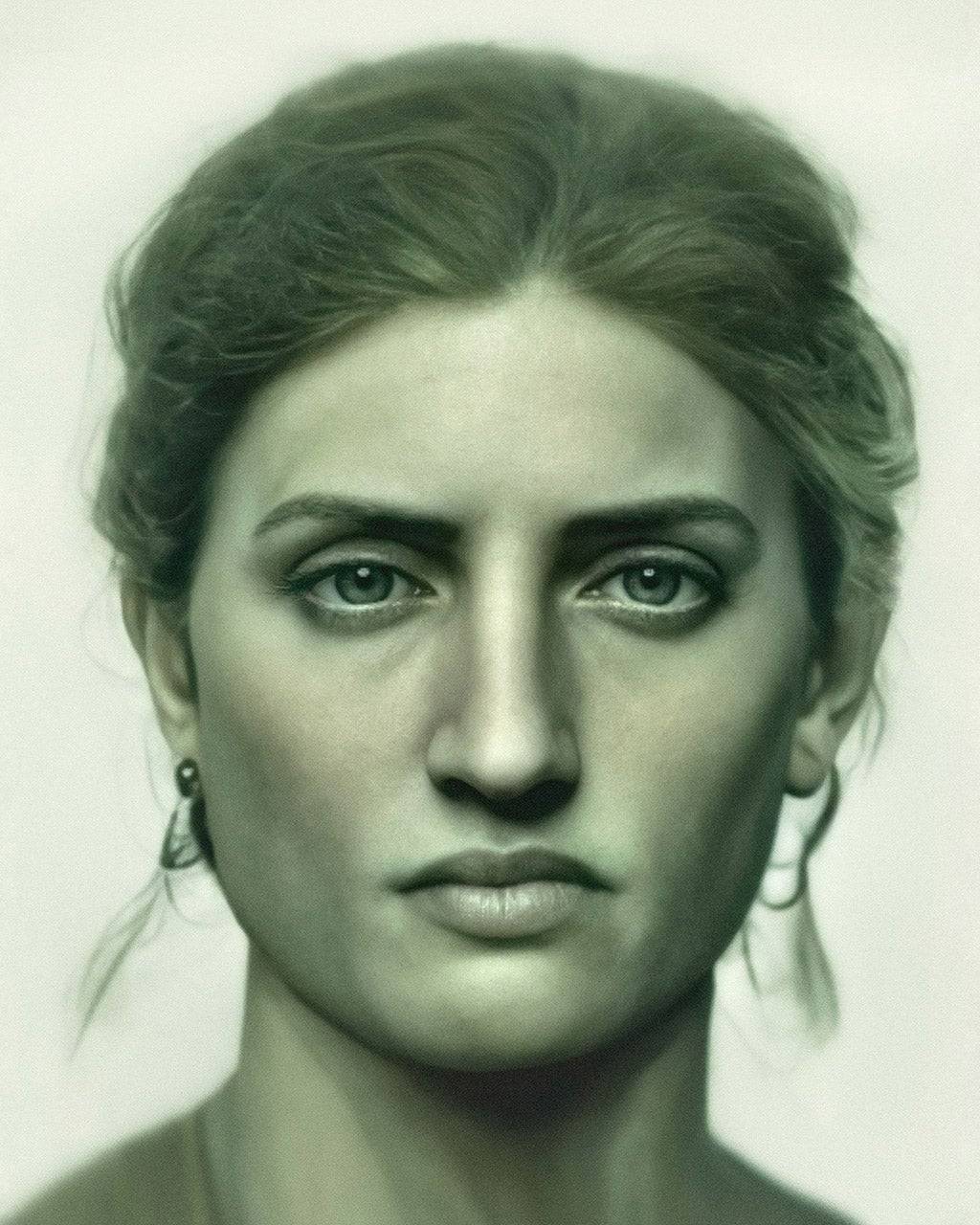
"I am not one who was born in the custody of wisdom. I am one who is fond of olden times and intense in quest of the sacred knowing of the ancients." Gustave Courbet
Showing posts with label Weil. Show all posts

03 February 2026

Happy Birthday, Simone Weil


Whether the mask is labeled fascism, democracy, or dictatorship of the proletariat, our great adversary remains the apparatus—the bureaucracy, the police, the military. Not the one facing us across the frontier of the battle lines, which is not so much our enemy as our brothers' enemy, but the one that calls itself our protector and makes us its slaves. No matter what the circumstances, the worst betrayal will always be to subordinate ourselves to this apparatus and to trample underfoot, in its service, all human values in ourselves and in others.

Simone Weil, born on this day in 1909, from "Reflections on War"

17 November 2025

Precedence.


Steve points to wisdom from "The Martian" ...
The concept of obligations takes precedence over that of rights, which are subordinate and relative to it.  A right is not effective on its own, but solely in relation to the obligation to which it corresponds. 

27 September 2025

Treasures.


A human being has roots by virtue of his real, active and natural participation in the life of the community which preserves in living shape certain particular treasures of the past and certain particular expectations of the future.

Thanks, Kurt.

09 February 2025

Open.


Steve has Gurri on free speech and ...
...[T]he resumption of the great American debate, of speech that is unencumbered and unafraid, of a Jeffersonian open society.
Hannah Arendt on soundbite discourse ...

To be sure, the judges were right when they finally told the accused that all he had said was "empty talk" -- except that they thought the emptiness was feigned, and that the accused wished to cover up other thoughts which, though hideous, were not empty. This supposition seems refuted by the striking consistency with which Eichmann, despite his rather bad memory, repeated word for word the same stock phrases and self-invented clichés each time he referred to an incident or event of importance to him. Whether writing his memoirs in Argentina or in Jerusalem, whether speaking to the police examiner or to the court, what he said was always the same, expressed in the same words. The longer one listened to him, the more obvious it became that his inability to speak was closely connected with an inability to think, namely, to think from the standpoint of somebody else. No communication was possible with him, not because he lied but because he was surrounded by the most reliable of all safeguards against the words and the presence of others, and hence against reality as such.

Later ...

The lesson of such stories is simple and within everybody’s grasp. Politically speaking, it is that under conditions of terror most people will comply but some people will not, just as the lesson of the countries to which the Final Solution was proposed is that “it could happen” in most places but it did not happen everywhere. Humanly speaking, no more is required, and no more can reasonably be asked, for this planet to remain a place fit for human habitation.

Hannah Arendt, Eichmann in Jerusalem: A Report on the Banality of Evil

Rosa Luxemburg: Those who do not move, do not notice their chains.

Simone Weil: Never react to an evil in such a way as to augment it.

Bertolt Brecht, from “O Germany, Pale Mother!”
O Germany— 
Hearing the speeches that ring from your house 
    one laughs. 
But whoever sees you, reaches for his knife.

03 February 2023

Happy Birthday, Weil


To give up our imaginary position as the center, to renounce it, not only intellectually but in the imaginative part of our soul, that means to awaken to what is real and eternal, to see the true light and hear the true silence.

Simone Weil, born on this day in 1909, from Waiting for God

03 February 2022

Happy Birthday, Weil


Simone Weil was born on this date in 1909.

Whether the mask is labeled fascism, democracy, or dictatorship of the proletariat, our great adversary remains the apparatus—the bureaucracy, the police, the military. Not the one facing us across the frontier of the battle lines, which is not so much our enemy as our brothers' enemy, but the one that calls itself our protector and makes us its slaves. No matter what the circumstances, the worst betrayal will always be to subordinate ourselves to this apparatus and to trample underfoot, in its service, all human values in ourselves and in others.

Simone Weil

11 February 2021

Questions.


Protection of freedom of thought requires that no group should be permitted by law to express an opinion. For when a group starts having opinions, it inevitably tends to impose them on its members. Sooner or later, these individuals find themselves debarred, with a greater or lesser degree of severity, and on a number of problems of greater or lesser importance, from expressing opinions opposed to those of the group, unless they care to leave it. But a break with any group to which one belongs always involves suffering—at any rate of a sentimental kind. And just as danger, exposure to suffering are healthy and necessary elements in the sphere of action, so are they unhealthy influences in the exercise of the intelligence. A fear, even a passing one, always provokes either a weakening or a tautening, depending on the degree of courage, and that is all that is required to damage the extremely delicate and fragile instrument of precision which constitutes our intelligence. Even friendship is, from this point of view, a great danger. The intelligence is defeated as soon as the expression of one’s thoughts is preceded, explicitly or implicitly, by the little word "we".  And when the light of the intelligence grows dim, it is not very long before the love of good becomes lost.

Simone Weil

Judge a man by his questions rather than by his answers.

Voltaire

29 November 2020

Protection.


Protection of freedom of thought requires that no group should be permitted by law to express an opinion. For when a group starts having opinions, it inevitably tends to impose them on its members. Sooner or later, these individuals find themselves debarred, with a greater or lesser degree of severity, and on a number of problems of greater or lesser importance, from expressing opinions opposed to those of the group, unless they care to leave it. But a break with any group to which one belongs always involves suffering—at any rate of a sentimental kind. And just as danger, exposure to suffering are healthy and necessary elements in the sphere of action, so are they unhealthy influences in the exercise of the intelligence. A fear, even a passing one, always provokes either a weakening or a tautening, depending on the degree of courage, and that is all that is required to damage the extremely delicate and fragile instrument of precision which constitutes our intelligence. Even friendship is, from this point of view, a great danger. The intelligence is defeated as soon as the expression of one’s thoughts is preceded, explicitly or implicitly, by the little word "we." And when the light of the intelligence grows dim, it is not very long before the love of good becomes lost.

Simone Weil, from The Need for Roots

Ka-ching, KA-CHING.

24 August 2020

Captive.


If a captive mind is unaware of being in prison, it is living in error. If it has recognized the fact, even for the tenth of a second, and then quickly forgotten it in order to avoid suffering, it is living in falsehood. Men of the most brilliant intelligence can be born, live and die in error and falsehood.

Simone Weil

29 March 2020

Attention.


Attention, taken to its highest degree, is the same thing as prayer. It presupposes faith and love. Absolutely unmixed attention is prayer.

Simone Weil

03 February 2020

Happy Birthday, Weil


Simone Weil was born on this date in 1909.

The man who has known pure joy, if only for a moment, is the only man for whom affliction is something devastating. At the same time he is the only man who has not deserved the punishment. But, after all, for him it is no punishment; it is God holding his hand and pressing rather hard. For, if he remains constant, what he will discover buried deep under the sound of his own lamentations is the pearl of the silence of God.

Simone Weil

16 May 2019

Apparatus.

Caravaggio, David with the Head of Goliath, 1610


Whether the mask is labeled fascism, democracy, or dictatorship of the proletariat, our great adversary remains the apparatus—the bureaucracy, the police, the military. Not the one facing us across the frontier of the battle lines, which is not so much our enemy as our brothers' enemy, but the one that calls itself our protector and makes us its slaves. No matter what the circumstances, the worst betrayal will always be to subordinate ourselves to this apparatus and to trample underfoot, in its service, all human values in ourselves and in others.

Simone Weil

24 May 2017

Differently.


Justice. To be ever ready to admit that another person is something quite different from what we read when he is there (or when we think about him). Or rather, to read in him that he is certainly something different, perhaps something completely different from what we read in him.

Every being cries out silently to be read differently.

Simone Weil

04 February 2017

Differently.


Every being cries out in silence to be read differently. Do not be indifferent to these cries.

Simone Weil 

03 February 2016

Happy birthday, Weil.


Simone Weil was born on  this day in 1909.

Above all it is thus that we can acquire the virtue of humility, and that is a far more precious treasure than all academic progress. From this point of view it is perhaps even more useful to contemplate our stupidity than our sin. Consciousness of sin gives us the feeling that we are evil, and a kind of pride sometimes finds a place in it. When we force ourselves to fix the gaze, not only of our eyes but of our souls, upon a school exercise that we have failed through sheer stupidity, a sense of our mediocrity is borne in upon us with irresistible evidence.  No knowledge is more to be desired. If we can arrive at knowing this truth with all our souls we shall be well established on the right foundation.

If these two conditions are perfectly carried out there is no doubt that school studies are quite as good a road to sanctity as any other.

To carry out the second, it is enough to wish to do so. This is not the case with the first.  In order really to pay attention, it is necessary to know how to set about it.

Most often attention is confused with a kind of muscular effort. If one says to one's pupils: “Now you must pay attention,” one sees them contracting their brows, holding their breath, stiffening their muscles. If after two minutes they are asked what they have been paying attention to, they cannot reply. They have not been paying attention. They have been contracting their muscles.

We often expend this kind of muscular effort on our studies. As it ends by making us tired, we have the impression that we have been working. That is an illusion.

Tiredness has nothing to do with work. Work itself is the useful effort, whether it is tiring or not. This kind of muscular effort in work is entirely barren, even if it is made with the best of intentions. Good intentions in such cases are among those that pave the way to hell. Studies conducted in such a way can sometimes succeed academically from the point of view of gaining good marks and passing examinations, but that is in spite of the effort and thanks to natural gifts; moreover such studies are never of any use.

Will power, the kind that, if need be, makes us set our teeth and endure suffering, is the principal weapon of the apprentice engaged in manual work. But contrary to the usual belief, it has practically no place in study. The intelligence can only be led by desire. For there to be desire, there must be pleasure and joy in the work. The intelligence only grows and bears fruit in joy. The joy of learning is as indispensable in study as breathing is in running. Where it is lacking there are no real students, but only poor caricatures of apprentices who, at the end of their apprenticeship, will not even have a trade.