"I am not one who was born in the custody of wisdom. I am one who is fond of olden times and intense in quest of the sacred knowing of the ancients." Gustave Courbet
Showing posts with label Trumbull. Show all posts

17 June 2025

Whites.

Trumbull, The Death of General Warren at the Battle of Bunker's Hill, 1778


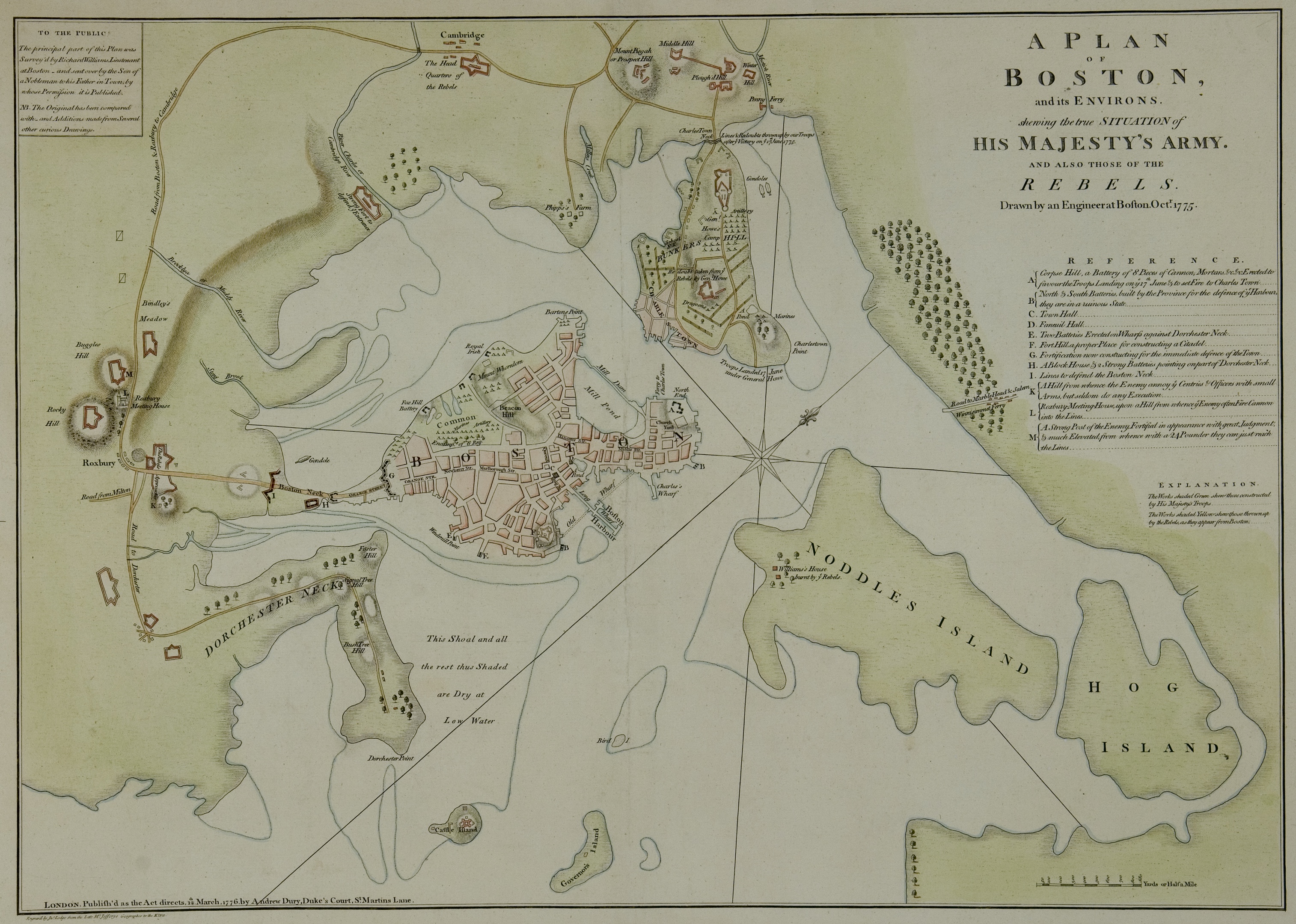
Don't fire until you see the whites of their eyes.

Colonel William Prescott, hollered this day in 1775 during the Battle of Bunker Hill.

Drury,  Plan of Boston and its Environs Shewing the True Situation of His Majesty's Army and Also Those of the Rebels, 1775


The American Battlefield Trust always does an outstanding job of telling the story ...


17 February 2025

Limited.


It's Presidents' Day ...
When I was first honored with a call into the service of my country, then on the eve of an arduous struggle for its liberties, the light in which I contemplated my duty required that I should renounce every pecuniary compensation. From this resolution I have in no instance departed; and being still under the impressions which produced it, I must decline as inapplicable to myself any share in the personal emoluments which may be indispensably included in a permanent provision for the executive department, and must accordingly pray that the pecuniary estimates for the station in which I am placed may during my continuance in it be limited to such actual expenditures as the public good may be thought to require.

George Washington, from his first inaugural speech in 1789 

19 October 2024

Meditate.

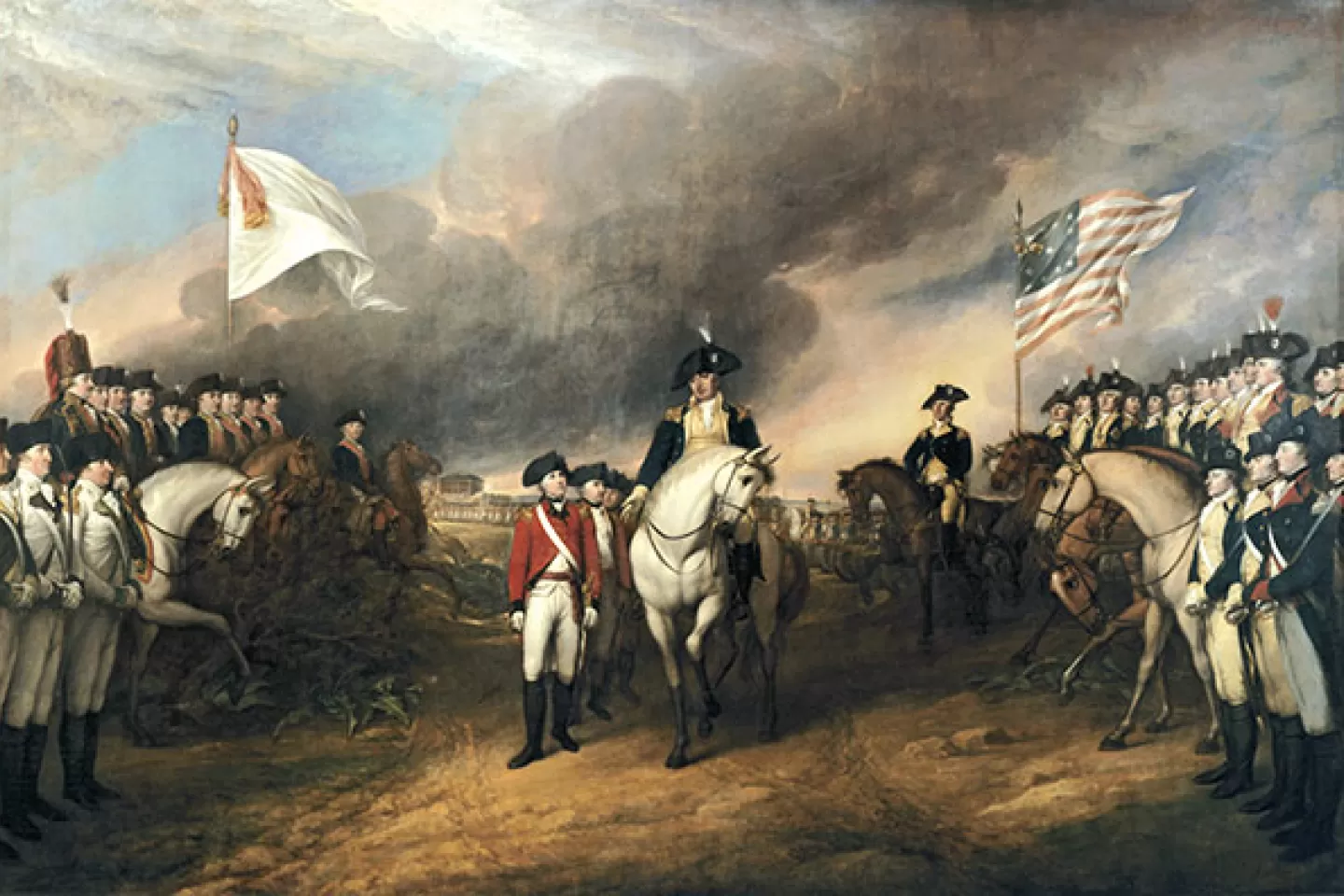
Trumbull, Surrender of Lord Cornwallis, 1788


On this day in 1781, British troops commanded by Lord Cornwallis surrendered at Yorktown, Virginia, signalling the end of the American Revolution.

The Architect of the Capitol explains John Trumbull's painting ...
Surrender of Lord Cornwallis in the Capitol Rotunda is one of two paintings that artist John Trumbull completed on this subject. He painted this version between 1819 and 1820, basing it upon a small painting (approximately 20 inches by 30 inches) that he had first envisioned in 1785, when he began to “meditate seriously the subjects of national history, of events of the Revolution.”

02 August 2024

Signing.

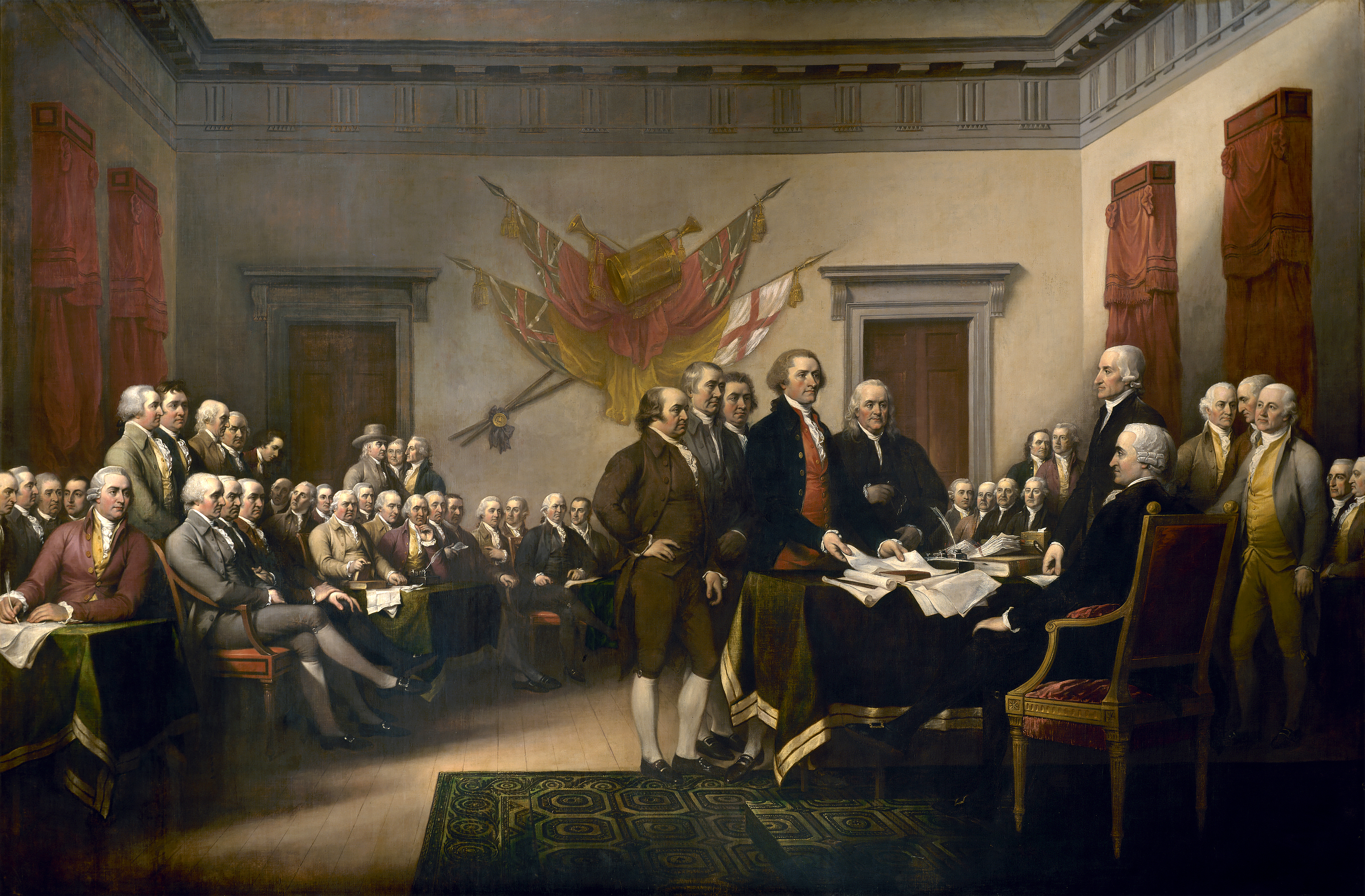
Trumbull, Declaration of Independence, 1819


On this day in 1776, members of the Continental Congress began signing the Declaration of Independence.

The Architect of the Capitol has more on the painting ...
When Trumbull was planning the smaller painting in 1786, he decided not to attempt a wholly accurate rendering of the scene; rather, he made his goal the preservation of the images of the Nation’s founders. He excluded those for whom no authoritative image could be found or created, and he included delegates who were not in attendance at the time of the event. In all, 47 individuals (42 of the 56 signers and 5 other patriots) are depicted, all painted from life or life portraits. Some of the room’s architectural features (e.g., the number and placement of doors and windows) differ from historical fact, having been based on an inaccurate sketch that Thomas Jefferson produced from memory in Paris. Trumbull also painted more elegant furniture, covered the windows with heavy draperies rather than venetian blinds, and decorated the room’s rear wall with captured British military flags, believing that such trophies were probably displayed there. 

10 July 2024

Excellent.

Thanks to Kurt for recommending this excellent book ...


This evening at 7:00, Brookhiser's talk from last week will air ...


In the meantime (if for nothing else, take a peak just for a look at his tie) ...

06 July 2024

Affected.

Copley, Self-Portrait, 1783


From Dr. Prown's Wyeth Lecture in American Art at the National Gallery: "Friends and Rivals: Copley, West, Peale, Trumbull, and Stuart" ...
John Singleton Copley and Benjamin West were born in 1738; Charles Willson Peale, some two and one-half years later. Gilbert Stuart and John Trumbull, born in 1755 and 1756, respectively, belonged to the next generation. Their paths crossed and recrossed throughout their uniformly long lives. They formed friendships, influenced each other both through their art and personally, competed for clients, and eventually drifted apart, or, in the case of Copley and West, became bitter enemies. Jules David Prown focuses on the artists’ personal and professional encounters and interactions to tell the story of how they affected each other’s lives and work.

02 July 2024

Decided.

Trumbull, Thomas Jefferson, 1788


Mr. Jefferson came into Congress, in June, 1775, and brought with him a reputation for literature, science, and a happy talent of composition. Writings of his were handed about, remarkable for the peculiar felicity of expression. Though a silent member in Congress, he was so prompt, frank, explicit, and decisive upon committees and in conversation, not even Samuel Adams was more so, that he soon seized upon my heart; and upon this occasion I gave him my vote, and did all in my power to procure the votes of others. I think he had one more vote than any other, and that placed him at the head of the committee. I had the next highest number, and that placed me the second. The committee met, discussed the subject, and then appointed Mr. Jefferson and me to make the draught, I suppose because we were the two first on the list.

The sub-committee met. Jefferson proposed to me to make the draught. I said, I will not. You should do it. Oh! no. Why will you not? You ought to do it. I will not. Why? Reasons enough. What can be your reasons? Reason first—You are a Virginian, and a Virginian ought to appear at the head of this business. Reason second—I am obnoxious, suspected, and unpopular. You are very much otherwise. Reason third—You can write ten times better than I can. “Well,” said Jefferson, “if you are decided, I will do as well as I can.” Very well. When you have drawn it up, we will have a meeting.

John Adams, from a letter to Timothy Pickering, August, 1822

17 June 2023

Pepper'd.


BATTLE OF BUNKER HILL
Composed by a British Officer, the day after the Battle, June 17, 1775

It was on the seventeenth, by break of day,
The Yankees did surprise us,
With their strong works they had thrown up,
To burn the town and drive us.

But soon we had an order came,
An order to defeat them;
Like rebels stout, they stood it out,
And thought we ne'er could beat them.

About the hour of twelve that day,
An order came for marching,
With three good flints and sixty rounds,
Each man hop'd to discharge them.

We march'd down to the Long Wharf,
Where boats were ready waiting;
With expedition we embark'd,
Our ships kept cannonading.

And when our boats all filled were,
With officers and soldiers,
With as good troops as England had,
To oppose, who dare control us.

And when our boats all filled were,
We row'd in line of battle,
Where showers of ball like hail did fly,
Our cannon loud did rattle.

There was Copp's hill battery near Charlestown,
Our twenty-fours they played;
And the three frigates in the stream,
That very well behaved.

The Glasgow frigate clear'd the shore,
All at the time of landing,
With her grape shot and cannon balls,
No Yankees e'er could stand them.

And when we landed on the shore,
We draw'd up all together;
The Yankees they all man'd their works,
And thought we'd neer come thither.

But soon they did perceive brave Howe,
Brave Howe, our bold commander;
With grenadiers, and infantry,
We made them to surrender.

Brave William Howe, on our right wing,
Cry'd boys fight on like thunder;
You soon will see the rebels flee,
With great amaze and wonder.

Now some lay bleeding on the ground,
And some fell fast a running;
O'er hills and dales, and mountains high,
Crying, zounds! brave Howe's a coming.

Brave Howe is so considerate,
As to guard against all dangers;
He allow'd each half a gill this day,
To rum we are no strangers.

They began to play on our left wing,
Where Pigot, he commanded;
But we return'd it back again.
With courage most undaunted.

To our grape shot and musket balls,
To which they were but strangers,
They thought to come with sword in hand,
But soon they found their danger.

And when the works were got into,
And put them to the flight, sir,
They pepper'd us, poor British elves,
And show'd us they could fight, sir.

And when their works we got into,
With some hard knocks and danger;
Their works we found both firm and strong,
Too strong for British Rangers.

But as for our Artillery,
They gave all way and run,
For while their ammunition held,
They gave us Yankee fun.

But our commander, he got broke,
For his misconduct, sure, sir;
The shot he sent for twelve pound guns,
Were made for twenty-fours, sir.

There's some in Boston, pleasd to say,
As we the field were taking,
We went to kill their countrymen,
While they their hay were making.

For such stout whigs I never saw,
To hang them all I'd rather;
By making hay with musket balls,
Lord Howe cursedly did bother.

Bad luck to him by land and sea,
For he's despisd by many;
The name of Bunker Hill he dreads,
Where he was flogg'd most plainly.

And now my song is at an end,
And to conclude my ditty;
'Tis only Britons ignorant,
That I most sincerely pity.

As for our King and William Howe,
And General Gage, if they're taken,
The Yankees will hang their heads up high,
On that fine hill call'd Beacon.
06 June 2022

Happy Birthday, Trumbull

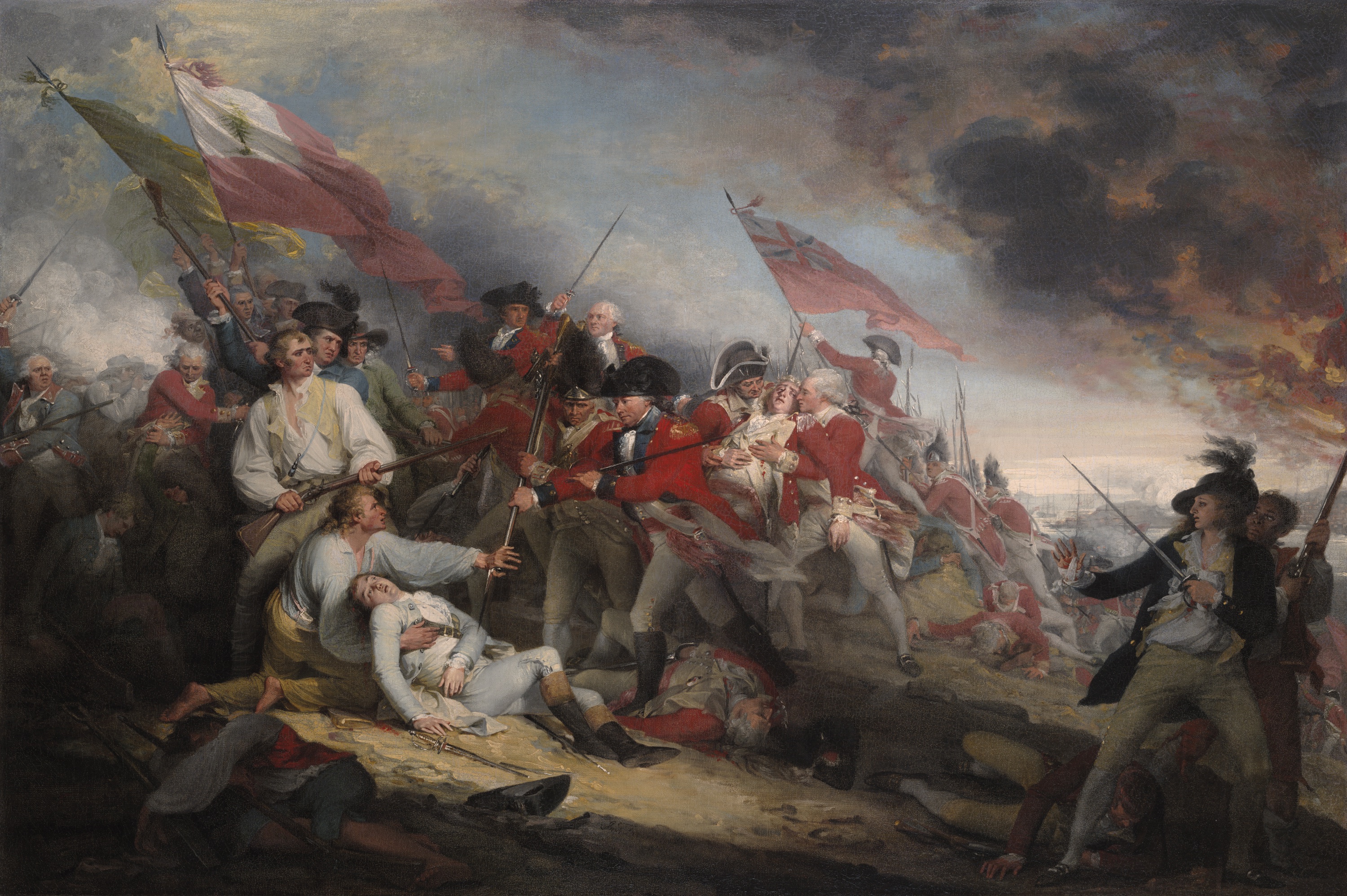
Trumbull, The Death of General Warren at the Battle of Bunker Hill, 1775, 1786


John Trumbull was born on this day in 1756.

07 June 2020

Valuable.

Trumbull, Thomas Jefferson, 1788


The spirit of resistance to government is so valuable on certain occasions that I wish it to be always kept alive. It will often be exercised when wrong, but better so than not to be exercised at all.

Thomas Jefferson, letter to Abigail Adams, February 22, 1787

02 July 2019

Forever.

Trumbull, Declaration of Independence, 1818


The second day of July, 1776, will be the most memorable epoch in the history of America. I am apt to believe that it will be celebrated by succeeding generations as the great anniversary festival. It ought to be commemorated as the day of deliverance, by solemn acts of devotion to God Almighty. It ought to be solemnized with pomp and parade, with shows, games, sports, guns, bells, bonfires, and illuminations, from one end of this continent to the other, from this time forward forever more.

John Adams