Showing posts with label Kohn. Show all posts
Showing posts with label Kohn. Show all posts
23 November 2022
Bach, The Art of Fuge, BWV 1080
Eloïse Bella Kohn performs Contrapunctus inversus 13.1 a 3 and Contrapunctus inversus 13.2 a 3 ...


26 February 2022
Understanding.

Discipline is born when the child concentrates his attention on some object that attracts him and which provides him not only with a useful exercise but with a control of error. Thanks to these exercises the child becomes calm, radiantly happy, busy, forgetful of himself and, in consequence, indifferent to prizes or material rewards.
Maria Montessori
Children have real understanding only of that which they invent themselves, and each time that we try to teach them something too quickly, we keep them from reinventing it themselves.
Jean Piaget
Children learn how to make good decisions by making decisions, not by following directions.
Alfie Kohn
11 August 2019
Challenge.
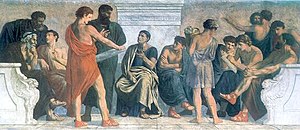
Spangenberg, Aristotle's School, 1883
Grades don’t prepare children for the “real world” — unless one has in mind a world where interest in learning and quality of thinking are unimportant. Nor are grades a necessary part of schooling, any more than paddling or taking extended dictation could be described that way. Still, it takes courage to do right by kids in an era when the quantitative matters more than the qualitative, when meeting (someone else’s) standards counts for more than exploring ideas, and when anything “rigorous” is automatically assumed to be valuable. We have to be willing to challenge the conventional wisdom, which in this case means asking not how to improve grades but how to jettison them once and for all.
Alfie Kohn, from "The Case Against Grades"
14 July 2019
Excellent.
An excellent book ...
Far from helping students to develop into mature, self-reliant, self-motivated individuals, schools seem to do everything they can to keep youngsters in a state of chronic, almost infantile, dependency. The pervasive atmosphere of distrust, together with rules covering the most minute aspects of existence, teach students every day that they are not people of worth, and certainly not individuals capable of regulating their own behavior.
Some who support coercive behavior strategies assume that children will run wild if they are not controlled. However, the children for whom this is true typically turn out to be those accustomed to being controlled—those who are not trusted, given explanations, encouraged to think for themselves, helped to develop and internalize good values, and so on. Control breeds the need for more control, which then is used to justify the use of control.
What rewards and punishments do is induce compliance, and this they do very well indeed. If your objective is to get people to obey an order, to show up on time and do what they’re told, then bribing or threatening them may be sensible strategies. But if your objective is to get long-term quality in the workplace, to help students become careful thinkers and self-directed learners, or to support children in developing good values, then rewards, like punishments, are absolutely useless. In fact, as we are beginning to see, they are worse than useless—they are actually counterproductive.
When we repeatedly promise rewards to children for acting responsibly, or to students for making an effort to learn something new, or to employees for doing quality work, we are assuming that they could not or would not choose to act this way on their own. The most significant factor in an individual’s ability to remain in good health may be a sense of control over the events of life. Students get the message bout what adults want. When 4th graders in a variety of classrooms were asked what their teachers most wanted them to do, they didn't say, "Ask thoughtful questions" or "Make responsible decisions" or Help others." They said, "Be quiet, don't fool around, and get our work done on time.
The more we try to measure, control, and pressure learning from without, the more we obstruct the tendencies of students to be actively involved and to participate in their own education. Not only does this result in a failure of students to absorb the cognitive agenda imparted by educators, but it also creates deleterious consequences for the affective agendas of schools, that is, how students feel about learning. Externally imposed evaluations, goals, rewards, and pressures seem to create a style of teaching and learning that is antithetical to quality learning outcomes in school, that is, learning characterized by durability, depth, and integration.
There is a time to admire the grace and persuasive power of an influential idea, and there is a time to fear its hold over us. The time to worry is when the idea is so widely shared that we no longer even notice it, when it is so deeply rooted that it feels to us like plain common sense. At the point when objections are not answered anymore because they are no longer even raised, we are not in control: we do not have the idea; it has us.
11 May 2017
De-grading.
Alfie Kohn on de-grading ...
You can tell a lot about a teacher’s values and personality
just by asking how he or she feels about giving grades. Some defend the
practice, claiming that grades are necessary to“motivate”students. Many of
these teachers actually seem to enjoy keeping intricate records of
students’marks. Such teachers periodically warn students that they’re“going to
have to know this for the test”as a way of compelling them to pay attention or
do the assigned readings—and they may even use surprise quizzes for that
purpose, keeping their gradebooks at the ready.
Frankly, we ought to be worried
for these teachers’students. In my experience, the most impressive teachers are
those who despise the whole process of giving grades. Their aversion, as it turns
out, is supported by solid evidence that raises questions about the very idea
of traditional grading.
29 March 2017

Subscribe to:
Posts (Atom)


































































































































