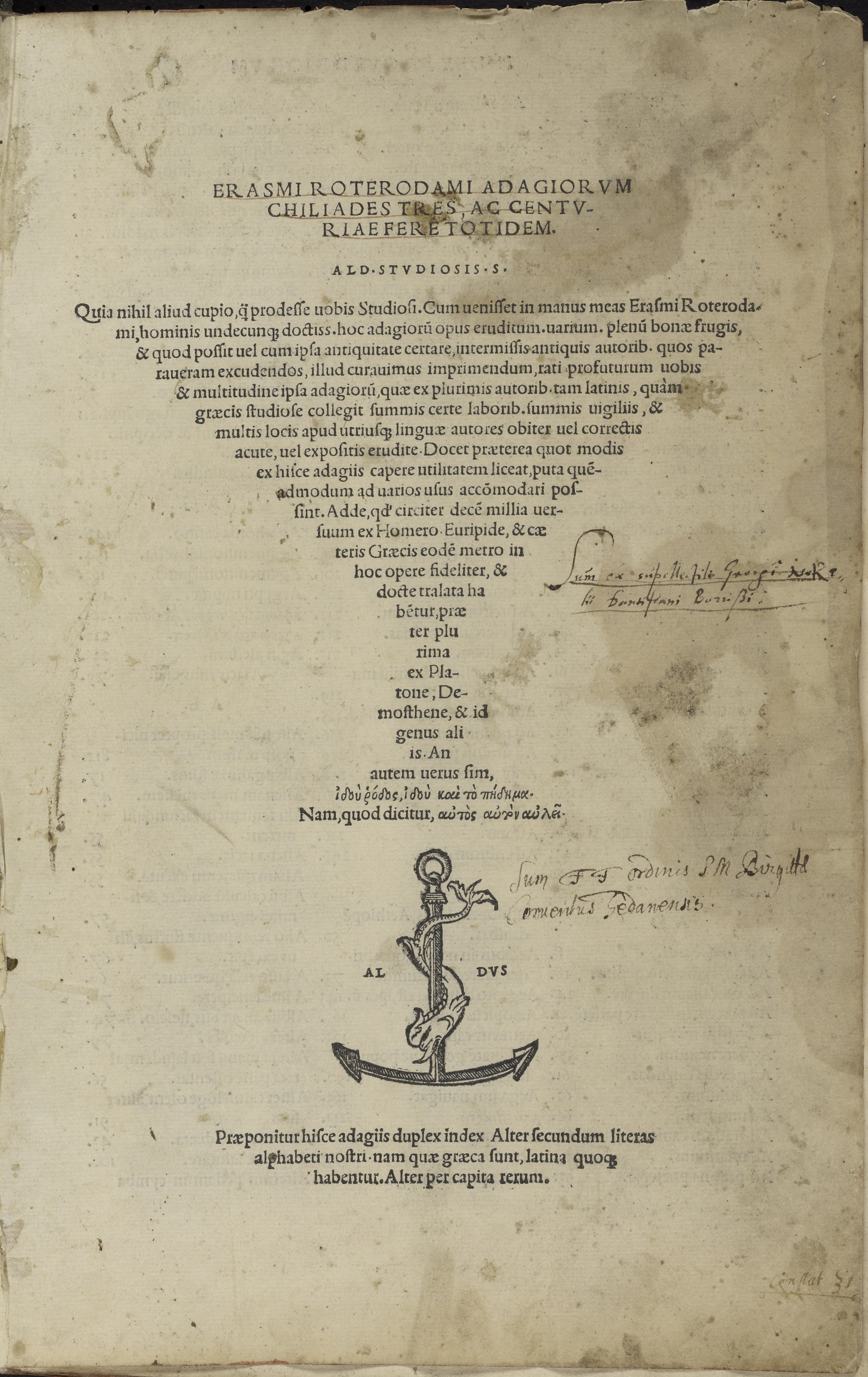
Manutius, Erasmi Roterodami Adagiorum Chiliades tres, ac centuriae
fere totidem, 1508
‘How many books do you have?’ asked Meggie. She had grown up
among piles of books, but even she couldn’t imagine there were books behind all
the windows of this huge house.
Elinor inspected her again, this time with unconcealed
contempt. ‘How many?’ she repeated. ‘Do you think I count them like buttons or
peas? A very, very great many. There are probably more books in every single
room of this house than you will ever read – and some of them are so valuable
that I wouldn’t hesitate to shoot you if you dared touch them. But as you’re a
clever girl, or so your father assures me, you wouldn’t do that anyway, would
you?’
Meggie didn’t reply. Instead, she imagined standing on tiptoe
and spitting three times into this old witch’s face.
However, Mo just laughed. ‘You haven’t changed, Elinor,’ he
remarked. ‘A tongue as sharp as a paper-knife. But I warn you, if you harm
Meggie I’ll do the same to your beloved books.’
Elinor’s lips curled in a tiny smile. ‘Well said,’ she
answered, stepping aside. ‘You obviously haven’t changed either. Come in. I’ll
show you the books that need your help, and a few others as well.’
Meggie had always thought Mo had a lot of books. She never
thought so again, not after setting foot in Elinor’s house.
There were no haphazard piles lying around as they did at
home. Every book obviously had its place. But where other people have
wallpaper, pictures, or just an empty wall, Elinor had bookshelves. The shelves
were white and went right up to the ceiling in the entrance hall through which
she had first led them, but in the next room and the corridor beyond it the
shelves were as black as the tiles on the floor.
‘These books,’ announced Elinor with a dismissive gesture as
they passed the closely-ranked spines, ‘have accumulated over the years.
They’re not particularly valuable, mostly of mediocre quality, nothing out of
the ordinary. Should certain fingers be unable to control themselves and take
one off the shelf now and then,’ she added, casting a brief glance at Meggie,
‘I don’t suppose the consequences would be too serious. Just so long as once
those fingers have satisfied their curiosity they put every book back in its
right place again and don’t leave any unappetising bookmarks inside.’ Here,
Elinor turned to Mo. ‘Believe it or not,’ she said, ‘I actually found a
dried-up slice of salami used as a bookmark in one of the last books I bought,
a wonderful nineteenth-century first edition.’
Meggie couldn’t help giggling, which naturally earned her
another stern look. ‘It’s nothing to laugh about, young lady,’ said Elinor.
‘Some of the most wonderful books ever printed were lost because some fool of a
fishmonger tore out their pages to wrap his stinking fish. In the Middle Ages,
thousands of books were destroyed when people cut up their bindings to make
soles for shoes or to heat steam baths with their paper.’ The thought of such
incredible abominations, even if they had occurred centuries ago, made Elinor
gasp for air. ‘Well, let’s forget about that,’ she said, ‘or I shall get
overexcited. My blood pressure’s much too high as it is.’
She had stopped in front of a door which had an anchor with
a dolphin coiled around it painted on the white wood. ‘This is a famous printer’s
special sign,’ explained Elinor, stroking the dolphin’s pointed nose with one
finger. ‘Just the thing for a library door, eh?’
‘I know,’ said Meggie. ‘Aldus Manutius. He lived in Venice
and printed books the right size to fit into his customers’ saddlebags.’
‘Really?’ Elinor wrinkled her brow, intrigued. ‘I didn’t
know that. In any case, I am the fortunate owner of a book that he printed with
his own hands in the year 1503.’
‘You mean it’s from his workshop,’ Meggie corrected her.
‘Of course that’s what I mean.’ Elinor cleared her throat
and gave Mo a reproachful glance, as if it could only be his fault that his
daughter was precocious enough to know such things. Then she put her hand on
the door handle. ‘No child,’ she said, as she pressed the handle down with
almost solemn reverence, ‘has ever before passed through this door, but as I
assume your father has taught you a certain respect for books I’ll make an
exception today. However, only on condition you keep at least three paces away
from the shelves. Is that agreed?’
For a moment Meggie felt like saying no, it wasn’t. She
would have loved to surprise Elinor by showing contempt for her precious books,
but she couldn’t do it. Her curiosity was too much for her. She felt almost as
if she could hear the books whispering on the other side of the half-open door.
They were promising her a thousand unknown stories, a thousand doors into
worlds she had never seen before. The temptation was stronger than Meggie’s
pride.
‘Agreed,’ she murmured, clasping her hands behind her back.
‘Three paces.’ Her fingers were itching with desire.