"I am not one who was born in the custody of wisdom. I am one who is fond of olden times and intense in quest of the sacred knowing of the ancients." Gustave Courbet
Showing posts with label Byron. Show all posts

22 January 2026

Happy Birthday, Lord Byron

Phillips, Lord Byron, 1814


STANZAS for MUSIC

There be none of Beauty's daughters
With a magic like thee;
And like music on the waters
Is thy sweet voice to me:
When, as if its sound were causing
The charmed ocean's pausing,
The waves lie still and gleaming,
And the lull'd winds seem dreaming:

And the midnight moon is weaving
Her bright chain o'er the deep;
Whose breast is gently heaving,
As an infant's asleep:
So the spirit bows before thee,
To listen and adore thee;
With a full but soft emotion,
Like the swell of Summer's ocean.

Lord George Gordon Byron, born on this day in 1788

21 January 2026

Happy Birthday, Lord Byron

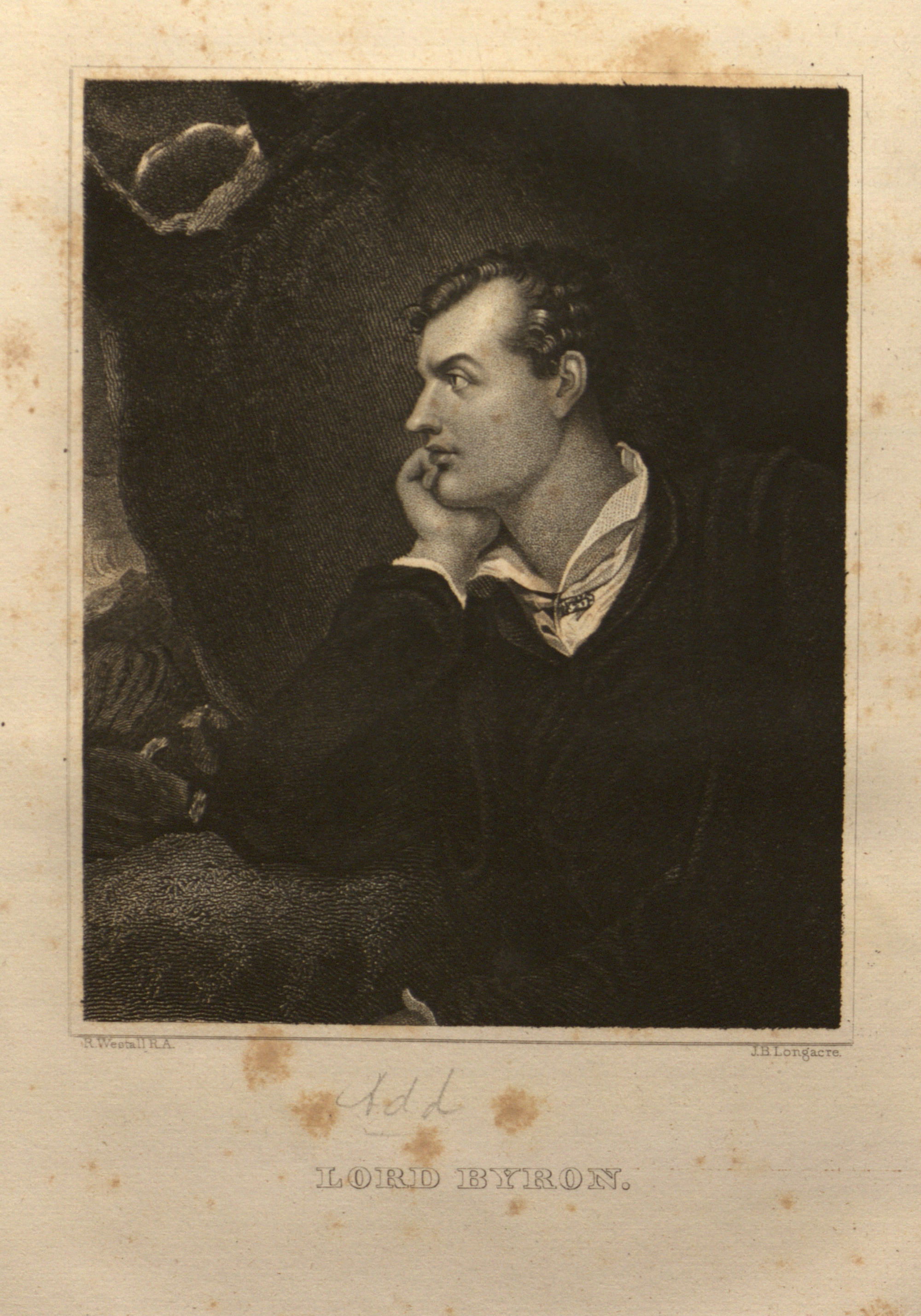
Westall, Lord Byron, 1841


CHILDE HAROLD'S PILGRMAGE

   There is a pleasure in the pathless woods,
   There is a rapture on the lonely shore,
   There is society where none intrudes,
   By the deep Sea, and music in its roar:
   I love not Man the less, but Nature more,
   From these our interviews, in which I steal
   From all I may be, or have been before,
   To mingle with the Universe, and feel
What I can ne'er express, yet cannot all conceal.

   Roll on, thou deep and dark blue Ocean--roll!
   Ten thousand fleets sweep over thee in vain;
   Man marks the earth with ruin--his control
   Stops with the shore;--upon the watery plain
   The wrecks are all thy deed, nor doth remain
   A shadow of man's ravage, save his own,
   When for a moment, like a drop of rain,
   He sinks into thy depths with bubbling groan,
Without a grave, unknelled, uncoffined, and unknown.

   His steps are not upon thy paths,--thy fields
   Are not a spoil for him,--thou dost arise
   And shake him from thee; the vile strength he wields
   For earth's destruction thou dost all despise,
   Spurning him from thy bosom to the skies,
   And send'st him, shivering in thy playful spray
   And howling, to his gods, where haply lies
   His petty hope in some near port or bay,
And dashest him again to earth: —there let him lay.

Lord Byron, born on this date in 1788

15 September 2025

Society.

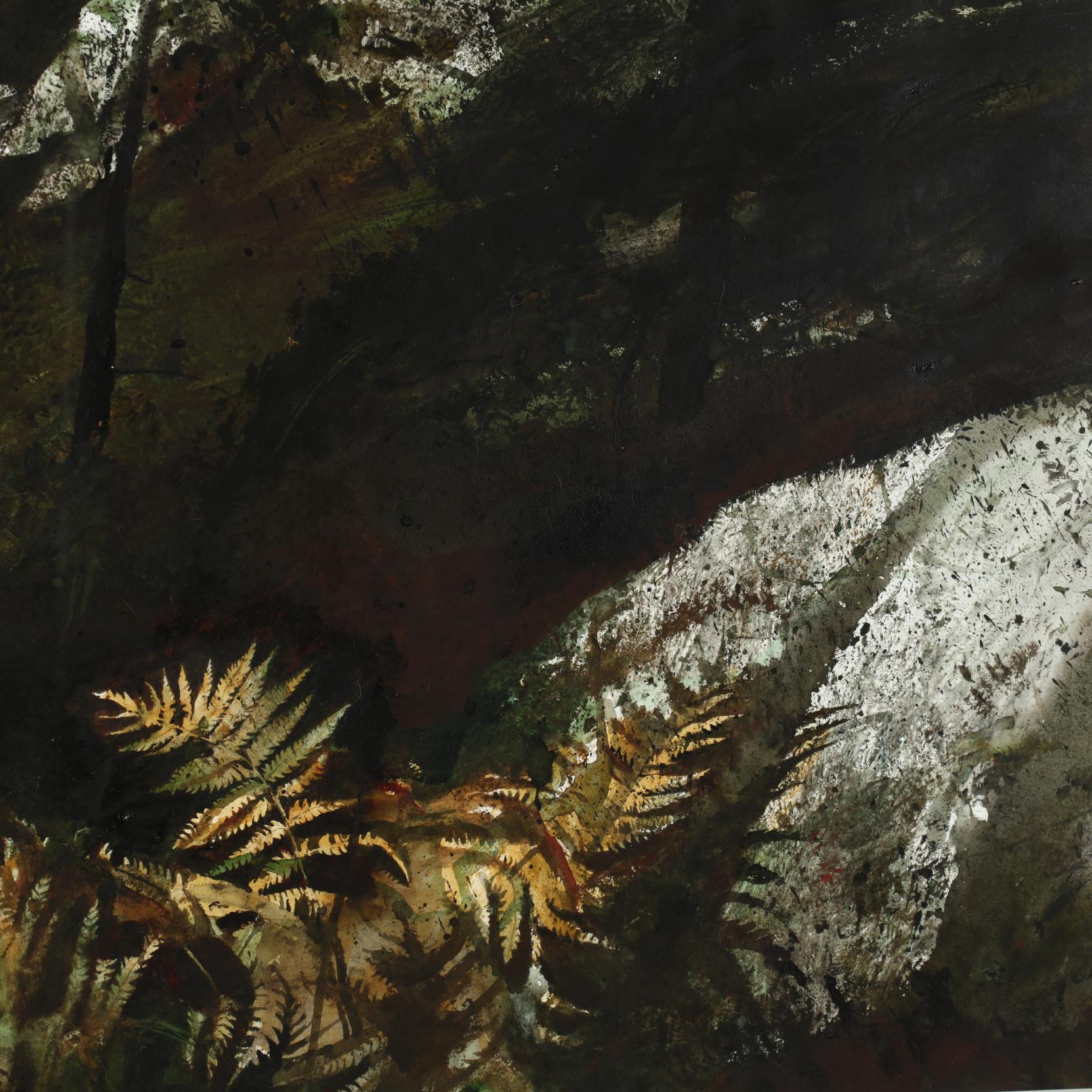
Wyeth, Deep Woods, 1973


There is a pleasure in the pathless woods,
   There is a rapture on the lonely shore,
   There is society where none intrudes,
   By the deep Sea, and music in its roar:
   I love not Man the less, but Nature more,
   From these our interviews, in which I steal
   From all I may be, or have been before,
   To mingle with the Universe, and feel
What I can ne'er express, yet cannot all conceal.

   Roll on, thou deep and dark blue Ocean--roll!
   Ten thousand fleets sweep over thee in vain;
   Man marks the earth with ruin--his control
   Stops with the shore;--upon the watery plain
   The wrecks are all thy deed, nor doth remain
   A shadow of man's ravage, save his own,
   When for a moment, like a drop of rain,
   He sinks into thy depths with bubbling groan,
Without a grave, unknelled, uncoffined, and unknown.

   His steps are not upon thy paths,--thy fields
   Are not a spoil for him,--thou dost arise
   And shake him from thee; the vile strength he wields
   For earth's destruction thou dost all despise,
   Spurning him from thy bosom to the skies,
   And send'st him, shivering in thy playful spray
   And howling, to his gods, where haply lies
   His petty hope in some near port or bay,
And dashest him again to earth: —there let him lay.

Lord Byron

14 February 2025

Whisper'd.

Carracci, Sleeping Venus, 1603


It is the hour when from the boughs
The nightingale's high note is heard;
It is the hour -- when lover's vows
Seem sweet in every whisper'd word;
And gentle winds and waters near,
Make music to the lonely ear.
Each flower the dews have lightly wet,
And in the sky the stars are met,
And on the wave is deeper blue,
And on the leaf a browner hue,
And in the Heaven that clear obscure
So softly dark, and darkly pure,
That follows the decline of day
As twilight melts beneath the moon away.

Lord Byron 

23 July 2023

Dark-Blue.


Adieu, adieu! my native shore
Fades o’er the water blue;
The night-winds sigh, the breakers roar,
And shrieks the wild sea-mew.
Yon sun that sets upon the sea
We follow in his flight;
Farewell awhile to him and thee,
My native Land – Good Night!

A few short hours and He will rise,
To give the Morrow birth;
And I shall hail the main and skies,
But not my mother Earth.
Deserted is my own good Hall,
Its hearth is desolate;
Wild weeds are gathering on wall,
My Dog howls at the gate.

And now I’m in the world alone,
Upon the wide, wide sea:
But why should I for others groan,
When none will sigh for me?
Perchance my Dog will whine in vain,
Till fed by stranger hands;
But long ere I come back again
He’d tear me where his stands.

With thee my bark, I’ll swiftly go
Athwart the foaming brine;
Nor care what land thou bear’st me to,
So not again to mine.
Welcome, welcome, ye dark-blue waves,
And when you fail my sight,
Welcome, ye deserts, and ye caves!
My native Land – Good night!

Lord Byron

Bless.


CHILDISH RECOLLECTIONS

When slow Disease, with all her host of pains,
Chills the warm, tide which flows along the veins
When Health,affrighted, spreads her rosy wing,
And flies with every changing gale of spring;
Not to the aching frame alone confined,
Unyielding pangs avail the drooping mind:
What grisly forms, the spectre-train of woe,
Bid shuddering Nature shrink beneath the blow
With Resignaion wage relentless strife,
While Hope retires appall’d, and clings to life!
Yet less the pang when, through the tedious hour,
Remembrance sheds around her genial power,
Calls back the vanish’d days to rapture given,
When love was bliss, and Beauty form’d our heaven;
Or, dear to youth, portrays each childish scene,
Those farry bowers, where all in turn have been.
As when through clouds that pour the sumrner storm
The orb of day unveils his distant form,
Gilds with faiht beams the crystal dews of rain,
And dimly twinkles o’er the watery plain;
Thus, while the future dark and cheerless gleams
The sun of memory, glowing through my drearns
Though sunk’ the radiance of his former blaze,
To scenes far distant points his paler rays;
Still rules my senses with unbounded sway,
The past confounding with the present day.

Oft does my heart indulge the rising thought,
Which still recurs, uniook’d for and Unsought
My soul to Fancy’s fond suggestion yields,
And roams romantic o’er her airy fields.
Scenes of my youth, developed, crowd to view,
To which I long have bade a last adieu!
Seats of delight, inspiring youthful themes;
Friends lost to me for aye, except in dreams;
Some who in marble prematurely sleep.
Whose forms I now remember but to weep;
Some who yet urge the same scholastic course
Of early science, future fame the source;
Who, still contending in the studious race,
In quick rotation fill the senior place.
These with a thousand visions now unite,
To dazzle, though they please, my aching sight
Ida blest spot, where science holds her reign,
How joyous once I join’d thv youthful train!
Bright in idea gleams thy lofty spire,
Again I mingle with thy playful quire;
Our tricks of mischief, every childish game,
Unchanged by time or distance, seem the same.
Through winding paths along the glade, I trace
The social smile of every welcome face;
My wonted haunts, my scenes of joy and woe,
Each early boyish friend, or youthful foe,
Our feuds dissolved, but not my friendship past,-
I bless the former and forgive the last.
Hours of my youth! when, nurtured in my breast,
To love a stranger, friendship made me blest
Friendship, the dear peculiar bond of youth
When every artless bosom throbs with truth
Untaught my worldly wisdom how to feign,
And check each impulse with prudential rein;
When all we feel, our honest souls disclose
In love to friends, in open hate to toes;
No varnish’d tales the lips of youth repeat,
No dear-bought knowledge purchased by deceit,
Hypocrisy, the gift of lengthen’d years,
Matured by age, the garb of prudence wears.
When now the boy is ripen’d into man,
His careful sire chalks forth some wary plan;
Instructs his son from candour’s path to shrink,
Smoothly to speak, and cauautiously to think;
Still to assent, and never to deny –
A patron’s praise can well reward the lie:
And who, when Fortune’s warning voice is heard,
Would lose his opening prospects for a word,
Although against that word his heart rebel,
And truth indignant all his bosom swell.

Away with themes like this! not mine the task
From flattering friends to tear the hateful mask;
Let keener bards delight in satire’s sting;
My fancy soars not on Detraction’s wing:
Once, and but once, she aim’d a deadly blow,
To hurl defiance on a secret foe;
But when that foe, from feeling or from shame,
The cause unknown, yet still to me the same,
Warn’d by some friendly hint, perchance, retired,
With this submission all her rage expired.
From dreaded pangs that feeble foe to save,
She hush’d her young resentment, and forgave;
Or, my muse a pedant’s portrait drew,
POMPOSUS’ virtues are but known to few:
I never fear’d the young usurper’s nod,
And he who wields must sometimes feel the rod.
If since on Granta’s failings, known to all
Who share the converse of a college hall,
She sometimes trifled in a lighter strain,
‘Tis past, and thus she will not sin again;
Soon must her early song for ever cease,
And all may rsii when I shall rest in peace.

Here first remember’d be the joyous band,
Who hail’d me chief, obedient to command;
Who join’d with rne in every boyish sport –
Their first adviser, and their last resort;
Nor shrunk beneath the upstart pedant’s frown,
Or all the sable glories of his gown;
Who, thus transplanted from his father’s school –
Unfit to govern, ignorant of rule –
Succeeded him, whom all unite to praise,
The dear preceptor of my early days!
PROBUS, the pride of science,and the boast,
To IDA now, alas! for ever lost,
With him, for years, we search’d the classic page,
And fear’d the master, though we loved the sage:
Retired at last’ his small yet peacefull seat
From learning’s labour is the blest retreat,
POMPOSUS fills his magisterial chair;
POMPOSUS governs,- but, my muse, forbear:
Contempt, in silence, be the pedant’s lot;
His name and precepts be alike forgot;
No more his mention shall my verse degrade
To him my tribute is already paid.

High through those elms, with hoary branches crown’d,
Fair Ida’s bower adorns the landscape round;
There Science, from her favour’d seat, surveys
The vale where rural Nature claims her praise;
To her awhile resigns her youthful train,
Who move in joy, and dance along the plain.
In scatter’d groups each favour’d haunt pursue,
Repeat old pastimes, and discover new;
Flush’d with his rays, beneath the noon-tide sun,
In rival bands, between the wickets run,
Drive o’er the sward the ball with active force,
Or chase with nimble feet its rapid course.
But these with slower steps direct their way,
Where Brent’s cool waves in limpid currents stray;
While yonder few search out some green retreat
And arbours shade them from the summer heat:
Others, again, a pert and lively crew,
Some rough and thoughtless stranger placed in view,
With frolic quaint their antic jests expose,
And tease the grumbling rustic as he goes;
Nor rest with this, but many a passing fray
Tradition treasures for a future day:
‘Twas here the gather’d swains for vengeance fought,
And here we earn’d the conquest dearly bought;
Here have we fled before superior might,
And here renew’d the wild tumultuous fight.’
While thus our souls with early passions swell
In lingering tones resounds the distant bell,
Th’ allotted hour of daily sport is o’er,
And Learning beckons from her temple’s door.
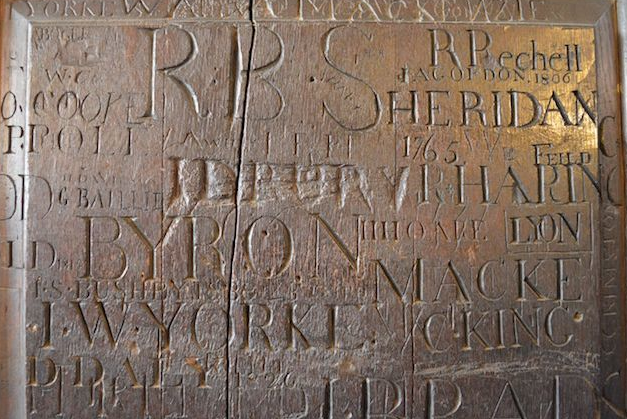
No splendid tablets grace her simple hall,
But ruder records fill the dusky wall;
There, deeply carved, behold! each tyro’s name
Secures its owner’s academic fame;
Here mingling view the names of sire and son –
The one long graved, the other just begun:
These shall survive alike when son and sire
Beneath one common stroke of fate expire;
Perhaps their last memorial these alone,
Denied in death a monumental stone,
Whilst to the gale in mournful cadence wave
The sighing weeds that hide their nameless grave.
And here my name, and many an early friend’s,
Along the wall in lengthen’d line extends.
Though still our deeds amuse the youthful race,
Who tread our steps, and fill our former place,
Who young obey’d their lords in silent awe,
Whose nod commanded, and whose voice was law;
And now, in turn, possess the reins of power,
To rule, the little tyrants of an hour;
Though sometimes, with the tales of ancient day,
They pass the dreary winter’s eve away
‘And thus our former rulers stemm’d the tide,
And thus they dealt the combat side by side;
Just in this place the mouldering walls they scaled,
Nor bolts nor bars against their strength avail’d;
Here PROBUS came, the rising fray to quell,
And here he falter’d forth his last farewell;
And here one night abroad they dared to roam,
While bold POMPOSUS bravely stay’d at home;’
While thus they speak, the hour must soon arrive,
When names of these, like ours, alone survive:
Yet a few years, one general wreck will whelm
The faint remembrance of our fairy realm.

Dear honest race! though now we meet no more,
One last long look on what we were before
Our first kind greetings, and our last adieu –
Drew tears from eyes unused to weep with you.
Through splendid circles, fashion’s gaudy world,
Where folly’s glaring standard waves unfurl’d,
I plunged to drown in noise my fond regret,
And all I sought or hoped was to forget.
Vain wish! if chance some well-remember’d face,
Some old companion of my early race,
Advanced to claim his friend with honest joy,
My eyes, my heart, proclaim’d me still a boy;
The glittering scene, the fluttering groups around’
Were quite forgotten when my friend was found;
The smiles of beauty–(for, alas! I’ve known
What ’tis to bend before Love’s mighty throne)–
The smiles of beauty, though those smiles were dear,
Could hardly charm me, when that friend was near;
My thoughts bewilder’d in the fond surprise,
The woods of IDA danced before my eyes;
I saw the sprightly wand’rers pour along,
I saw and join’d again the joyous throng;
Panting, again I traced her lofty grove,
And friendship’s feelings triumph’d over love.
Yet why should I alone with such delight
Retrace the circuit of my former flight?
Is there no cause beyond the common claim
Endear’d to all in childhood’s very name?
Ah! sure some stronger impulse vibrates here,
Which whispers friendship will be doubly dear
To one who thus for kindred hearts must roam,
And seek abroad the love denied at home.
Those hearts, dear IDA, have I found in thee–
A home, a worid, a paradise to me.
Stern Death forbade my orphan youth to share
The tender guidance of a father’s care.
Can rank, or e’en a guardian’s name supply
The love which glistens in a father’s eye?
For this can wealth or title’s sound atone,
Made, by a parent’s early loss, my own?
What brother springs a brother’s love to seek?
What sister’s gentle kiss has prest my cheek?
For me how dull the vacant moments rise,
To no fond bosom link’d by kindred ties!
Oft in the progress of some fleeting dream
Fraternal smiles collected round me seem;
While still the visions to my heart are prest,
The voice of love will murmur in my rest:
I hear-I wake-and in the sound rejoice;
I hear again,-but, ah! no brother’s voice.
A hermit, ‘midst of crowds, I fain must stray
Alone, though thousand pilgrims fill the way;
While these a thousand kindred wreaths entwine
I cannot call one single blossom mine:
What then remains? in solitude to groan,
To mix in friendship, or to sigh alone.
Thus must I cling to some endearing hand,
And none more dear than IDA’S social band.
Alonzo! best and dearest of my friends,
Thy name ennobles him who thus commends;
From this fond tribute thou canst gain no praise;
The praise as his who now that tribute pays.
Oh! in the promise of thy early youth,
If hope anticipate the words of truth,
Some loftier bard shall sing thy glorious name,
To build his own upon thy deathless fame.
Friend of my heart, and foremost of the list
Of those with whom I lived supremely blest,
Oft have we drain’d the font of ancient lore;
Though drinking deeply, thirsting still the more.
Yet, when confinement’s lingering hour was done,
Our sports, our studies, and our souls were one:
Together we impell’d the flying ball;
Together waited in our tutor’s hall;
Together join’d in cricket’s manly toil,
Or shared the produce of the river’s spoil;
Or, plunging from the green declining shore,
Our pliant limbs the buoyant billows bore;
In every element, unchanged, the same,
All, all that brothers should be, but the name.

Nor yet are you forgot, my jocund boy!
DAVUS, the harbinger of childish joy;
For ever foremost in the ranks of fun,
The laughing herald of the harmless pun;
Yet with a breast of such materials made–
Anxious to please, of pleasing half afraid;
Candid and liberal, with a heart of steel
In danger’s path, though not untaught to feel.
Sill I remember, in the factious strife,
The rustic’s musket aim’d against my life:
High pois’d in air the massy weapon hung,
A cry of horror burst from every tongue;
Whilst I, in combat with another foe,
Fought on, unconscious of th’ impending blow;
Your arm, brave boy, arrested his career–
Forward you sprung, insensible to fear;
Disarm’d and baffled by your conquering hand,
Thc grovelling savage roll’d upon,the sand:
An act like this, can simple thanks repay?
Or all the labours of a grateful lay?
Oh no! whene’er my breast forgets the deed,
That instant, DAVUS, it deserves to bleed.

LYCUS! on me thy claims are justly great:
Thy milder virtues could my muse relate,
To thee alone, unrivall’d would belong.
The feeble efforts of my lengthen’d song.
Well canst thou boast, to lead in senates fit,
A Spartan firmness with Athenian wit:
Though yet in embryo these perfections shine,
Lycus! thy father’s fame will soon be thine.
Where learning nurtures the superior mind,
What may we hope from genius thus re fined!
When time at length matures thy growing years,
How wilt thou tower above thy fellow peers!
Prudence and sense, a spirit bold and free,
With honour’s soul, united beam in thee.

Shall fair EURYALUS pass by unsung?
From ancient lineage, not unworthy sprung:
What though one sad dissension bade us part?
That name is yet embalm’d within my heart;
Yet at the mention does that heart rebound,
And palpitate, responsive to the sound.
Envy dissolved our ties, and not our will:
We once were friends, –I’ll think we are so still.
A form unmatch’d in nature’s partial mould,
A heart untainted, we in thee behold:
Yet not the senate’s thunder thou shalt wield,
Nor seek for glory in the tented field;
To minds of ruder texture these be given–
Thy soul shall nearer soar its native heaven.
Haply, in polish’d courts might be thy seat,
But that thy tongue could never forge deceit:
The courtier’s supple bow and sneering smile,
The flow of compliment, the slippery wile,
Would make that breast with indignation burn,
And all the glittering snares to tempt thee spurn.
Domestic happiness will stamp thy fate;
Sacred to love, unclouded e’er by hate;
The world admire thee, and thy friends adore;
Ambition’s slave alone would toil for more.

Now last, but nearest of the social band,
See honest, open, generous CLEON stand;
With scarce one speck to cloud the pleasing scene,
No vice degrades that purest soul serene.
On the same day our studious race begun,
On the same day our studious race was run;
Thus side by side we pass’d our first career,
Thus side by side we strove for many a year;
At last concluded our scholastic life,
We neither conquer’d in the classic strife:
As speakers each supports an equal name,
And crowds allow to both a partial fame:
To soothe a youthful rival’s early pride,
Though Cleon’s candour would the palm divide,
Yet candour’s self compels me now to own
Justice awards it to my friend alone.

Oh! friends regretted, scenes for ever dear,
Remembrance hails you with her warmest tear!
Drooping, she bends o’er pensive Fancy’s urn,
To trace the hours which never can return;
Yet with the retrospection loves to dwell,
And soothe the sorrows of her last farewell!
Yet greets the triumph of my boyish mind,
As infant laurels round my head were twined,
When PROBUS’ praise repaid my lyric song,
Or placed me higher in the studious throng;
Or when my first harangue received applause,
His sage instruction the primeval cause,
What gratitude to him my soul posseat,
While hope of dawning honours fill’d my breast!
For all my humble fame, to him alone
The praise is due, who made that fame my own.
Oh! could I soar above these feeble lays,
These young effusions of my early days,
To him my muse her noblest strain would give:
The song might perish, but the theme might live.
Yet why for him the needless verse essay?
His honour’d name requires no vain display:
By every son of grateful IDA blest,
It finds an echo in each youthful breast;
A fame beyond the glories of the proud,
Or all the plaudits of the venal crowd.

IDA! not yet exhausted is the theme,
Nor closed the progress of my youthful dream.
How many a friend deserves the grateful strain!
What scenes of childhood still unsung remain!
Yet let me hush this echo of the past,
This parting song, the dearest and the last;
And brood in secret o’er those hours of joy,
To me a silent and a sweet employ,
While future hope and fear alike unknown,
I think with pleasure on the past alone;
Yes to the past alone my heart confine,
And chase the phantom of what once was mine.

IDA! still o’er thy hills in joy preside,
And proudly steer through time’s eventful tide;
Still may thy blooming sons thy name revere,
Smile in thy bower, but quit thee with a tear,-
That tear, perhaps, the fondest which will flow,
O’er their last scene of happiness below.
Tell me, ye hoary few, who glide along,
The feeble veterans of some former throng,
Whose friends, like autumn leaves by tempests whirl’d,
Are swept for ever from this busy world;
Revolve the fleeting moments of your youth,
While Care has yet withheld her venom’d tooth;
Say if remembrance days like these endears
Beyond the rapture of succeeding years?
Say, can ambition’s fever’d dream bestow
So sweet a balm to soothe your hours of woe?
Can treasures, hoarded for some thankless son,
Can royal smiles, or wreaths by slaughter won,
Can stars or ermine, man’s maturer toys
(For glittering baubles are not left to boys),
Recall one scene so much beloved to view,
As those where Youth her garland twined for you?
Ah, no! amidst the gloomy calm of age
You turn with faltering hand life’s varied page;
Peruse the record of your days on earth,
Unsullied only where it marks your birth;
Still lingering pause above each chequer’d leaf,
And blot with tears the sable lines of grief;
Where passion o’er the theme her mantle threw,
Or weeping Virtue sigh’d a faint adieu;
But bless the scroll which fairer words adorn,
Traced by the rosy finger of the morn;
When Friendship bow’d before the shrine of Truth,
And Love without his pinion, smiled on Youth.

Lord Byron

22 January 2023

Happy Birthday, Byron

Lupton, Lord Byron, 1824


Clear, placid Leman! thy contrasted lake,
    With the wild world I dwelt in, is a thing
    Which warns me, with its stillness, to forsake
    Earth’s troubled waters for a purer spring.
    This quiet sail is as a noiseless wing         
    To waft me from distraction; once I loved
    Torn ocean’s roar, but thy soft murmuring
    Sounds sweet as if a Sister’s voice reproved,
That I with stern delights should e’er have been so moved.
 
    It is the hush of night, and all between         
    Thy margin and the mountains, dusk, yet clear,
    Mellow’d and mingling, yet distinctly seen,
    Save darken’d Jura, whose capt heights appear
    Precipitously steep; and drawing near,
    There breathes a living fragrance from the shore,         
    Of flowers yet fresh with childhood; on the ear
    Drops the light drip of the suspended oar,
Or chirps the grasshopper one good-night carol more;
 
    He is an evening reveller, who makes
    His life an infancy, and sings his fill;         
    At intervals, some bird from out the brakes
    Starts into voice a moment, then is still.
    There seems a floating whisper on the hill,
    But that is fancy, for the starlight dews
    All silently their tears of love instil,         
    Weeping themselves away, till they infuse
Deep into nature’s breast the spirit of her hues.
 
    Ye stars! which are the poetry of heaven!
    If in your bright leaves we would read the fate
    Of men and empires,—’tis to be forgiven,         
    That in our aspirations to be great,
    Our destinies o’erleap their mortal state,
    And claim a kindred with you; for ye are
    A beauty and a mystery, and create
    In us such love and reverence from afar,         
That fortune, fame, power, life, have named themselves a star.
 
    All heaven and earth are still—though not in sleep,
    But breathless, as we grow when feeling most;
    And silent, as we stand in thoughts too deep:—
    All heaven and earth are still: From the high host         
    Of stars, to the lull’d lake and mountain-coast,
    All is concenter’d in a life intense,
    Where not a beam, nor air, nor leaf is lost,
    But hath a part of being, and a sense
Of that which is of all Creator and defence.         
 
    Then stirs the feeling infinite, so felt
    In solitude, where we are least alone;
    A truth, which through our being then doth melt,
    And purifies from self: it is a tone,
    The soul and source of music, which makes known         
    Eternal harmony, and sheds a charm
    Like to the fabled Cytherea’s zone,
    Binding all things with beauty;—’t would disarm
The spectre Death, had he substantial power to harm.
 
    Not vainly did the early Persian make         
    His altar the high places, and the peak
    Of earth-o’ergazing mountains, and thus take
    A fit and unwall’d temple, there to seek
    The Spirit, in whose honour shrines are weak,
    Uprear’d of human hands. Come, and compare         
    Columns and idol-dwellings, Goth or Greek,
    With Nature’s realms of worship, earth and air,
Nor fix on fond abodes to circumscribe thy pray’r!
 
    The sky is changed!—and such a change! Oh night,
    And storm, and darkness, ye are wondrous strong,         
    Yet lovely in your strength, as is the light
    Of a dark eye in woman! Far along,
    From peak to peak, the rattling crags among
    Leaps the live thunder! Not from one lone cloud,
    But every mountain now hath found a tongue,         
    And Jura answers, through her misty shroud,
Back to the joyous Alps, who call to her aloud!
 
    And this is in the night:—Most glorious night!
    Thou wert not sent for slumber! let me be
    A sharer in thy fierce and far delight,—         
    A portion of the tempest and of thee!
    How the lit lake shines, a phosphoric sea,
    And the big rain comes dancing to the earth!
    And now again ’tis black,—and now, the glee
    Of the loud hills shakes with its mountain-mirth,         
As if they did rejoice o’er a young earthquake’s birth.
 
    Now, where the swift Rhone cleaves his way between
    Heights which appear as lovers who have parted
    In hate, whose mining depths so intervene,
    That they can meet no more, though broken-hearted;         
    Though in their souls, which thus each other thwarted,
    Love was the very root of the fond rage
    Which blighted their life’s bloom, and then departed;
    Itself expired, but leaving them an age
Of years all winters,—war within themselves to wage.         
 
    Now, where the quick Rhone thus hath cleft his way,
    The mightiest of the storms hath ta’en his stand:
    For here, not one, but many, make their play,
    And fling their thunder-bolts from hand to hand,
    Flashing and cast around: of all the band,         
    The brightest through these parted hills hath fork’d
    His lightnings,—as if he did understand,
    That in such gaps as desolation work’d,
There the hot shaft should blast whatever therein lurk’d.
 
    Sky, mountains, river, winds, lake, lightnings! ye!         
    With night, and clouds, and thunder, and a soul
    To make these felt and feeling, well may be
    Things that have made me watchful; the far roll
    Of your departing voices, is the knoll
    Of what in me is sleepless,—if I rest.         
    But where of ye, O tempests! is the goal?
    Are ye like those within the human breast?
Or do ye find, at length, like eagles, some high nest?
 
    Could I embody and unbosom now
    That which is most within me,—could I wreak         
    My thoughts upon expression, and thus throw
    Soul, heart, mind, passions, feelings, strong or weak,
    All that I would have sought, and all I seek,
    Bear, know, feel, and yet breathe—into one word,
    And that one word were Lightning, I would speak;         
    But as it is, I live and die unheard,
With a most voiceless thought, sheathing it as a sword.
 
Lord Byron, born on this day in 1788, from Childe Harold’s Pilgrimage, "Canto the Third"

03 November 2022

Melts.

Carracci, Sleeping Venus, 1603


It is the hour when from the boughs
The nightingale's high note is heard;
It is the hour -- when lover's vows
Seem sweet in every whisper'd word;
And gentle winds and waters near,
Make music to the lonely ear.
Each flower the dews have lightly wet,
And in the sky the stars are met,
And on the wave is deeper blue,
And on the leaf a browner hue,
And in the Heaven that clear obscure
So softly dark, and darkly pure,
That follows the decline of day
As twilight melts beneath the moon away.

Lord Byron 

25 March 2022

Chase.


A thousand hearts beat happily; and when         
  Music arose with its voluptuous swell,
  Soft eyes looked love to eyes which spake again,
  And all went merry as a marriage bell;
But hush! hark! a deep sound strikes like a rising knell!
 
Did ye not hear it?—No; ’twas but the wind,         
  Or the car rattling o’er the stony street:
  On with the dance! let joy be unconfined;
  No sleep till morn, when youth and pleasure meet
To chase the glowing hours with flying feet.

Lord Byron

22 January 2022

Happy Birthday, Byron

Westall, Lord Byron, 1841


Lord George Gordon Byron was born on this day in 1788.

A song.

Fill the goblet again! for I never before
Felt the glow which now gladdens my heart to its core;
Let us drink!  ---  who would not?  ---  since, through life's varied round,
In the goblet alone no deception is found. 
 
I have tried in its turn all that life can supply;
I have bask'd in the beam of a dark rolling eye;
I have loved!  ---  who has not?  ---   but what heart can declare
That pleasure existed while passion was there? 
 
In the days of my youth, when the heart's in its spring,
And dreams that affection can never take wing,
I had friends!  ---  who has not?   ---  but what tongue will avow,
That friends, rosy wine! Are so faithful as thou? 
 
The heart of a mistress some boy may estrange,
Friendship shifts with the sunbeam --- thou never canst change;
Thou grow'st old --- who does not?  ---  but on earth what appears,
Whose virtues, like thine, still increase with its years? 
 
Yet if blest to the utmost that love can bestow,
Should a rival bow down to our idol below,
We are jealous!  ---  who's not?  ---  thou hast no such alloy;
For the more that enjoy thee, the more we enjoy. 
 
Then the season of youth and its vanities past,
For refuge we fly to the goblet at last;
There we find --- do we not? --- in the flow of the soul,
That truth, as of yore, is confined to the bowl. 
 
When the box of Pandora was opened on earth,
And Misery's triumph commenced over Mirth,
Hope was left, --- was she not? --- but the goblet we kiss,
And care not for Hope, who are certain of bliss. 
 
Long life to the grape!  for when summer is flown.
The age of our nectar shall gladden our own:
We must die --- who shall not?  ---  May our sins be forgiven,
And Hebe shall never be idle in heaven.

Lord Byron

07 April 2020

Reaching.


Peter Ackroyd presents The Romantics ...

LIBERTY
Ackroyd reveals how the radical ideas of liberty that inspired the French Revolution opened up a world of possibility for great British writers such as William Blake, Samuel Taylor Coleridge and William Wordsworth, inspiring some of the greatest works of literature in the English language. 


NATURE
Ackroyd summons the ghosts of the Romantics to tell the story of man's escape from the shackles of industry and commerce to the freedom of nature.

As the Industrial Revolution took hold of Britain during the late 18th Century, the Romantics embraced nature in search of sublime experience. But this was much more than just a walk in the country; it was a groundbreaking endeavour to understand what it means to be human. They forged poetry of radical protest against a dark world that was descending upon Britain.

Mary Shelley's Frankenstein was a prophecy that science might be used to corrupt nature, a warning people are still preaching to this day. 


ETERNITY
Byron, Keats and Shelley lived short lives, but the radical way they lived them would change the world. At 19, Shelley wrote The Necessity of Atheism - it was banned and burned, but it freed the Romantics from religion. Through their search for meaning in a world without God, they pioneered the notions of free love, celebrity and secular idolatry that are at the centre of modern Western culture.

For them poetry became the new religion, a way of reaching eternity.

22 January 2020

Happy Birthday, Byron

Westall, Lord Byron, 1841


Lord Byron was born on this date in 1788.

CHILDE HAROLD'S PILGRMAGE

   There is a pleasure in the pathless woods,
   There is a rapture on the lonely shore,
   There is society where none intrudes,
   By the deep Sea, and music in its roar:
   I love not Man the less, but Nature more,
   From these our interviews, in which I steal
   From all I may be, or have been before,
   To mingle with the Universe, and feel
What I can ne'er express, yet cannot all conceal.

   Roll on, thou deep and dark blue Ocean--roll!
   Ten thousand fleets sweep over thee in vain;
   Man marks the earth with ruin--his control
   Stops with the shore;--upon the watery plain
   The wrecks are all thy deed, nor doth remain
   A shadow of man's ravage, save his own,
   When for a moment, like a drop of rain,
   He sinks into thy depths with bubbling groan,
Without a grave, unknelled, uncoffined, and unknown.

   His steps are not upon thy paths,--thy fields
   Are not a spoil for him,--thou dost arise
   And shake him from thee; the vile strength he wields
   For earth's destruction thou dost all despise,
   Spurning him from thy bosom to the skies,
   And send'st him, shivering in thy playful spray
   And howling, to his gods, where haply lies
   His petty hope in some near port or bay,
And dashest him again to earth: —there let him lay.

Lord Byron

23 January 2019

Happy birthday, Byron.

Phillips, The Lord Byron, 1813


Lord Byron was born on this day in 1788.

STANZAS for MUSIC


There be none of Beauty's daughters 
With a magic like thee; 
And like music on the waters 
Is thy sweet voice to me: 
When, as if its sound were causing 
The charmed ocean's pausing, 
The waves lie still and gleaming, 
And the lull'd winds seem dreaming: 

And the midnight moon is weaving 

Her bright chain o'er the deep; 
Whose breast is gently heaving, 
As an infant's asleep: 
So the spirit bows before thee, 
To listen and adore thee; 
With a full but soft emotion, 
Like the swell of Summer's ocean. 

Lord Byron

14 June 2018

Unconfin'd.


On with the dance! let joy be unconfin’d;
No sleep till morn, when Youth and Pleasure meet
To chase the glowing Hours with flying feet—

Lord Byron, from "Eve of Quatre Bras"

22 January 2018

Happy birthday, Byron.

Westall, George Gordon Byron, 6th Baron Byron, 1813


Lord George Gordon Byron was born on this day in 1788.

A song.

Fill the goblet again ! for I never before
Felt the glow which now gladdens my heart to its core;
Let us drink !  ---  who would not ?  ---  since, through life's varied round,
In the goblet alone no deception is found.
I have tried in its turn all that life can supply;
I have bask'd in the beam of a dark rolling eye;
I have loved !  ---  who has not ?  ---   but what heart can declare
That pleasure existed while passion was there?
In the days of my youth, when the heart's in its spring,
And dreams that affection can never take wing,
I had friends !  ---  who has not ?   ---  but what tongue will avow,
That friends, rosy wine! Are so faithful as thou?
The heart of a mistress some boy may estrange,
Friendship shifts with the sunbeam --- thou never canst change;
Thou grow'st old --- who does not ?  ---  but on earth what appears,
Whose virtues, like thine, still increase with its years?
Yet if blest to the utmost that love can bestow,
Should a rival bow down to our idol below,
We are jealous !  ---  who's not ?  ---  thou hast no such alloy;
For the more that enjoy thee, the more we enjoy.
Then the season of youth and its vanities past,
For refuge we fly to the goblet at last;
There we find --- do we not ? --- in the flow of the soul,
That truth, as of yore, is confined to the bowl.
When the box of Pandora was opened on earth,
And Misery's triumph commenced over Mirth,
Hope was left, --- was she not ? --- but the goblet we kiss,
And care not for Hope, who are certain of bliss.
Long life to the grape!  for when summer is flown.
The age of our nectar shall gladden our own:
We must die --- who shall not ?  ---  May our sins be forgiven,
And Hebe shall never be idle in heaven.

Lord Byron

05 November 2017

Roll.


CHILDE HAROLD'S PILGRIMAGE

There is a pleasure in the pathless woods,
  There is a rapture on the lonely shore,
  There is society where none intrudes,
  By the deep Sea, and music in its roar:
  I love not Man the less, but Nature more,
  From these our interviews, in which I steal
  From all I may be, or have been before,
  To mingle with the Universe, and feel
What I can ne’er express, yet cannot all conceal.

  Roll on, thou deep and dark blue Ocean--roll!
  Ten thousand fleets sweep over thee in vain;
  Man marks the earth with ruin--his control
  Stops with the shore;--upon the watery plain
  The wrecks are all thy deed, nor doth remain
  A shadow of man’s ravage, save his own,
  When for a moment, like a drop of rain,
  He sinks into thy depths with bubbling groan,
Without a grave, unknelled, uncoffined, and unknown.

  His steps are not upon thy paths,--thy fields
  Are not a spoil for him,--thou dost arise
  And shake him from thee; the vile strength he wields
  For earth’s destruction thou dost all despise,
  Spurning him from thy bosom to the skies,
  And send’st him, shivering in thy playful spray
  And howling, to his gods, where haply lies
  His petty hope in some near port or bay,
And dashest him again to earth: —there let him lay.


Lord Byron

08 March 2017

Universe.

Wyeth, Sparks, 2001


DARKNESS

I had a dream, which was not all a dream. 
The bright sun was extinguish'd, and the stars 
Did wander darkling in the eternal space, 
Rayless, and pathless, and the icy earth 
Swung blind and blackening in the moonless air; 
Morn came and went—and came, and brought no day, 
And men forgot their passions in the dread 
Of this their desolation; and all hearts 
Were chill'd into a selfish prayer for light: 
And they did live by watchfires—and the thrones, 
The palaces of crowned kings—the huts, 
The habitations of all things which dwell, 
Were burnt for beacons; cities were consum'd, 
And men were gather'd round their blazing homes 
To look once more into each other's face; 
Happy were those who dwelt within the eye 
Of the volcanos, and their mountain-torch: 
A fearful hope was all the world contain'd; 
Forests were set on fire—but hour by hour 

They fell and faded—and the crackling trunks 
Extinguish'd with a crash—and all was black. 
The brows of men by the despairing light 
Wore an unearthly aspect, as by fits 
The flashes fell upon them; some lay down 

And hid their eyes and wept; and some did rest 
Their chins upon their clenched hands, and smil'd; 
And others hurried to and fro, and fed 
Their funeral piles with fuel, and look'd up 
With mad disquietude on the dull sky, 
The pall of a past world; and then again 
With curses cast them down upon the dust, 
And gnash'd their teeth and howl'd: the wild birds shriek'd And, terrified, did flutter on the ground, 
And flap their useless wings; the wildest brutes 
Came tame and tremulous; and vipers crawl'd 
And twin'd themselves among the multitude, 
Hissing, but stingless—they were slain for food. 
And War, which for a moment was no more, 
Did glut himself again: a meal was bought 
With blood, and each sate sullenly apart 
Gorging himself in gloom: no love was left; 
All earth was but one thought—and that was death 
Immediate and inglorious; and the pang 
Of famine fed upon all entrails—men 
Died, and their bones were tombless as their flesh; 
The meagre by the meagre were devour'd, 
Even dogs assail'd their masters, all save one, 
And he was faithful to a corse, and kept 
The birds and beasts and famish'd men at bay, 
Till hunger clung them, or the dropping dead 
Lur'd their lank jaws; himself sought out no food, 
But with a piteous and perpetual moan, 
And a quick desolate cry, licking the hand 
Which answer'd not with a caress—he died. 
The crowd was famish'd by degrees; but two 
Of an enormous city did survive, 
And they were enemies: they met beside 
The dying embers of an altar-place 
Where had been heap'd a mass of holy things 
For an unholy usage; they rak'd up, 
And shivering scrap'd with their cold skeleton hands 
The feeble ashes, and their feeble breath 
Blew for a little life, and made a flame 
Which was a mockery; then they lifted up 
Their eyes as it grew lighter, and beheld 
Each other's aspects—saw, and shriek'd, and died— 
Even of their mutual hideousness they died, 
Unknowing who he was upon whose brow 
Famine had written Fiend. The world was void, 
The populous and the powerful was a lump, 
Seasonless, herbless, treeless, manless, lifeless— 
A lump of death—a chaos of hard clay. 
The rivers, lakes and ocean all stood still, 
And nothing stirr'd within their silent depths; 
Ships sailorless lay rotting on the sea, 
And their masts fell down piecemeal: as they dropp'd 
They slept on the abyss without a surge— 
The waves were dead; the tides were in their grave, 
The moon, their mistress, had expir'd before; 
The winds were wither'd in the stagnant air, 
And the clouds perish'd; Darkness had no need
Of aid from them—She was the Universe.

Lord Byron