"I am not one who was born in the custody of wisdom. I am one who is fond of olden times and intense in quest of the sacred knowing of the ancients." Gustave Courbet
Showing posts with label pleasures. Show all posts

17 January 2022

Pleasures.

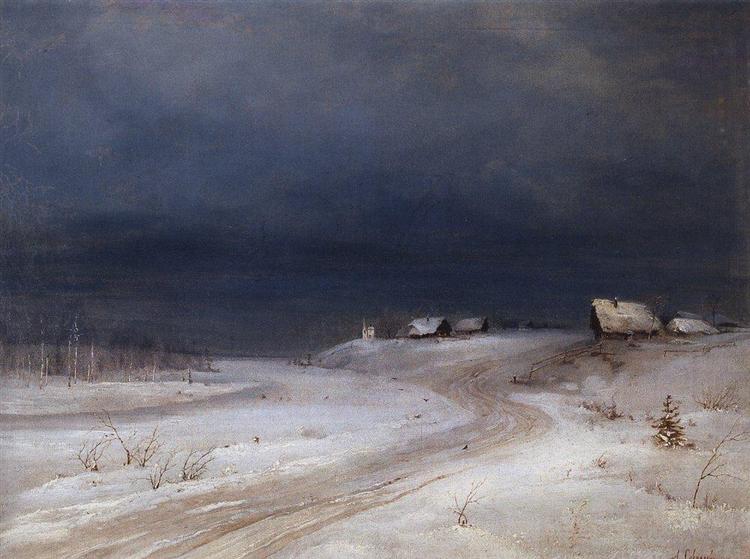
Savrasov, Winter, 1890


Let there be a cottage -- a real cottage -- a white cottage, embowered with flowering shrubs, so chosen as to unfold a succession of flowers upon the walls, and clustering round the windows through all the months of spring, summer, and autumn—beginning, in fact, with May roses, and ending with jasmine. Let it, however, not be spring, nor summer, nor autumn—but winter, in his sternest shape. This is a most important point in the science of happiness. And I am surprised to see people overlook it, and think it matter of congratulation that winter is going; or, if coming, is not likely to be a severe one. On the contrary, I put up a petition annually, for as much snow, hail, frost, or storm, of one kind or other, as the skies can possibly afford us. Surely every body is aware of the divine pleasures which attend a winter fire-side: candles at four o'clock, warm hearth-rugs, tea, a fair tea-maker, shutters closed, curtains flowing in ample draperies on the floor, whilst the wind and rain are raging audibly without.

Thomas De Quincey

09 February 2020

Pleasures.


If I have done anything, even a little, to help small children enjoy honest, simple pleasures, I have done a bit of good.

Beatrix Potter

31 December 2019

Everything.


He went to the church, and walked about the streets, and watched the people hurrying to and for, and patted the children on the head, and questioned beggars, and looked down into the kitchens of homes, and up to the windows, and found that everything could yield him pleasure. He had never dreamed of any walk, that anything, could give him so much happiness.

Charles Dickens, from A Christmas Carol

18 October 2019

Pleasure.


It was a quick walk walk to Lipp's and every place I passed that my stomach noticed as quickly as my eyes or my nose made the walk and added pleasure.  There were few people in the brasserie and when I sat down on the bench against the wall with the mirror in the back and a table in front and the waiter asked if I wanted a beer I asked for a distingué, the big glass mug that held a liter, and for potato salad.

The beer was very cold and wonderful to drink.  The pommes à l'huile were firm and marinated and the olive oil delicious.  I ground black pepper over the potatoes and moistened the bread in the olive oil.  After the first heavy draft of beer I drank and ate very slowly.  When the pommes à l'huile were gone I ordered another serving and a cervelas.  This was a sausage like a heavy, wide frankfurter split in two and covered with a special mustard. 

I mopped up all the oil and all of the sauce with the bread and drank the beer slowly until it began to lose its coldness and then I finished it and ordered a demi and watched it drawn.  It seemed colder than the distingué and I drank half of it. 

Ernest Hemingway, from A Moveable Feast

29 November 2018

Pleasures.


We now settled into a routine which has ever since served in my mind as an archetype, so that what I still mean when I speak of a "normal" day (and lament that normal days are so rare) is a day of the Bookham pattern. For if I could please myself I would always live as I lived there. I would choose always to breakfast at exactly eight and to be at my desk by nine, there to read or write till one. If a cup of good tea or coffee could be brought me about eleven, so much the better. A step or so out of doors for a pint of beer would not do quite so well; for a man does not want to drink alone and if you meet a friend in the taproom the break is likely to be extended beyond its ten minutes. At one precisely lunch should be on the table; and by two at the latest I would be on the road. Not, except at rare intervals, with a friend. Walking and talking are two very great pleasures, but it is a mistake to combine them. Our own noise blots out the sounds and silences of the outdoor world; and talking leads almost inevitably to smoking, and then farewell to nature as far as one of our senses is concerned. The only friend to walk with is one (such as I found, during the holidays, in Arthur) who so exactly shares your taste for each mood of the countryside that a glance, a halt, or at most a nudge, is enough to assure us that the pleasure is shared. The return from the walk, and the arrival of tea, should be exactly coincident, and not later than a quarter past four. Tea should be taken in solitude, as I took it as Bookham on those (happily numerous) occasions when Mrs. Kirkpatrick was out; the Knock himself disdained this meal. For eating and reading are two pleasures that combine admirably. Of course not all books are suitable for mealtime reading. It would be a kind of blasphemy to read poetry at table. What one wants is a gossipy, formless book which can be opened anywhere. The ones I learned so to use at Bookham were Boswell, and a translation of Herodotus, and Lang's History of English Literature. Tristram Shandy, Elia and the Anatomy of Melancholy are all good for the same purpose. At five a man should be at work again, and at it till seven. Then, at the evening meal and after, comes the time for talk, or, failing that, for lighter reading; and unless you are making a night of it with your cronies (and at Bookham I had none) there is no reason why you should ever be in bed later than eleven. But when is a man to write his letters? You forget that I am describing the happy life I led with Kirk or the ideal life I would live now if I could. And it is essential of the happy life that a man would have almost no mail and never dread the postman's knock.

C.S. Lewis