"I am not one who was born in the custody of wisdom. I am one who is fond of olden times and intense in quest of the sacred knowing of the ancients." Gustave Courbet
Showing posts with label mindset. Show all posts

01 December 2024

Fully-Lived.

Sir Winston on the arts, imagination, and other things related to a life fully-lived ...


The arts are essential to any complete national life. The State owes it to itself to sustain and encourage them. The country possesses in the Royal Academy an institution of wealth and power for the purpose of encouraging the arts of painting and sculpture….

The Prime Minister, who spoke with so much feeling and thought on this subject, has reminded us of the old saying that it is by art man gets nearest to the angels and farthest from the animals. Indeed it is a pregnant thought. Here you have a man with a brush and palette. With a dozen blobs of pigment he makes a certain pattern on one or two square yards of canvas, and something is created which carries its shining message of inspiration not only to all who are living with him on the world, but across hundreds of years to generations unborn. It lights the path and links the thought of one generation with another, and in the realm of price holds its own in intrinsic value with an ingot of gold. Evidently we are in the presence of a mystery which strikes down to the deepest foundations of human genius and of human glory. Ill fares the race which fails to salute the arts with the reverence and delight which are their due.

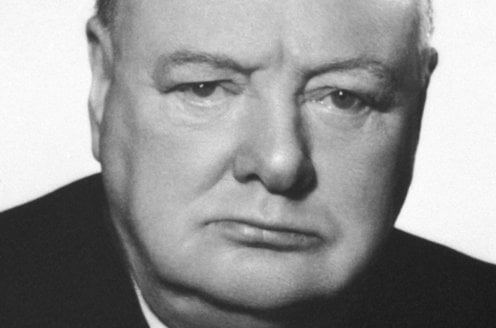
Winston Churchill, born on this day in 1874, from a speech given at The Royal Academy of Arts, 30 April 1938
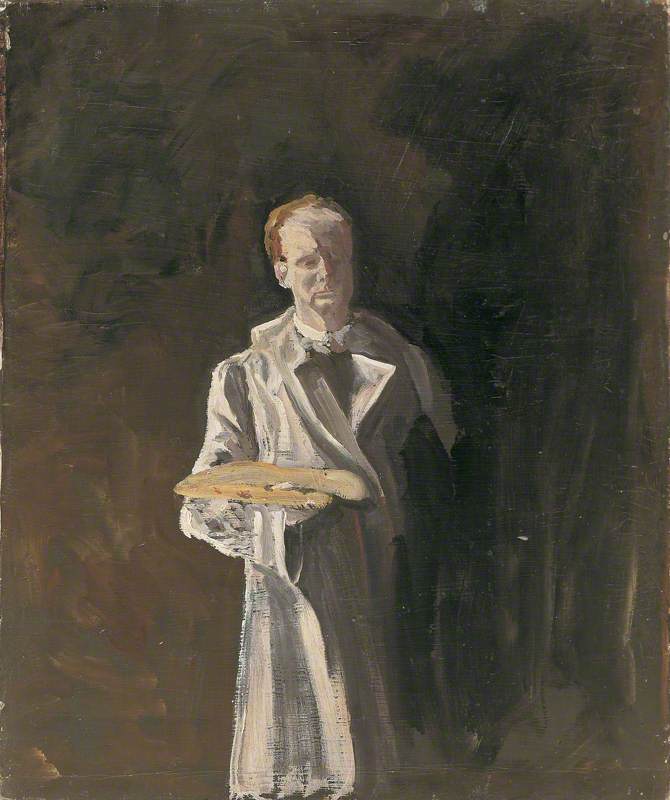

If you are inclined - late in life though it be - to reconnoitre a foreign sphere of limitless extent, be persuaded that the first quality that is needed is Audacity. There really is no time for the deliberate approach. Two years of drawing-lessons, three years of copying woodcuts, five years of plaster casts - these are for the young. They have enough to bear. And this thorough grounding is for those who, hearing the call in the morning of their days, are able to make painting their paramount lifelong vocation. The truth and beauty of line and form which by the slightest touch or twist of the brush a real artist imparts to every feature of his design must be founded on long, hard, persevering apprenticeship and a practice so habitual that it has become instinctive. We must not be too ambitious. We cannot aspire to masterpieces. We may content ourselves with a joy ride in a paint-box. And for this Audacity is the only ticket.

Sir Winston Churchill, from Painting as a Pastime


Armed with a paint-box, one cannot be bored, one cannot be left at a loose end, one cannot "have several days on one's hands." One must not be too ambitious. One cannot aspire to masterpieces. We may content ourselves with a joy ride in a paint box. And, for this, audacity is the only ticket.  Just to paint is great fun. The colors are lovely to look at and delicious to squeeze out. Matching them, however crudely, with what you see is fascinating and absolutely absorbing. 

Sir Winston Churchill, from Painting as a Pastime


You cannot tell from appearances how things will go. Sometimes imagination makes things out far worse than they are; yet without imagination not much can be done. Those people who are imaginative see many more dangers than perhaps exist; certainly many more than will happen; but then they must also pray to be given that extra courage to carry this far-reaching imagination. But for everyone, surely, what we have gone through in this period - I am addressing myself to the School - surely from this period of ten months this is the lesson: never give in, never give in, never, never, never-in nothing, great or small, large or petty - never give in except to convictions of honour and good sense. Never yield to force; never yield to the apparently overwhelming might of the enemy. We stood all alone a year ago, and to many countries it seemed that our account was closed, we were finished. All this tradition of ours, our songs, our School history, this part of the history of this country, were gone and finished and liquidated.

Winston Churchill, from his speech at the Harrow School, October 29, 1941

28 April 2024

Devotion.

van Eyck, Man in a Red Turban, 1433


I thoroughly enjoyed over twenty-five years in the food service industry (I miss it like an addict) which overlapped into my career as a teacher, which I have been aspiring to for twenty years.  I was kicked out of college twice before I finally figured myself out. My undergraduate degrees in the History of Art and Historic Preservation of Architecture have made every single day of my life full and more greatly appreciated.  Any success I have enjoyed in my personal and professional lives is due to my training and continued devotion to the arts.  

08 April 2024

Endlessly.


If your mind is expansive and unfettered, you will find yourself in a more accommodating world, a place that's endlessly interesting and alive. That quality isn't inherent in the place but in your state of mind.

Pema Chödrön

26 December 2021

Indespensible.


For art to exist, for any sort of aesthetic activity or perception to exist, a certain physiological precondition is indispensable: intoxication.

Friedrich Nietzsche

21 December 2020

Cheerful.


As the traveler sees farthest by day, and becomes aware of rugged mountains and trackless plains which the friendly darkness had shrouded from his sight and mind together, so, the wayfarer in the toilsome path of human life sees, with each returning sun, some new obstacle to surmount, some new height to be attained. Distances stretch out before him which, last night, were scarcely taken into account, and the light which gilds all nature with its cheerful beams, seems but to shine upon the weary obstacles that yet lie strewn between him and the grave.

Charles Dickens, from Nicholas Nickleby

24 August 2019

Presence.


I am not absentminded. It is the presence of mind that makes me unaware of everything else.

G.K. Chesterton

26 February 2019

Accepting.


The story is told that when Joe was a child his cousins emptied his Christmas stocking and replaced the gifts with horse manure. Joe took one look and bolted for the door, eyes glittering with excitement. "Wait, Joe, where are you going? What did ol’ Santa bring you?" According to the story Joe paused at the door for a piece of rope. "Brought me a bran’-new pony but he got away. I’ll catch 'em if I hurry."  And ever since then it seemed that Joe had been accepting more than his share of hardship as good fortune, and more than his share of shit as a sign of Shetland ponies just around the corner, thoroughbred stallions just up the road.

Ken Kesey, from Sometimes a Great Notion

Thank you, Hopeleslie.

11 January 2018

Work.


The truth is that the more we understand about the human brain, the better able we are to describe what free action really is. At present, scientists distinguish between the amygdala, the most primitive part of the brain, conditioned to sensitise us to potential danger; the limbic system, sometimes called the “social brain,” which is responsible for much of our emotional life; and the prefrontal cortex, which is analytical and capable of dispassionately weighing the consequences of alternative choices.  The tensions between these three form the arena within which personal freedom is won or lost.

Patterns of behaviour are shaped by neural pathways connecting different parts of the brain, but not all of them are good for us. So, for instance, we might turn to drugs or binge eating or thrill-seeking to distract us from some of the unhappy chemicals – fears and anxieties, for instance – that are also part of the architecture of the brain. The more often we do so, the more myelin gets wrapped around the pathway, and the more rapid and instinctive the behaviour. So the more often we behave in certain ways, the harder it is to break the habit and create a new and different pathway. To do so requires the acquisition of new habits, acted on consistently for an extended period of time. Current scientific thinking suggests that a minimum of 66 days is needed to form a new habit.

So we now have a scientific way of explaining the hardening taking place in Pharaoh’s heart. Having established a pattern of response to the first five plagues, he would find it progressively more difficult at every level – neuro-scientifically, psychologically and politically – to change. The same is true of every bad habit and political decision. Almost all our structures, mental and social, tend to reinforce previous patterns of behaviour. So our freedom diminishes every time we fail to exercise it.

If so, then today’s parsha and contemporary science tell the same story: that freedom is not a given, nor is it an absolute. We have to work for it. We acquire it slowly in stages, and we can lose it, as Pharaoh lost his, and as drug addicts, workaholics, and people addicted to computer games lose theirs. In one of the most famous opening lines in all literature, Jean-Jacques Rousseau wrote, at the beginning of The Social Contract, that “Man is born free and everywhere he is in chains.” In fact, the opposite is true. Our early character is determined partly by DNA – the genetic heritage of our parents and theirs – partly by our home and upbringing, partly by our friends, and partly by the surrounding culture. We are not born free. We have to work hard to achieve freedom.

That takes rituals, whose repeated performance creates new neural pathways and new rapid-response behaviour. It requires a certain calibrated distance from the surrounding culture, if we are not to be swept away by social fads and fashions that seem liberating now but destructive in retrospect. It needs a mental mindset that pauses before any significant action and asks, “Should I do this? May I do this? What rules of conduct should I bring to bear?” It involves an internalised narrative of identity, so that we can ask of any course of action, “Is this who I am and what I stand for?”

Rabbi Lord Jonathan Sacks

Thank you, Cultural Offering.