"I am not one who was born in the custody of wisdom. I am one who is fond of olden times and intense in quest of the sacred knowing of the ancients." Gustave Courbet
Showing posts with label Sacks. Show all posts

04 December 2025

Power.


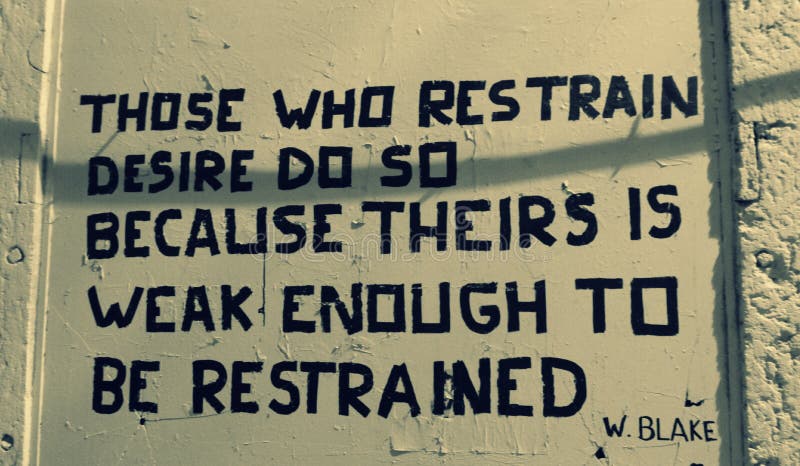
But no human being can be trusted to keep his or her word when he or she has access to power—a power not available to opponents. 

Dr. Frankl would remind us ...

Between stimulus and response there is a space. In that space is our power to choose our response. In our response lies our growth and freedom.

What power is truly eluding you? 

26 April 2025

Obeyed.


The alternative to power is law: law freely accepted and freely obeyed. Only by observing the rule of law – law that applies equally to the rich and poor, the powerful and powerless – do we escape the tragic cycle of freedom that begets conflict that leads to chaos, resulting in the use of force that generates tyranny, the freedom of the few and the enslavement of the many. God reveals Himself in the form of law, because law is the constitution of liberty. That is the moral shape of a society of freedom under the sovereignty of God.

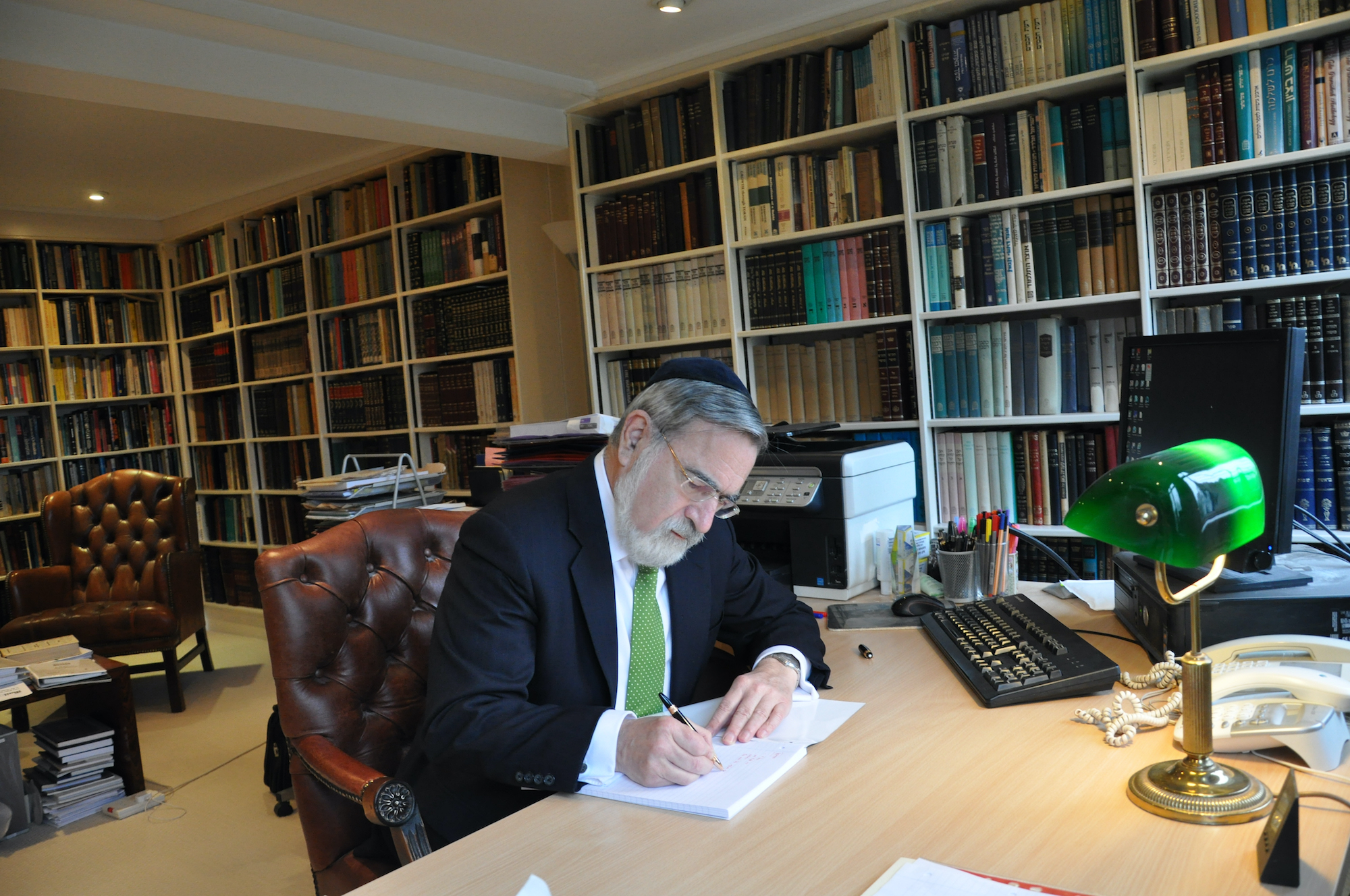
Rabbi Lord Jonathan Sacks, from Essays on Ethics

12 October 2024

Joy.


There are two kinds of joy. There’s expressive joy, the joy you experience and communicate because that’s how you feel. But there’s also therapeutic joy, the joy you will yourself to feel in order to protect yourself against negative emotions ... 

We will not be intimidated. We will not be traumatized. We will not be defined by our enemies. We will live with the threats and even laugh at them because what we can laugh at, we cannot be held captive by ... It’s about surviving, and beyond that, thriving, even as we walk through the valley of the shadow of death.

Rabbi Lord Jonathan Sacks

31 March 2024

Covenant.


Rabbi Sacks on defeating death ...
Life is good, death is bad. Life is a blessing, death is a curse. These are truisms for us. Why even mention them? Because they were not common ideas in the ancient world. They were revolutionary. They still are.

How then do you defeat death? Yes there is an afterlife. Yes there is techiyat hametim, resurrection. But Moses does not focus on these obvious ideas. He tells us something different altogether. You achieve immortality by being part of a covenant – a covenant with eternity itself, that is to say, a covenant with God.

When you live your life within a covenant something extraordinary happens. Your parents and grandparents live on in you. You live on in your children and grandchildren. They are part of your life. You are part of theirs. That is what Moses meant when he said, near the beginning of this week’s parsha:
It is not with you alone that I am making this covenant and oath, but with whoever stands with us here today before the Lord our God as well as those not with us here today.

Deut. 29:13-14
In Moses’ day that last phrase meant “your children not yet born.” He did not need to include “your parents, no longer alive” because their parents had themselves made a covenant with God forty years before at Mount Sinai. But what Moses meant in a larger sense is that when we renew the covenant, when we dedicate our lives to the faith and way of life of our ancestors, they become immortal in us, as we become immortal in our children.

08 September 2018

Thanks.


Give thanks. Praying, we give thanks to God for all we have, and for life itself. This may sound simple but it is life-transforming. It makes us notice what otherwise we would merely take for granted. It helps us see that we are surrounded by blessings. We are here, we are free, we have family, we have friends, we have opportunities our parents did not have and our grandparents could not even imagine. Yes, we have problems, fears, pains; but they can wait until we have finished giving thanks; and once we have given thanks, our problems seem a little smaller and we feel a little stronger. There is medical evidence that people who have an attitude of gratitude live longer and develop stronger immunities to illness. Be that as it may, the psychological evidence is incontrovertible: giving thanks brings happiness even in hard times.

Rabbi Lord Jonathan Sacks

CONNECT

Thank you, Kurt.

11 January 2018

Work.


The truth is that the more we understand about the human brain, the better able we are to describe what free action really is. At present, scientists distinguish between the amygdala, the most primitive part of the brain, conditioned to sensitise us to potential danger; the limbic system, sometimes called the “social brain,” which is responsible for much of our emotional life; and the prefrontal cortex, which is analytical and capable of dispassionately weighing the consequences of alternative choices.  The tensions between these three form the arena within which personal freedom is won or lost.

Patterns of behaviour are shaped by neural pathways connecting different parts of the brain, but not all of them are good for us. So, for instance, we might turn to drugs or binge eating or thrill-seeking to distract us from some of the unhappy chemicals – fears and anxieties, for instance – that are also part of the architecture of the brain. The more often we do so, the more myelin gets wrapped around the pathway, and the more rapid and instinctive the behaviour. So the more often we behave in certain ways, the harder it is to break the habit and create a new and different pathway. To do so requires the acquisition of new habits, acted on consistently for an extended period of time. Current scientific thinking suggests that a minimum of 66 days is needed to form a new habit.

So we now have a scientific way of explaining the hardening taking place in Pharaoh’s heart. Having established a pattern of response to the first five plagues, he would find it progressively more difficult at every level – neuro-scientifically, psychologically and politically – to change. The same is true of every bad habit and political decision. Almost all our structures, mental and social, tend to reinforce previous patterns of behaviour. So our freedom diminishes every time we fail to exercise it.

If so, then today’s parsha and contemporary science tell the same story: that freedom is not a given, nor is it an absolute. We have to work for it. We acquire it slowly in stages, and we can lose it, as Pharaoh lost his, and as drug addicts, workaholics, and people addicted to computer games lose theirs. In one of the most famous opening lines in all literature, Jean-Jacques Rousseau wrote, at the beginning of The Social Contract, that “Man is born free and everywhere he is in chains.” In fact, the opposite is true. Our early character is determined partly by DNA – the genetic heritage of our parents and theirs – partly by our home and upbringing, partly by our friends, and partly by the surrounding culture. We are not born free. We have to work hard to achieve freedom.

That takes rituals, whose repeated performance creates new neural pathways and new rapid-response behaviour. It requires a certain calibrated distance from the surrounding culture, if we are not to be swept away by social fads and fashions that seem liberating now but destructive in retrospect. It needs a mental mindset that pauses before any significant action and asks, “Should I do this? May I do this? What rules of conduct should I bring to bear?” It involves an internalised narrative of identity, so that we can ask of any course of action, “Is this who I am and what I stand for?”

Rabbi Lord Jonathan Sacks

Thank you, Cultural Offering.

11 December 2017

Conversation.

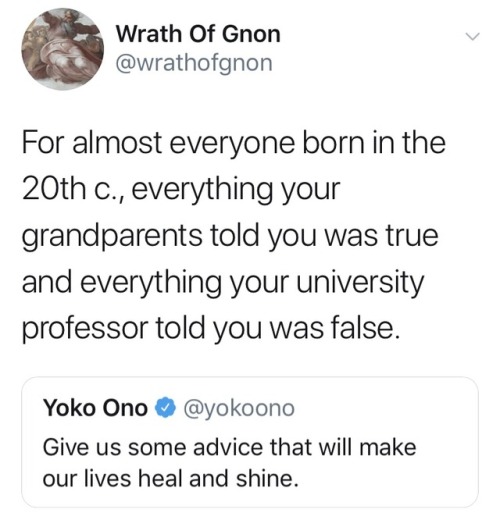
Education [is] the conversation between generations.

Rabbi Lord Jonathan Sacks


Thank you, Kurt.

David Brooks' "Eulogy Virtues" ... HERE.