"I am not one who was born in the custody of wisdom. I am one who is fond of olden times and intense in quest of the sacred knowing of the ancients." Gustave Courbet
Showing posts with label Crane. Show all posts

01 March 2025

Eager.

Crane, The Shepherd's Calendar: March, 1898


THE SHEPHERD'S CALENDAR: MARCH

March, month of " many weathers, " wildly comes
In hail, and snow, and rain, and threatening hums,
And floods; — while often at his cottage-door
The shepherd stands, to hear the distant roar
Loosed from the rushing mills and river-locks,
With thundering sound and overpowering shocks.

From bank to bank, along the meadow lea,
The river spreads, and shines a little sea;
While, in the pale sunlight, a watery brood
Of swopping white birds flock about the flood.
Yet Winter seems half weary of his toil;
And round the ploughmen, on the elting soil,
Will thread a minute's sunshine wild and warm,
Through the ragg'd places of the swimming storm;
And oft the shepherd in his path will spy
The little daisy in the wet grass lie,
That to the peeping sun uncloses gay,
Like Labour smiling on a holiday;
And where the steep bank fronts the southern sky,
By lanes or brooks where sunbeams love to lie,
A cowslip-peep will open faintly coy,
Soon seen and gather'd by a wondering boy.
A tale of Spring around the distant haze
Seems muttering pleasures with the lengthening days;
Morn wakens, mottled oft with May-day stains;
And shower-drops hang the grassy sprouting plains,
Or on the naked thorns of brassy hue
Drip glistening, like a summer-dream of dew.

The woodman, in his pathway down the wood,
Crushes with hasty feet full many a bud
Of early primrose; yet if timely spied,
Shelter'd some old half-rotten stump beside,
The sight will cheer his solitary hour,
And urge his feet to stride and save the flower.

The hedger's toils oft scare the doves, that browze
The chocolate berries on the ivy boughs,
Or flocking fieldfares, speckled like the thrush,
Picking the berry from the hawthorn bush,
That come and go on Winter's chilling wing,
And seem to share no sympathy with Spring.

The ploughmen now along the doughy sloughs
Will often stop their songs, to clean their ploughs
From teazing twitch, that in the spongy soil
Clings round the coulter, interrupting toil.

The sower o'er his heavy hopper leans,
Strewing with swinging arms the pattering beans,
Which, soon as April's milder weather gleams,
Will shoot up green between the furrow'd seams.
The driving boy, glad when his steps can trace
The swelling headland as a resting-place,
Flings from his clotted shoes the dirt around,
And fain would rest him on the solid ground.
Not far behind them struts the nauntly crow,
And daw, whose head seems powder'd o'er with snow,
Seeking the worms: the rook, a noisy guest,
That on the wind-rock'd elms prepares her nest,
On the fresh furrow often drops, to pull
The twitching roots, or gather sticks and wool,
From trees whose dead twigs litter to the wind,
And gaps where stray sheep left their coats behind;
While ground-larks, on a swinging clump of rushes,
Or on the top twigs of the scatter'd bushes,
Chirp their " cree-creery " note, that sounds of Spring;
And sky-larks meet the sun with fluttering wing.

The shepherd-boy, that hastens now and then
From hail and snow beneath his sheltering den
Of flags, or file-leaved sedges tied in sheaves,
Or stubble shocks, oft as his eye perceives
Sun-threads shrink out in momentary smiles,
With fairy thoughts his loneliness beguiles;
Thinking the struggling Winter howling by,
As down the edges of the distant sky
The hail-storm sweeps; — and while he stops to strip
The stooping hedgebriar of its lingering hip,
He hears the wild geese gabble o'er his head;
Then, pleased with fancies in his musings bred,
He marks the figured forms in which they fly,
And pausing, follows with a wondering eye,
Likening their curious march, in curves or rows,
To every letter which his memory knows;
While, far above, the solitary crane
Swings lonely to unfrozen dykes again,
Cranking a jarring melancholy cry
Through the wild journey of the cheerless sky.
Often, at early seasons, mild and fair
March bids farewell, with garlands in her hair
Of hazel tassels, woodbine's bushy sprout,
And sloe and wild-plum blossoms peeping out
In thick-set knots of flowers, preparing gay,
For April's reign, a mockery of May.

The old dame then oft stills her humming wheel —
When the bright sun-beams through the windows steal
And gleam upon her face, and dancing fall
In diamond shadows on the pictur'd wall;
While the white butterfly, as in amaze,
Will settle on the glossy glass to gaze —

And smiling, glad to see such things once more,
Up she will get and totter to the door,
And look upon the trees beneath the eaves —
Sweetbriar and lad's-love — swelling into leaves;

And, stooping down, cull from her garden beds
The early blossoms perking out their heads,

In flower-pots on the window-board to stand,
Where the old hour-glass spins its thread of sand.

And while the passing clown remarks, with pride,
Days lengthen in their visits a " cock's stride, "
She cleans her candlesticks and sets them by,
Glad of the make-shift light that eves supply!
The boy, retiring home at night from toil,
Down lane and close, o'er footbrig, gate, and stile,
Oft trembles into fear, and stands to hark
The waking fox renew his short gruff bark;

And shepherds — that within their hulks remain
Night after night upon the chilly plain,
To watch the dropping lambs, that at all hours
Come in the quaking blast like tender flowers —

When in the nightly watch they chance to hear
The badger's shrieks, can hardly stifle fear;
Likening the cry, from woodland's dark recess,
To that of helpless woman in distress:

For Superstition hath a thousand tales
To people all her midnight woods and vales; —
And the dread spot from whence the dismal noise
Mars the night-musings of their dark employs,
Owns its sad tale to realize their fear —
A tale their hearts in boyhood ached to hear.
A maid, at night, by treacherous love decoy'd,
Was in that shrieking wood, years past, destroy'd.
She went, 'twas said, to meet the waiting swain;
But home and friends ne'er saw her face again!
'Mid brake and thorns that crowded round the dell,
And matting weeds that had no tongue to tell,
He murder'd her alone at dead midnight,
While the pale moon threw round her sickly light.
Loud screams assail'd the thicket's slumbers deep,
But only scared the little birds from sleep;
When the pale murderer's terror-frowning eye
Told its dread errand — that the maid should die. —
'Mid thick black thorns her secret grave was made;
And there the unresisting corpse was laid,
When no one saw the deed but God and he,
And moonlight sparkling through the sleeping tree.
The Robin-redbreast might at morning steal
There, for the worm to meet his early meal,
In fresh-turn'd moulds which first beheld the sun —
Nor know the deed that dismal night had done.
Such is the tale that Superstition gives;
Which in her midnight memory ever lives;
Which makes the boy run by with wild affright,
And shepherds startle on their rounds at night.
Now love-teazed maidens, from the droning wheel,
At the red hour of sun-set, slily steal
From scolding dames, to meet their swains again;
Though water checks their visits o'er the plain:
They slive where no one sees, some wall behind,
Or orchard apple-tree that stops the wind,
To talk about Spring's pleasures hovering nigh,
And happy rambles when the roads get dry.
The insect-world, now sunbeams higher climb,
Oft dream of Spring, and wake before their time.
Bees stroke their little legs across their wings,
And venture short flights where the snow-drop hings
Its silver bell, and winter aconite
Its butter-cup-like flowers that shut at night,
With green leaf furling round its cup of gold,
Like tender maiden muffled from the cold:
They sip, and find their honey-dreams are vain,
Then feebly hasten to their hives again. —
The butterflies, by eager hopes undone,
Glad as a child come out to greet the sun,
Beneath the shadow of a sudden shower
Are lost — nor see to-morrow's April flower.

John Clare

01 February 2025

Dream.

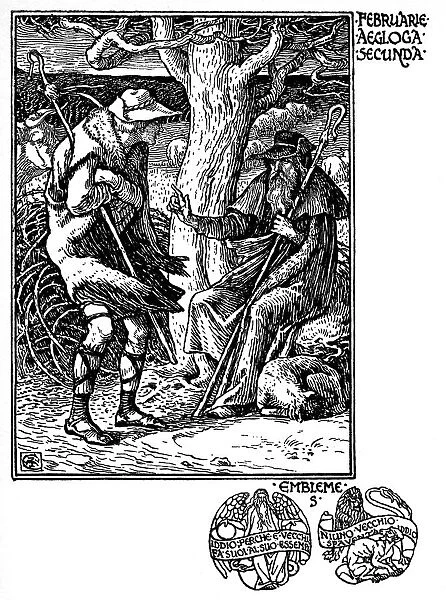
Crane, The Shepherd's Calendar: February, 1898


THE SHEPHERD'S CALENDAR: FEBRUARY

The snow has left the cottage top;
The thatch moss grows in brighter green;
And eaves in quick succession drop,
Where grinning icicles have been,
Pit-patting with a pleasant noise
In tubs set by the cottage-door;
While ducks and geese, with happy joys,
Plunge in the yard-pond brimming o'er.

The sun peeps through the window-pane;
Which children mark with laughing eye,
And in the wet street steal again
To tell each other spring is nigh:
Then, as young hope the past recalls,
In playing groups they often draw,
To build beside the sunny walls
Their spring-time huts of sticks or straw.

And oft in pleasure's dreams they hie
Round homesteads by the village side,
Scratching the hedgerow mosses by,
Where painted pooty shells abide,
Mistaking oft the ivy spray
For leaves that come with budding spring,
And wondering, in their search for play,
Why birds delay to build and sing.

The milkmaid singing leaves her bed,
As glad as happy thoughts can be,
While magpies chatter o'er her head
As jocund in the change as she:
Her cows around the closes stray,
Nor lingering wait the foddering-boy,
Tossing the molehills in their play,
And staring round with frolic joy.

The shepherd now is often seen
Near warm banks o'er his hook to bend,
Or o'er a gate or stile to lean,
Chattering to a passing friend:
Ploughmen go whistling to their toils,
And yoke again the rested plough;
And, mingling o'er the mellow soils,
Boys shout, and whips are noising now.

The barking dogs, by lane and wood,
Drive sheep afield from foddering ground;
And Echo, in her summer mood,
Briskly mocks the cheering sound.
The flocks, as from a prison broke,
Shake their wet fleeces in the sun,
While, following fast, a misty smoke
Reeks from the moist grass as they run.

No more behind his master's heels
The dog creeps on his winter-pace;
But cocks his tail, and o'er the fields
Runs many a wild and random chase,
Following, in spite of chiding calls,
The startled cat with harmless glee,
Scaring her up the weed-green walls,
Or mossy mottled apple-tree.

As crows from morning perches fly,
He barks and follows them in vain;
E'en larks will catch his nimble eye,
And off he starts and barks again,
With breathless haste and blinded guess,
Oft following where the hare hath gone,
Forgetting, in his joy's excess,
His frolic puppy-days are done.

The hedgehog, from his hollow root,
Sees the wood-moss clear of snow,
And hunts the hedge for fallen fruit--
Crab, hip, and winter-bitten sloe;
But often checked by sudden fears,
As shepherd-dog his haunt espies,
He rolls up in a ball of spears,
And all his barking rage defies.

The gladdened swine bolt from the sty,
And round the yard in freedom run,
Or stretching in their slumbers lie
Beside the cottage in the sun.
The young horse whinnies to his mate,
And, sickening from the thresher's door,
Rubs at the straw-yard's banded gate,
Longing for freedom on the moor.

The small birds think their wants are o'er,
To see the snow-hills fret again,
And, from the barn's chaff-littered door,
Betake them to the greening plain.
The woodman's robin startles coy,
Nor longer to his elbow comes,
To peck, with hunger's eager joy,
'Mong mossy stulps the littered crumbs.

'Neath hedge and walls that screen the wind,
The gnats for play will flock together;
And e'en poor flies some hope will find
To venture in the mocking weather;
From out their hiding-holes again,
With feeble pace, they often creep
Along the sun-warmed window-pane,
Like dreaming things that walk in sleep.

The mavis thrush with wild delight,
Upon the orchard's dripping tree,
Mutters, to see the day so bright,
Fragments of young Hope's poesy:
And oft Dame stops her buzzing wheel
To hear the robin's note once more,
Who tootles while he pecks his meal
From sweetbrier hips beside the door.

The sunbeams on the hedges lie,
The south wind murmurs summer-soft;
The maids hang out white clothes to dry
Around the elder-skirted croft:
A calm of pleasure listens round,
And almost whispers winter by;
While Fancy dreams of summer's sound,
And quiet rapture fills the eye.

Thus Nature of the spring will dream
While south winds thaw; but soon again
Frost breathes upon the stiffening stream,
And numbs it into ice: the plain
Soon wears its mourning garb of white;
And icicles, that fret at noon,
Will eke their icy tails at night
Beneath the chilly stars and moon.

Nature soon sickens of her joys,
And all is sad and dumb again.
Save merry shouts of sliding boys
About the frozen furrowed plain.
The foddering-boy forgets his song,
And silent goes with folded arms;
And croodling shepherds bend along,
Crouching to the whizzing storms.

John Clare

02 November 2024

Little.

Dürer, Piece of Great Turf, 1503


IN HEAVEN

In Heaven,
Some little blades of grass
Stood before God.
“What did you do?”
Then all save one of the little blades
Began eagerly to relate
The merits of their lives.

This one stayed a small way behind
Ashamed.
Presently God said:
“And what did you do?”
The little blade answered: “Oh, my lord,
“Memory is bitter to me
“For if I did good deeds
“I know not of them.”
Then God in all His splendor
Arose from His throne.
“Oh, best little blade of grass,” He said.

Stephen Crane

03 May 2022

Vast.


Little birds of the night
Aye, they have much to tell
Perching there in rows
Blinking at me with their serious eyes
Recounting of flowers they have seen and loved
Of meadows and groves of the distance
And pale sands at the foot of the sea
And breezes that fly in the leaves.
They are vast in experience
These little birds that come in the night.

Stephen Crane

01 November 2020

Happy Birthday, Crane


Stephen Crane was born on this day in 1871.

I saw a man pursuing the horizon;
Round and round they sped.
I was disturbed at this;   
I accosted the man.
“It is futile,” I said,
“You can never —”

“You lie,” he cried,   
And ran on.

Stephen Crane

22 April 2020

Occurs.


When it occurs to a man that nature does not regard him as important, and that she feels she would not maim the universe by disposing of him, he at first wishes to throw bricks at the temple, and he hates deeply the fact that there are no bricks and no temples.

Stephen Crane, from The Open Boat

04 June 2017

Memory.

Homer, Hurricane, Bahamas, 1898


RIVERS of REPOSE

The willows carried a slow sound, 
A sarabande the wind mowed on the mead. 
I could never remember 
That seething, steady leveling of the marshes 
Till age had brought me to the sea. 

Flags, weeds. And remembrance of steep alcoves 
Where cypresses shared the noon’s 
Tyranny; they drew me into hades almost. 
And mammoth turtles climbing sulphur dreams 
Yielded, while sun-silt rippled them 
Asunder ... 

How much I would have bartered! the black gorge 
And all the singular nestings in the hills 
Where beavers learn stitch and tooth. 
The pond I entered once and quickly fled— 
I remember now its singing willow rim. 

And finally, in that memory all things nurse; 
After the city that I finally passed 
With scalding unguents spread and smoking darts 
The monsoon cut across the delta 
At gulf gates ... There, beyond the dykes 

I heard wind flaking sapphire, like this summer, 
And willows could not hold more steady sound. 

Hart Crane

01 August 2016

Heard.


REPOSE OF RIVERS

The willows carried a slow sound, 
A sarabande the wind mowed on the mead. 
I could never remember 
That seething, steady leveling of the marshes 
Till age had brought me to the sea. 

Flags, weeds. And remembrance of steep alcoves 
Where cypresses shared the noon’s 
Tyranny; they drew me into hades almost. 
And mammoth turtles climbing sulphur dreams 
Yielded, while sun-silt rippled them 
Asunder ... 

How much I would have bartered! the black gorge 
And all the singular nestings in the hills 
Where beavers learn stitch and tooth. 
The pond I entered once and quickly fled— 
I remember now its singing willow rim. 

And finally, in that memory all things nurse; 
After the city that I finally passed 
With scalding unguents spread and smoking darts 
The monsoon cut across the delta 
At gulf gates ... There, beyond the dykes 

I heard wind flaking sapphire, like this summer, 
And willows could not hold more steady sound.

Hart Crane