"I am not one who was born in the custody of wisdom. I am one who is fond of olden times and intense in quest of the sacred knowing of the ancients." Gustave Courbet
Showing posts with label Cameron. Show all posts

27 February 2026

Happy Birthday, Henry Wadsworth Longfellow

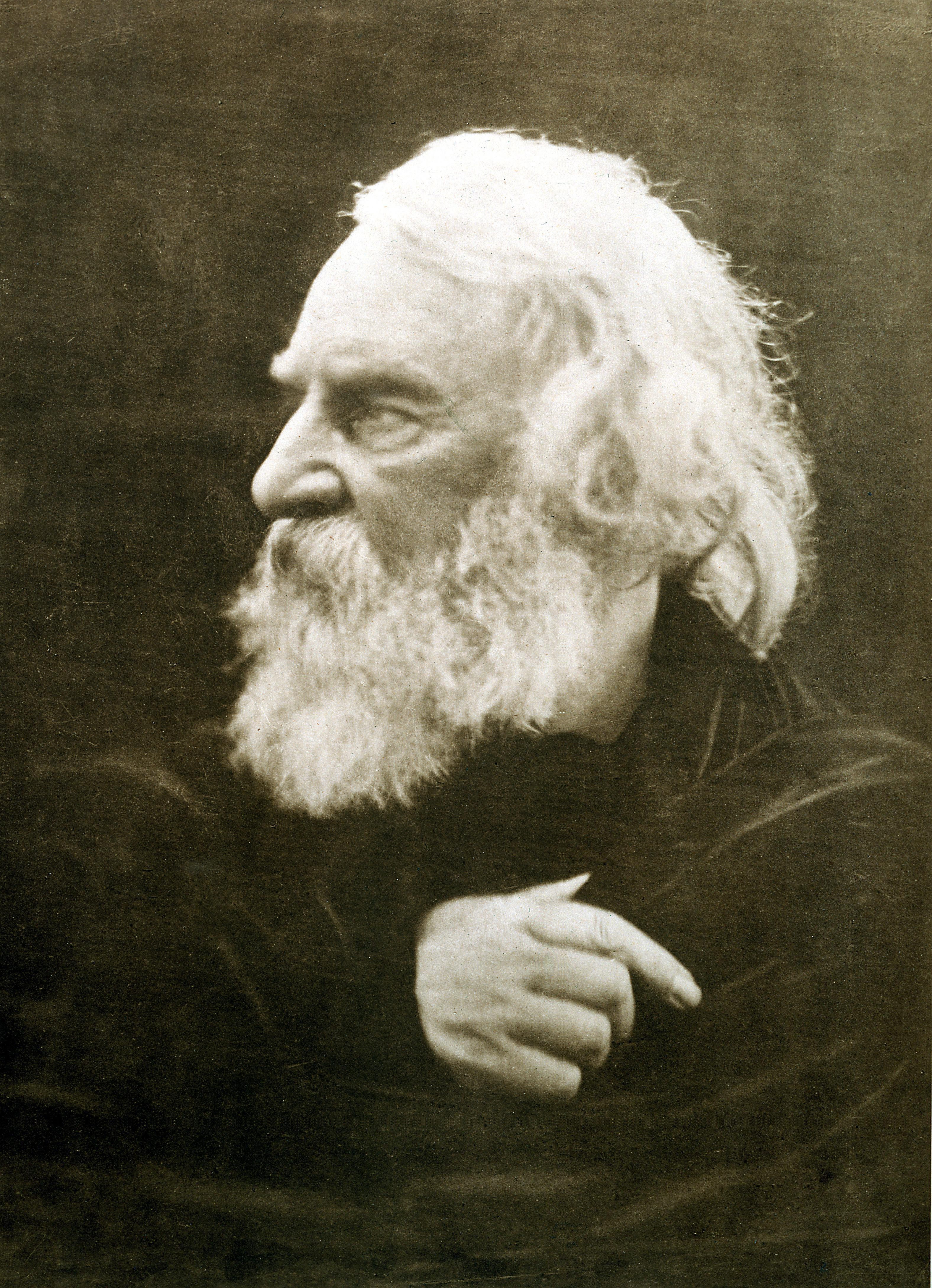
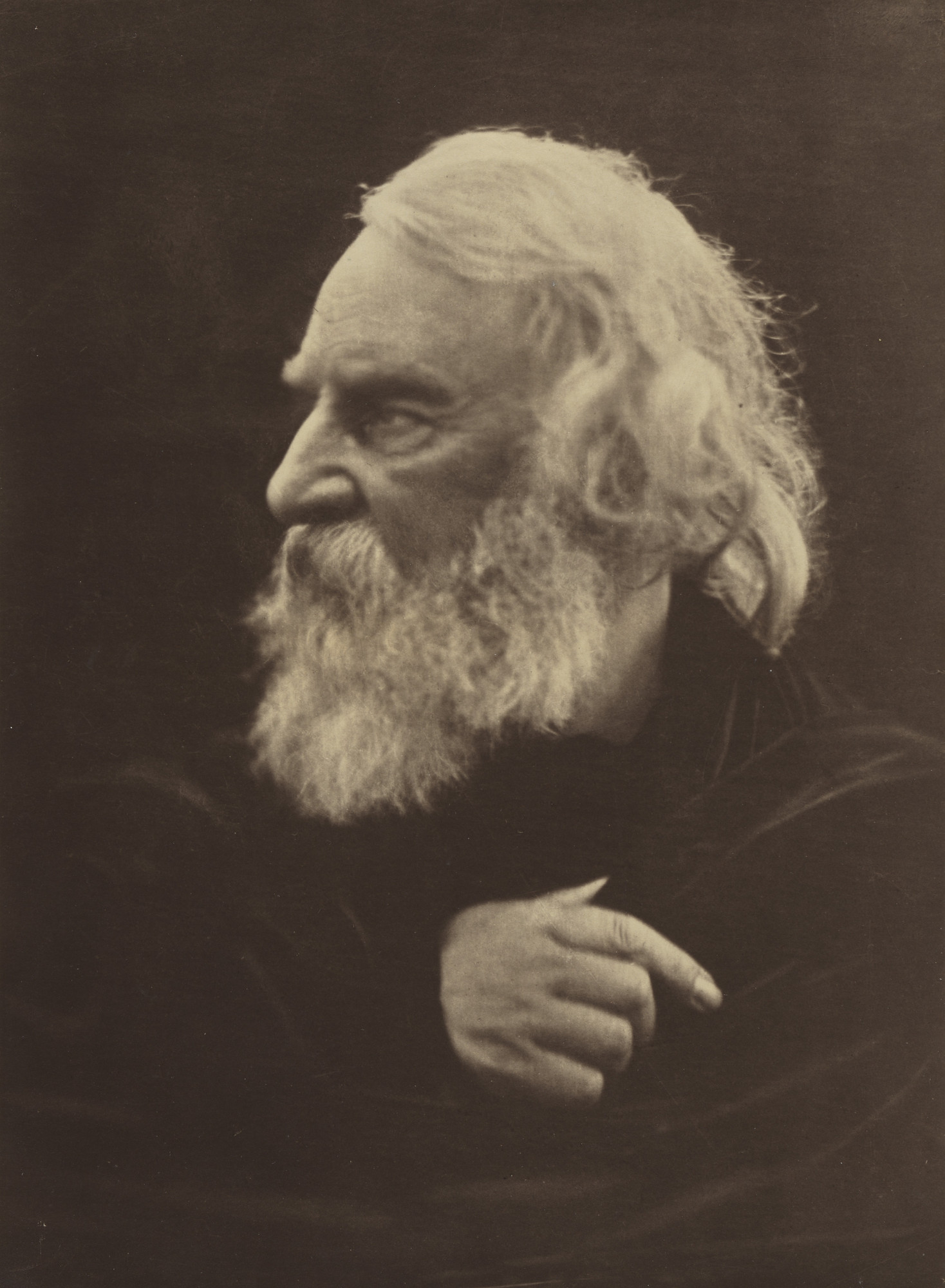
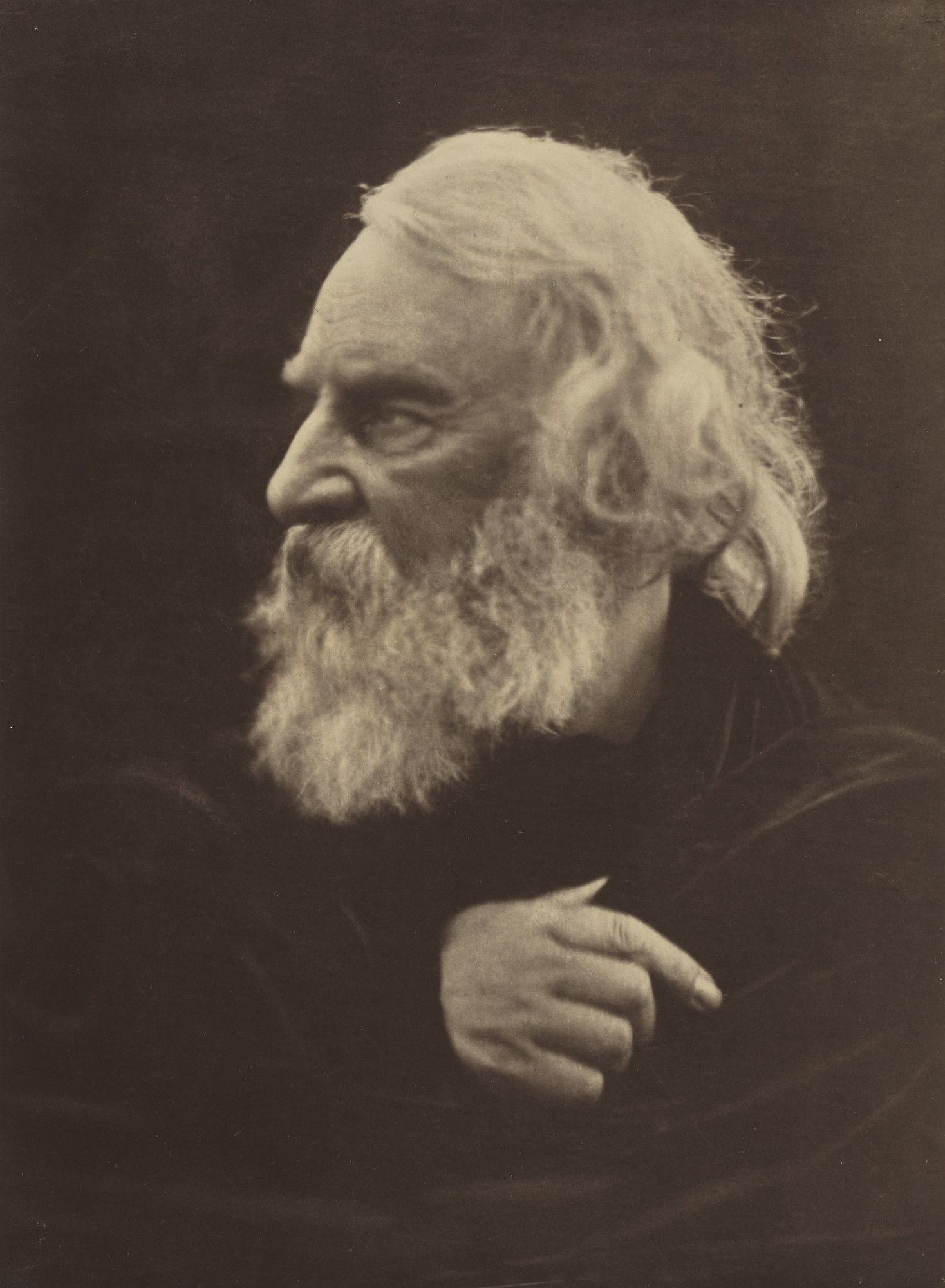
Cameron, Henry Wadsworth Longfellow, 1868


I stood upon the hills, when heaven's wide arch
Was glorious with the sun's returning march,
And woods were brightened, and soft gales
Went forth to kiss the sun-clad vales.
The clouds were far beneath me; bathed in light,
They gathered mid-way round the wooded height,
And, in their fading glory, shone
Like hosts in battle overthrown.
As many a pinnacle, with shifting glance.
Through the gray mist thrust up its shattered lance,
And rocking on the cliff was left
The dark pine blasted, bare, and cleft.
The veil of cloud was lifted, and below
Glowed the rich valley, and the river's flow
Was darkened by the forest's shade,
Or glistened in the white cascade;
Where upward, in the mellow blush of day,
The noisy bittern wheeled his spiral way.

Henry Wadworth Longfellow, born on this day in 1807, from Sunrise on the Hills

09 January 2026

Nobler.

Cameron, Henry Wadsworth Longfellow, 1868


The LADDER of ST. AUGUSTINE

Saint Augustine! well hast thou said,
      That of our vices we can frame
A ladder, if we will but tread
      Beneath our feet each deed of shame!

All common things, each day's events,
      That with the hour begin and end,
Our pleasures and our discontents,
      Are rounds by which we may ascend.

The low desire, the base design,
      That makes another's virtues less;
The revel of the ruddy wine,
      And all occasions of excess;

The longing for ignoble things;
      The strife for triumph more than truth;
The hardening of the heart, that brings
      Irreverence for the dreams of youth;

All thoughts of ill; all evil deeds,
      That have their root in thoughts of ill;
Whatever hinders or impedes
      The action of the nobler will; —

All these must first be trampled down
      Beneath our feet, if we would gain
In the bright fields of fair renown
      The right of eminent domain.

We have not wings, we cannot soar;
      But we have feet to scale and climb
By slow degrees, by more and more,
      The cloudy summits of our time.

The mighty pyramids of stone
      That wedge-like cleave the desert airs,
When nearer seen, and better known,
      Are but gigantic flights of stairs.

The distant mountains, that uprear
      Their solid bastions to the skies,
Are crossed by pathways, that appear
      As we to higher levels rise.

The heights by great men reached and kept
      Were not attained by sudden flight,
But they, while their companions slept,
      Were toiling upward in the night.

Standing on what too long we bore
      With shoulders bent and downcast eyes,
We may discern — unseen before —
      A path to higher destinies,

Nor deem the irrevocable Past
      As wholly wasted, wholly vain,
If, rising on its wrecks, at last
      To something nobler we attain.

Henry Wadsworth Longfellow

Viktoria Mullova performs the Chaconne from Bach's Partita No. 2, BWV 1004 ...

06 August 2025

Strong.

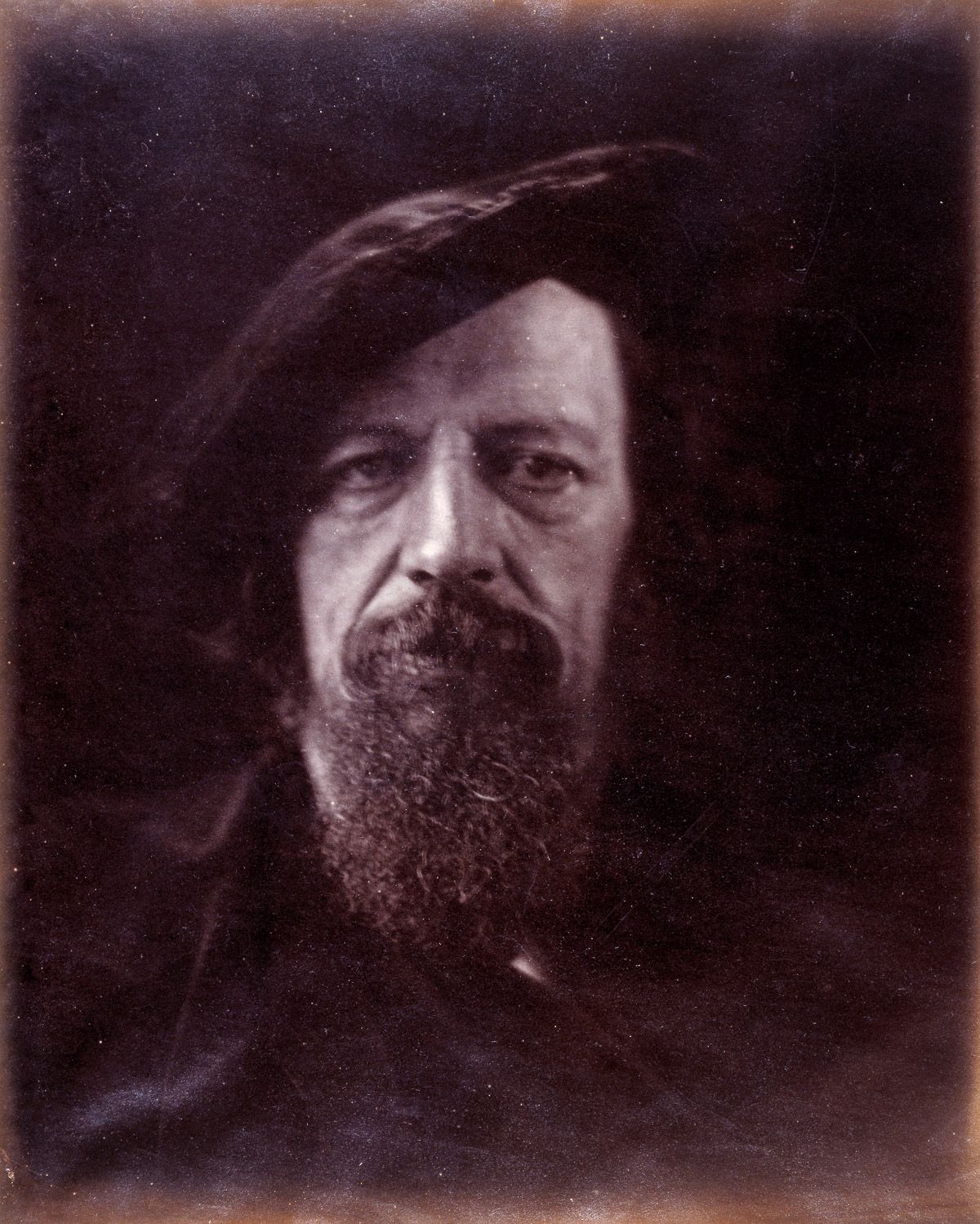
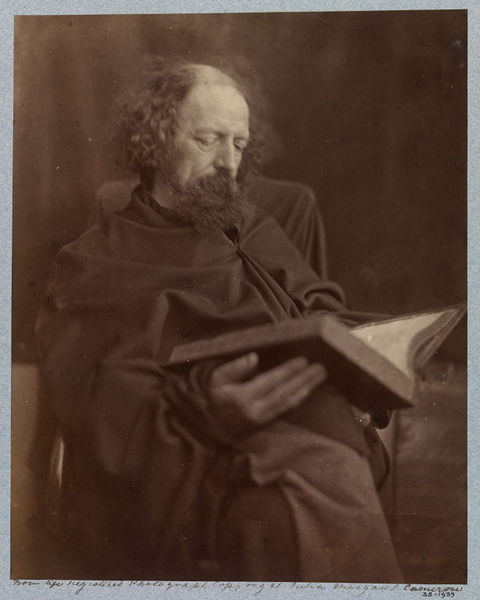
Cameron, Alfred Tennyson, 1865


ULYSSES

It little profits that an idle king,
By this still hearth, among these barren crags,
Match'd with an aged wife, I mete and dole
Unequal laws unto a savage race,
That hoard, and sleep, and feed, and know not me.
I cannot rest from travel: I will drink
Life to the lees: All times I have enjoy'd
Greatly, have suffer'd greatly, both with those
That loved me, and alone, on shore, and when
Thro' scudding drifts the rainy Hyades
Vext the dim sea: I am become a name;
For always roaming with a hungry heart
Much have I seen and known; cities of men
And manners, climates, councils, governments,
Myself not least, but honour'd of them all;
And drunk delight of battle with my peers,
Far on the ringing plains of windy Troy.
I am a part of all that I have met;
Yet all experience is an arch wherethro'
Gleams that untravell'd world whose margin fades
For ever and forever when I move.
How dull it is to pause, to make an end,
To rust unburnish'd, not to shine in use!
As tho' to breathe were life! Life piled on life
Were all too little, and of one to me
Little remains: but every hour is saved
From that eternal silence, something more,
A bringer of new things; and vile it were
For some three suns to store and hoard myself,
And this gray spirit yearning in desire
To follow knowledge like a sinking star,
Beyond the utmost bound of human thought.

         This is my son, mine own Telemachus,
To whom I leave the sceptre and the isle,—
Well-loved of me, discerning to fulfil
This labour, by slow prudence to make mild
A rugged people, and thro' soft degrees
Subdue them to the useful and the good.
Most blameless is he, centred in the sphere
Of common duties, decent not to fail
In offices of tenderness, and pay
Meet adoration to my household gods,
When I am gone. He works his work, I mine.

         There lies the port; the vessel puffs her sail:
There gloom the dark, broad seas. My mariners,
Souls that have toil'd, and wrought, and thought with me—
That ever with a frolic welcome took
The thunder and the sunshine, and opposed
Free hearts, free foreheads—you and I are old;
Old age hath yet his honour and his toil;
Death closes all: but something ere the end,
Some work of noble note, may yet be done,
Not unbecoming men that strove with Gods.
The lights begin to twinkle from the rocks:
The long day wanes: the slow moon climbs: the deep
Moans round with many voices. Come, my friends,
'T is not too late to seek a newer world.
Push off, and sitting well in order smite
The sounding furrows; for my purpose holds
To sail beyond the sunset, and the baths
Of all the western stars, until I die.
It may be that the gulfs will wash us down:
It may be we shall touch the Happy Isles,
And see the great Achilles, whom we knew.
Tho' much is taken, much abides; and tho'
We are not now that strength which in old days
Moved earth and heaven, that which we are, we are;
One equal temper of heroic hearts,
Made weak by time and fate, but strong in will
To strive, to seek, to find, and not to yield.

Alfred, Lord Tennyson

Happy Birthday, Alfred, Lord Tennyson

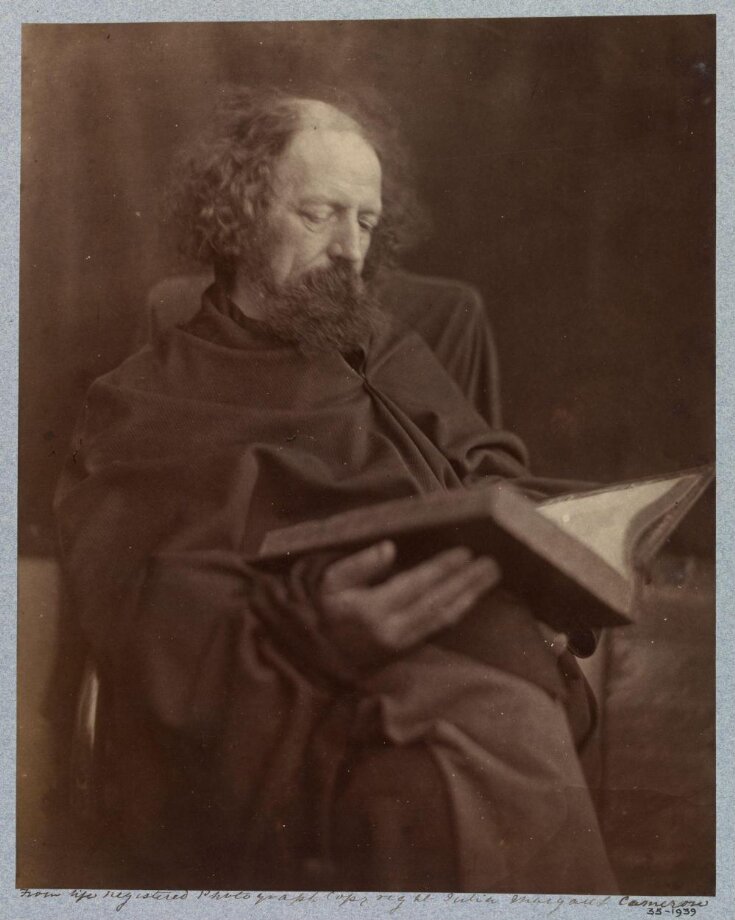
Cameron, Alfred Tennyson, 1866


More things are wrought by prayer
Than this world dreams of. Wherefore, let thy voice
Rise like a fountain for me night and day.
For what are men better than sheep or goats
That nourish a blind life within the brain,
If, knowing God, they lift not hands of prayer
Both for themselves and those who call them friend?
For so the whole round earth is every way
Bound by gold chains about the feet of God.

Alfred, Lord Tennyson, born on this day in 1809

27 February 2025

Happy Birthday, Longfellow

Cameron, Longfellow, 1868


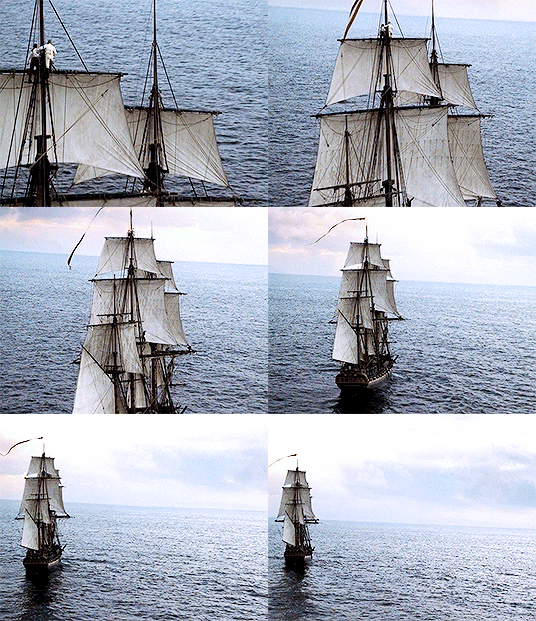
The BUILDING of the SHIP

"Build me straight, O worthy Master!
Stanch and strong, a goodly vessel,
That shall laugh at all disaster,
And with wave and whirlwind wrestle!"

The merchant's word
Delighted the Master heard;
For his heart was in his work, and the heart
Giveth grace unto every Art.
A quiet smile played round his lips,
As the eddies and dimples of the tide
Play round the bows of ships,
That steadily at anchor ride.
And with a voice that was full of glee,
He answered, "Erelong we will launch
A vessel as goodly, and strong, and stanch,
As ever weathered a wintry sea!"
And first with nicest skill and art,
Perfect and finished in every part,
A little model the Master wrought,
Which should be to the larger plan
What the child is to the man,
Its counterpart in miniature;
That with a hand more swift and sure
The greater labor might be brought
To answer to his inward thought.
And as he labored, his mind ran o'er
The various ships that were built of yore,
And above them all, and strangest of all
Towered the Great Harry, crank and tall,
Whose picture was hanging on the wall,
With bows and stern raised high in air,
And balconies hanging here and there,
And signal lanterns and flags afloat,
And eight round towers, like those that frown
From some old castle, looking down
Upon the drawbridge and the moat.
And he said with a smile, "Our ship, I wis,
Shall be of another form than this!"
It was of another form, indeed;
Built for freight, and yet for speed,
A beautiful and gallant craft;
Broad in the beam, that the stress of the blast,
Pressing down upon sail and mast,
Might not the sharp bows overwhelm;
Broad in the beam, but sloping aft
With graceful curve and slow degrees,
That she might be docile to the helm,
And that the currents of parted seas,
Closing behind, with mighty force,
Might aid and not impede her course.

In the ship-yard stood the Master,
With the model of the vessel,
That should laugh at all disaster,
And with wave and whirlwind wrestle!
Covering many a rood of ground,
Lay the timber piled around;
Timber of chestnut, and elm, and oak,
And scattered here and there, with these,
The knarred and crooked cedar knees;
Brought from regions far away,
From Pascagoula's sunny bay,
And the banks of the roaring Roanoke!
Ah! what a wondrous thing it is
To note how many wheels of toil
One thought, one word, can set in motion!
There 's not a ship that sails the ocean,
But every climate, every soil,
Must bring its tribute, great or small,
And help to build the wooden wall!

The sun was rising o'er the sea,
And long the level shadows lay,
As if they, too, the beams would be
Of some great, airy argosy,
Framed and launched in a single day.
That silent architect, the sun,
Had hewn and laid them every one,
Ere the work of man was yet begun.
Beside the Master, when he spoke,
A youth, against an anchor leaning,
Listened, to catch his slightest meaning.
Only the long waves, as they broke
In ripples on the pebbly beach,
Interrupted the old man's speech.
Beautiful they were, in sooth,
The old man and the fiery youth!
The old man, in whose busy brain
Many a ship that sailed the main
Was modelled o'er and o'er again; —
The fiery youth, who was to be
The heir of his dexterity,
The heir of his house, and his daughter's hand,
When he had built and launched from land
What the elder head had planned.

"Thus," said he, "will we build this ship!
Lay square the blocks upon the slip,
And follow well this plan of mine.
Choose the timbers with greatest care;
Of all that is unsound beware;
For only what is sound and strong
To this vessel shall belong.
Cedar of Maine and Georgia pine
Here together shall combine.
A goodly frame, and a goodly fame,
And the Union be her name!
For the day that gives her to the sea
Shall give my daughter unto thee!"

The Master's word
Enraptured the young man heard;
And as he turned his face aside,
With a look of joy and a thrill of pride
Standing before
Her father's door,
He saw the form of his promised bride.
The sun shone on her golden hair,
And her cheek was glowing fresh and fair,
With the breath of morn and the soft sea air.
Like a beauteous barge was she,
Still at rest on the sandy beach,
Just beyond the billow's reach;
But he
Was the restless, seething, stormy sea!
Ah, how skilful grows the hand
That obeyeth Love's command!
It is the heart, and not the brain,
That to the highest doth attain,
And he who followeth Love's behest
Far excelleth all the rest!

Thus with the rising of the sun
Was the noble task begun,
And soon throughout the ship-yard's bounds
Were heard the intermingled sounds
Of axes and of mallets, plied
With vigorous arms on every side;
Plied so deftly and so well,
That, ere the shadows of evening fell,
The keel of oak for a noble ship,
Scarfed and bolted, straight and strong,
Was lying ready, and stretched along
The blocks, well placed upon the slip.
Happy, thrice happy, every one
Who sees his labor well begun,
And not perplexed and multiplied,
By idly waiting for time and tide!

And when the hot, long day was o'er,
The young man at the Master's door
Sat with the maiden calm and still,
And within the porch, a little more
Removed beyond the evening chill,
The father sat, and told them tales
Of wrecks in the great September gales,
Of pirates coasting the Spanish Main,
And ships that never came back again,
The chance and change of a sailor's life,
Want and plenty, rest and strife,
His roving fancy, like the wind,
That nothing can stay and nothing can bind,
And the magic charm of foreign lands,
With shadows of palms, and shining sands,
Where the tumbling surf,
O'er the coral reefs of Madagascar,
Washes the feet of the swarthy Lascar,
As he lies alone and asleep on the turf.
And the trembling maiden held her breath
At the tales of that awful, pitiless sea,
With all its terror and mystery,
The dim, dark sea, so like unto Death,
That divides and yet unites mankind!
And whenever the old man paused, a gleam
From the bowl of his pipe would awhile illume
The silent group in the twilight gloom,
And thoughtful faces, as in a dream;
And for a moment one might mark
What had been hidden by the dark,

That the head of the maiden lay at rest,
Tenderly, on the young man's breast!

Day by day the vessel grew,
With timbers fashioned strong and true,
Stemson and keelson and sternson-knee,
Till, framed with perfect symmetry,
A skeleton ship rose up to view!
And around the bows and along the side
The heavy hammers and mallets plied,
Till after many a week, at length,
Wonderful for form and strength,
Sublime in its enormous bulk,
Loomed aloft the shadowy hulk!
And around it columns of smoke, upwreathing,
Rose from the boiling, bubbling, seething
Caldron, that glowed,
And overflowed
With the black tar, heated for the sheathing.
And amid the clamors
Of clattering hammers,
He who listened heard now and then
The song of the Master and his men: —

"Build me straight, O worthy Master,
      Staunch and strong, a goodly vessel,
That shall laugh at all disaster,
      And with wave and whirlwind wrestle!"

With oaken brace and copper band,
Lay the rudder on the sand,
That, like a thought, should have control
Over the movement of the whole;
And near it the anchor, whose giant hand
Would reach down and grapple with the land,
And immovable and fast
Hold the great ship against the bellowing blast!
And at the bows an image stood,
By a cunning artist carved in wood,
With robes of white, that far behind
Seemed to be fluttering in the wind.
It was not shaped in a classic mould,
Not like a Nymph or Goddess of old,
Or Naiad rising from the water,
But modelled from the Master's daughter!
On many a dreary and misty night,
'T will be seen by the rays of the signal light,
Speeding along through the rain and the dark,
Like a ghost in its snow-white sark,
The pilot of some phantom bark,
Guiding the vessel, in its flight,
By a path none other knows aright!

Behold, at last,
Each tall and tapering mast
Is swung into its place;
Shrouds and stays
Holding it firm and fast!

Long ago,
In the deer-haunted forests of Maine,
When upon mountain and plain
Lay the snow,
They fell, — those lordly pines!
Those grand, majestic pines!
'Mid shouts and cheers
The jaded steers,
Panting beneath the goad,
Dragged down the weary, winding road
Those captive kings so straight and tall,
To be shorn of their streaming hair,
And naked and bare,
To feel the stress and the strain
Of the wind and the reeling main,
Whose roar
Would remind them forevermore
Of their native forests they should not see again.
And everywhere
The slender, graceful spars
Poise aloft in the air,
And at the mast-head,
White, blue, and red,
A flag unrolls the stripes and stars.
Ah! when the wanderer, lonely, friendless,
In foreign harbors shall behold
That flag unrolled,
'T will be as a friendly hand
Stretched out from his native land,
Filling his heart with memories sweet and endless!

All is finished! and at length
Has come the bridal day
Of beauty and of strength.
To-day the vessel shall be launched!
With fleecy clouds the sky is blanched,
And o'er the bay,
Slowly, in all his splendors dight,
The great sun rises to behold the sight.

The ocean old,
Centuries old,
Strong as youth, and as uncontrolled,
Paces restless to and fro,
Up and down the sands of gold.
His beating heart is not at rest;
And far and wide,
With ceaseless flow,
His beard of snow
Heaves with the heaving of his breast.
He waits impatient for his bride.
There she stands,
With her foot upon the sands,
Decked with flags and streamers gay,
In honor of her marriage day,
Her snow-white signals fluttering, blending,
Round her like a veil descending,
Ready to be
The bride of the gray old sea.

On the deck another bride
Is standing by her lover's side.
Shadows from the flags and shrouds,
Like the shadows cast by clouds,
Broken by many a sunny fleck,
Fall around them on the deck.

The prayer is said,
The service read,
The joyous bridegroom bows his head;
And in tears the good old Master
Shakes the brown hand of his son,
Kisses his daughter's glowing cheek
In silence, for he cannot speak,
And ever faster
Down his own the tears begin to run.
The worthy pastor —
The shepherd of that wandering flock,
That has the ocean for its wold,
That has the vessel for its fold,
Leaping ever from rock to rock —
Spake, with accents mild and clear,
Words of warning, words of cheer,
But tedious to the bridegroom's ear.
He knew the chart
Of the sailor's heart,
All its pleasures and its griefs,
All its shallows and rocky reefs,
All those secret currents, that flow
With such resistless undertow,
And lift and drift, with terrible force,
The will from its moorings and its course.
Therefore he spake, and thus said he: —

"Like unto ships far off at sea,
Outward or homeward bound, are we.
Before, behind, and all around,
Floats and swings the horizon's bound,
Seems at its distant rim to rise
And climb the crystal wall of the skies,
And then again to turn and sink,
As if we could slide from its outer brink.
Ah! it is not the sea,
It is not the sea that sinks and shelves,
But ourselves
That rock and rise
With endless and uneasy motion,
Now touching the very skies,
Now sinking into the depths of ocean.
Ah! if our souls but poise and swing
Like the compass in its brazen ring,
Ever level and ever true
To the toil and the task we have to do,
We shall sail securely, and safely reach
The Fortunate Isles, on whose shining beach
The sights we see, and the sounds we hear,
Will be those of joy and not of fear!"

Then the Master,
With a gesture of command,
Waved his hand;
And at the word,
Loud and sudden there was heard,
All around them and below,
The sound of hammers, blow on blow,
Knocking away the shores and spurs.
And see! she stirs!
She starts, — she moves, — she seems to feel
The thrill of life along her keel,
And, spurning with her foot the ground,
With one exulting, joyous bound,
She leaps into the ocean's arms!

And lo! from the assembled crowd
There rose a shout, prolonged and loud,
That to the ocean seemed to say,
"Take her, O bridegroom, old and gray,
Take her to thy protecting arms,
With all her youth and all her charms!"

How beautiful she is! How fair
She lies within those arms, that press
Her form with many a soft caress
Of tenderness and watchful care!
Sail forth into the sea, O ship!
Through wind and wave, right onward steer!
The moistened eye, the trembling lip,
Are not the signs of doubt or fear.
Sail forth into the sea of life,
O gentle, loving, trusting wife,
And safe from all adversity
Upon the bosom of that sea
Thy comings and thy goings be!
For gentleness and love and trust
Prevail o'er angry wave and gust;
And in the wreck of noble lives
Something immortal still survives!

Thou, too, sail on, O Ship of State!
Sail on, O Union, strong and great!
Humanity with all its fears,
With all the hopes of future years,
Is hanging breathless on thy fate!
We know what Master laid thy keel,
What Workmen wrought thy ribs of steel,
Who made each mast, and sail, and rope,
What anvils rang, what hammers beat,
In what a forge and what a heat
Were shaped the anchors of thy hope!
Fear not each sudden sound and shock,
'T is of the wave and not the rock;
'T is but the flapping of the sail,
And not a rent made by the gale!
In spite of rock and tempest's roar,
In spite of false lights on the shore,
Sail on, nor fear to breast the sea!
Our hearts, our hopes, are all with thee,
Our hearts, our hopes, our prayers, our tears,
Our faith triumphant o'er our fears,
Are all with thee, — are all with thee!
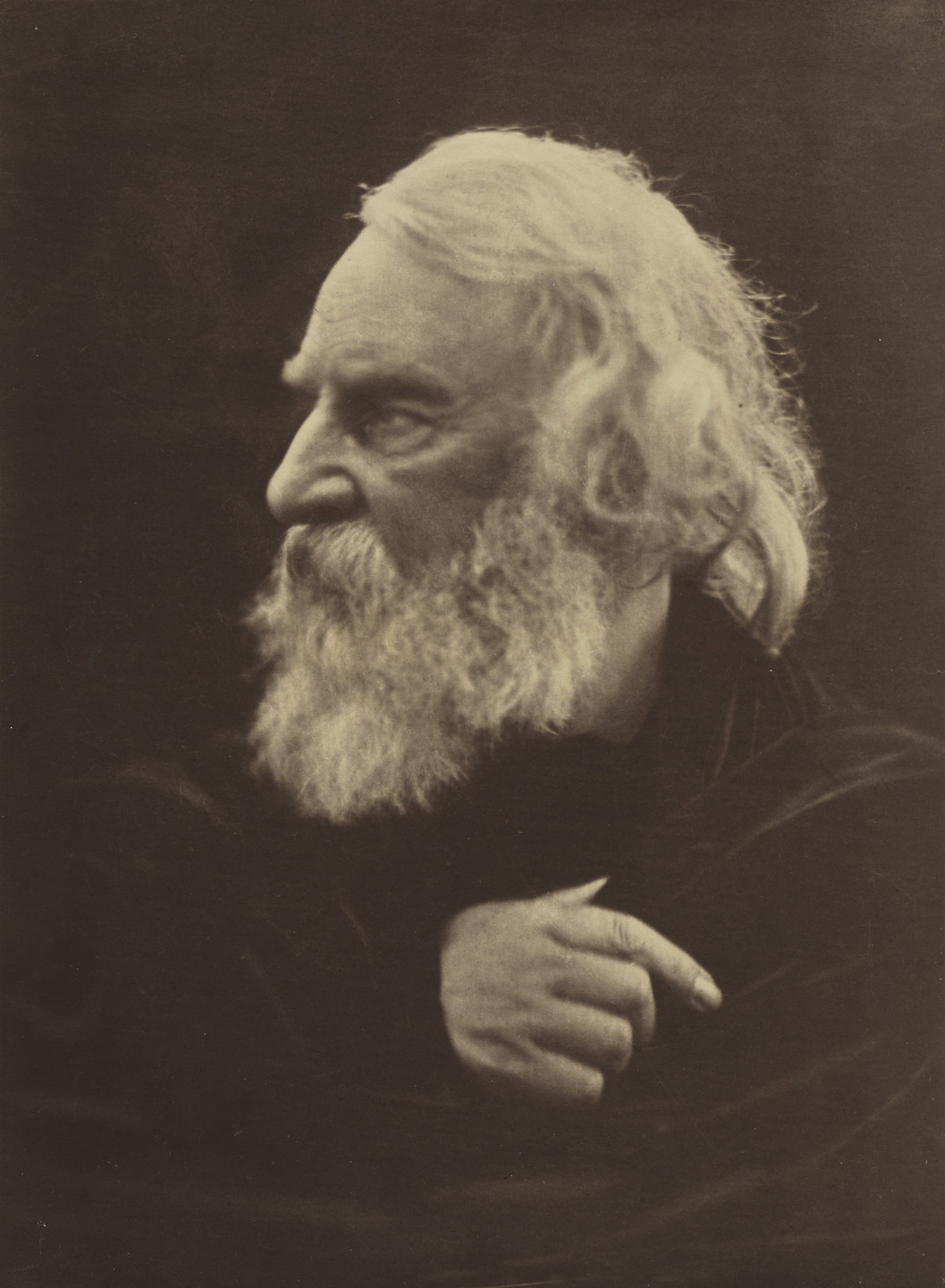
Henry Wadsworth Longfellow, born on this day in 1807

11 June 2024

Happy Birthday, Cameron

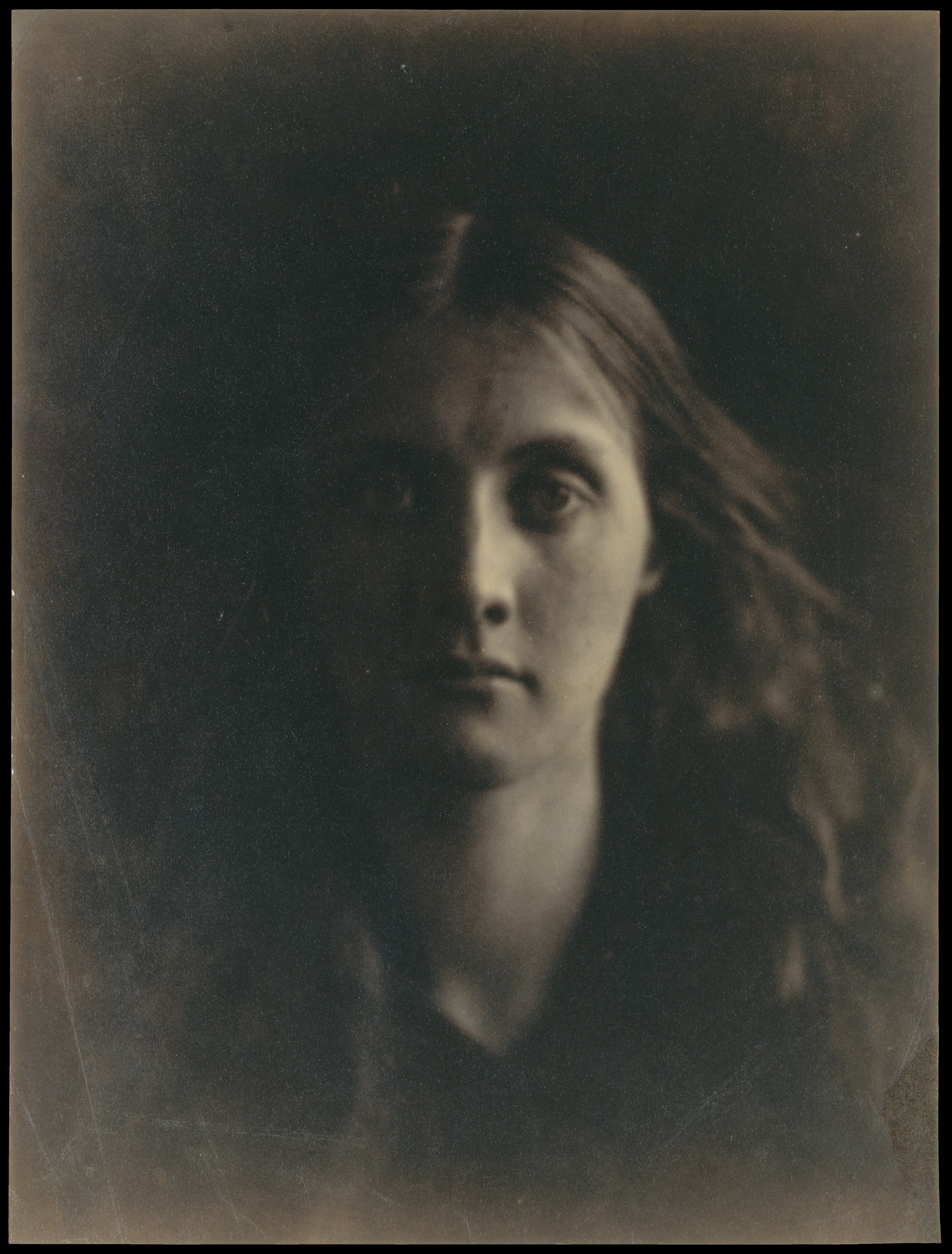
Cameron, Julia Jackson, 1867


Julia Margaret Cameron was born on this day in 1815.

27 February 2024

Happy Birthday, Longfellow

Cameron, Henry Wadsworth Longfellow, 1868


MORITURI SALUTAMUS

Poem for the fiftieth anniversary of the class of 1825 in Bowdoin College Tempora labuntur, tacitisque senescimus annis, Et fugiunt freno non remorante dies.--OVID, Fastorum, Lib. vi.

"O Caesar, we who are about to die
Salute you!" was the gladiators' cry
In the arena, standing face to face
With death and with the Roman populace. 

O ye familiar scenes,--ye groves of pine,
That once were mine and are no longer mine,--
Thou river, widening through the meadows green
To the vast sea, so near and yet unseen,--
Ye halls, in whose seclusion and repose
Phantoms of fame, like exhalations, rose
And vanished,--we who are about to die,
Salute you; earth and air and sea and sky,
And the Imperial Sun that scatters down
His sovereign splendors upon grove and town. 

Ye do not answer us! ye do not hear!
We are forgotten; and in your austere
And calm indifference, ye little care
Whether we come or go, or whence or where.
What passing generations fill these halls,
What passing voices echo front these walls,
Ye heed not; we are only as the blast,
A moment heard, and then forever past. 

Not so the teachers who in earlier days
Led our bewildered feet through learning's maze;
They answer us--alas! what have I said?
What greetings come there from the voiceless dead?
What salutation, welcome, or reply?
What pressure from the hands that lifeless lie?
They are no longer here; they all are gone
Into the land of shadows,--all save one.
Honor and reverence, and the good repute
That follows faithful service as its fruit,
Be unto him, whom living we salute. 

The great Italian poet, when he made
His dreadful journey to the realms of shade,
Met there the old instructor of his youth,
And cried in tones of pity and of ruth:
"Oh, never from the memory of my heart
Your dear, paternal image shall depart,
Who while on earth, ere yet by death surprised,
Taught me how mortals are immortalized;
How grateful am I for that patient care
All my life long my language shall declare." 

To-day we make the poet's words our own
And utter them in plaintive undertone;
Nor to the living only be they said,
But to the other living called the dead,
Whose dear, paternal images appear
Not wrapped in gloom, but robed in sunshine here;
Whose simple lives, complete and without flaw,
Were part and parcel of great Nature's law;
Who said not to their Lord, as if afraid
"Here is thy talent in a napkin laid,"
But labored in their sphere, as men who live
In the delight that work alone can give.
Peace be to them; eternal peace and rest,
And the fulfilment of the great behest:
"Ye have been faithful over a few things,
Over ten cities shall ye reign as kings." 

And ye who fill the places we once filled,
And follow in the furrows that we tilled,
Young men, whose generous hearts are beating high,
We who are old, and are about to die,
Salute you; hail you; take your hands in ours,
And crown you with our welcome as with flowers!
How beautiful is youth! how bright it gleams
With its illusions, aspirations, dreams!
Book of Beginnings, Story without End,
Each maid a heroine, and each man a friend!
Aladdin's Lamp, and Fortunatus' Purse,
That holds the treasures of the universe!
All possibilities are in its hands,
No danger daunts it, and no foe withstands;
In its sublime audacity of faith,
"Be thou removed!" it to the mountain saith,
And with ambitious feet, secure and proud,
Ascends the ladder leaning on the cloud! 

As ancient Priam at the Scaean gate
Sat on the walls of Troy in regal state
With the old men, too old and weak to fight,
Chirping like grasshoppers in their delight
To see the embattled hosts, with spear and shield,
Of Trojans and Achaians in the field;
So from the snowy summits of our years
We see you in the plain, as each appears,
And question of you; asking, "Who is he
That towers above the others?  Which may be
Atreides, Menelaus, Odysseus,
Ajax the great, or bold Idomeneus?" 

Let him not boast who puts his armor on
As he who puts it off, the battle done.
Study yourselves; and most of all note well
Wherein kind Nature meant you to excel.
Not every blossom ripens into fruit;
Minerva, the inventress of the flute,
Flung it aside, when she her face surveyed
Distorted in a fountain as she played;
The unlucky Marsyas found it, and his fate
Was one to make the bravest hesitate. 

Write on your doors the saying wise and old,
"Be bold! be bold!" and everywhere,--"Be bold;
Be not too bold!"  Yet better the excess
Than the defect; better the more than less;
Better like Hector in the field to die,
Than like a perfumed Paris turn and fly.

And now, my classmates; ye remaining few
That number not the half of those we knew,
Ye, against whose familiar names not yet
The fatal asterisk of death is set,
Ye I salute!  The horologe of Time
Strikes the half-century with a solemn chime,
And summons us together once again,
The joy of meeting not unmixed with pain. 

Where are the others?  Voices from the deep
Caverns of darkness answer me: "They sleep!"
I name no names; instinctively I feel
Each at some well-remembered grave will kneel,
And from the inscription wipe the weeds and moss,
For every heart best knoweth its own loss.
I see their scattered gravestones gleaming white
Through the pale dusk of the impending night;
O'er all alike the impartial sunset throws
Its golden lilies mingled with the rose;
We give to each a tender thought, and pass
Out of the graveyards with their tangled grass,
Unto these scenes frequented by our feet
When we were young, and life was fresh and sweet. 

What shall I say to you?  What can I say
Better than silence is?  When I survey
This throng of faces turned to meet my own,
Friendly and fair, and yet to me unknown,
Transformed the very landscape seems to be;
It is the same, yet not the same to me.
So many memories crowd upon my brain,
So many ghosts are in the wooded plain,
I fain would steal away, with noiseless tread,
As from a house where some one lieth dead.
I cannot go;--I pause;--I hesitate;
My feet reluctant linger at the gate;
As one who struggles in a troubled dream
To speak and cannot, to myself I seem. 

Vanish the dream! Vanish the idle fears!
Vanish the rolling mists of fifty years!
Whatever time or space may intervene,
I will not be a stranger in this scene.
Here every doubt, all indecision, ends;
Hail, my companions, comrades, classmates, friends! 

Ah me! the fifty years since last we met
Seem to me fifty folios bound and set
By Time, the great transcriber, on his shelves,
Wherein are written the histories of ourselves.
What tragedies, what comedies, are there;
What joy and grief, what rapture and despair!
What chronicles of triumph and defeat,
Of struggle, and temptation, and retreat!
What records of regrets, and doubts, and fears
What pages blotted, blistered by our tears!
What lovely landscapes on the margin shine,
What sweet, angelic faces, what divine
And holy images of love and trust,
Undimmed by age, unsoiled by damp or dust!

Whose hand shall dare to open and explore
These volumes, closed and clasped forevermore?
Not mine.  With reverential feet I pass;
I hear a voice that cries, "Alas! alas!
Whatever hath been written shall remain,
Nor be erased nor written o'er again;
The unwritten only still belongs to thee:
Take heed, and ponder well what that shall be." 

As children frightened by a thunder-cloud
Are reassured if some one reads aloud
A tale of wonder, with enchantment fraught,
Or wild adventure, that diverts their thought,
Let me endeavor with a tale to chase
The gathering shadows of the time and place,
And banish what we all too deeply feel
Wholly to say, or wholly to conceal. 

In mediaeval Rome, I know not where,
There stood an image with its arm in air,
And on its lifted finger, shining clear,
A golden ring with the device, "Strike here!"
Greatly the people wondered, though none guessed
The meaning that these words but half expressed,
Until a learned clerk, who at noonday
With downcast eyes was passing on his way,
Paused, and observed the spot, and marked it well,
Whereon the shadow of the finger fell;
And, coming back at midnight, delved, and found
A secret stairway leading underground.
Down this he passed into a spacious hall,
Lit by a flaming jewel on the wall;
And opposite, in threatening attitude,
With bow and shaft a brazen statue stood.
Upon its forehead, like a coronet,
Were these mysterious words of menace set:
"That which I am, I am; my fatal aim
None can escape, not even yon luminous flame!" 

Midway the hall was a fair table placed,
With cloth of gold, and golden cups enchased
With rubies, and the plates and knives were gold,
And gold the bread and viands manifold.
Around it, silent, motionless, and sad,
Were seated gallant knights in armor clad,
And ladies beautiful with plume and zone,
But they were stone, their hearts within were stone;
And the vast hall was filled in every part
With silent crowds, stony in face and heart. 

Long at the scene, bewildered and amazed
The trembling clerk in speechless wonder gazed;
Then from the table, by his greed made bold,
He seized a goblet and a knife of gold,
And suddenly from their seats the guests upsprang,
The vaulted ceiling with loud clamors rang,
The archer sped his arrow, at their call,
Shattering the lambent jewel on the wall,
And all was dark around and overhead;--
Stark on the door the luckless clerk lay dead! 

The writer of this legend then records
Its ghostly application in these words:
The image is the Adversary old,
Whose beckoning finger points to realms of gold;
Our lusts and passions are the downward stair
That leads the soul from a diviner air;
The archer, Death; the flaming jewel, Life;
Terrestrial goods, the goblet and the knife;
The knights and ladies, all whose flesh and bone
By avarice have been hardened into stone;
The clerk, the scholar whom the love of pelf
Tempts from his books and from his nobler self. 

The scholar and the world!  The endless strife,
The discord in the harmonies of life!
The love of learning, the sequestered nooks,
And all the sweet serenity of books;
The market-place, the eager love of gain,
Whose aim is vanity, and whose end is pain! 

But why, you ask me, should this tale be told
To men grown old, or who are growing old?
It is too late!  Ah, nothing is too late
Till the tired heart shall cease to palpitate.
Cato learned Greek at eighty; Sophocles
Wrote his grand Oedipus, and Simonides
Bore off the prize of verse from his compeers,
When each had numbered more than fourscore years,
And Theophrastus, at fourscore and ten,
Had but begun his “Characters of Men.”
Chaucer, at Woodstock with the nightingales,
At sixty wrote the Canterbury Tales;
Goethe at Weimar, toiling to the last,
Completed Faust when eighty years were past.
These are indeed exceptions; but they show
How far the gulf-stream of our youth may flow
Into the arctic regions of our lives.
Where little else than life itself survives. 

As the barometer foretells the storm
While still the skies are clear, the weather warm,
So something in us, as old age draws near,
Betrays the pressure of the atmosphere.
The nimble mercury, ere we are aware,
Descends the elastic ladder of the air;
The telltale blood in artery and vein
Sinks from its higher levels in the brain;
Whatever poet, orator, or sage
May say of it, old age is still old age.
It is the waning, not the crescent moon;
The dusk of evening, not the blaze of noon;
It is not strength, but weakness; not desire,
But its surcease; not the fierce heat of fire,
The burning and consuming element,
But that of ashes and of embers spent,
In which some living sparks we still discern,
Enough to warm, but not enough to burn. 

What then?  Shall we sit idly down and say
The night hath come; it is no longer day?
The night hath not yet come; we are not quite
Cut off from labor by the failing light;
Something remains for us to do or dare;
Even the oldest tree some fruit may bear;
Not Oedipus Coloneus, or Greek Ode,
Or tales of pilgrims that one morning rode
Out of the gateway of the Tabard Inn,
But other something, would we but begin;
For age is opportunity no less
Than youth itself, though in another dress,
And as the evening twilight fades away
The sky is filled with stars, invisible by day.

Henry Wadsworth Longfellow, born on this day in 1807

06 August 2023

Lured.

Cameron, Poet Alfred, Lord Tennyson, 1865


What sight so lured him thro’ the fields he knew
As where earth’s green stole into heaven’s own hue,

Far–far–away?

What sound was dearest in his native dells?
The mellow lin-lan-lone of evening bells

Far–far–away.

What vague world-whisper, mystic pain or joy,
Thro’ those three words would haunt him when a boy,

Far–far–away?

A whisper from his dawn of life? a breath
From some fair dawn beyond the doors of death

Far–far–away?

Far, far, how far? from o’er the gates of Birth,
The faint horizons, all the bounds of earth,

Far–far–away?

What charm in words, a charm no words could give?
O dying words, can Music make you live

Far–far–away?

Alfred, Lord Tennyson

Happy Birthday, Tennyson

Cameron, Tennyson, 1865


The FLOWER

Once in a golden hour
   I cast to earth a seed.
Up there came a flower,
   The people said, a weed.
 
To and fro they went
   Thro’ my garden bower,
And muttering discontent
   Cursed me and my flower.
 
Then it grew so tall
   It wore a crown of light,
But thieves from o’er the wall
   Stole the seed by night.
 
Sow’d it far and wide
   By every town and tower,
Till all the people cried,
   ‘Splendid is the flower! ’
 
Read my little fable:
   He that runs may read.
Most can raise the flowers now,
   For all have got the seed.
 
And some are pretty enough,
   And some are poor indeed;
And now again the people
   Call it but a weed.

Alfred, Lord Tennyson, born on this day in 1809

27 February 2023

Happy Birthday, Longfellow

Cameron, Henry Wadsworth Longfellow, 1868


The LADDER of ST. AUGUSTINE

Saint Augustine! well hast thou said,
      That of our vices we can frame
A ladder, if we will but tread
      Beneath our feet each deed of shame!

All common things, each day's events,
      That with the hour begin and end,
Our pleasures and our discontents,
      Are rounds by which we may ascend.

The low desire, the base design,
      That makes another's virtues less;
The revel of the ruddy wine,
      And all occasions of excess;

The longing for ignoble things;
      The strife for triumph more than truth;
The hardening of the heart, that brings
      Irreverence for the dreams of youth;

All thoughts of ill; all evil deeds,
      That have their root in thoughts of ill;
Whatever hinders or impedes
      The action of the nobler will; —

All these must first be trampled down
      Beneath our feet, if we would gain
In the bright fields of fair renown
      The right of eminent domain.

We have not wings, we cannot soar;
      But we have feet to scale and climb
By slow degrees, by more and more,
      The cloudy summits of our time.

The mighty pyramids of stone
      That wedge-like cleave the desert airs,
When nearer seen, and better known,
      Are but gigantic flights of stairs.

The distant mountains, that uprear
      Their solid bastions to the skies,
Are crossed by pathways, that appear
      As we to higher levels rise.

The heights by great men reached and kept
      Were not attained by sudden flight,
But they, while their companions slept,
      Were toiling upward in the night.

Standing on what too long we bore
      With shoulders bent and downcast eyes,
We may discern — unseen before —
      A path to higher destinies,

Nor deem the irrevocable Past
      As wholly wasted, wholly vain,
If, rising on its wrecks, at last
      To something nobler we attain.

Henry Wadsworth Longfellow

02 December 2022

Learn.


Ari Weinzweig on humility ...
Humbleness, for me, would include awe, inspiration, openness, beginner’s mind, appreciation, acceptance, reality checks… It’s knowing how little I know, remembering how many mistakes I’ve made, and then reminding myself, twice, that those shortfalls are what humanity and creative pursuit of new things is about. It’s about learning from everyone. Seeing beauty in everything. Appreciating our achievements. Finding the flaws in all we’ve done, but doing it from the loving supportive place of what Julia Cameron called being a “believing mirror,” though in this case for oneself. It’s understanding that everything we do matters, but that at the same time we’re almost insignificant. It’s knowing we mess up daily but we’re still good people. It’s realizing that the more you learn, as James Baldwin said, “You learn how little you know.”

27 February 2021

Happy Birthday, Longfellow

Cameron, Henry Wadsworth Longfellow, 1868


Henry Wadsworth Longfellow was born on this day in 1807.

TRAVELS by the FIRESIDE

The ceaseless rain is falling fast,
  And yonder gilded vane,
Immovable for three days past,
  Points to the misty main, 

It drives me in upon myself
  And to the fireside gleams,
To pleasant books that crowd my shelf,
  And still more pleasant dreams, 

I read whatever bards have sung
  Of lands beyond the sea,
And the bright days when I was young
  Come thronging back to me. 

In fancy I can hear again
  The Alpine torrent's roar,
The mule-bells on the hills of Spain,
  The sea at Elsinore. 

I see the convent's gleaming wall
  Rise from its groves of pine,
And towers of old cathedrals tall,
  And castles by the Rhine. 

I journey on by park and spire,
  Beneath centennial trees,
Through fields with poppies all on fire,
  And gleams of distant seas. 

I fear no more the dust and heat,
  No more I feel fatigue,
While journeying with another's feet
  O'er many a lengthening league. 

Let others traverse sea and land,
  And toil through various climes,
I turn the world round with my hand
  Reading these poets' rhymes. 

From them I learn whatever lies
  Beneath each changing zone,
And see, when looking with their eyes,
  Better than with mine own.

Henry Wadsworth Longfellow

09 August 2020

Pealing.

Cameron, Alfred Tennyson, 1865


"If indeed there haunt
   About the mouldered lodges of the Past
   So sweet a voice and vague, fatal to men,
   Well needs it we should cram our ears with wool
   And so pace by:  but thine are fancies hatched
   In silken-folded idleness; nor is it
   Wiser to weep a true occasion lost,
   But trim our sails, and let old bygones be,
   While down the streams that float us each and all
   To the issue, goes, like glittering bergs of ice,
   Throne after throne, and molten on the waste
   Becomes a cloud:  for all things serve their time
   Toward that great year of equal mights and rights,
   Nor would I fight with iron laws, in the end
   Found golden:  let the past be past; let be
   Their cancelled Babels:  though the rough kex break
   The starred mosaic, and the beard-blown goat
   Hang on the shaft, and the wild figtree split
   Their monstrous idols, care not while we hear
   A trumpet in the distance pealing news
   Of better, and Hope, a poising eagle, burns
   Above the unrisen morrow" ... 

Alfred, Lord Tennyson, from "The Princess"

06 August 2020

Arise.

Cameron, The Poet, Tennyson, 1865


Break, break, break,
         On thy cold gray stones, O Sea!
And I would that my tongue could utter
         The thoughts that arise in me.

O, well for the fisherman's boy,
         That he shouts with his sister at play!
O, well for the sailor lad,
         That he sings in his boat on the bay!

And the stately ships go on
         To their haven under the hill;
But O for the touch of a vanish'd hand,
         And the sound of a voice that is still!

Break, break, break
         At the foot of thy crags, O Sea!
But the tender grace of a day that is dead
         Will never come back to me.

Alfred, Lord Tennyson

27 February 2020

Happy Birthday, Longfellow

Cameron, Longfellow, 1868


Henry Wadsworth Longfellow was born on this date in 1807.

MORITURI SALUTAMUS

"O Caesar, we who are about to die
Salute you!" was the gladiators' cry
In the arena, standing face to face
With death and with the Roman populace. 

O ye familiar scenes,--ye groves of pine,
That once were mine and are no longer mine,--
Thou river, widening through the meadows green
To the vast sea, so near and yet unseen,--
Ye halls, in whose seclusion and repose
Phantoms of fame, like exhalations, rose
And vanished,--we who are about to die,
Salute you; earth and air and sea and sky,
And the Imperial Sun that scatters down
His sovereign splendors upon grove and town. 

Ye do not answer us! ye do not hear!
We are forgotten; and in your austere
And calm indifference, ye little care
Whether we come or go, or whence or where.
What passing generations fill these halls,
What passing voices echo front these walls,
Ye heed not; we are only as the blast,
A moment heard, and then forever past. 

Not so the teachers who in earlier days
Led our bewildered feet through learning's maze;
They answer us--alas! what have I said?
What greetings come there from the voiceless dead?
What salutation, welcome, or reply?
What pressure from the hands that lifeless lie?
They are no longer here; they all are gone
Into the land of shadows,--all save one.
Honor and reverence, and the good repute
That follows faithful service as its fruit,
Be unto him, whom living we salute. 

The great Italian poet, when he made
His dreadful journey to the realms of shade,
Met there the old instructor of his youth,
And cried in tones of pity and of ruth:
"Oh, never from the memory of my heart
Your dear, paternal image shall depart,
Who while on earth, ere yet by death surprised,
Taught me how mortals are immortalized;
How grateful am I for that patient care
All my life long my language shall declare." 

To-day we make the poet's words our own
And utter them in plaintive undertone;
Nor to the living only be they said,
But to the other living called the dead,
Whose dear, paternal images appear
Not wrapped in gloom, but robed in sunshine here;
Whose simple lives, complete and without flaw,
Were part and parcel of great Nature's law;
Who said not to their Lord, as if afraid
"Here is thy talent in a napkin laid,"
But labored in their sphere, as men who live
In the delight that work alone can give.
Peace be to them; eternal peace and rest,
And the fulfilment of the great behest:
"Ye have been faithful over a few things,
Over ten cities shall ye reign as kings." 

And ye who fill the places we once filled,
And follow in the furrows that we tilled,
Young men, whose generous hearts are beating high,
We who are old, and are about to die,
Salute you; hail you; take your hands in ours,
And crown you with our welcome as with flowers!
How beautiful is youth! how bright it gleams
With its illusions, aspirations, dreams!
Book of Beginnings, Story without End,
Each maid a heroine, and each man a friend!
Aladdin's Lamp, and Fortunatus' Purse,
That holds the treasures of the universe!
All possibilities are in its hands,
No danger daunts it, and no foe withstands;
In its sublime audacity of faith,
"Be thou removed!" it to the mountain saith,
And with ambitious feet, secure and proud,
Ascends the ladder leaning on the cloud! 

As ancient Priam at the Scaean gate
Sat on the walls of Troy in regal state
With the old men, too old and weak to fight,
Chirping like grasshoppers in their delight
To see the embattled hosts, with spear and shield,
Of Trojans and Achaians in the field;
So from the snowy summits of our years
We see you in the plain, as each appears,
And question of you; asking, "Who is he
That towers above the others?  Which may be
Atreides, Menelaus, Odysseus,
Ajax the great, or bold Idomeneus?" 

Let him not boast who puts his armor on
As he who puts it off, the battle done.
Study yourselves; and most of all note well
Wherein kind Nature meant you to excel.
Not every blossom ripens into fruit;
Minerva, the inventress of the flute,
Flung it aside, when she her face surveyed
Distorted in a fountain as she played;
The unlucky Marsyas found it, and his fate
Was one to make the bravest hesitate. 

Write on your doors the saying wise and old,
"Be bold! be bold!" and everywhere,--"Be bold;
Be not too bold!"  Yet better the excess
Than the defect; better the more than less;
Better like Hector in the field to die,
Than like a perfumed Paris turn and fly.

And now, my classmates; ye remaining few
That number not the half of those we knew,
Ye, against whose familiar names not yet
The fatal asterisk of death is set,
Ye I salute!  The horologe of Time
Strikes the half-century with a solemn chime,
And summons us together once again,
The joy of meeting not unmixed with pain. 

Where are the others?  Voices from the deep
Caverns of darkness answer me: "They sleep!"
I name no names; instinctively I feel
Each at some well-remembered grave will kneel,
And from the inscription wipe the weeds and moss,
For every heart best knoweth its own loss.
I see their scattered gravestones gleaming white
Through the pale dusk of the impending night;
O'er all alike the impartial sunset throws
Its golden lilies mingled with the rose;
We give to each a tender thought, and pass
Out of the graveyards with their tangled grass,
Unto these scenes frequented by our feet
When we were young, and life was fresh and sweet. 

What shall I say to you?  What can I say
Better than silence is?  When I survey
This throng of faces turned to meet my own,
Friendly and fair, and yet to me unknown,
Transformed the very landscape seems to be;
It is the same, yet not the same to me.
So many memories crowd upon my brain,
So many ghosts are in the wooded plain,
I fain would steal away, with noiseless tread,
As from a house where some one lieth dead.
I cannot go;--I pause;--I hesitate;
My feet reluctant linger at the gate;
As one who struggles in a troubled dream
To speak and cannot, to myself I seem. 

Vanish the dream! Vanish the idle fears!
Vanish the rolling mists of fifty years!
Whatever time or space may intervene,
I will not be a stranger in this scene.
Here every doubt, all indecision, ends;
Hail, my companions, comrades, classmates, friends! 

Ah me! the fifty years since last we met
Seem to me fifty folios bound and set
By Time, the great transcriber, on his shelves,
Wherein are written the histories of ourselves.
What tragedies, what comedies, are there;
What joy and grief, what rapture and despair!
What chronicles of triumph and defeat,
Of struggle, and temptation, and retreat!
What records of regrets, and doubts, and fears
What pages blotted, blistered by our tears!
What lovely landscapes on the margin shine,
What sweet, angelic faces, what divine
And holy images of love and trust,
Undimmed by age, unsoiled by damp or dust!

Whose hand shall dare to open and explore
These volumes, closed and clasped forevermore?
Not mine.  With reverential feet I pass;
I hear a voice that cries, "Alas! alas!
Whatever hath been written shall remain,
Nor be erased nor written o'er again;
The unwritten only still belongs to thee:
Take heed, and ponder well what that shall be." 

As children frightened by a thunder-cloud
Are reassured if some one reads aloud
A tale of wonder, with enchantment fraught,
Or wild adventure, that diverts their thought,
Let me endeavor with a tale to chase
The gathering shadows of the time and place,
And banish what we all too deeply feel
Wholly to say, or wholly to conceal. 

In mediaeval Rome, I know not where,
There stood an image with its arm in air,
And on its lifted finger, shining clear,
A golden ring with the device, "Strike here!"
Greatly the people wondered, though none guessed
The meaning that these words but half expressed,
Until a learned clerk, who at noonday
With downcast eyes was passing on his way,
Paused, and observed the spot, and marked it well,
Whereon the shadow of the finger fell;
And, coming back at midnight, delved, and found
A secret stairway leading underground.
Down this he passed into a spacious hall,
Lit by a flaming jewel on the wall;
And opposite, in threatening attitude,
With bow and shaft a brazen statue stood.
Upon its forehead, like a coronet,
Were these mysterious words of menace set:
"That which I am, I am; my fatal aim
None can escape, not even yon luminous flame!" 

Midway the hall was a fair table placed,
With cloth of gold, and golden cups enchased
With rubies, and the plates and knives were gold,
And gold the bread and viands manifold.
Around it, silent, motionless, and sad,
Were seated gallant knights in armor clad,
And ladies beautiful with plume and zone,
But they were stone, their hearts within were stone;
And the vast hall was filled in every part
With silent crowds, stony in face and heart. 

Long at the scene, bewildered and amazed
The trembling clerk in speechless wonder gazed;
Then from the table, by his greed made bold,
He seized a goblet and a knife of gold,
And suddenly from their seats the guests upsprang,
The vaulted ceiling with loud clamors rang,
The archer sped his arrow, at their call,
Shattering the lambent jewel on the wall,
And all was dark around and overhead;--
Stark on the door the luckless clerk lay dead! 

The writer of this legend then records
Its ghostly application in these words:
The image is the Adversary old,
Whose beckoning finger points to realms of gold;
Our lusts and passions are the downward stair
That leads the soul from a diviner air;
The archer, Death; the flaming jewel, Life;
Terrestrial goods, the goblet and the knife;
The knights and ladies, all whose flesh and bone
By avarice have been hardened into stone;
The clerk, the scholar whom the love of pelf
Tempts from his books and from his nobler self. 

The scholar and the world!  The endless strife,
The discord in the harmonies of life!
The love of learning, the sequestered nooks,
And all the sweet serenity of books;
The market-place, the eager love of gain,
Whose aim is vanity, and whose end is pain! 

But why, you ask me, should this tale be told
To men grown old, or who are growing old?
It is too late!  Ah, nothing is too late
Till the tired heart shall cease to palpitate.
Cato learned Greek at eighty; Sophocles
Wrote his grand Oedipus, and Simonides
Bore off the prize of verse from his compeers,
When each had numbered more than fourscore years,
And Theophrastus, at fourscore and ten,
Had but begun his ?Characters of Men.?
Chaucer, at Woodstock with the nightingales,
At sixty wrote the Canterbury Tales;
Goethe at Weimar, toiling to the last,
Completed Faust when eighty years were past.
These are indeed exceptions; but they show
How far the gulf-stream of our youth may flow
Into the arctic regions of our lives.
Where little else than life itself survives. 

As the barometer foretells the storm
While still the skies are clear, the weather warm,
So something in us, as old age draws near,
Betrays the pressure of the atmosphere.
The nimble mercury, ere we are aware,
Descends the elastic ladder of the air;
The telltale blood in artery and vein
Sinks from its higher levels in the brain;
Whatever poet, orator, or sage
May say of it, old age is still old age.
It is the waning, not the crescent moon;
The dusk of evening, not the blaze of noon;
It is not strength, but weakness; not desire,
But its surcease; not the fierce heat of fire,
The burning and consuming element,
But that of ashes and of embers spent,
In which some living sparks we still discern,
Enough to warm, but not enough to burn. 

What then?  Shall we sit idly down and say
The night hath come; it is no longer day?
The night hath not yet come; we are not quite
Cut off from labor by the failing light;
Something remains for us to do or dare;
Even the oldest tree some fruit may bear;
Not Oedipus Coloneus, or Greek Ode,
Or tales of pilgrims that one morning rode
Out of the gateway of the Tabard Inn,
But other something, would we but begin;
For age is opportunity no less
Than youth itself, though in another dress,
And as the evening twilight fades away
The sky is filled with stars, invisible by day.

Henry Wadsworth Longfellow