"I am not one who was born in the custody of wisdom. I am one who is fond of olden times and intense in quest of the sacred knowing of the ancients." Gustave Courbet
Showing posts with label The White House. Show all posts

28 July 2024

Scarcity.


I am more and more convinced that Man is a dangerous creature, and that power whether vested in many or a few is ever-grasping, and like the grave cries give, give. The great fish swallow up the small, and he who is most strenuous for the Rights of the people, when vested with power, is as eager after the prerogatives of Government. You tell me of degrees of perfection to which Humane Nature is capable of arriving, and I believe it, but at the same time lament that our admiration should arise from the scarcity of the instances.

Abigail Adams, from a letter to John Adams, 27 October 1775

17 June 2023

23 August 2020

Aliveness.


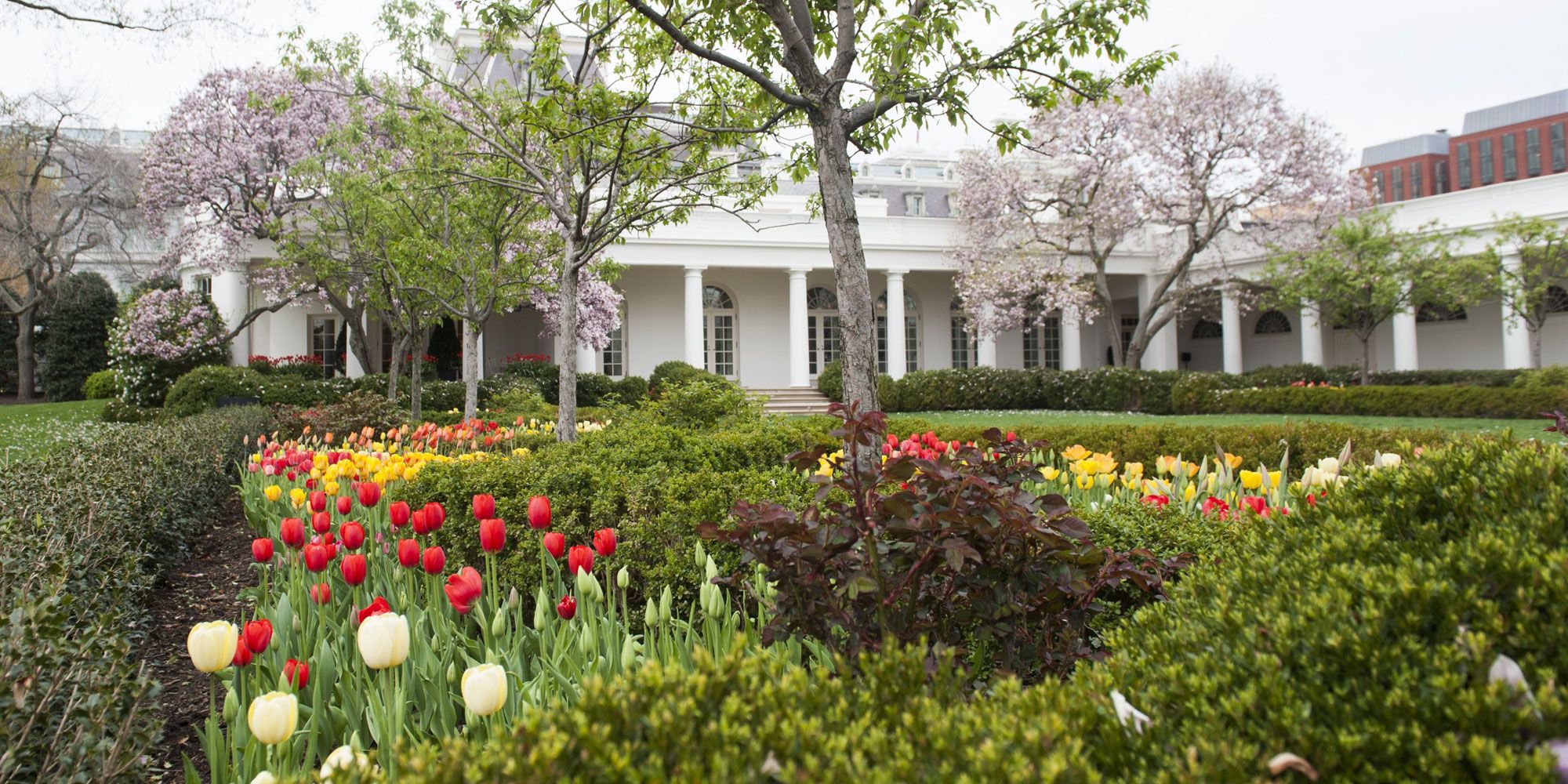
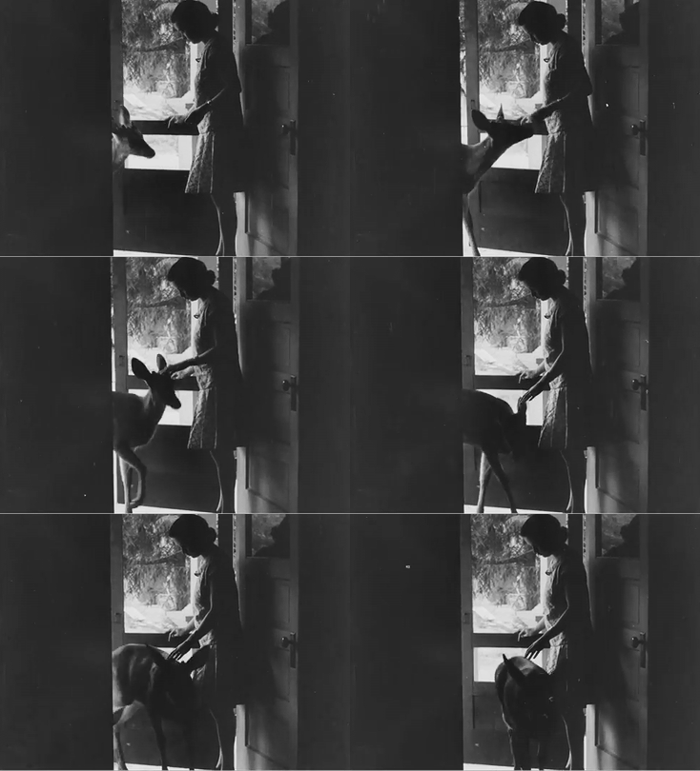
Rachel Lambert Mellon gives her account of designing the iconic Kennedy Rose Garden ...
We continued to dig. The garden area was filled with rubble and relics and yielded many curiosities, such as Civil War horseshoes and bits of pots from the old greenhouses. We dug out the whole area to a depth of four feet and filled it with fertile soil. With new soil in place and Mr. Williams at work, my thoughts turned to finding available plant material. The magnolias I imagined planting there would be hard to find.
There were, however, seemingly forgotten groves of interesting trees in the vast public land of the federal city, where old plant material had been allowed to grow in a state of apparent abandon. Near the Tidal Basin and behind the rambling wartime Navy buildings (since torn down) I finally found the four magnolias. Forgotten for many years, these trees had survived both men and war. They were balled and burlapped and moved by a crane from obscurity to the White House, where they took root in President Kennedy’s Rose Garden.
Their presence changed the entire character of this empty space. Their natural untended growth filled the four bare corners. The tree whose trunk reached higher than the others was planted in the northeast corner by the White House. Crowded by other trees in its previous planting ground, this magnolia had reached toward the light; it had gained a height not often found in Magnolia soulangeana, which tend to spread after a certain period of upward growth. 
When the planting was completed, the trees were pruned to give them strength and to create the shape each corner demanded. The special pruning was done by Everett Hicks, an exceptional man in his field. He had been trained by, and spent most of this life with, the Davey Tree Company. He combined a knowledge of pruning large trees with the eye and talent of a sculptor. These magnolias, my original inspiration, were not disappointing when they were in place. They gave life to what had been a cold, bleak space.
There is often unspoken encouragement when trees or shrubs are planted and you review the original plan to see how the reality of three dimensions measures up. Now in the Rose Garden shadows gave a quality of aliveness that could be repeated by the smaller trees I hoped to plant in the two flanking twelve-foot borders. The length of the borders would allow for five trees on each side. The force of the summer sun that bakes the city of Washington would be broken by the height and width of these trees.
CONNECT

03 June 2020

Returning.


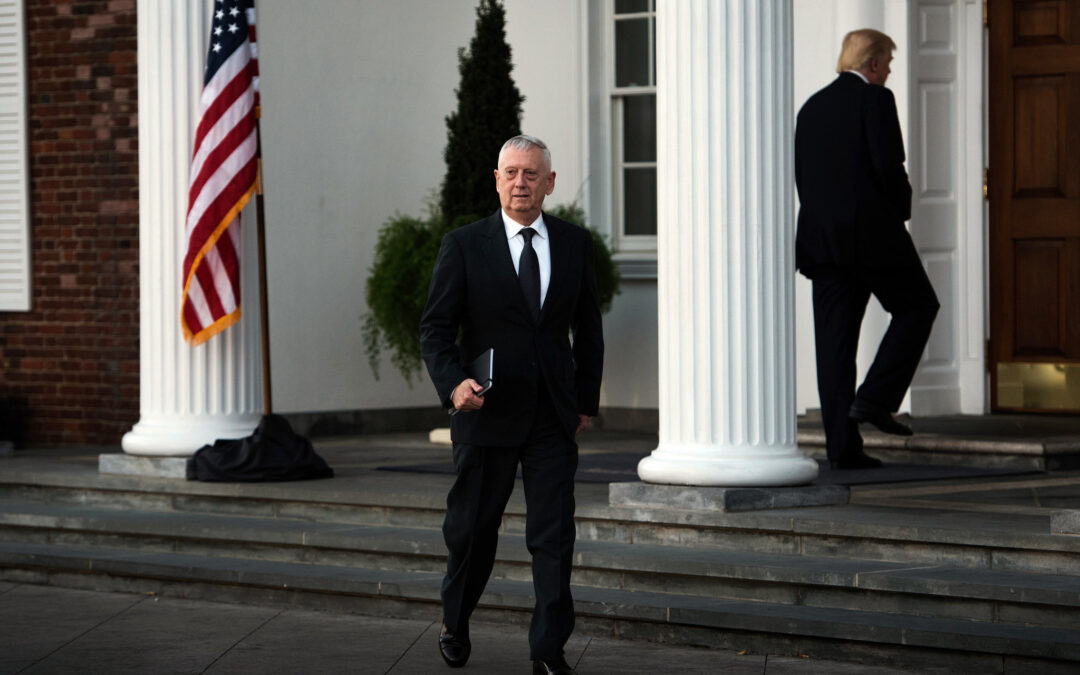
James Mattis, this evening ...

I have watched this week’s unfolding events, angry and appalled. The words “Equal Justice Under Law” are carved in the pediment of the United States Supreme Court. This is precisely what protesters are rightly demanding. It is a wholesome and unifying demand—one that all of us should be able to get behind. We must not be distracted by a small number of lawbreakers. The protests are defined by tens of thousands of people of conscience who are insisting that we live up to our values—our values as people and our values as a nation.

When I joined the military, some 50 years ago, I swore an oath to support and defend the Constitution. Never did I dream that troops taking that same oath would be ordered under any circumstance to violate the Constitutional rights of their fellow citizens—much less to provide a bizarre photo op for the elected commander-in-chief, with military leadership standing alongside.

We must reject any thinking of our cities as a “battlespace” that our uniformed military is called upon to “dominate.” At home, we should use our military only when requested to do so, on very rare occasions, by state governors. Militarizing our response, as we witnessed in Washington, D.C., sets up a conflict—a false conflict—between the military and civilian society. It erodes the moral ground that ensures a trusted bond between men and women in uniform and the society they are sworn to protect, and of which they themselves are a part. Keeping public order rests with civilian state and local leaders who best understand their communities and are answerable to them.

James Madison wrote in Federalist 14 that “America united with a handful of troops, or without a single soldier, exhibits a more forbidding posture to foreign ambition than America disunited, with a hundred thousand veterans ready for combat.” We do not need to militarize our response to protests. We need to unite around a common purpose. And it starts by guaranteeing that all of us are equal before the law.

Instructions given by the military departments to our troops before the Normandy invasion reminded soldiers that “The Nazi slogan for destroying us…was ‘Divide and Conquer.’ Our American answer is ‘In Union there is Strength.’” We must summon that unity to surmount this crisis—confident that we are better than our politics.

Donald Trump is the first president in my lifetime who does not try to unite the American people—does not even pretend to try. Instead he tries to divide us. We are witnessing the consequences of three years of this deliberate effort. We are witnessing the consequences of three years without mature leadership. We can unite without him, drawing on the strengths inherent in our civil society. This will not be easy, as the past few days have shown, but we owe it to our fellow citizens; to past generations that bled to defend our promise; and to our children.

We can come through this trying time stronger, and with a renewed sense of purpose and respect for one another. The pandemic has shown us that it is not only our troops who are willing to offer the ultimate sacrifice for the safety of the community. Americans in hospitals, grocery stores, post offices, and elsewhere have put their lives on the line in order to serve their fellow citizens and their country. We know that we are better than the abuse of executive authority that we witnessed in Lafayette Square. We must reject and hold accountable those in office who would make a mockery of our Constitution. At the same time, we must remember Lincoln’s “better angels,” and listen to them, as we work to unite.

Only by adopting a new path—which means, in truth, returning to the original path of our founding ideals—will we again be a country admired and respected at home and abroad.

01 June 2020

Unhinged.


George Will, this afternoon ...

This unraveling presidency began with the Crybaby-in-Chief banging his spoon on his highchair tray to protest a photograph — a photograph — showing that his inauguration crowd the day before had been smaller than the one four years previous. Since then, this weak person’s idea of a strong person, this chest-pounding advertisement of his own gnawing insecurities, this low-rent Lear raging on his Twitter-heath has proven that the phrase malignant buffoon is not an oxymoron.

Presidents, exploiting modern communications technologies and abetted today by journalists preening as the “resistance” — like members of the French Resistance 1940-1944, minus the bravery — can set the tone of American society, which is regrettably soft wax on which presidents leave their marks. The president’s provocations — his coarsening of public discourse that lowers the threshold for acting out by people as mentally crippled as he — do not excuse the violent few. They must be punished. He must be removed ...

In life’s unforgiving arithmetic, we are the sum of our choices. Congressional Republicans have made theirs for more than 1,200 days. We cannot know all the measures necessary to restore the nation’s domestic health and international standing, but we know the first step: Senate Republicans must be routed, as condign punishment for their Vichyite collaboration, leaving the Republican remnant to wonder: Was it sensible to sacrifice dignity, such as it ever was, and to shed principles, if convictions so easily jettisoned could be dignified as principles, for . . . what? Praying people should pray, and all others should hope: May I never crave anything as much as these people crave membership in the world’s most risible deliberative body.

A political party’s primary function is to bestow its imprimatur on candidates, thereby proclaiming: This is who we are. In 2016, the Republican Party gave its principal nomination to a vulgarian and then toiled to elect him. And to stock Congress with invertebrates whose unswerving abjectness has enabled his institutional vandalism, who have voiced no serious objections to his Niagara of lies, and whom T.S. Eliot anticipated:
We are the hollow men . . .
Our dried voices, when
We whisper together
Are quiet and meaningless
As wind in dry grass
or rats’ feet over broken glass . . .
Those who think our unhinged president’s recent mania about a murder two decades ago that never happened represents his moral nadir have missed the lesson of his life: There is no such thing as rock bottom. 

CONNECT

24 May 2020

Sheep.


The utility of information is admitted practically as well as theoretically; without a literate population a modern State is impossible. But the utility of intelligence is admitted only theoretically, not practically; it is not desired that ordinary people should think for themselves, because it is felt that people who think for themselves are awkward to manage and cause administrative difficulties. Only the guardians, in Plato’s language, are to think; the rest are to obey, or to follow leaders like a herd of sheep.

Bertrand Russell

22 May 2020

Twist.


It is a capital mistake to theorize before one has data. Insensibly one begins to twist facts to suit theories, instead of theories to suit facts.

Sir Arthur Conan Doyle

01 March 2020

See.


He who Doubts from what he sees
Will ne’er Believe do what you Please
If the Sun & Moon should Doubt
They’d immediately Go out
To be in a Passion you Good may Do
But no Good if a Passion is in you
The Whore & Gambler by the State
Licenc’d build that Nation’s Fate
The Harlot’s cry from Street to Street
Shall weave Old England’s winding Sheet
The Winner’s Shout the Loser’s Curse
Dance before dead England’s Hearse
Every Night & every Morn
Some to Misery are Born
Every Morn and every Night
Some are Born to sweet delight
Some are Born to Endless Night
We are led to Believe a Lie
When we see not Thro the Eye
Which was Born in a Night to perish in a Night
When the Soul Slept in Beams of Light
God Appears & God is Light
To those poor Souls who dwell in Night
But does a Human Form Display
To those who Dwell in Realms of day

William Blake, from "Auguries of Innocence"

Distort.


Man has such a predilection for systems and abstract deductions that he is ready to distort the truth intentionally, he is ready to deny the evidence of his senses only to justify his logic.

Fyodor Dostoevsky

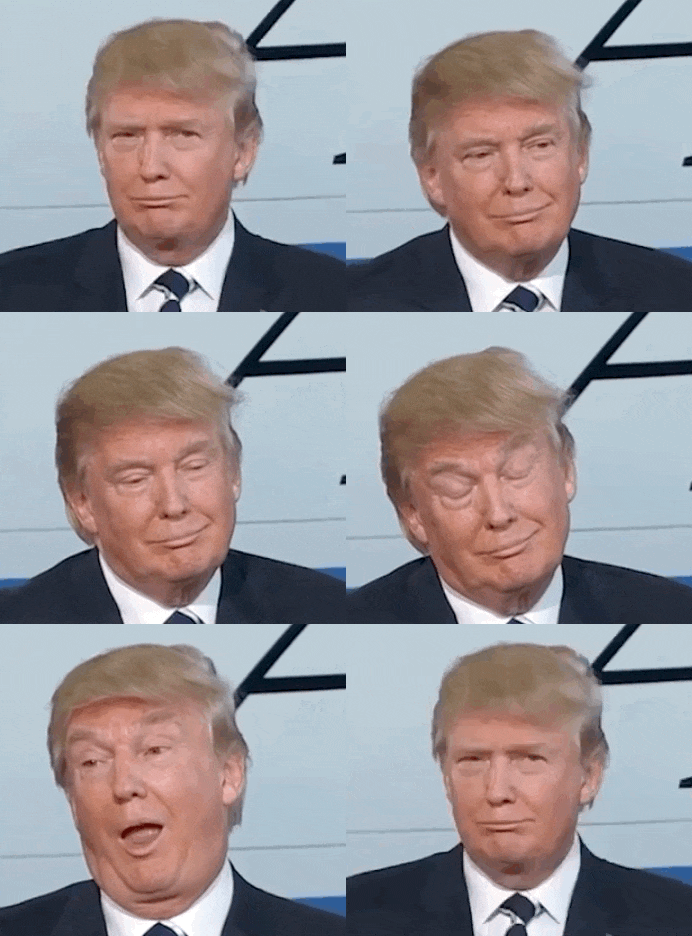
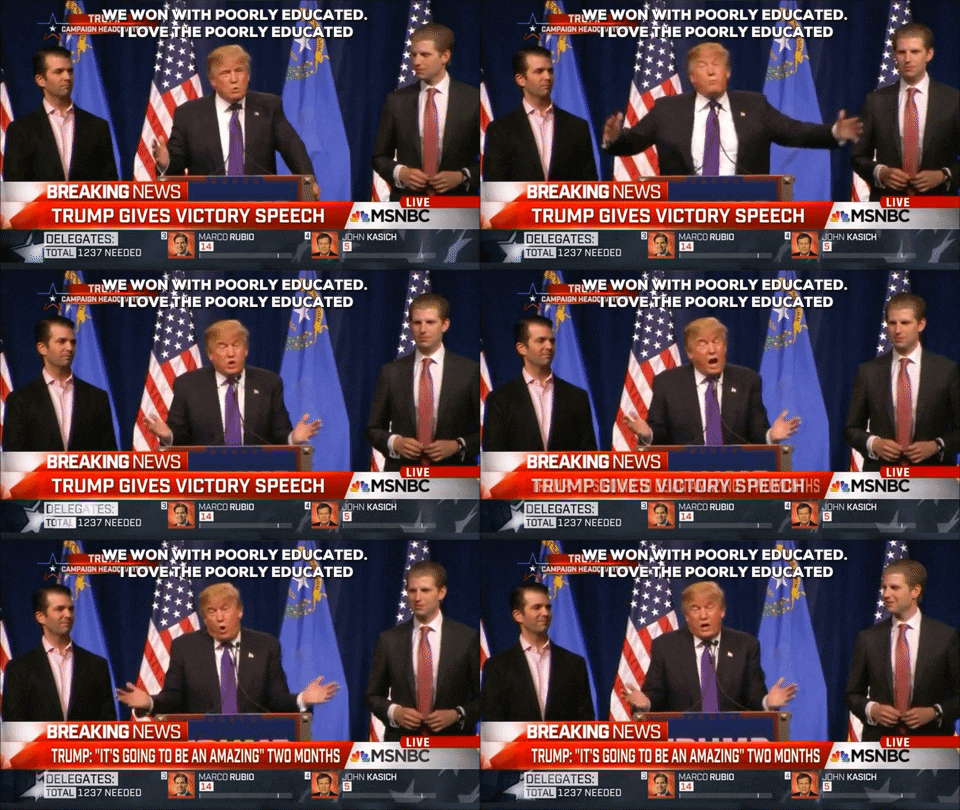
Hold the bucket, monkeys, The Donald says, "Wait for the shake."

18 January 2020

Preserve.

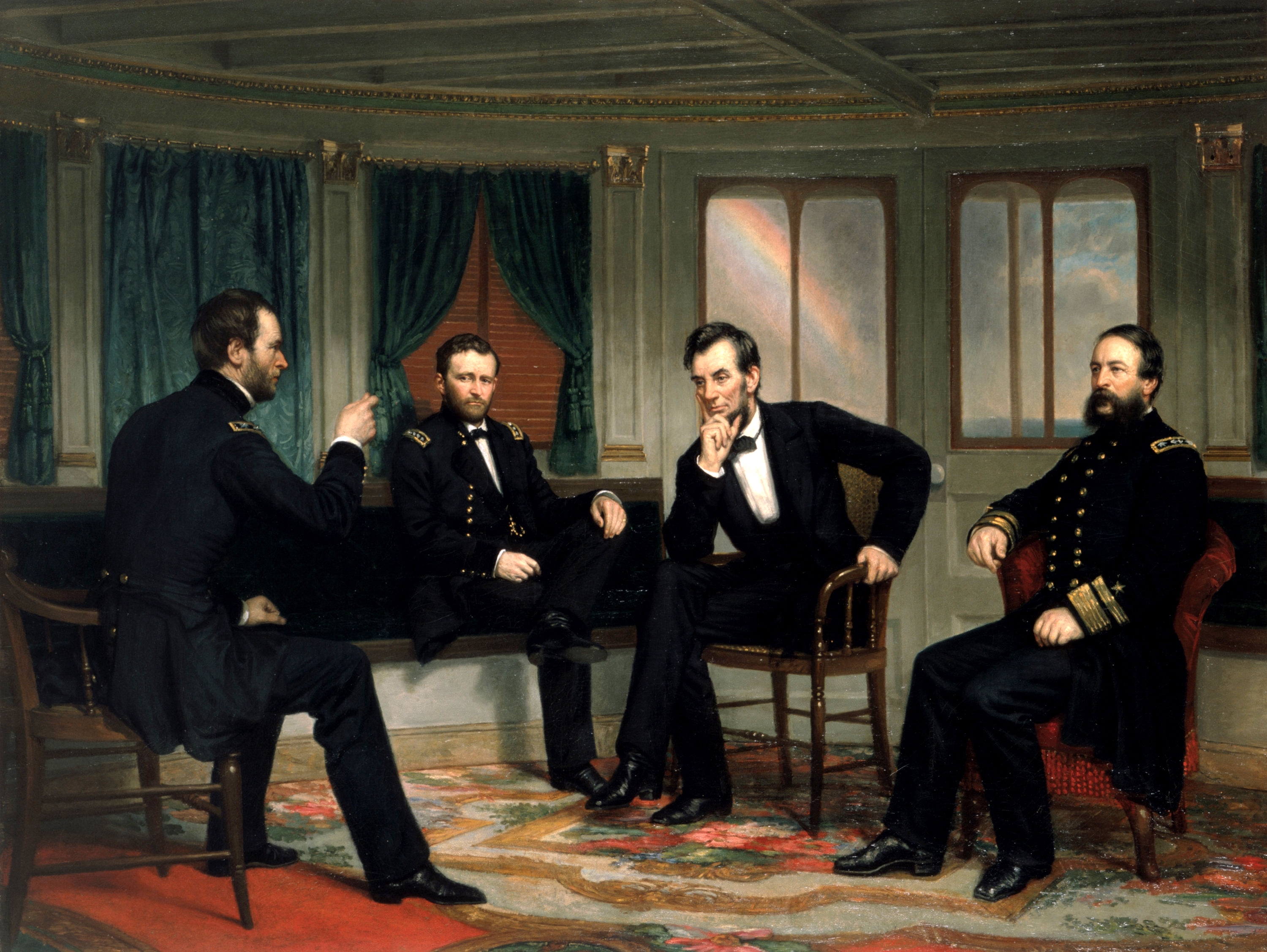
Healy, The Peacemakers, 1868


There is no more sacred room for military officers than 2E924 of the Pentagon, a windowless and secure vault where the Joint Chiefs of Staff meet regularly to wrestle with classified matters. Its more common name is “the Tank.” The Tank resembles a small corporate boardroom, with a gleaming golden oak table, leather swivel armchairs and other mid-century stylings. Inside its walls, flag officers observe a reverence and decorum for the wrenching decisions that have been made there.

Hanging prominently on one of the walls is The Peacemakers, a painting that depicts an 1865 Civil War strategy session with President Abraham Lincoln and his three service chiefs — Lieutenant General Ulysses S. Grant, Major General William Tecumseh Sherman, and Rear Admiral David Dixon Porter. One hundred fifty-​­two years after Lincoln hatched plans to preserve the Union, President Trump’s advisers staged an intervention inside the Tank to try to preserve the world order.
By that point, six months into his administration, Secretary of Defense Jim Mattis, Director of the National Economic Council Gary Cohn, and Secretary of State Rex Tillerson had grown alarmed by gaping holes in Trump’s knowledge of history, especially the key alliances forged following World War II. Trump had dismissed allies as worthless, cozied up to authoritarian regimes in Russia and elsewhere, and advocated withdrawing troops from strategic outposts and active theaters alike.

Trump organized his unorthodox worldview under the simplistic banner of “America First,” but Mattis, Tillerson, and Cohn feared his proposals were rash, barely considered, and a danger to America’s superpower standing. They also felt that many of Trump’s impulsive ideas stemmed from his lack of familiarity with U.S. history and, even, where countries were located. To have a useful discussion with him, the trio agreed, they had to create a basic knowledge, a shared language.

So on July 20, 2017, Mattis invited Trump to the Tank for what he, Tillerson, and Cohn had carefully organized as a tailored tutorial. What happened inside the Tank that day crystallized the commander in chief’s berating, derisive and dismissive manner, foreshadowing decisions such as the one earlier this month that brought the United States to the brink of war with Iran. The Tank meeting was a turning point in Trump’s presidency. Rather than getting him to appreciate America’s traditional role and alliances, Trump began to tune out and eventually push away the experts who believed their duty was to protect the country by restraining his more dangerous impulses.

The episode has been documented numerous times, but subsequent reporting reveals a more complete picture of the moment and the chilling effect Trump’s comments and hostility had on the nation’s military and national security leadership.

CONNECT

Thank You, Jessica.

When I became President, I had a meeting at the Pentagon with lots of generals. They were like from a movie. Better looking than Tom Cruise and stronger. And I had more generals than I've ever seen, and we were at the bottom of this incredible room. I said "this is greatest room I've ever seen." I saw more computer boards than I think that they make today.

CONNECT

31 December 2019

Protecting.


@LindseyGraham: This is your moment to convince the American people the US-Iraq relationship is meaningful to you and worth protecting. 

Protect our American personnel. You will not regret it. 

@realDonaldTrumpHeading back to The Southern White House (Mar-a-Lago!). 

Dwight D. EisenhowerThe supreme quality for leadership is unquestionably integrity. Without it, no real success is possible, no matter whether it is on a section gang, a football field, in an army, or in an office ... (or on a golf course - Ed.).