"I am not one who was born in the custody of wisdom. I am one who is fond of olden times and intense in quest of the sacred knowing of the ancients." Gustave Courbet
Showing posts with label Steiner. Show all posts

11 July 2024

Together.


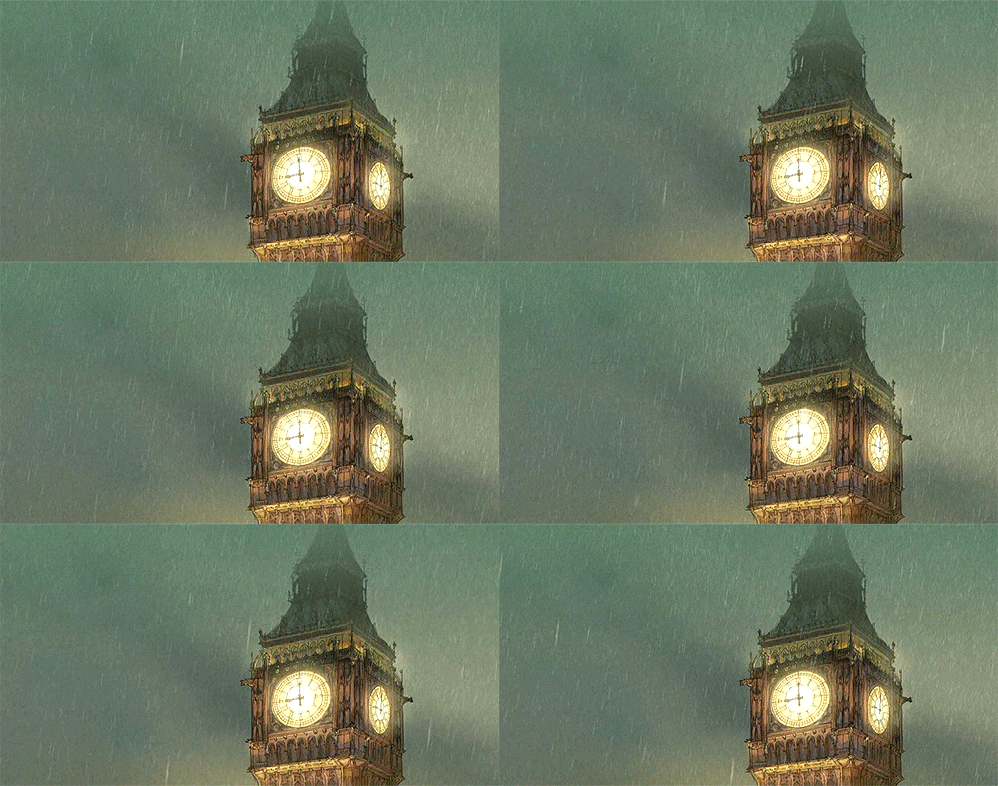
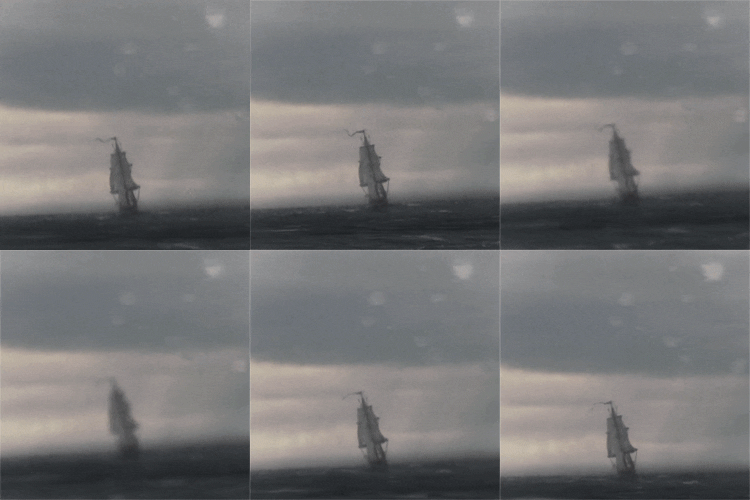
The thing itself is one; the images are many. What leads to a perceptive understanding of the thing is not the focus on one image, but the viewing of many images together. 

Rudolf Steiner

12 December 2021

Thank.

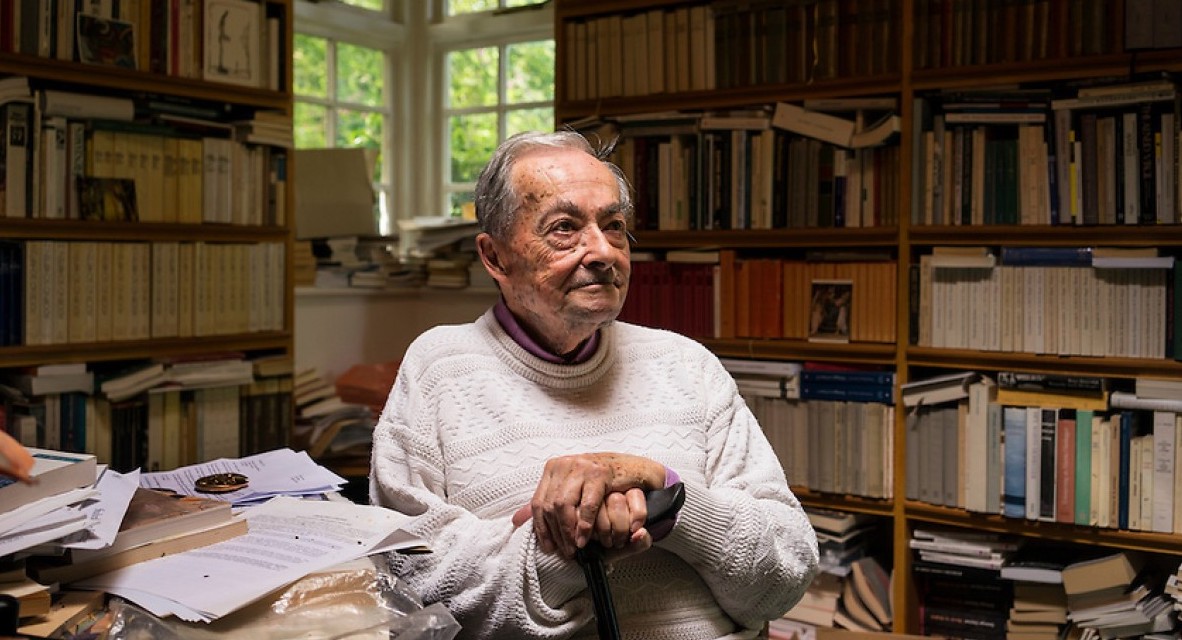
From George Steiner's lecture, Universitas? ...  
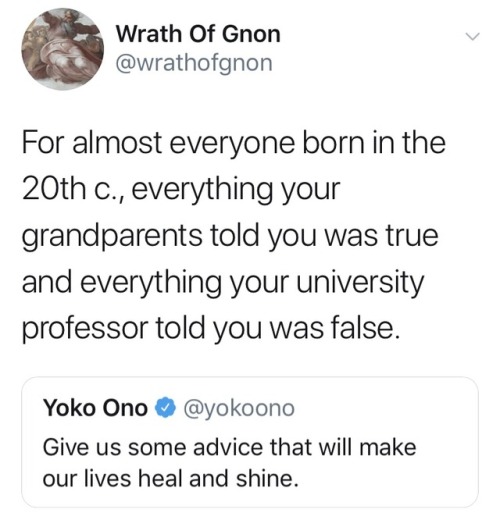
What is a true university? It’s libraries; it is a custodian, and engagement with the living past. It strives to advance knowledge and clarify critically the processes of thought. A true university serves neither political purpose nor social programs, necessarily partisan and transitory. Above all, it rebukes censorship and correctness of any kind. What we have done through political correctness. The lies we are teaching, or having to accept. The questions we are not allowed to ask. Not even to ask. No question of answering. Political correctness makes impossible great fields of comparative study. 

A university should house and it should honor anarchic provocation and the passion of uselessness. What is the most wonderful passion in the world? Uselessness. If someone comes to me and says, “I’m going to give my life to the study of Tang Dynasty bronzes,” I say, “You’re a very lucky person. You’re going to be a very happy and hungry person, but you lead a blessed life.” The notion that the useless is the highest form of human activity.

First and foremost we must insist on recapturing some of the ground the humanities have yielded to the sciences. Is a 21st century-educated man or woman literate when in total ignorance of elementary mathematics, of the concept of numeracy, which organize and determine the world around us? When she or he cannot grasp such a notion as a mean average, an irrational? Notions instrumental to our socioeconomic existence, indispensible to current debates on genetic modification, euthanasia, and law. The frequent assignment to the least gifted, to the most disillusioned, of the teaching of mathematics in our schools is a suicidal scandal. How does it go in the university of Newton, and Crick? If you get a first in mathematics, you can go on to research. If you get a good second, you will enter hedge funds and banking, which are very sophisticated in their mathematics. If you are a third—the worst—you will go teach mathematics. [audience laughs] You realize, the self-fulfilling lunacy of such a system. Overnight, Stalin decided that schoolteachers of mathematics would be paid as much as university professors, and honored throughout society. And he brought on the great revolution in Soviet and then in Russian mathematical literacy. It can be done. It can be done, it’s not impossible.

It is never too late. A core curriculum should, I’m persuaded, contain—and now I hope you will bear with me. This is my one very practical reform. At the center of our curriculum should be architecture. Why? It draws on mathematics—very richly, of course; geology; what I call in English the material sciences: steel, iron, wood. It draws on environmental politics at every level. It embodies ancestry and futurity. In architecture the notorious gap between the two cultures is wholly abolished. Archimedes joins Michelangelo. Together they teach us, and the technical phrase is so beautiful, “how to read a building.” How to read a building, that is the phrase they teach you. There is no aspect of law, sociology, environmental economics, but also urban politics, which architecture does not involve in our daily lives. How to read. How to read a building. How to read? Which is the center of my remarks this morning. 

We are learning to read together. No secondary text, please. No criticism. No comments on comments on comments. Complete loss of truth. You learn to read together. And what do you do at the end—and this is the end of my too-long remarks this morning. The closing or rather opening motion is that of memorization. We learn by heart, par cœur. Not by brain. We learn by heart. The poem or piece of relevant prose to memorize is to thank for what the text has given us. It’s the only effective way of saying merci, thank you, danke. For the inexhaustible liberality of meaning, for the miracle of sense. What we know by heart cannot be taken from us. Never forget that.
"Science and the Humanities" ...


"The Humanities Don't Humanize" ...


"How to Reform the Humanities" ...

Heart


A canon is a guarded catalogue of that speech, music and art which houses inside us, which is irrevocably familiar to our homecomings. And this will include, if honestly arrived at and declared (even if solely to oneself), all manner of ephemera, trivial, and possibly mendacious matter.  No man or woman need justify his personal anthology, his canonic welcomes. Love does not argue its necessities.  The most important tribute any human being can pay to a poem or a piece of prose he or she really loves is to learn it by heart. Not by brain, by heart.  What you know by heart, the bastards cannot touch; they cannot take it from you. 

George Steiner

15 July 2019

Circumstance.


Whoever seeks higher knowledge must create it for himself. He must instill it into his soul. It cannot be done by study; it can only be done through life. Whoever, therefore, wishes to become a student of higher knowledge must assiduously cultivate this inner life of devotion. Everywhere in his environment and his experiences he must seek motives of admiration and homage. If I meet a man and blame him for his shortcomings, I rob myself of power to attain higher knowledge; but if I try to enter lovingly into his merits, I gather such power. The student must continually be intent upon following this advice. The spiritually experienced know how much they owe to the circumstance that in face of all things they ever again turn to the good, and withhold adverse judgement. But this must not remain an external rule of life; rather it must take possession of our innermost soul.

Rudolf Steiner

29 December 2017

Higher.


The task of understanding is not to replicate in conceptual form something that already exists, but rather to create a wholly new realm, that together with the world given to our senses constitutes the fullness of reality. If we do not believe within ourselves this deeply rooted feeling that there is something higher than ourselves, we shall never find the strength to evolve into something higher.  The higher worlds are around us. These worlds are not only heavenly worlds, not only worlds of happiness, though paradise and happiness are in them, but they are also worlds that could be terrible for the people, by dangerous facts and creatures.  If man wants to obtain knowledge of the greatness and happiness of these worlds, then is nothing else possible than that he also will be introduced to the dangerous, with the fearfulness that they contain. One is not possible without the other.

Rudolf Steiner

02 August 2017

Hitherto.


Where is the book in which the teacher can read about what teaching is? The children themselves are this book. We should not learn to teach out of any book other than the one lying open before us and consisting of the children themselves.

Whoever seeks higher knowledge must create it for himself. He must instill it into his soul. It cannot be done by study; it can only be done through life. Whoever, therefore, wishes to become a student of higher knowledge must assiduously cultivate this inner life of devotion. Everywhere in his environment and his experiences he must seek motives of admiration and homage. If I meet a man and blame him for his shortcomings, I rob myself of power to attain higher knowledge; but if I try to enter lovingly into his merits, I gather such power. The student must continually be intent upon following this advice. The spiritually experienced know how much they owe to the circumstance that in face of all things they ever again turn to the good, and withhold adverse judgement. But this must not remain an external rule of life; rather it must take possession of our innermost soul.

All knowledge pursued merely for the enrichment of personal learning and the accumulation of personal treasure leads you away from the path; but all knowledge pursued for growth to ripeness within the process of human ennoblement and cosmic development brings you a step forward.

The tranquility of the moments set apart will also affect everyday existence. In his whole being he will grow calmer; he will attain firm assurance in all his actions, and cease to be put out of countenance by all manner of incidents. By thus advancing he will gradually become more and more his own guide, and allow himself less and less to be led by circumstances and external influences. He will soon discover how great a source of strength is available to him in these moments thus set apart. He will begin no longer to get angry at things which formerly annoyed him; countless things he formerly feared cease to alarm him. He acquires a new outlook on life.

When we have come so far on our soul's pilgrimage that we carry within ourselves as a memory all that we call "ourself," namely, our own being in physical life, and experience ourselves instead in another, newly-won superior ego, then we become capable of seeing our life stretching beyond the limits of earthly life. Before our spiritual sight appears the fact that we have shared in another life, in the spiritual world, prior to our present existence in the world of the senses; and in that spiritual life are to be found the real causes of the shaping of our physical existence. We become acquainted with the fact that before we received a physical body and entered upon this physical existence we lived a purely spiritual life. We see that that human being which we now are, with its faculties and inclinations, was prepared during a life that we spent in a purely spiritual world before birth. We look upon ourselves as upon beings who lived spiritually before their entrance into the world of the senses, and who are now striving to live as physical beings with those faculties and psychic characteristics which were originally attached to them and which have developed since their birth. It would be a mistake to say: "How is it possible that in spiritual life I should have aspired to possess faculties and inclinations, which now, when I have got them, do not please me at all?" It does not matter whether something pleases the soul in the world of senses or not. That is not the point. The soul has quite different points of view for its aspirations in the spiritual world from those which it adopts in the life of the senses. The character of knowledge and will is quite different in the two worlds. In the spiritual life we know that for the sake of our total evolution we need a certain kind of life in the physical world, which when we get there may seem unsympathetic or depressing to the soul; and yet we strive for it, because in the spiritual existence we do not prefer what is sympathetic and agreeable, but what is necessary to the right development of our individual being.

It cannot be repeated too often that this transformation does not alienate him from the world. He will in no way be estranged from his daily tasks and duties, for he comes to realize that the most insignificant action he has to accomplish, the most insignificant experience which offers itself to him, stands in connection with cosmic beings and cosmic events. When once this connection is revealed to him in his moments of contemplation, he comes to his daily activities with a new, fuller power. For now he knows that his labor and his suffering are given and endured for the sake of a great, spiritual, cosmic whole. Not weariness, but strength to live springs from meditation.

Above all, it is imperative to extirpate the idea that any fantastic, mysterious practices are required for the attainment of higher knowledge. It must be clearly realized that a start has to be made with the thoughts and feelings with which we continually live, and that these feelings and thoughts must merely be given a new direction. Everyone must say to himself: “In my own world of thought and feeling the deepest mysteries lie hidden, only hitherto I have been unable to perceive them.”

Rudolf Steiner

20 June 2015

Opened.


Just as in the body, eye and ear develop as organs of perception, as senses for bodily processes, so does a man develop in himself soul and spiritual organs of perception through which the soul and spiritual worlds are opened to him. For those who do not have such higher senses, these worlds are dark and silent, just as the bodily world is dark and silent for a being without eyes and ears.

Rudolf Steiner