"I am not one who was born in the custody of wisdom. I am one who is fond of olden times and intense in quest of the sacred knowing of the ancients." Gustave Courbet
Showing posts with label Keller. Show all posts

25 September 2026

Record.

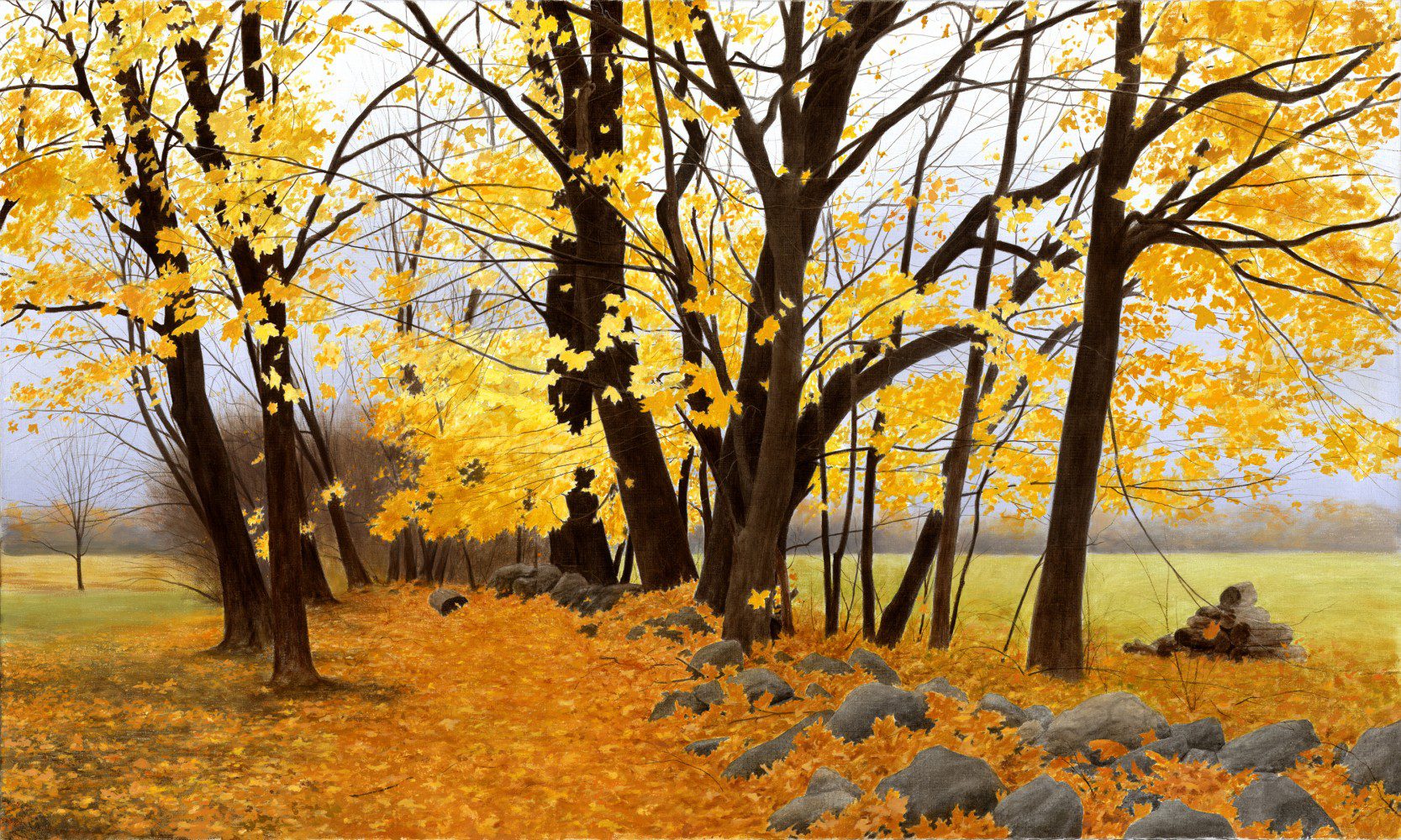
Volkov, The Old Divide, n/d


SONG of the STONE WALL

Come walk with me, and I will tell
What I have read in this scroll of stone;
I will spell out this writing on hill and meadow.
This is New England's entablature of rock,
Leagues upon leagues of sealed history awaiting an interpreter.
It is a chronicle wrought by praying workmen,
The forefathers of our nation.
The walls have many things to tell me,
And the days are long. I come and listen;
My hand is upon the stones, and the tale I fain would hear
Is of the men who built the walls,
And of the God who made the stones and the workers.

With searching feet I walk beside the wall;
I plunge and stumble over the fallen stones;
I follow the windings of the wall
Over the heaving hill, down by the meadow-brook,
Beyond the scented fields, by the marsh where rushes grow.
On I trudge through pine woods fragrant and cool,
And emerge amid clustered pools and by rolling acres of rye.

The wall is built of field stones great and small,
Tumbled about by frost and storm,
Shaped and polished by ice and rain and sun;
Some flattened, grooved, and chiseled
By the inscrutable sculpture of the weather;
Some with clefts and rough edges harsh to the touch.
Gracious Time has glorified the wall
And covered the historian stones with a mantle of green;
The sunbeams flit and waver in the rifts,
Vanish and reappear, linger and sleep,
Conquer with radiance the obdurate angles,
Filter between the naked rents and wind-bleached jags.

I understand the triumph and the truth
Wrought into these walls of rugged stone.
They are a miracle of patient hands,
They are a victory of suffering, a paean of pain.
All pangs of death, all cries of birth,
Are in the mute, moss-covered stones;
They are eloquent to my hands.
O beautiful, blind stones, inarticulate and dumb!
In the deep gloom of their hearts there is a gleam
Of the primeval sun which looked upon them
When they were begotten.
So in the heart of man shines forever
A beam from the everlasting sun of God.
Unresponsive, rude are the stones;
Yet in them divine things lie concealed.
I hear their imprisoned chant:

"We are fragments of the universe,
Chips of the rock whereon God laid the foundation of the world;
Out of immemorial chaos He wrought us.
Out of the sun, out of the tempest, out of the travail of the earth, we grew.
We are wonderfully mingled of life and death;
We serve as crypts for innumerable, unnoticed, tiny forms.
We are manifestations of the Might
That rears the granite hills unto the clouds
And sows the tropic seas with coral isles.
We are shot through and through with hidden color;
A thousand hues are blended in our gray substance.
Sapphire, turquoise, ruby, opal,
Emerald, diamond, amethyst, are our sisters from the beginning;
And our brothers are iron, lead, zinc,
Copper, and silver, and gold.
We are the dust of continents past and to come,
We are a deathless frieze carved with man's destiny;
In us is the record sibylline of far events.

Helen Keller, from "Song of the Stone Wall"

04 December 2024

Attention.


Kurt has been on top of the news related to artificial intelligence (AI), the latest being the incessant tug-of-war between efficiency and drudgery.

Some keys from the article ...
  • Overall, AI will make working easier, but it won’t make one happy. In the future, people will be slaves to AI, and no longer be owners of any work.
  • I plan to use AI to build a more efficient and effective educational environment in which both teachers and students thrive. (blah, blah, blah
  • The future belongs not to those who can generate content but to those who can skillfully use it.
  • When joined with human talent, AI boosts productivity, enables workers to focus on high-value tasks, and strengthens adaptability within businesses. This strategic pairing drives innovation and fosters sustainable growth. The choice is clear: AI must empower, not replace.
Excellence in any craft is partially derived from transforming drudgery into an individual expression (think the creativity in the grotesques found in ancient cathedrals and castles).  Offering attitudes, skills, and performances that are indispensable in the workplace requires years of maturation, but make no mistake, this is is what makes not only a career, but life and learning, worthwhile.  Socrates said it.  Van Gogh said it. Rilke said it. The authenticity of human expression that is compromised through artificial shortcuts isn't sustainable unless the hivemind that feeds it becomes its host.  This is where AI becomes like a gateway drug to kids.  Without an appreciation for the grand and glorious gifts of failure, they see no process (see YouTube DIY clips), just the relative ease of success, and the tool becomes a tragic hamster wheel.  On nearly a daily basis, I'm rejuvenated by the skepticism I see kids showing toward AI.  They clearly understand and resent it's hallmark delusiveness.

Twenty five years ago, I read an essay by French Laundry owner and Executive Chef, Thomas Keller about the nobility inherent in what some may call "drudgery"...
PLEASURE and PERFECTION

When you acknowledge, as you must, that there is no such thing as perfect food, only the idea of it, the real purpose of striving toward perfection becomes clear: to make people happy. That’s what cooking is all about.

But to give pleasure, you have to take pleasure yourself. For me, it’s the satisfaction of cooking every day: tourneing a carrot, or cutting salmon, or portioning foie gras – the mechanical jobs I do daily, year after year. This is the great challenge: to maintain passion for the everyday routine and the endlessly repeated act, to derive deep satisfaction from the mundane.

Say, for instance, you intend to make a barigoule, a stew of artichoke hearts, braised with carrots and onions, fresh herbs, oil and wine. You may look at your artichokes and think, “Look at all those artichokes I’ve got to cut and clean.” But turning them – pulling off the leaves, trimming their stems, scooping out the chokes, pulling your knife around its edge – that is cooking. It is one of my favorite things to do.

Another source of pleasure in cooking is respect for the food. To undercook a lobster and serve it to a customer, and have him send it back, is not only a waste of the lobster and all those involved in its life, it’s a waste of the potential of pleasing that customer. Respect for food is a respect for life, for who we are and what we do. 

When you’ve pulled your pot from the oven to regard your braise, to really see it, to smell it, you’ve connected yourself to generations and generations of people who have done the same thing for hundreds of years, in exactly the same way. Cooking is not about convenience and it’s not about shortcuts. Cooking is about wanting to take time to do something that is priceless. Our hunger for the twenty-minute gourmet meal, for one-pot ease and pre-washed, pre-cut ingredients has severed our lifeline to the satisfactions of cooking. Take your time. Take a long time. Move slowly and deliberately and with great attention.

A recipe has no soul. You, as the cook, must bring soul to the recipe. I can tell you the mechanics – how to make a custard, for instance. But you won’t have a perfect one if you merely follow my instructions. If you don’t feel it, it’s not a perfect custard, no matter how well you’ve executed the mechanics. On the other hand, if it’s not literally a perfect custard, but you have not maintained a great feeling for it, then you’ve created a recipe perfectly because there was no passion behind what you did.

The "recipe" is AI, which has no soul.  Marvelous opportunities lie ahead if we keep our soul intact. 

What will happen to us when, finally, we have no more problems to solve, when we are "free" from stress and drudgery? 
23 October 2021

Soul.


PLEASURE and PERFECTION

When you acknowledge, as you must, that there is no such thing as perfect food, only the idea of it, the real purpose of striving toward perfection becomes clear: to make people happy. That’s what cooking is all about.

But to give pleasure, you have to take pleasure yourself. For me, it’s the satisfaction of cooking every day: tourneing a carrot, or cutting salmon, or portioning foie gras – the mechanical jobs I do daily, year after year. This is the great challenge: to maintain passion for the everyday routine and the endlessly repeated act, to derive deep satisfaction from the mundane.

Say, for instance, you intend to make a barigoule, a stew of artichoke hearts, braised with carrots and onions, fresh herbs, oil and wine. You may look at your artichokes and think, “Look at all those artichokes I’ve got to cut and clean.” But turning them – pulling off the leaves, trimming their stems, scooping out the chokes, pulling your knife around its edge – that is cooking. It is one of my favorite things to do.

Another source of pleasure in cooking is respect for the food. To undercook a lobster and serve it to a customer, and have him send it back, is not only a waste of the lobster and all those involved in its life, it’s a waste of the potential of pleasing that customer. Respect for food is a respect for life, for who we are and what we do. 

When you’ve pulled your pot from the oven to regard your braise, to really see it, to smell it, you’ve connected yourself to generations and generations of people who have done the same thing for hundreds of years, in exactly the same way. Cooking is not about convenience and it’s not about shortcuts. Cooking is about wanting to take time to do something that is priceless. Our hunger for the twenty-minute gourmet meal, for one-pot ease and pre-washed, pre-cut ingredients has severed our lifeline to the satisfactions of cooking. Take your time. Take a long time. Move slowly and deliberately and with great attention.

A recipe has no soul. You, as the cook, must bring soul to the recipe. I can tell you the mechanics – how to make a custard, for instance. But you won’t have a perfect one if you merely follow my instructions. If you don’t feel it, it’s not a perfect custard, no matter how well you’ve executed the mechanics. On the other hand, if it’s not literally a perfect custard, but you have not maintained a great feeling for it, then you’ve created a recipe perfectly because there was no passion behind what you did.

Thomas Keller
Executive Chef
The French Laundry

10 June 2019

Attention.


PLEASURE and PERFECTION

When you acknowledge, as you must, that there is no such thing as perfect food, only the idea of it, the real purpose of striving toward perfection becomes clear: to make people happy. That’s what cooking is all about.

But to give pleasure, you have to take pleasure yourself. For me, it’s the satisfaction of cooking every day: tourneing a carrot, or cutting salmon, or portioning foie gras – the mechanical jobs I do daily, year after year. This is the great challenge: to maintain passion for the everyday routine and the endlessly repeated act, to derive deep satisfaction from the mundane.

Say, for instance, you intend to make a barigoule, a stew of artichoke hearts, braised with carrots and onions, fresh herbs, oil and wine. You may look at your artichokes and think, “Look at all those artichokes I’ve got to cut and clean.” But turning them – pulling off the leaves, trimming their stems, scooping out the chokes, pulling your knife around its edge – that is cooking. It is one of my favorite things to do.

Another source of pleasure in cooking is respect for the food. To undercook a lobster and serve it to a customer, and have him send it back, is not only a waste of the lobster and all those involved in its life, it’s a waste of the potential of pleasing that customer. Respect for food is a respect for life, for who we are and what we do. 

When you’ve pulled your pot from the oven to regard your braise, to really see it, to smell it, you’ve connected yourself to generations and generations of people who have done the same thing for hundreds of years, in exactly the same way. Cooking is not about convenience and it’s not about shortcuts. Cooking is about wanting to take time to do something that is priceless. Our hunger for the twenty-minute gourmet meal, for one-pot ease and pre-washed, pre-cut ingredients has severed our lifeline to the satisfactions of cooking. Take your time. Take a long time. Move slowly and deliberately and with great attention.

A recipe has no soul. You, as the cook, must bring soul to the recipe. I can tell you the mechanics – how to make a custard, for instance. But you won’t have a perfect one if you merely follow my instructions. If you don’t feel it, it’s not a perfect custard, no matter how well you’ve executed the mechanics. On the other hand, if it’s not literally a perfect custard, but you have not maintained a great feeling for it, then you’ve created a recipe perfectly because there was no passion behind what you did.

Thomas Keller
Executive Chef
The French Laundry

20 March 2016

Experience.


Character cannot be developed in ease and quiet. Only through experience of trial and suffering can the soul be strengthened, vision cleared, ambition inspired, and success achieved.

Helen Keller