"I am not one who was born in the custody of wisdom. I am one who is fond of olden times and intense in quest of the sacred knowing of the ancients." Gustave Courbet
Showing posts with label Independence Day. Show all posts

01 July 2026

Deeds.


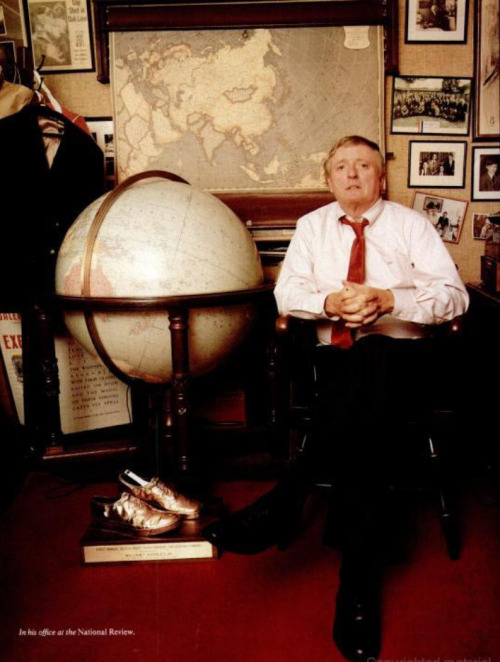
To fail to experience gratitude when walking through the corridors of the Metropolitan Museum, when listening to the music of Bach or Beethoven, when exercising our freedom to speak, or to give, or withhold, our assent, is to fail to recognize how much we have received from the great wellsprings of human talent and concern that gave us Shakespeare, Abraham Lincoln, Mark Twain, our parents, our friends. We need a rebirth of gratitude for those who have cared for us, living and, mostly, dead. The high moments of our way of life are their gifts to us. We must remember them in our thoughts and in our prayers; and in our deeds.

William F. Buckley, from Gratitude

Universal.


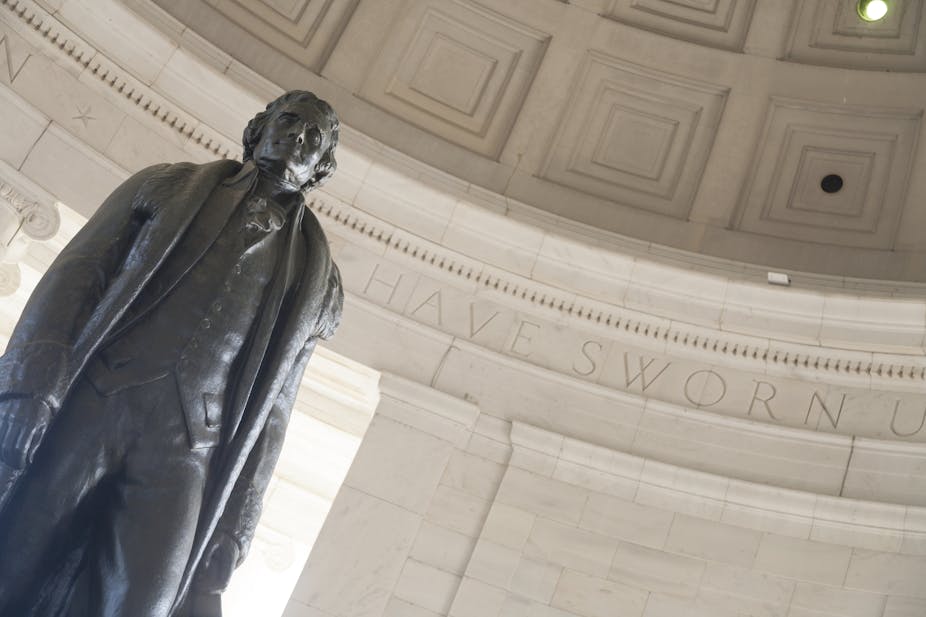
Without Thomas Jefferson and his Declaration of Independence, there would have been no American revolution that announced universal principles of liberty. Without his participation by the side of the unforgettable Marquis de Lafayette, there would have been no French proclamation of The Rights of Man. Without his brilliant negotiation of the Louisiana treaty, there would be no United States of America. Without Thomas Jefferson and James Madison, there would have been no Virginia Statute on Religious Freedom, and no basis for the most precious clause of our most prized element of our imperishable Bill of Rights - the First Amendment to the United States Constitution.

Christopher Hitchens

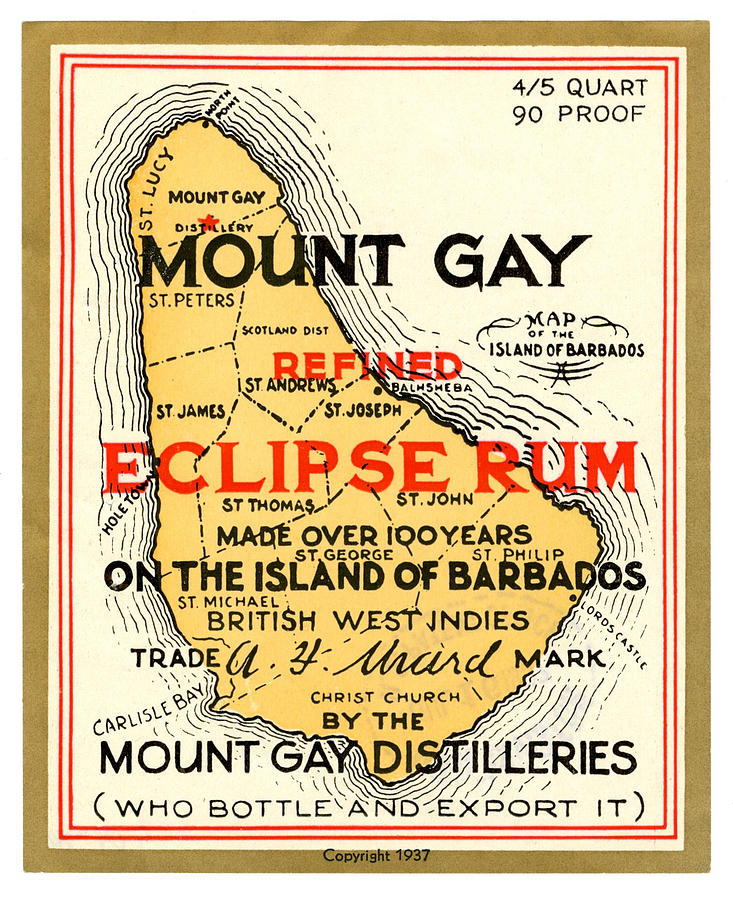
Eclipsed.


One hears talk of "millions" of Americans not celebrating Independence Day.  

Here's Charles C.W. Cooke on gratitude ...
That the Founders fought their war anyway was admirable. That the leading voices of their era had the presence of mind to hijack the American revolution and to codify a set of radical principles into a national charter was even more so. Indeed, we might today learn a great deal from a political culture that, per Burke, preferred to detect “ill principle” not by “actual grievance” but instead to “judge of the pressure of the grievance by the badness of the principle” and to “augur misgovernment at a distance; and snuff the approach of tyranny in every tainted breeze.” And yet our celebration of their fortitude is rendered as folly if we forget that, for all that the rebels went through, they were not facing down evil in its purest form.

That task would fall to other Americans — many of whom would pay a terrible price for their rebellions. Eventually, after a century-long struggle and a series of yo-yoing attempts, the twin horrors of slavery and segregation would indeed fall to posterity — but only after they had presented challenges that eclipsed those that were posed during the Revolution. The two eras are essentially incomparable. The crime of the British in America was to deny British conceptions of good government to a people who had become accustomed to it, and to do so capriciously. The crime of white supremacy in the South was, in the words of Ida B. Wells, to “cut off ears, toes, and fingers, strips off flesh, and distribute portions” of any person whom the majority disliked, and to do so in many cases as a matter of established public policy. When Paul Revere warned that “the regulars are coming,” he was alerting his neighbors against an invading force to which more than half the country felt it belonged; when a teenaged Rosa Parks conceded that she wanted to see her grandfather “kill a Ku-Kluxer,” she was fighting for her very survival.

For most of America’s story, an entire class of people was, as a matter of course, enslaved, beaten, lynched, subjected to the most egregious miscarriages of justice, and excluded either explicitly or practically from the body politic. We prefer today to reserve the word “tyranny” for its original target, King George III, or to apply it to foreign despots. But what other characterization can be reasonably applied to the governments that, ignoring the words of the Declaration of Independence, enacted and enforced the Fugitive Slave Act? How else can we see the men who crushed Reconstruction? How might we view the recalcitrant American South in the early 20th century? “It” did “happen here.”
Later, quoting President Lincoln..
But soberly, it is now no child’s play to save the principles of Jefferson from total overthrow in this nation.

One would start with great confidence that he could convince any sane child that the simpler propositions of Euclid are true; but, nevertheless, he would fail, utterly, with one who should deny the definitions and axioms. The principles of Jefferson are the definitions and axioms of free society.

And yet they are denied and evaded, with no small show of success.

One dashingly calls them “glittering generalities”; another bluntly calls them “self evident lies”; and still others insidiously argue that they apply only to “superior races.”

These expressions, differing in form, are identical in object and effect–the supplanting the principles of free government, and restoring those of classification, caste, and legitimacy. They would delight a convocation of crowned heads, plotting against the people. They are the vanguard–the miners, and sappers–of returning despotism.

We must repulse them, or they will subjugate us.

This is a world of compensations; and he who would be no slave, must consent to have no slave. Those who deny freedom to others, deserve it not for themselves; and, under a just God, can not long retain it.

All honor to Jefferson–to the man who, in the concrete pressure of a struggle for national independence by a single people, had the coolness, forecast, and capacity to introduce into a merely revolutionary document, an abstract truth, applicable to all men and all times, and so to embalm it there, that to-day, and in all coming days, it shall be a rebuke and a stumbling-block to the very harbingers of re-appearing tyranny and oppression.

See also

29 June 2026

Pomp.

Copley, John Adams, 1783


John Adams had the right idea ...
It ought to be commemorated, as the Day of Deliverance by solemn Acts of Devotion to God Almighty. It ought to be solemnized with Pomp and Parade, with Shews, Games, Sports, Guns, Bells, Bonfires and Illuminations from one End of this Continent to the other from this Time forward forever more.

There's not much chance that Adams could've expected our freedom to reach such heights as BÖC covering MC5 (Abigail might have), but he did ask for pomp, so Independence Week starts here and now as we, for the 250th time, "kick out the jams, brothers and sisters" ... 


The British blew a thirteen-colony lead.

08 February 2026

04 July 2025

Constantly.

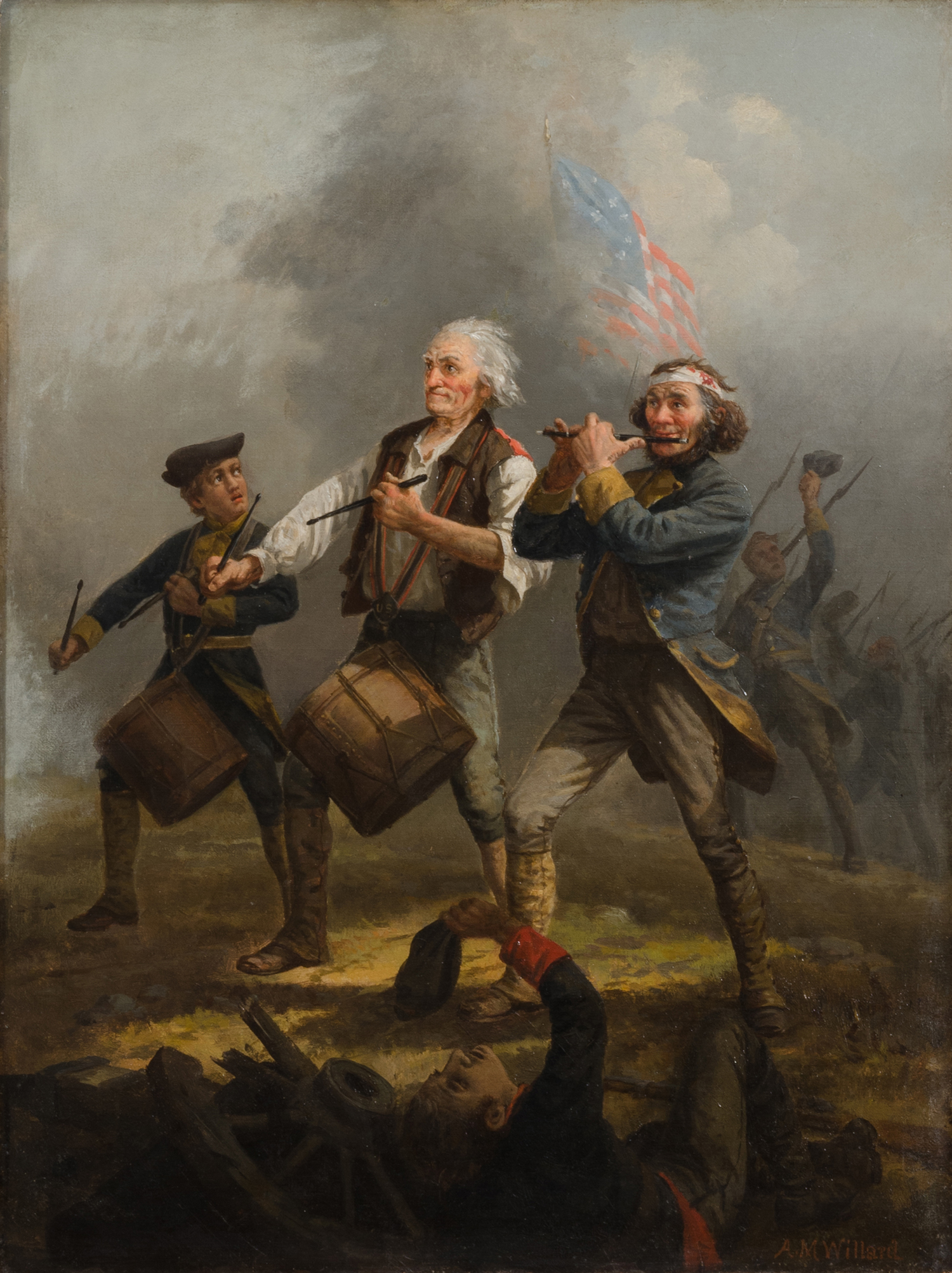
Willard, Yankee Doodle, 1876


It did not really matter what we expected from life, but rather what life expected from us. We needed to stop asking about the meaning of life, and instead to think of ourselves as those who were being questioned by life—daily and hourly. Our answer must consist, not in talk and meditation, but in right action and in right conduct. Life ultimately means taking the responsibility to find the right answer to its problems and to fulfill the tasks which it constantly sets for each individual.

Viktor E. Frankl, from Man's Search for Meaning

Sign.

Trumbull, Signing the Declaration of Independence, 1818


An Independence Day classic from Mr. Wade ...
The document is on the table. Although some of your colleagues are making jokes, each one knows that the signature places the signer's head in a hangman's noose. To sign means you will be regarded as a traitor by the nation that has held your loyalty since birth. Your livelihood may be destroyed and your family doomed to a life of isolation and poverty. Many of your friends and associates will be under suspicion. Others will shun you. Your side, which has feeble and poorly-trained forces, will be fighting the greatest military power in the world. Despite all of the grand talk, the odds of success are small. Even if your side is successful, your new nation will be vulnerable to internal disputes and attacks from predatory powers. This theory of self-government, however attractive, might not work. It's your turn. Will you sign? 

Unalienable.


On this day in 1776, the Continental Congress adopted the Declaration of Independence.
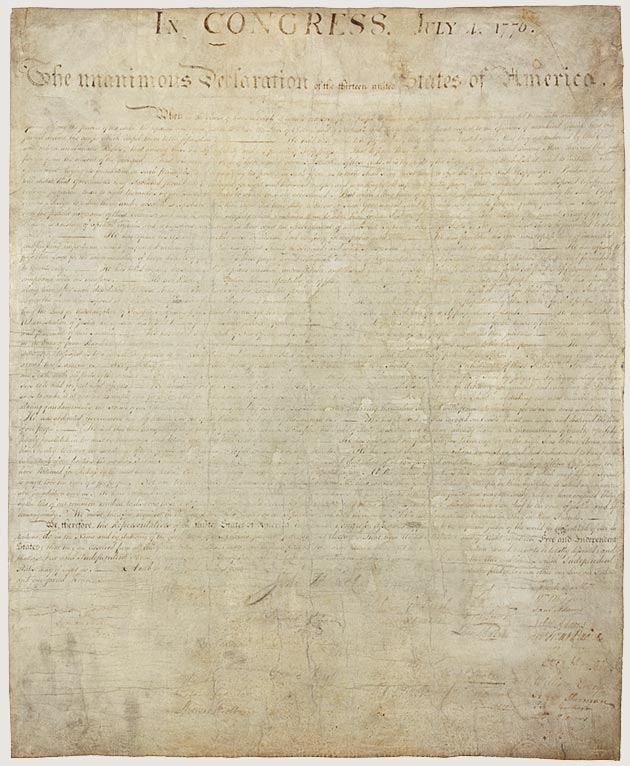
We hold these truths to be self-evident, that all men are created equal, that they are endowed by their Creator with certain unalienable Rights, that among these are Life, Liberty and the pursuit of Happiness.--That to secure these rights, Governments are instituted among Men, deriving their just powers from the consent of the governed, --That whenever any Form of Government becomes destructive of these ends, it is the Right of the People to alter or to abolish it, and to institute new Government, laying its foundation on such principles and organizing its powers in such form, as to them shall seem most likely to effect their Safety and Happiness. Prudence, indeed, will dictate that Governments long established should not be changed for light and transient causes; and accordingly all experience hath shewn, that mankind are more disposed to suffer, while evils are sufferable, than to right themselves by abolishing the forms to which they are accustomed. But when a long train of abuses and usurpations, pursuing invariably the same Object evinces a design to reduce them under absolute Despotism, it is their right, it is their duty, to throw off such Government, and to provide new Guards for their future security.

25 June 2025

Forever.


In a letter to his wife, Abigail, John Adams laid out enthusiastic plans for future celebrations of the Independence he helped secure ...
It ought to be commemorated, as the Day of Deliverance by solemn Acts of Devotion to God Almighty. It ought to be solemnized with Pomp and Parade, with Shews, Games, Sports, Guns, Bells, Bonfires and Illuminations from one End of this Continent to the other from this Time forward forever more.
The city fathers of New Albany, Ohio think they know better. 

Gird yourself for today's abomination ...
The City of New Albany is proud to introduce an Inclusivity Zone at the end of this year’s Independence Day Parade route. Located near accessible parking, this area is designed to be more sensory-friendly so that all families can enjoy the parade. Parade participants are required to adjust their performances when passing through this zone by lowering volume, avoiding flashing lights or sudden noises, and not throwing items from floats. 

29 June 2024

Joy.

Willard, Yankee Doodle, 1876


We Celebrated Independence here [Richmond] to the day by eating an Excellent dinner at Anderson’s Tavern and drinking a number of proper toasts. We had the Band of Music, the discharge of Cannon, colors flying, &c. &c., manifesting our joy.

James Currie, from a letter to Thomas Jefferson, 9 July 1786

29 June 2023

Reminder.

Filleul, Portrait of Benjamin Franklin, 1779


They bark, "It's a free country!"

In preparation for The Independence Days, Kurt points to Franklin's reminder ...
[T]he people, on tasting the dish, are always disposed to eat more of it than does them good.

04 July 2022

Excellent.

 Flint's very own, an excellent hot dog ...

Hamtramck's essential excellence ...

American.

Pyle, Thomas Jefferson Writing the Declaration of Independence, 1898


From David McCullough's John Adams ... 
Alone in his upstairs parlor at Seventh and Market, Jefferson went to work, seated in an unusual revolving Windsor chair and holding on his lap a portable writing box, a small folding desk of his own design which, like the chair, he had especially made for him by a Philadelphia cabinetmaker. Traffic rattled by below the open windows. The June days and nights turned increasingly warm. He worked rapidly and, to judge by surviving drafts, with a sure command of his material. He had none of his books with him, nor needed any, he later claimed. It was not his objective to be original, he would explain, only “to place before mankind the common sense of the subject.” Unlike his friend and colleague, John Adams, Jefferson admitted that he was without the skill of oratory. His talents lie with the quill. What must have Jefferson experienced in that room? How imposing was the weight of the task, the responsibility? Or, was the struggle from within -- the writer’s worst enemy – himself. Adams wanted the 33 year old Virginian to write the document. What was his routine over those few weeks in Philadelphia? The foundation for not only the maturation of thirteen rag-tag colonies, but the inspiration for every independence movement since then, was laid in the courses of Jefferson's words and ideas. With his words Jefferson was committing treason, an act punishable by death. The stakes were higher than that and I believe that Jefferson understood that. Not just the 13 colonies ... but men ... all men. Jefferson stated, "Neither aiming at originality of principle or sentiment, nor yet copied from any particular and previous writing, it was intended to be an expression of the American mind, and to give to that expression the proper tone and spirit called for by the occasion." Unlike his friend and colleague, John Adams, Jefferson admitted that he was without the skill of oratory. His talents lie with the quill. His efforts produced a living document, capable of growth, flexibility, and ... change.
The Smithsonian shows us Mr. Jefferson's writing box ...
The desk wears its status lightly. Up close, you can’t help but notice a series of ink stains on the surface of the drawer. They are the careless, reassuring evidence of life. They mark the desk to this day with the daily humanity of the man who leaned on the writing box for half a century and supported on its sturdy wood the immense store of his mind.

 Three annotated texts of The Declaration of Independence are here.

Sign.

Trumbull, Signing the Declaration of Independence, 1818


An Independence Day classic from Mr. Wade ...
The document is on the table. Although some of your colleagues are making jokes, each one knows that the signature places the signer's head in a hangman's noose. To sign means you will be regarded as a traitor by the nation that has held your loyalty since birth. Your livelihood may be destroyed and your family doomed to a life of isolation and poverty. Many of your friends and associates will be under suspicion. Others will shun you. Your side, which has feeble and poorly-trained forces, will be fighting the greatest military power in the world. Despite all of the grand talk, the odds of success are small. Even if your side is successful, your new nation will be vulnerable to internal disputes and attacks from predatory powers. This theory of self-government, however attractive, might not work. It's your turn. Will you sign? 
 Thanks, Execupundit.

Truths.


In Congress, July 4, 1776.

The unanimous Declaration of the thirteen united States of America, When in the Course of human events, it becomes necessary for one people to dissolve the political bands which have connected them with another, and to assume among the powers of the earth, the separate and equal station to which the Laws of Nature and of Nature's God entitle them, a decent respect to the opinions of mankind requires that they should declare the causes which impel them to the separation.

We hold these truths to be self-evident, that all men are created equal, that they are endowed by their Creator with certain unalienable Rights, that among these are Life, Liberty and the pursuit of Happiness.--That to secure these rights, Governments are instituted among Men, deriving their just powers from the consent of the governed, --That whenever any Form of Government becomes destructive of these ends, it is the Right of the People to alter or to abolish it, and to institute new Government, laying its foundation on such principles and organizing its powers in such form, as to them shall seem most likely to effect their Safety and Happiness. Prudence, indeed, will dictate that Governments long established should not be changed for light and transient causes; and accordingly all experience hath shewn, that mankind are more disposed to suffer, while evils are sufferable, than to right themselves by abolishing the forms to which they are accustomed. But when a long train of abuses and usurpations, pursuing invariably the same Object evinces a design to reduce them under absolute Despotism, it is their right, it is their duty, to throw off such Government, and to provide new Guards for their future security.--Such has been the patient sufferance of these Colonies; and such is now the necessity which constrains them to alter their former Systems of Government. The history of the present King of Great Britain is a history of repeated injuries and usurpations, all having in direct object the establishment of an absolute Tyranny over these States. To prove this, let Facts be submitted to a candid world.

He has refused his Assent to Laws, the most wholesome and necessary for the public good.

He has forbidden his Governors to pass Laws of immediate and pressing importance, unless suspended in their operation till his Assent should be obtained; and when so suspended, he has utterly neglected to attend to them.

He has refused to pass other Laws for the accommodation of large districts of people, unless those people would relinquish the right of Representation in the Legislature, a right inestimable to them and formidable to tyrants only.

He has called together legislative bodies at places unusual, uncomfortable, and distant from the depository of their public Records, for the sole purpose of fatiguing them into compliance with his measures.

He has dissolved Representative Houses repeatedly, for opposing with manly firmness his invasions on the rights of the people.

He has refused for a long time, after such dissolutions, to cause others to be elected; whereby the Legislative powers, incapable of Annihilation, have returned to the People at large for their exercise; the State remaining in the mean time exposed to all the dangers of invasion from without, and convulsions within.

He has endeavoured to prevent the population of these States; for that purpose obstructing the Laws for Naturalization of Foreigners; refusing to pass others to encourage their migrations hither, and raising the conditions of new Appropriations of Lands.

He has obstructed the Administration of Justice, by refusing his Assent to Laws for establishing Judiciary powers.

He has made Judges dependent on his Will alone, for the tenure of their offices, and the amount and payment of their salaries.

He has erected a multitude of New Offices, and sent hither swarms of Officers to harrass our people, and eat out their substance.

He has kept among us, in times of peace, Standing Armies without the Consent of our legislatures.

He has affected to render the Military independent of and superior to the Civil power.

He has combined with others to subject us to a jurisdiction foreign to our constitution, and unacknowledged by our laws; giving his Assent to their Acts of pretended Legislation:

For Quartering large bodies of armed troops among us:

For protecting them, by a mock Trial, from punishment for any Murders which they should commit on the Inhabitants of these States:

For cutting off our Trade with all parts of the world:

For imposing Taxes on us without our Consent:

For depriving us in many cases, of the benefits of Trial by Jury:

For transporting us beyond Seas to be tried for pretended offences

For abolishing the free System of English Laws in a neighbouring Province, establishing therein an Arbitrary government, and enlarging its Boundaries so as to render it at once an example and fit instrument for introducing the same absolute rule into these Colonies:

For taking away our Charters, abolishing our most valuable Laws, and altering fundamentally the Forms of our Governments:

For suspending our own Legislatures, and declaring themselves invested with power to legislate for us in all cases whatsoever.

He has abdicated Government here, by declaring us out of his Protection and waging War against us.

He has plundered our seas, ravaged our Coasts, burnt our towns, and destroyed the lives of our people.

He is at this time transporting large Armies of foreign Mercenaries to compleat the works of death, desolation and tyranny, already begun with circumstances of Cruelty & perfidy scarcely paralleled in the most barbarous ages, and totally unworthy the Head of a civilized nation.

He has constrained our fellow Citizens taken Captive on the high Seas to bear Arms against their Country, to become the executioners of their friends and Brethren, or to fall themselves by their Hands.

He has excited domestic insurrections amongst us, and has endeavoured to bring on the inhabitants of our frontiers, the merciless Indian Savages, whose known rule of warfare, is an undistinguished destruction of all ages, sexes and conditions.

In every stage of these Oppressions We have Petitioned for Redress in the most humble terms: Our repeated Petitions have been answered only by repeated injury. A Prince whose character is thus marked by every act which may define a Tyrant, is unfit to be the ruler of a free people.

Nor have We been wanting in attentions to our Brittish brethren. We have warned them from time to time of attempts by their legislature to extend an unwarrantable jurisdiction over us. We have reminded them of the circumstances of our emigration and settlement here. We have appealed to their native justice and magnanimity, and we have conjured them by the ties of our common kindred to disavow these usurpations, which, would inevitably interrupt our connections and correspondence. They too have been deaf to the voice of justice and of consanguinity. We must, therefore, acquiesce in the necessity, which denounces our Separation, and hold them, as we hold the rest of mankind, Enemies in War, in Peace Friends.

We, therefore, the Representatives of the united States of America, in General Congress, Assembled, appealing to the Supreme Judge of the world for the rectitude of our intentions, do, in the Name, and by Authority of the good People of these Colonies, solemnly publish and declare, That these United Colonies are, and of Right ought to be Free and Independent States; that they are Absolved from all Allegiance to the British Crown, and that all political connection between them and the State of Great Britain, is and ought to be totally dissolved; and that as Free and Independent States, they have full Power to levy War, conclude Peace, contract Alliances, establish Commerce, and to do all other Acts and Things which Independent States may of right do. And for the support of this Declaration, with a firm reliance on the protection of divine Providence, we mutually pledge to each other our Lives, our Fortunes and our sacred Honor.

Button Gwinnett
Lyman Hall
George Walton
William Hooper
Joseph Hewes
John Penn
Edward Rutledge
Thomas Heyward, Jr.
Thomas Lynch, Jr.
Arthur Middleton
John Hancock
Samuel Chase
William Paca
Thomas Stone
Charles Carroll of Carrollton
George Wythe
Richard Henry Lee
Thomas Jefferson
Benjamin Harrison
Thomas Nelson, Jr.
Francis Lightfoot Lee
Carter Braxton
Robert Morris
Benjamin Rush
Benjamin Franklin
John Morton
George Clymer
James Smith
George Taylor
James Wilson
George Ross
Caesar Rodney
George Read
Thomas McKean
William Floyd
Philip Livingston
Francis Lewis
Lewis Morris
Richard Stockton
John Witherspoon
Francis Hopkinson
John Hart
Abraham Clark
Josiah Bartlett
William Whipple
Samuel Adams
John Adams
Robert Treat Paine
Elbridge Gerry
Stephen Hopkins
William Ellery
Roger Sherman
Samuel Huntington
William Williams
Oliver Wolcot
Matthew Thornton

04 July 2021

Sign.

Trumbull, Signing the Declaration of Independence, 1818


An Independence Day classic from Mr. Wade ...
The document is on the table. Although some of your colleagues are making jokes, each one knows that the signature places the signer's head in a hangman's noose. To sign means you will be regarded as a traitor by the nation that has held your loyalty since birth. Your livelihood may be destroyed and your family doomed to a life of isolation and poverty. Many of your friends and associates will be under suspicion. Others will shun you. Your side, which has feeble and poorly-trained forces, will be fighting the greatest military power in the world. Despite all of the grand talk, the odds of success are small. Even if your side is successful, your new nation will be vulnerable to internal disputes and attacks from predatory powers. This theory of self-government, however attractive, might not work. It's your turn. Will you sign? 
 Thanks, Execupundit.

03 July 2021

Refresh.

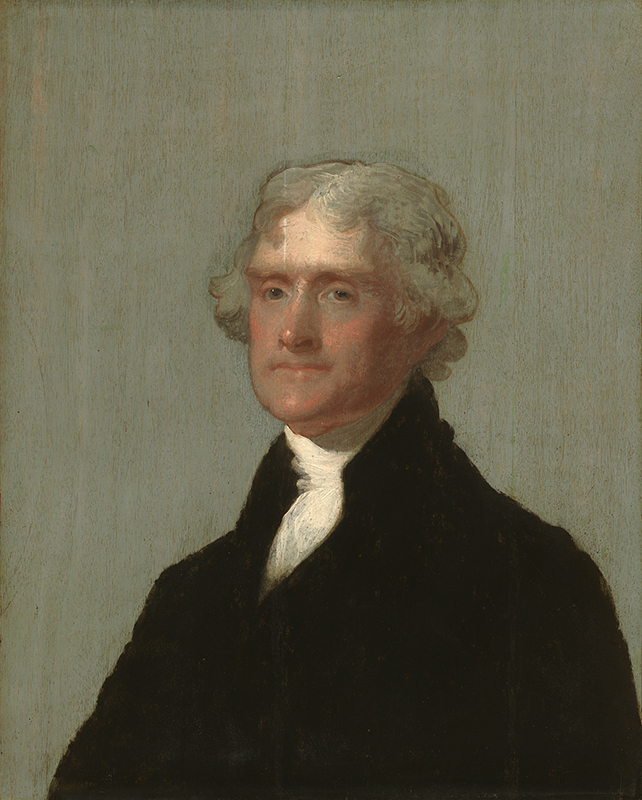
Stuart, Thomas Jefferson, 1805


June 24, 1826

Respected Sir:

The kind invitation I receive from you, on the part of the citizens of the city of Washington, to be present with them at their celebration on the fiftieth anniversary of American Independence, as one of the surviving signers of an instrument pregnant with our own, and the fate of the world, is most flattering to myself, and heightened by the honorable accompaniment proposed for the comfort of such a journey. It adds sensibly to the sufferings of sickness, to be deprived by it of a personal participation in the rejoicings of that day.  But acquiescence is a duty, under circumstances not placed among those we are permitted to control.

I should, indeed, with peculiar delight, have met and exchanged there congratulations personally with the small band, the remnant of that host of worthies, who joined with us on that day, in the bold and doubtful election we were to make for our country, between submission or the sword; and to have enjoyed with them the consolatory fact, that our fellow citizens, after half a century of experience and prosperity, continue to approve the choice we made. May it be to the world, what I believe it will be, (to some parts sooner, to others later, but finally to all,) the signal of arousing men to burst the chains under which monkish ignorance and superstition had persuaded them to bind themselves, and to assume the blessings and security of self-government.That form which we have substituted, restores the free right to the unbounded exercise of reason and freedom of opinion. All eyes are opened, or opening, to the rights of man. The general spread of the light of science has already laid open to every view the palpable truth, that the mass of mankind has not been born with saddles on their backs, nor a favored few booted and spurred, ready to ride them legitimately, by the grace of God. These are grounds of hope for others. For ourselves, let the annual return of this day forever refresh our recollections of these rights, and an undiminished devotion to them.

I will ask permission here to express the pleasure with which I should have met my ancient neighbors of the city of Washington and of its vicinities, with whom I passed so many years of a pleasing social intercourse; an intercourse which so much relieved the anxieties of the public cares, and left impressions so deeply engraved in my affections, as never to be forgotten. With my regret that ill health forbids me the gratification of an acceptance, be pleased to receive for yourself, and those for whom you write, the assurance of my highest respect and friendly attachments.

Thomas Jefferson, from a letter to Roger C. Weightman

02 July 2021

Independent.


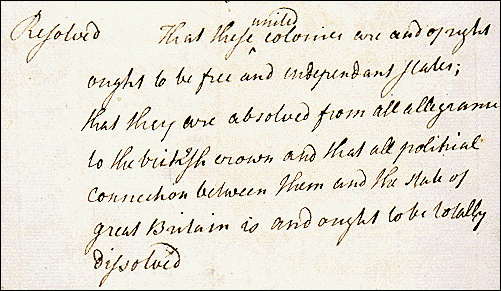
On this day in 1776, the Continental Congress passed the Lee Resolution, stating that "these United Colonies are, and of right, ought to be, Free and Independent States."

The Second Day of July 1776 will be the most memorable Epocha, in the History of America. It ought to be solemnized with Pomp and Parade, with Shews, Games, Sports, Guns, Bells, Bonfires, and Illuminations from one End of this Continent to the other from this Time forward forever more.

John Adams to Abigail Adams, July 3, 1776

CONNECT