"I am not one who was born in the custody of wisdom. I am one who is fond of olden times and intense in quest of the sacred knowing of the ancients." Gustave Courbet
Showing posts with label Church. Show all posts

16 May 2026

Notice.

Eric Church recently gave the commencement speech at the University of North Carolina ...
Six strings. Six strings of life and willingness to keep them in tune. Six principles. Six pillars. When all six are in tune with each other, the chord your life makes is full and resonant and true. All six will drift. Not one or two. All six in their own time, in their own season. 
Your faith will go quiet when you need it loud. Your family will get complicated in a way only the people who love you most can complicate things.  You will go through hard seasons with your spouse. Your ambition will hollow out and your resilience will wear thin.  Your community will start to feel like an obligation and your world will try to sand down the edges of exactly who you are. 
This is not failure. This is not weakness. It's the inevitable universal experience of living in an imperfect world that doesn't stop to let us tune up. And the difference between a life that sounds like music and a life that sounds like noise is whether you stop and listen. Whether you're honest enough to hear which string has drifted out of tune and humble enough to make the adjustment instead of just turning up the volume and hoping nobody notices, because you will notice. The part of you that knows what the chord should sound like will always notice.  It will not let you go. Life won't be right until it is tuned. Trust what your heart hears and is telling you about your song.

Thank you, Hayden. 

28 July 2024

Being.

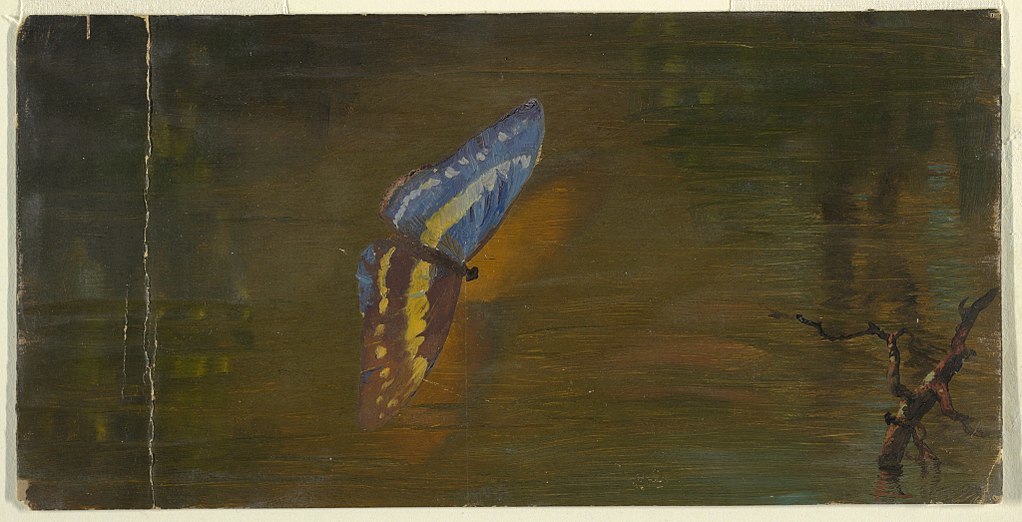
Church, Butterfly Over Water, 1865


Oludamini Ogunnaike on the magic of poetry ...

Good poetry feels like truth, true poetry sounds beautiful, beautiful poetry “tastes” good, and all decent poetry is perfumed by the scent of wonder and awe, making us see things anew. Poetry makes tangible and existentially realizable the union of the transcendentals of truth, beauty, and goodness; poetry allows us to experience the harmony of the very qualities of Being (and even sense the ineffable quality of no-qualities of Beyond Being) in ourselves and in every being. As Wallace Stevens concludes the “The Snow Man”: 
For the listener, who listens in the snow, 
And, nothing himself, beholds 
Nothing that is not there and the nothing that is.

05 April 2021

19 June 2016

Trust.

Church, Cloud Study, 1871


The fear of the inexplicable has not only impoverished the reality of the individual; it has also narrowed the relationship between one human being and another, which has as it were been lifted out of the riverbed of infinite possibilities and set down in a fallow place on the bank, where nothing happens. For it is not only indolence that causes human relationships to be repeated from case to case with such unspeakable monotony and boredom; it is timidity before any new, inconceivable experience, which we don't think we can deal with. But only someone who is ready for everything, who doesn't exclude any experience, even the most incomprehensible, will live the relationship with another person as something alive and will himself sound the depths of his own being. For if we imagine this being of the individual as a larger or smaller room, it is obvious that most people come to know only one corner of their room, one spot near the window, one narrow strip on which they keep walking back and forth. In this way they have a certain security. And yet how much more human is the dangerous in security that drives those prisoners in Poe's stories to feel out the shapes of their horrible dungeons and not be strangers to the unspeakable terror of their cells. We, however, are not prisoners. No traps or snares have been set around us, and there is nothing that should frighten or upset us. We have been put into life as into the element we most accord with, and we have, moreover, through thousands of years of adaptation, come to resemble this life so greatly that when we hold still, through a fortunate mimicry we can hardly be differentiated from everything around us. We have no reason to harbor any mistrust against our world, for it is not against us. If it has terrors, they are our terrors; if it has abysses, these abysses belong to us; if there are dangers, we must try to love them. And if only we arrange our life in accordance with the principle which tells us that we must always trust in the difficult, then what now appears to us as the most alien will become our most intimate and trusted experience. How could we forget those ancient myths that stand at the beginning of all races, the myths about dragons that at the last moment are transformed into princesses? Perhaps all the dragons in our lives are princesses who are only waiting to see us act, just once, with beauty and courage. Perhaps everything that frightens us is, in its deepest essence, something helpless that wants our love.

Rainer Maria Rilke