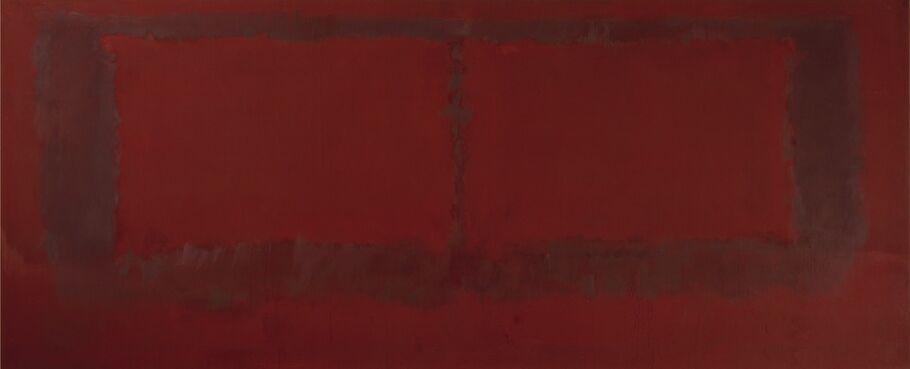
Abigail Cain looks at Rothko's Seagram murals ...
The numerous Seagram murals (he eventually made 30), are some of the first paintings in which he experimented with darker shades. This so-called “dark palette” is the focus of a current, unprecedented show at Pace Gallery, featuring works drenched in deep hues of black, blue, purple, and red, spanning 1955 through the 1960s. It’s a period of his artmaking that is often overlooked, according to Pace Gallery chairman and founder Arne Glimcher. This is the gallery’s 12th Rothko show, and the first to explore his dark palette in great depth.“Each show has been a kind of peeling of the onion, revealing other layers of the artist’s work,” Glimcher said. “It’s so easy to just think of Rothko as this kind of museum postcard image of a red picture, or of a red-and-yellow picture. But there’s this other side of Rothko, deep and voluptuous colors that reveal themselves very slowly.”Glimcher said there’s a misperception that these darker-hued works are “end-of-life” paintings that preceded Rothko’s suicide in 1970. But many of these works were created long before that date, as is the case with the Seagram murals. Additionally, Glimcher notes, for Rothko, bright colors could be as menacing as rust or burgundy.He recalls a moment at Rothko’s studio when he complimented a painting done in shades of burgundy, plum, and black. The painter responded that he’d offered the work to someone just that day and she’d refused, saying: “Mr. Rothko I’d like a happy painting. A red painting, an orange painting, a yellow painting. A happy painting.” Rothko’s retort? “Red, orange, yellow—isn’t that the color of an inferno?”Rothko took a break from the Seagram murals in June 1959 and traveled to Europe with his family. Upon his return to the United States, he went to eat at the completed Four Seasons with his wife, Mell. Jackson Pollock’s Blue Poles (1952) hung on the wall as a stand-in for Rothko’s soon-to-be-completed commission. For a man who once proclaimed it was “criminal to spend more than $5 on a meal,” it comes as no surprise that he found the experience off-putting. What is shocking was the level of his distaste. That night, he called a friend and informed them that he would be returning every cent of the commission and reclaiming his paintings. “Anybody who will eat that kind of food for those kind of prices will never look at a painting of mine,” he seethed to a studio assistant.






















































































No comments:
Post a Comment