Rembrandt, Monk Reading, 1661
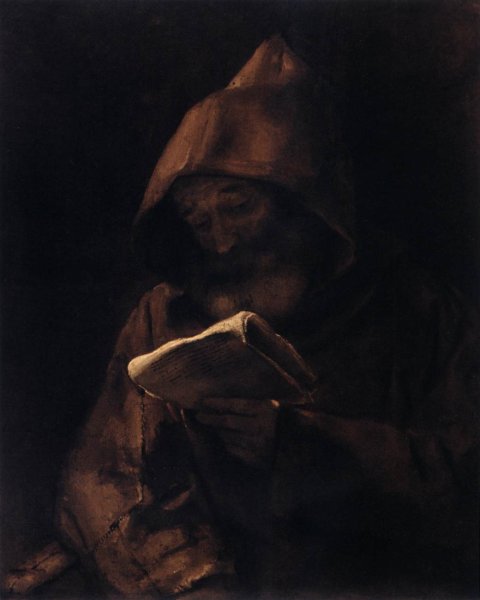
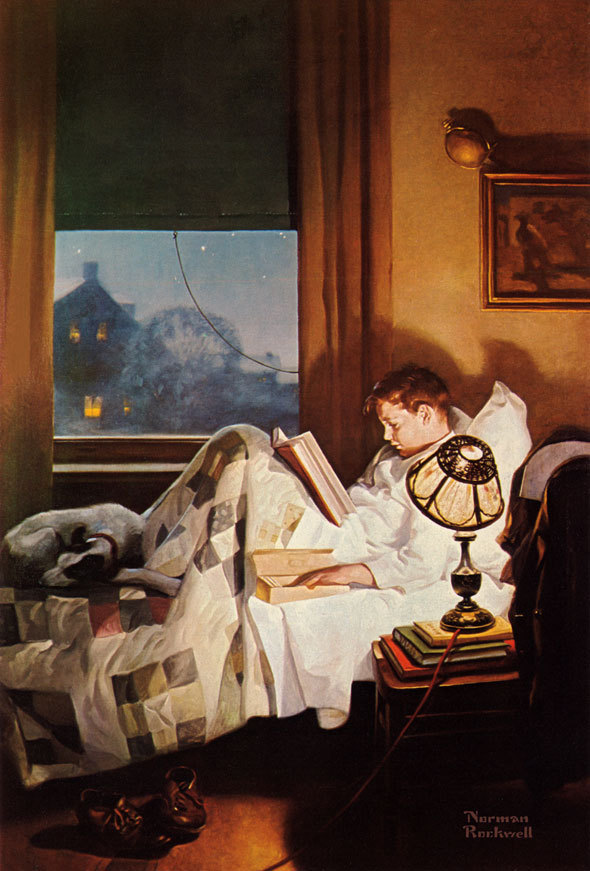
Reading is a means of listening.
Reading is not as passive as hearing or viewing. It’s an act: you do it. You read at your pace, your own speed, not the ceaseless, incoherent, gabbling, shouting rush of the media. You take in what you can and want to take in, not what they shove at you fast and hard and loud in order to overwhelm and control you. Reading a story, you may be told something, but you’re not being sold anything. And though you’re usually alone when you read, you are in communion with another mind. You aren’t being brainwashed or co-opted or used; you’ve joined in an act of the imagination.
I know no reason why our media could not create a similar community of the imagination, as theater has often done in societies of the past, but they’re mostly not doing it. They are so controlled by advertising and profiteering that the best people who work in them, the real artists, if they resist the pressure to sell out, get drowned out by the endless rush for novelty, by the greed of the entrepreneurs.
Much of literature remains free of such co-optation, in part because a lot of books were written by dead people, who by definition are not greedy. And many living poets and novelists, though their publishers may be crawling abjectly after bestsellers, continue to be motivated less by the desire for gain than by the wish to do what they’d probably do for nothing if they could afford it, that is, practice their art—make something well, get something right. Literature remains comparatively, and amazingly, honest and reliable.
Books may not be “books,” of course, they may not be ink on wood pulp but a flicker of electronics in the palm of a hand. Incoherent and commercialised and worm-eaten with porn and hype and blather as it is, electronic publication offers those who read a strong new means of active community. The technology is not what matters. Words are what matter. The sharing of words. The activation of imagination through the reading of words.
The reason literacy is important is that literature is the operating instructions. The best manual we have. The most useful guide to the country we’re visiting, life.
Ursula K. Le Guin, from “The Operating Instructions”



















































































No comments:
Post a Comment