Soon after their rise to power in 1933, the Nazis purged so-called "degenerate art" from German public institutions. Artworks deemed degenerate by the Nazis included modern French and German artists in the areas of cubism, expressionism, and impressionism. Approximately sixteen thousand pieces were removed, and by 1938 the Nazi Party declared that all German art museums were purified. State-sponsored exhibitions of this art followed the Nazi purges, clarifying to Germans which types of modern art were now unacceptable in the new German Reich. Soon after, an auction of 126 degenerate artworks took place in 1939 at the Fischer Gallerie in Lucerne, Switzerland, in order to increase revenues for the party. The auctioned paintings by modern masters, many previously purged from German public institutions, included works by van Gogh and Matisse.Hitler called for a new art, an art that portrayed the Volk and the Volksgemeinschaft (Volk community) as "a realization not of individual talents or of the inspiration of a lone genius, but of the collective expression of the Volk, channeled through the souls of individual creators."8 Hitler wanted new cultural and artistic creativity to arise in Germany, with the "folk-related" and "race-conscious" arts of Nazi culture replacing what he called the "Jewish decadence" of the Weimar Republic.9 According to the Nazis, acceptable and desirable art included Old Flemish and Dutch masters; medieval and Renaissance German artworks; Italian Renaissance and baroque pieces; eighteenth-century French artworks; and nineteenth-century German realist painters depicting the German Volk culture.
This week in The Hill ...
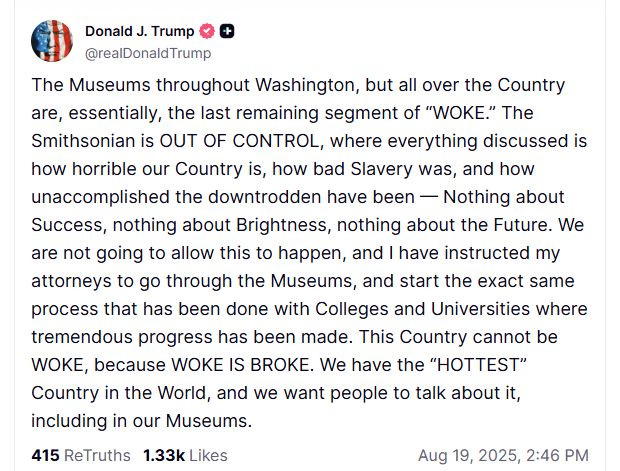
“The Smithsonian is OUT OF CONTROL, where everything discussed is how horrible our Country is, how bad Slavery was, and how unaccomplished the downtrodden have been — Nothing about Success, nothing about Brightness, nothing about the Future,” the president wrote Tuesday in a Truth Social post.
“We are not going to allow this to happen, and I have instructed my attorneys to go through the Museums, and start the exact same process that has been done with Colleges and Universities where tremendous progress has been made,” he added. “This Country cannot be WOKE, because WOKE IS BROKE.”
During his first term, Trump lauded the opening of the National Museum of African American History and Culture for its portrayal of harsh truths and storied victories for disenfranchised Black citizens.
Trump’s issue with the depiction of slavery in museums has been widely challenged by Black historians and community leaders.
“Just as the Holocaust is remembered in all its brutality, so must America reckon with the truth of chattel slavery, Jim Crow and racial terror,” Toni Draper, publisher of the Afro-American Newspaper — the archives of which were used to help curate the museum — wrote in a recent op-ed for Afro.com. “Anything less is historical erasure, a rewriting of facts to make the nation appear more palatable.”
“But history is not meant to comfort — it is meant to confront. And only in confrontation do we find the lessons that lead us forward,” she added.
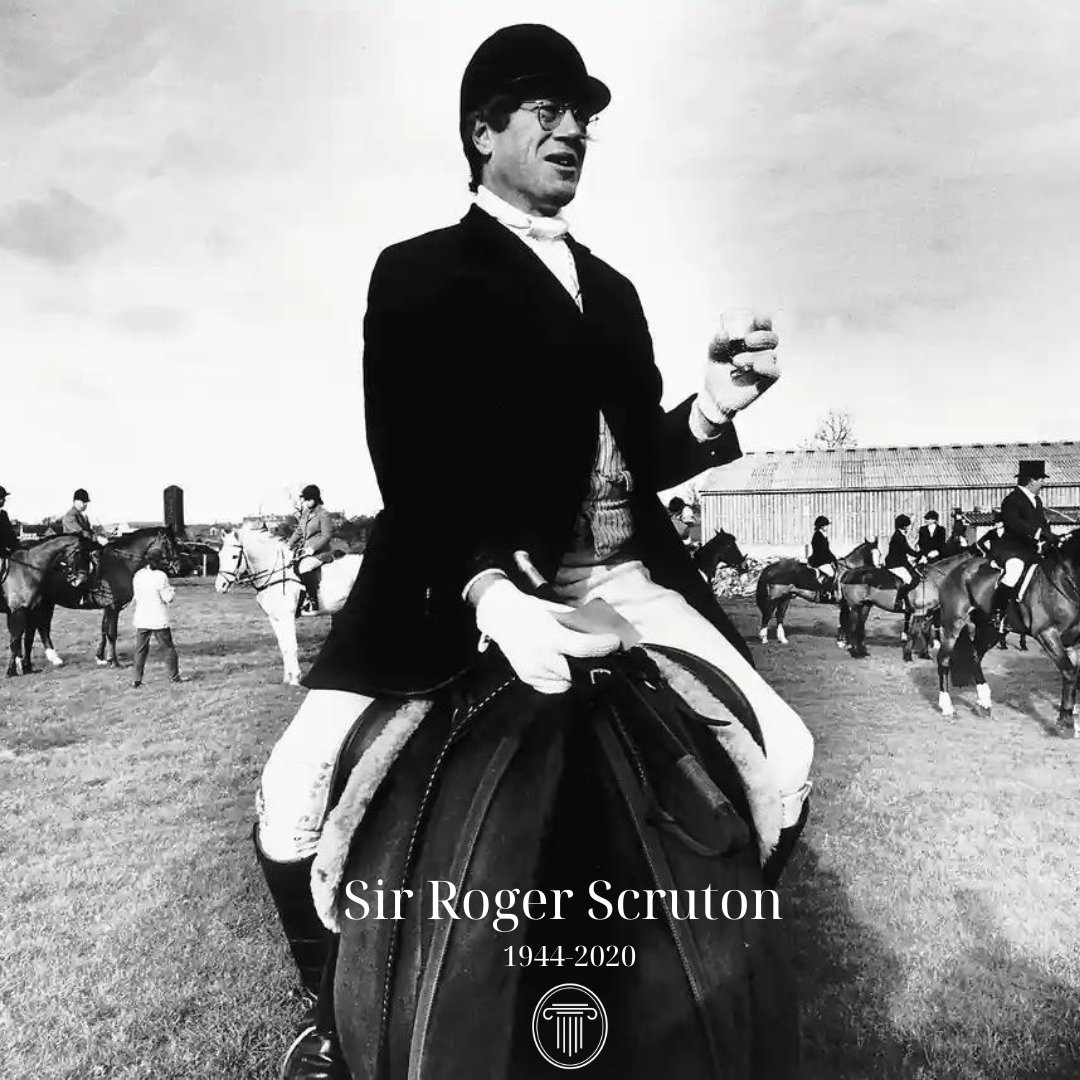
Sir Roger Scruton from his essay, "Why I Became a Conservative"...
Real freedom, concrete freedom, the freedom that can actually be defined, claimed, and granted, was not the opposite of obedience but its other side. The abstract, unreal freedom of the liberal intellect was really nothing more than childish disobedience, amplified into anarchy.
I saw a huge steam roller,
It blotted out the sun.
The people all lay down, lay down;
They did not try to run.
My love and I, we looked amazed
Upon the gory mystery.
"Lie down, lie down!" the people cried.
"The great machine is history!"
My love and I, we ran away,
The engine did not find us.
We ran up to a mountain top,
Left history far behind us.
Perhaps we should have stayed and died,
But somehow we don't think so.
We went to see where history'd been,
And my, the dead did stink so.

















































































No comments:
Post a Comment